Can Mr Hockey be saved by a big idea?

There’s a very interesting article in The New Daily today, about what our Treasurer Mr Hockey might be up to.

It suggests Mr Hockey’s insistence that Australians spend six months working for the government is a deliberate ploy to turn us against income tax, which will dovetail with an idea from the Commission of Audit:

“providing the States with access to part of the Commonwealth’s personal income tax base.”

The Commission expands on that idea like this:

“A further option to increase State source income is a combined Commonwealth-State personal income tax, which could include providing the States with a designated share of personal income tax raised, or allowing the States to levy a State income tax surcharge (with the Commonwealth ‘making room’ so that overall income tax rate need not rise).”

The article‘s logic linking recent statements to this policy idea may be a tiny bit convoluted, but that doesn’t make it necessarily false, and it is well worth remembering that there is a Federation White Paper lurking, due for completion this year.

The first issues paper of the Federation White Paper was released just prior to Christmas (and I mean just, it came out on the 23rd of December). The amount of coverage it got was slightly less than the NORAD Santa tracking radar. Is the idea that the Abbott government going to reform our whole federation as fictional as the man in the red suit?

Maybe it’s the best idea this government has left.  States spend all the money, but can’t raise enough. This is bad from an accountability perspective, and also because it diverts effort to rent-seeking. States spend time scrapping over the GST shares and the conditions on Specific Purpose Payments.

States don’t appear set to introduce a land tax, which I reckon is the only other solution. So giving them the power to raise their own income taxes is a potentially sensible move. This is a classic small-l liberal solution, allowing each state to set the income tax that best suits its needs, and also encouraging competition between jurisdictions. Vertical Fiscal Imbalance could be over!

(I’ve always thought Vertical Fiscal Imbalance was a terrible bit of terminology and it should be known as something more catchy. I quite like calling it the Federal-State Tax Mismatch.)

This could be the high-minded idea that the Coalition need to administer a shock to the electorate, to make people realise they are actually full of ideas, not just a team of cutters. If done right it could deliver positive media alongside well-liked (probably Labor) state premiers.

The only problem now is that the narrative is all but set. Mr Hockey is seen as a hardline right-wing ideologue, so even a rather sensible plan to optimise subsidiarity will likely be seen through that lens. Will Mr Hockey gamble and introduce this idea – doubtless new to many voters and potentially confused with a tax hike – in these conditions?

Your favourite government policy is going to make inequality worse.

According to a new working paper by economists at Stockholm University and the University of Chicago, a key factor making unskilled workers worse off is broadband internet.

That means the NBN (which may be the most popular infrastructure investment ever announced in Australia) won’t be good for everyone.

The study had access to amazing data on 80 per cent of firms and 70 per cent of employees in Norway in the period 2000-2008, during which time Broadband Internet was rolled out slowly in Norway, allowing meaningful comparisons.

“For every employee, we know his or her length of education, and annual labor income.”

By Heinrich Pniok. Source Wikipedia.
NORWAY.  By Heinrich Pniok. Source Wikipedia.

If you have a university degree, you are considered to be “skilled labor.” The premium for skilled labor increased very neatly alongside broadband availability as it rolled out in Norway.

return to skill

The result for unskilled workers is not so good:

“[T]he estimates imply that a 10 percentage point increase in broadband availability in a municipality raises wages of skilled workers in that local labor market by about 0.2 percent. By comparison, we find evidence of a decline in wages of low skilled individuals.”

The researchers constructed counter-factuals to measure what might have happened in the absence of high-speed internet. They show the gap between skilled and unskilled would have been lower if the optical fibres had never crossed the fjords..

Screen Shot 2015-01-20 at 10.54.46 am

The reason more educated people do better with the internet is that they tend to not be doing complex tasks

“The estimates suggest an important channel behind the skill bias of broadband internet is that it complements non-routine abstract tasks but substitutes for routine tasks…. the expansion of broadband internet re-enforced the wage premiums to workers performing abstract tasks. By comparison, the wages paid to jobs requiring routine tasks declined because of the broadband expansion”

Broadband internet is obviously putting the postman out of work, but it is apparently having a less obvious effect on a range of other routine but non-manual jobs. This is very much worth bearing in mind as the internet enriches and enlivens our lives in so many ways.

This is not an argument against the NBN. We need high-speed internet and we’re going to get it one way or another.

It’s an argument for being aware that some people get left behind. The smartest policy we can institute to deal with that is high quality, universal education. This should start with high quality earl childhood education (this is extremely important to ameliorate skill-gaps that can develop in disadvantaged populations even prior to starting school), extend through good quality public schooling (needs-based funding as per the Gonski Report is a good start), and culminate in excellent universities that remain highly accessible (this would probably preclude the deregulation currently being proposed by the federal government).

The why and where of Milk Bars in 2015

I was walking down the street a few nights ago when two people zoomed past on bikes. I could hear them talking and one of them exclaimed, “A milk bar! Do they still have those? Who would ever go there?”

I looked over my shoulder at the shop I’d just gone past and sure enough, there was nobody inside.

It got me thinking.

I live in a suburb with three milk bars* within a few minutes walk of my house. (*a milk bar, for those unaware, is like a very small grocery shop selling the bare essentials with a focus on lollies, ice-cream and tinned goods. In parts of the world it may be called a general store, a corner store, a deli or a dairy.) Why is that? In my whole life, I’ve never been so near to so many milk bars.

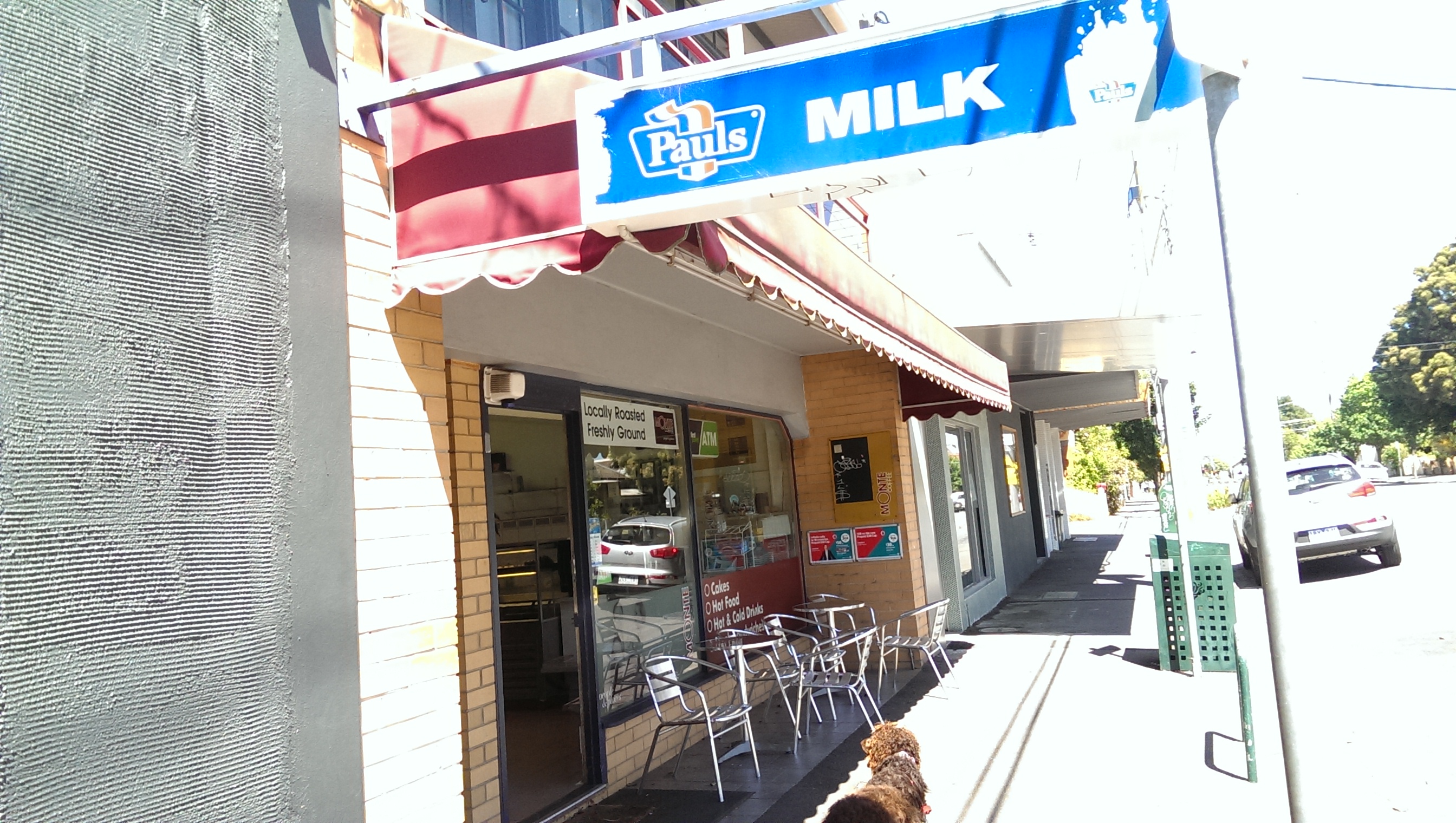
2 minutes 40 walk to this one: IMAG2941

3 minutes walk to this one:IMAG2943

6 minutes 40 walk to this one:

IMAG2935
Complete with core demographic of kids on holidays.

These are not sophisticated places. They have so little internet presence you can’t even find them on Google Maps. They don’t even have names. They exist principally for locals to pick up a few things.

I remember when I was a boy of about five, the milk bar near my family home closed. At that stage I’d only gone there to get lollies once or twice, but I sure was disappointed. I understood that as the end of an era. Retail was consolidating into a few big supermarkets and people didn’t need milk bars any more.

I subsequently moved to a house in North Fitzroy that had one milk bar nearby but I only used it once, when I was halfway through cooking and realised I needed another tin of tuna. It cost $7. So milk bars stopped figuring in my life. Until I moved to Clifton Hill. Then they were everywhere.

The three milk bars pictured above differ in their product offerings.

The closest one sells newspapers, has a coffee machine, sells Baklava and stocks a moderate range of groceries.

The second closest one does some deep-fried takeaway foods and stocks a minimal range of groceries.

The furthest one has DVDs, does dry-cleaning and stocks a minimal range of groceries.

There’s also, in this suburb, a continental supermarket, which I almost consider a milk bar. But since it calls itself a supermarket I will give it the benefit of the doubt. It is all of 40 metres away from one of the milk bars.

I was trying to explain to myself what it might be about the nature of this particular quiet, leafy, left-wing pocket of the inner north that made it so inclined to milk bars. Might the residents tend to be very forgetful and need to pop out for more cat food? Might they prefer not driving to the shops? Might they be opposed to big supermarkets? Any of these seemed unlikely given the rest of the inner north is demographically similar.

The reason, I eventually concluded, is the absence of big supermarkets. Clifton Hill is tucked into a bend of Merri Creek and that makes it probably uneconomical to put a big supermarket here. The above-mentioned Continental Supermarket does an okay job, and there’s a small FoodWorks around 15 minutes walk away too, (although it has earned the nickname ExpensiveWorks.)

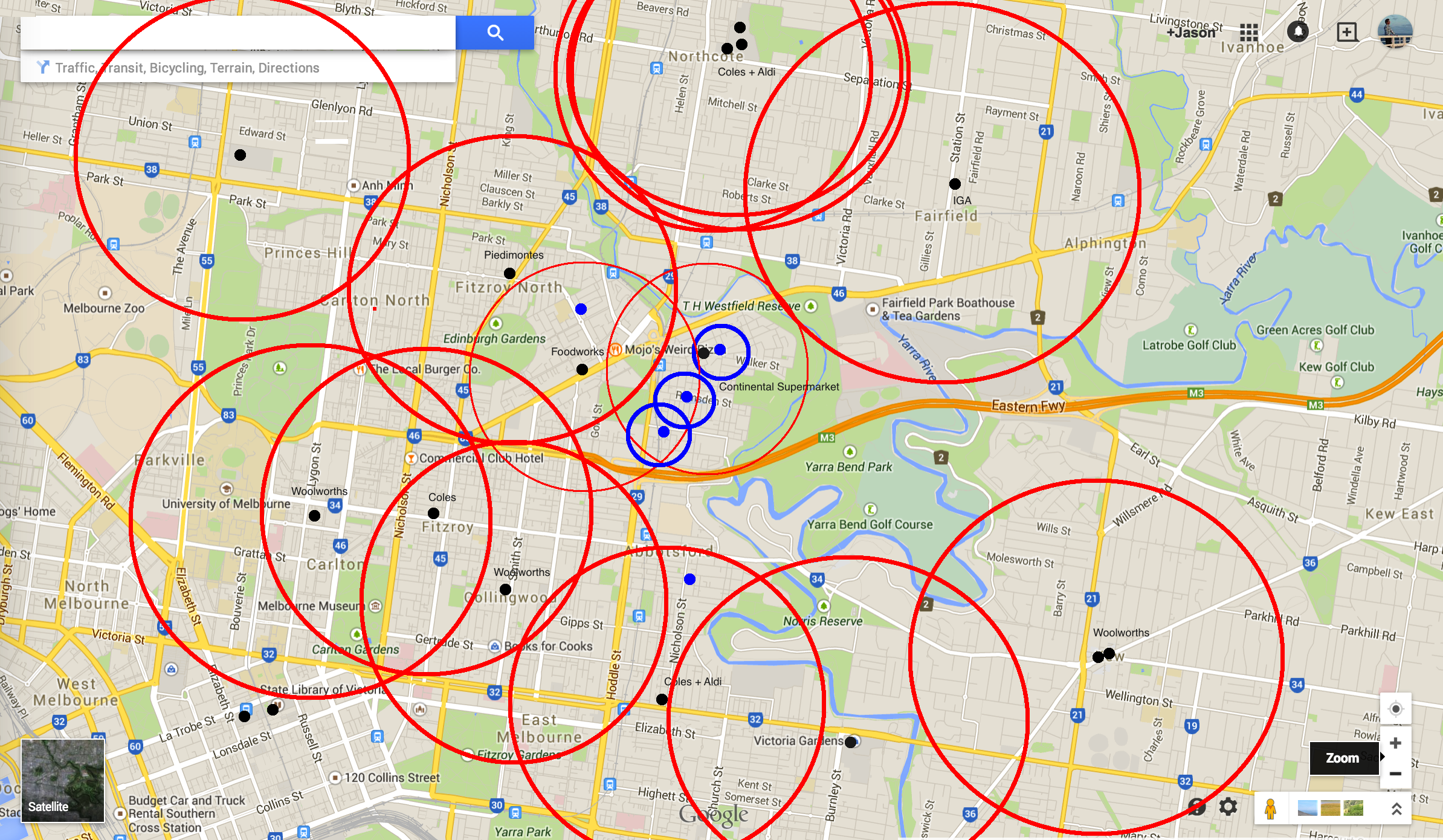
I mapped the supermarkets of the region and I can report that it is 2.3 km to the nearest major supermarket, Smith St Woolworths, 2.4 km to Piedimontes supermarket and 3.3 km to Northcote plaza. That is apparently the magic distance you need for milk bars to start clustering.

In the following map, Supermarkets are black dots and the local milk bars are blue dots. I’ve put rings around them to indicate their catchments, for purely illustrative purposes. There are smaller, lighter red rings around the two small “supermarkets” that serve Clifton Hill.  What is most notable is Clifton Hill is rare in being so far from a major supermarket.

Supermarkets of the inner north
Click to open larger

In a lot of the inner north, the red circles overlap. This suggests higher population density, sterner competition, and perhaps lower willingness of residents to drive to the supermarket. I suspect in much of Melbourne, the red circles would be far apart, leaving gaps just like Clifton Hill, but the population density would not be enough to support such a density of milk bars.

I’d be very interested to hear about other regions that seem to support disproportionate numbers of milk bars. Do they also fall into the cracks, more than 2.4km from a major supermarket? Or are there other reasons you can think of for their continued existence?

Not long until the SUV is Australia’s most popular vehicle

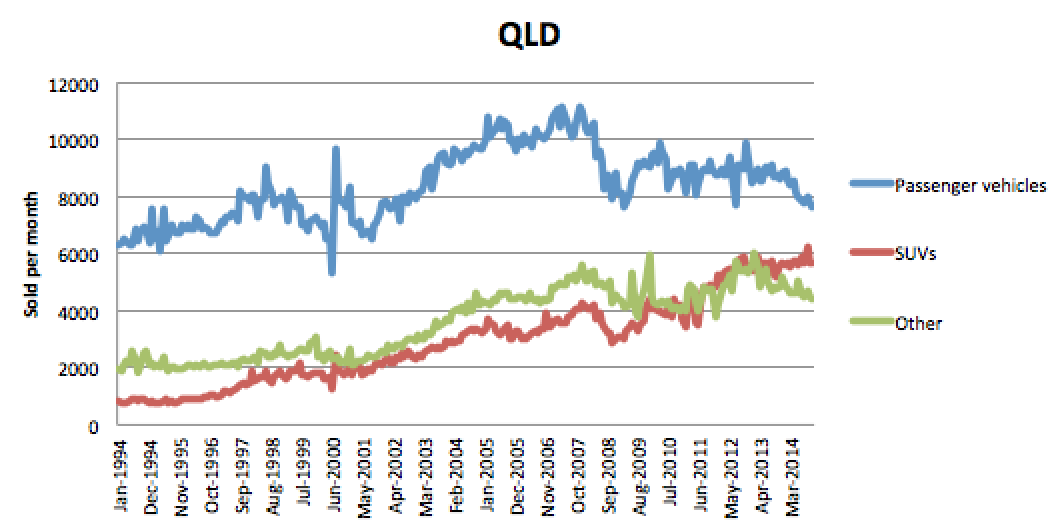
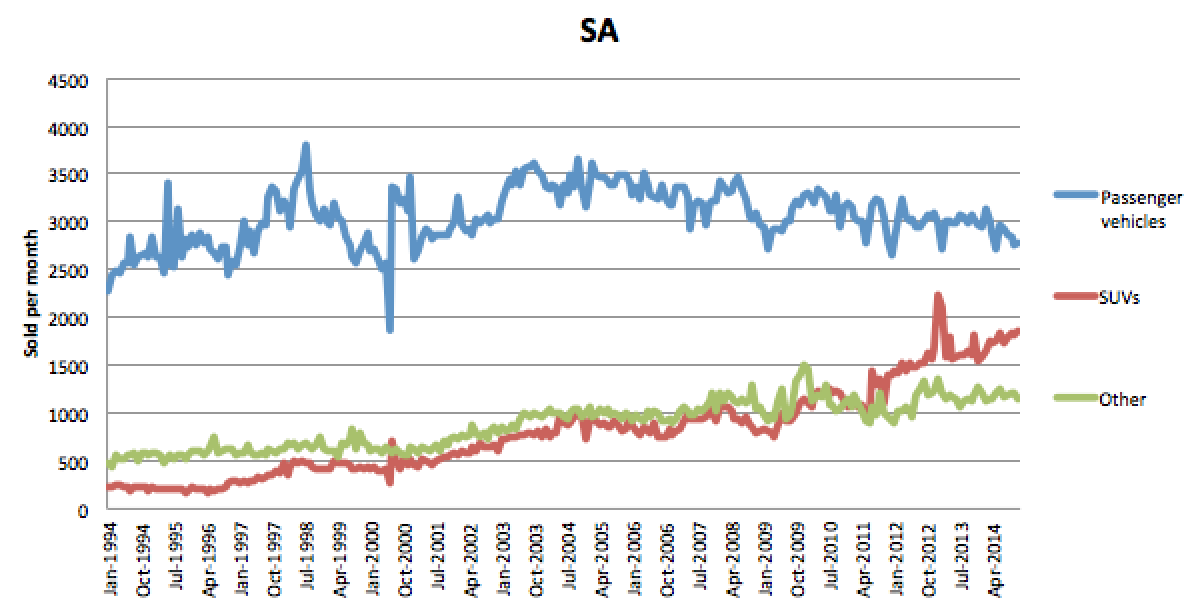
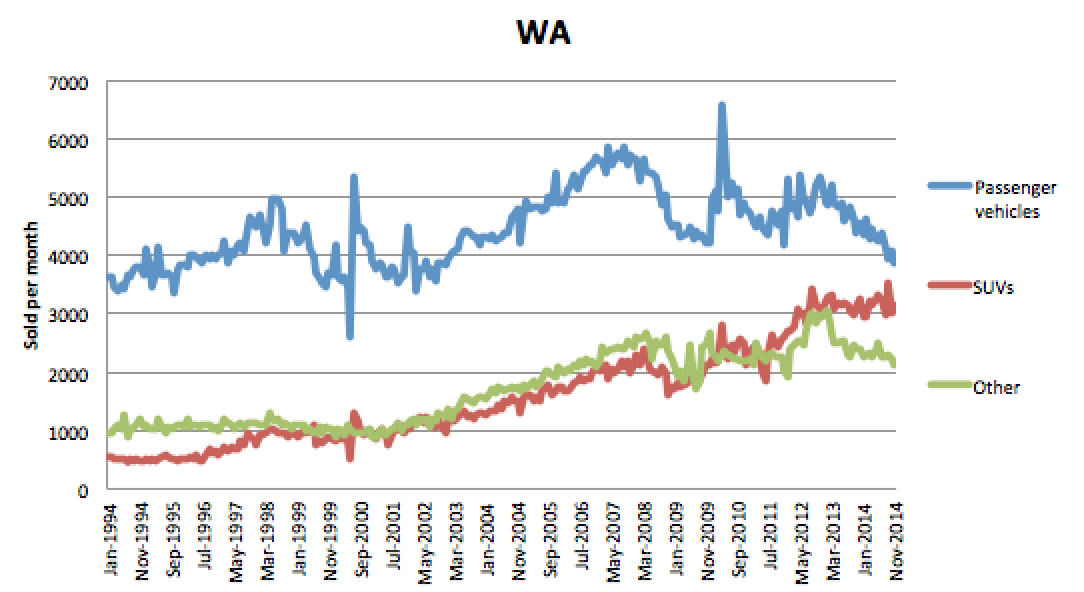
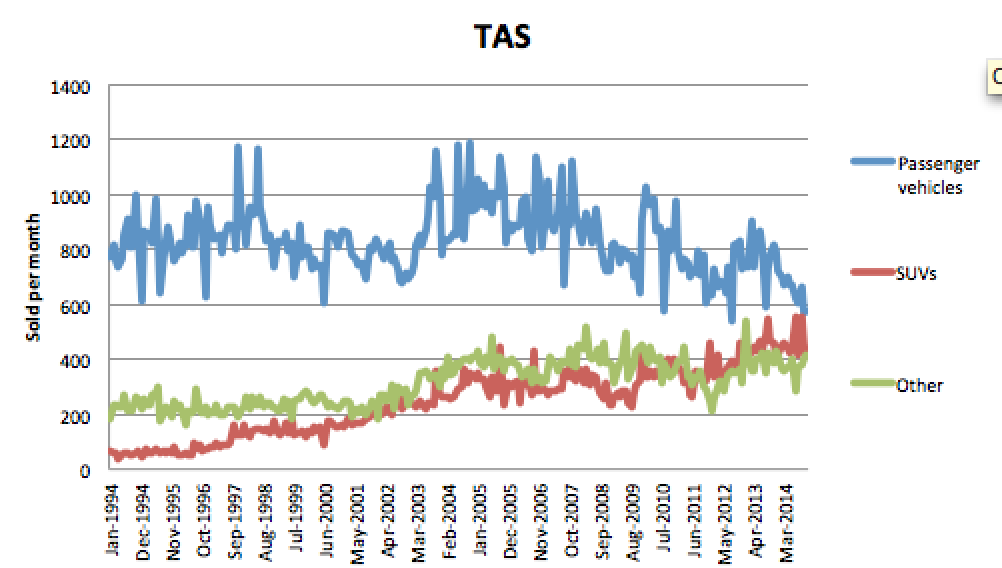
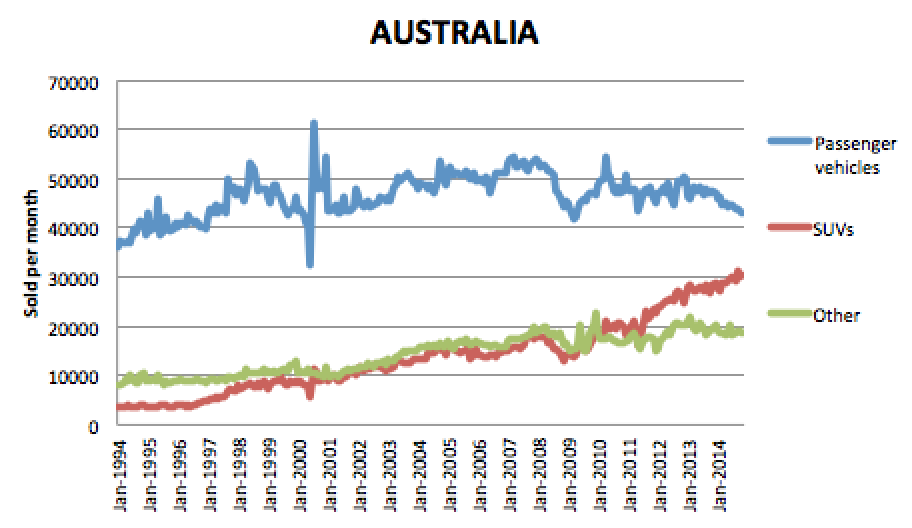
The SUV is rapidly becoming Australia’s favourite kind of car. In every state, SUV sales look set to outstrip sales of passenger vehicles soon, if they have not done so already.

Screen Shot 2014-12-16 at 9.44.11 am Screen Shot 2014-12-16 at 9.43.38 am Screen Shot 2014-12-16 at 9.43.13 am Screen Shot 2014-12-16 at 9.42.53 am Screen Shot 2014-12-16 at 9.42.25 am Screen Shot 2014-12-16 at 9.41.50 am

Screen Shot 2014-12-16 at 9.41.22 am

Congratulations NT, the only state where more SUVS are now sold than passenger vehicles.Screen Shot 2014-12-16 at 9.40.46 am Screen Shot 2014-12-16 at 9.40.18 am

The Toyota Hilux, Mistubishi Triton, Ford Ranger and Hyundai i35 are among the top selling SUVs.

SUVs are great. They’re safer for drivers, they give you a better view, they can mount any terrain, and they have lots of boot space. But they come with costs. More vulnerable road users get hurt. And we can see those costs across the whole country.

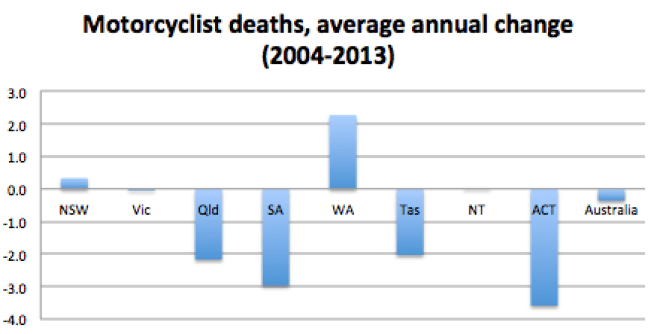
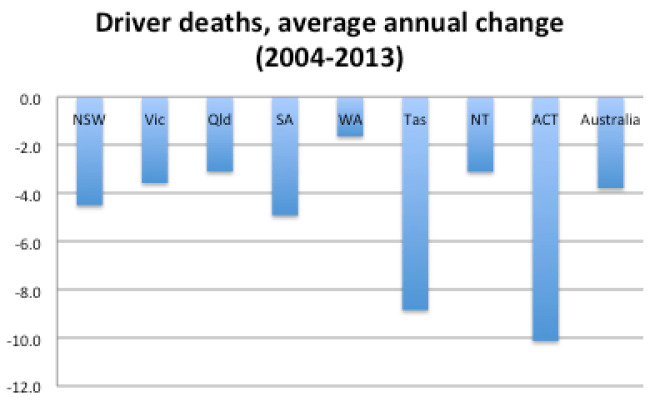
The results for non-drivers are substantially more mixed than the results for drivers, which show clear falls. Some of the states with the biggest proportional increase in SUVs (especially Tasmania) show the worst results for pedestrians and motorcylists..

Screen Shot 2014-12-16 at 10.11.51 am

Screen Shot 2014-12-16 at 10.12.03 am

For comparison, here’s the rate of change in driver deaths. It’s worth noting that Tasmania’s population has been pretty stable in this time while WA has grown.

Screen Shot 2014-12-16 at 10.12.24 am

These “hatchbacks on stilts” are a game theory problem. If everyone else has one, we want one too, to be able to feel safe and to see what’s happening on the road. They come with clear externalities. There is a case for the government to intervene. 

Everyone’s panicking about the falling oil price. Should we panic too?

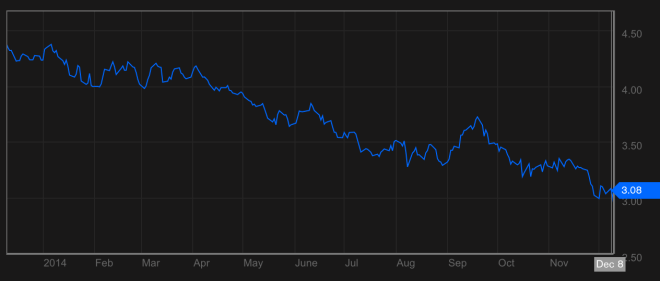
The price of oil has fallen an amazing amount in a short time.

Brent
Source: Nasdaq

Which is sending global markets into a bit of a panic.

oil hurts shares
Source: AFR

But is this really the moment where the Australian economy comes crashing down?

Lower petrol prices are already a reality, which has the same effect for many households as a reduction in interest rates – more money in their pocket.

Source: Australian Institute of Petroleum

Since this graph was made a week ago, retail prices have fallen even further, to 2005-era levels of $1.20/L. The median household spends $40 a week on petrol, so a 25 per cent fall gives them $10 extra to spend on other things.

This is a real boost to the Australian economy at a time when it really needs it.

And our major trading partner, China, is in the same boat. It is an oil importer and it is apparently stockpiling fast during this period of low prices. Like Australia, China is trying to get growth to continue without causing a surge in inflation. The oil price drop just made this a lot easier.

If lower oil prices perk up the Australian consumer just as a lower dollar makes life easier for Australian business, and China is able to continue to grow strongly, that represents just about a best-case scenario for the Australian economy.

But it’s worth remembering: What goes down can go back up.

crude history
Source: Bloomberg

If consumers in China and Australia re-set their oil price expectations, and then the price of oil goes back up, it will feel like an interest rate hike – at the worst possible time. In that scenario, with Australian consumer confidence falling as China suffers a blow to growth, anything could happen.

Bill Shorten should probably zip it about next year’s budget deficit.

Next May, Tony Abbott and Joe Hockey are going to feel very uncomfortable indeed. They’ll be bringing down a Budget that is completely the opposite of what they hoped for.

The 2014-15 Budget was full of spending cut plans and forecasts of rising tax revenues. The spending cuts are mainly in shreds on the floor of the Senate, and the rising tax revenue projections got vapourised by weak growth and falling iron ore prices. The few measures they did pass, like a temporary tax hike on high income earners, aren’t likely to be enough.

The Abbbott/Hockey game plan was to get their horror budget out of the way early. But the ghost train didn’t stop at the station, and it looks like they’re stuck on the ride as it enters the tunnel once again.

The Budget, when it comes out, is going to include some large negative numbers. They were expecting deficits of $30 billion this year and $17 billion next year.

deficit

But revenue fell hard in the most recent quarter as growth fell to 0.3 per cent.

Budget update

I expect the government will be forced to admit the deficit this year is very much like the last Labor year (around $50 billion), and that the 2015-16 one will be at least twice the size they expected.

What’s worse for them is this – the more they try to correct this scenario, the worse their reputations become.

I wouldn’t want to face the dilemma Hockey faces – try to put the budget on track and cement once and for all the impression of having a heart of stone, or try to salvage a bit of popularity while letting the nation’s finances spiral away. Perhaps he will happily give up his job to Mr Turnbull.

So, from a fiscal perspective, Opposition leader Bill Shorten has been given a free kick in the goal square. This is political gold!

But should he go hard on this topic? Should he try to drive a fiscal stake through this government’s heart?

I see three reasons he should not.

1. Don’t perpetuate Deficit-phobia.

The fear of deficits is extremely corrosive to our national debate. Governments are absolutely petrified of borrowing, for fear of being accused of running a deficit.

Interest rate the government faces on a 10-year loan. Source: Bloomberg

The cost of borrowing, right now, is exceedingly low, and the benefits of borrowing could be very high. Almost everyone thinks Australia could use a big whack of infrastructure to set it up for the next century. Obsessing about spending only what you earn is for people who can’t get credit, or for people whose expenses are smooth and predictable. A mid-size first world nation can get credit cheaply, and might want to occasionally build a huge project. In those cases a deficit should be celebrated.

If Shorten accusing Abbott of incompetence because of the existence of a deficit, then he further limits the policy options of all governments of all stripes.

2. Focus on something important.

Budget day I argued in April that Labor should have made equality a big budget figure. You could hoard all the relevant data on equality until Budget day, brief the right people that an important measure was coming out that day, and then boom, get some cut through on a topic that wasn’t so meaningless.

If Mr Shorten goes after Mr Abbott on the defict, he adds his imprimatur to the idea that managing a deficit is the most important job a government can have. Assuredly, it’s part of the government’s role. But to place it at the centre of responsibilities is to show a distinct lack of imagination. Find something important and make Budget day about that instead.

3. Tying your own noose.

If Mr Shorten wins government in late 2016 and the deficit is all he’s talked about for the preceding three years, he’ll be forced to fix it, fast. That could prove uncomfortable for him.

Mr Shorten’s approach will depend to some extent on what Mr Hockey has planned. We will know a but more about that once the mid-year economic update (MYEFO) comes out.

It was exactly 51 weeks ago that I wrote about the first MYEFO that Mr Hockey brought down, which was clearly setting the stage for big cuts. I wrote this

“What is the last “cut” that is heralded as a major political reform? Howard strangled the dole payment down below some estimates of the poverty line, but that’s oddly omitted in his hagiography. Even right-wing economist Judith Sloan has argued the dole should now be raised.

When we list the economic reforms that have made Australia great we include microeconomic reform, floating the dollar, an inflation-targeting central bank and the GST.  Not cuts.

If the Abbott government’s first term economic reforms can mainly be labelled “cuts”, what will be its legacy?”

It will be very interesting to see what themes we can read into this year’s MYEFO (perhaps coming out next week, and required by law before the end of January).

Time to start getting ready for when the robots take our jobs.

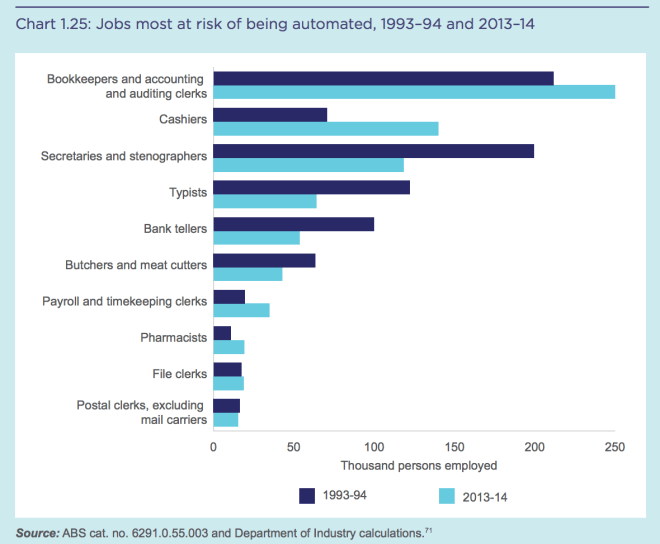
When the federal Department of Industry starts investigating when robots will be taking our jobs, you know the possibility has gone from remote to real.

A lot of jobs are at risk – half a million, according to the article – and they’re not “bad” jobs.

“The challenges presented by more automation are not limited to low-skilled positions, as robots are increasingly replicating the tasks of medium and high-skilled workers.”

job automation
Source: Department of Industry

I’ve written before about what will eventually happen to employment after the Robot Revolution. I think new skill-sets will rise to the top: people-skills and creative skills. The inspiration angle and the emotion angle will be our edge when robots are doing the physical and routine thinking work.

In the mean time, automation will make things cheaper. More and more goods will be like water.

water

Water is cheap. So cheap we don’t even think about it. Water is plentiful. You can easily get more than you could ever use.

Its abundance makes it easy to forget that it is incredibly important. And many other goods and services are much like water. Energy, definitely. You no longer need to pay a fortune for firewood and paraffin. Electricity comes into the house at far less than our willingness to pay.

You could argue clothing and food have already gone that way too. At certain very popular stores, you could buy a complete outfit, including shoes, for under $40. You can meet your daily energy needs for a couple of dollars.

We don’t talk much about how awesome this is. But it is incredible. It’s why absolute poverty doesn’t exist in the same way any more. Being poor is still a huge disadvantage, but has more to do with access to other needs like healthcare and housing and opportunity and with the challenges that poses to decision making, than simple starvation.

When people complain, saying things becoming cheap strips them of their value, they don’t realise the alternative.

Indulge me for a moment longer, let’s imagine prices going the other way – from free to expensive – and instead of using water as our example, let’s use air.

Air is abundant and cheap, and we barely think about it. Should we charge for it? Would that make people value it? Charging for air would be great for GDP. The whole population would be customers of the various air providers. Maybe they’d pre-pay, maybe they’d be on a plan (don’t go over your cap!). The government would set up a means-tested scheme to provide free air for certain groups. Still, it would be a big bump to the economy, and there’d be a lot of jobs in it. Jobs! Given how politicians love to promise jobs, I’m surprised charging for air isn’t on their radar.

So I hope I’ve convinced you, via these examples, that cheaper goods and fewer jobs is not necessarily bad. It can be good, in part.

But it will not be uniformly good for social outcomes. Here’s how the Department of Industry sees it.

“The comparative advantages of being human — the ability to solve problems intuitively, improvise spontaneously and act creatively — as well as the unlimited needs and wants of humans suggest that the displacement of jobs due to automation is unlikely to be long term.”

Note their use of the words “long term.”

The advance of the robots will not be uniform, and there will be times when lots of people get put out of work all at once. At these times, the returns to capital will be higher, and the returns to labour will be lower. In these times, panic will rise. Even though a future where humans are all out of work is laughably implausible, it might not seem that way if you and everyone you know just got the sack.

We will need policy settings that will help at these times.

The policies could try to prevent the robots from taking the jobs, but that means forfeiting the benefits in terms of cheaper goods. It would also be incredibly hard to implement.

So what is the best way to make sure we’re ready for a bump in unemployment? What’s the best way to make sure people are ready to get back into the workforce?

I’d argue there are two big things we should do:

1. Invest in education now. Education protects against long-term unemployment according to the data,  probably by making people ready to re-learn. This is not the time to be making university educations more expensive. Quite the reverse. It’s also the time to be investing in making sure nobody falls through the cracks. Proper implementation of needs-based school funding, in the manner suggested by David Gonksi, would be a good way to make sure that people are adaptable when the time comes.

2. Stop starving the beast. The federal deficit is growing, and since the government has failed to implement a range of spending cuts, and is opposed to tax hikes, it will probably keep growing. In the future, we may need to exploit the federal government’s ability to provide Keynesian stimulus via the  “automatic stabilisers” that are welfare payments. Bulking up the budget is necessary, and we probably need to push up the tax-to-gdp ratio. It may seem like an economically sensitive time to be lifting taxes, but that’s not the case if you put land tax on the agenda. Unlike taxes on income and companies, land taxes are not a tax on productive activity, plus they tend to be progressive (rich pay more, poor pay less).

With these policies in place, we should be much better placed to welcome the robots as our servants, not our rivals.

The man to sell tax hikes to the Australian people … is John Howard.

Australia’s budget is in a spot of trouble. The ABS released its latest Government finance statistics this week and they show a slump in revenue. 

Budget update


This, to me, is not a crisis. It’s not good news, but just as you don’t judge a game of football on a 2 minute period, you don’t judge a fiscal situation on a quarter (or even a year, or even a group of years). You ned to judge the fiscal position in the long run.

I’m interested in this high-level measure, the tax-to-gdp ratio. And that’s an interesting thing, with a few moving parts.

Tax to GDP ratio

Treasury has relatively recently begun spruiking it. (This began in the Rudd era, I believe, when he wanted to seem fiscally prudent while spending a lot.) It can be affected by deliberate actions of government, or by shifts in GDP and prices of key exports.

That spike in the red line at the end is now at risk, due to factors beyond the government’s control. In the 2014 Budget, the government announced it would increase revenue as a percentage of GDP, from 23 per cent to 24.9 per cent.

Given the way everything economic and budgetary has come up turds since, the MYEFO is likely to replace this optimistic assumption when it comes out (soon).

A 1 per cent fall in the terms of trade is estimated to have a $2.6 billion impact on the budget, according to published sensitivty analysis. And this week’s national accounts show an 8.9 per cent fall in terms of trade over the last 12 months.

So we’re likely to get a budget deficit that is expanding and a tax to GDP ratio that is falling.

So what should the government do? In the short-run, it should keep spending to prop up growth. But in the medium to long run it needs to do more.

The most senior figure in Australian economics, Max Corden, strips the issues back to their essentials in the Conversation today.

“Given the deficit prospect, the government faces three choices: (1) Run a bigger deficit, (2) raise taxes, or (3) cut government spending… What the government should consider is raising taxes.”

Cutting spending is important where programs are ineffective, or where you’re trimming fat. That is crucial. But it won’t be enough. The Australian people want the government to do more, not less – we want important things like the NDIS and funding childcare and kindergarten.

I’d support raising taxes, slowly and in a clever way, to try to right the structural budget deficit.

This might seem like an impossible PR job for the government. But with the help of one man, it may not be.

John Howard, Prime Minister 1996-2007

The name John Howard is like a magic charm in contemporary politics.  A man who wins four elections  (96, 99, 2001, 2004) gets a lot of kudos in retrospect, even if he had a seriously easy incumbency, bountiful in threats to national security and bumps to government revenue.

Mr Howard presided over an era that saw the tax-to-GDP ratio rise over 24 per cent, even as he gave away income tax cuts as fast as he could. People remember that time fondly. The song that pleaded for us to not take a rose coloured glasses view of his legacy? That record broke.

The man is viewed (wrongly) as a fiscal genius.If I were Joe Hockey, and I was facing up to the fact I needed to to try to sell tax hikes, I’d stick his name on it.

“Reverting to a John Howard era tax-to-GDP ratio” sounds a lot more palatable than simply “hiking taxes.”

Supply and demand for city views? The economics of skylines.

A skyline is one of the most iconic things a city can offer.

best skylines

Great skylines are rare – New York and Paris have terrific, unique skylines. But most cities are just a cluster of square towers.

Melbourne’s skyline, from many angles, is a classic example. Nice in the right light, but far from distinctive.

skyline 1

Melbourne’s more iconic features (Arts Centre Spire, Wheel, Bolte Bridge) are hard to get in frame with the CBD.

skyline melb


The Eureka Tower – Melbourne’s tallest building – isn’t a great building to my eye, but it is so prominent that it is now a feature in tourist mementoes.

tea towel

Skylines are a classic economic problem. The benefit of the skyline accrues not the to building’s owner, but to the people who gaze upon it. These are externalities, and so the market for a city skyline is clearly subject to market failure.

skylines


Worth mentioning – these external benefits are more than just warm fuzzy feelings. There is a reason houses on top of hills sell for a lot more. “City views” is a magic word in real estate.

When a building owner decides to make another 25-storey square grey tower, they’re not thinking about the city at large. What is most profitable for them is not necessarily what’s best for the skyline.

London’s Gherkin, Shanghai’s Pearl TV tower, Beijing’s CCTV building are great examples of where a bit of financial largesse has made for amazing, distinctive buildings. But the two Chinese buildings were not the result of market forces. And the Gherkin was put into receivership earlier this year.


Can the market deliver a great skyline?

The Eiffel Tower was not a result of market forces. Neither was the Statue of Liberty.  The Empire State Building was privately built, but that was in the 1920s, when market failures were left free to thrive and vast fortunes were sloshing around New York. Then, a handful of wealthy new Yorkers could afford to put up a signature building that would lose money for its first 20 years.

Will the sharpness of modern market forces deliver us only the drabbest lumps to adorn our horizons? If so, that’s truly a shame.

There has never been a better time to kill negative gearing.

Talk about killing negative gearing is like elevator music in our national debate. It is ever-present and we’ve tuned it out.

But there will never be a better time than now to rip negative gearing from the tax code. That’s because right now investor activity in the housing market is a major macroeconomic problem.

The RBA would love to cut official interest rates – if it weren’t for the strength in housing. It is worried trimming the interest rate even more could create further mad results, like this terrace house around the corner from me that sold for $1.96 million.

This is what Glenn Stevens said last month.

“A situation where:

  • prices have already risen considerably in the two largest cities (where about a third of our population live)
  • prices are rising, at present, faster than income by a noticeable margin, and
  • an important area of credit growth has picked up to double-digit rates,

should prompt a reasonable observer to ask the question whether some people might be starting to get just a little overexcited.”

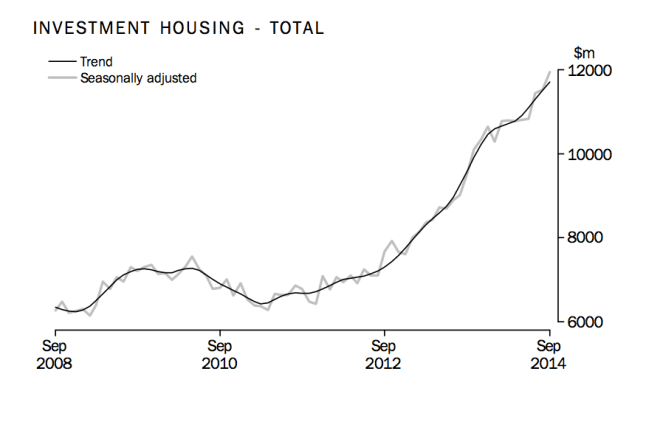
The strength in housing is very much on the investor side, not the owner-occupier side.

investment housing
Source: ABS catalogue 5609.0 Housing Finance Australia September 2014


The share of lending going to investors is at historic highs.

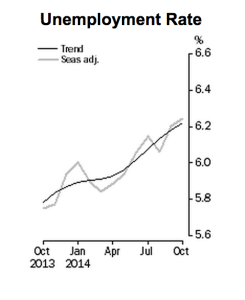
And the rest of the economy is in a morass with unemployment moving sluggishly higher.

unemployment
Source: ABS Catalogue 6202.0 Labour Force, October 2014


If the strength of the housing market was more in line with the rest of the economy, rates would fall like a tonne of bricks. Reducing investor demand for housing could give the RBA the freedom it needs to cut rates to the point where the economy picks up.

rates, unemp
Traditionally, if the red line is rising while inflation is controlled, the RBA will make the blue line fall. But house prices are impeding them. (Data: RBA. ABS Labour Force)


In summary, this is what the experts call a policy window.

If there was ever a time where scrapping negative gearing (on existing homes at least) was going to fly, it would be when the topic is macro-economically important.

Negative gearing has haunted the Australian policy landscape since 1985, doing much to enrich property investors while having an altogether ambiguous effect on the social outcome it was designed to address – housing affordability

A brave treasurer would reach back to the Henry Review and say, ‘ in order to reduce the policy bind the rba finds itself in, it’s high time we looked at this recommendation.’

The Treasurer would find plenty of backing in the Henry Review. It did not argue that cutting negative gearing would cause an immediate reversal in house prices. But it did point out that the policy represented a big fat subsidy, and recommended something a lot more modest.

“When negatively geared, asymmetries in the treatment of expenses and  receipts give rise to a more favourable treatment (see Chart A1–20). This asymmetry ranks  amongst the greatest tax induced biases to the savings choices of households. “

henry graph negative g
Source, Henry Review, page 419

The beat of the drums against negative gearing will never be louder than now. Let’s see if policy makers can hear them.

The ABC should be slashed. But not like that.

The Industry Minister stands up to make his announcement:

The federal government is going to set up a car making company, and give cars away for free!

This would be a highly controversial policy. Consumers would be pretty excited, car-makers would be furious, and economists would probably mutter darkly. It doesn’t seem like a good idea.

But there is another struggling industry where the government supports a competitor that gives away product for free.

Media.

As Fairfax and Crikey and all the rest struggle mightily against falling revenues, the ABC and SBS continue to send reporters to news conferences, run documentaries, and blast pop music across the radio spectrum.

This is also controversial, but mainly among News Limited journalists. They’ve cried wolf on government policy so many times they have lost all credibility. But that obscures the few times they ‘re right, including now.

There are important economic differences between cars and news. Unlike cars, News has positive externalities and economies of scale. Both of these mean that news may be under-delivered by the market.

But notice I say news. I do not argue media in general has positive externalities.

There are heaps of things the ABC does that should stop, immediately. If it continues, it wastes its own money, (i.e. our money) and also hurts the profitability to other media outlets.

When the ABC broadcasts the Socceroos match versus Japan, as it did on Tuesday night, that’s not so different to Channel 7 broadcasting the AFL. There is no market failure here to correct. The ABC ought not touch it.

If we look at this evening’s prime time, we can see that the ABC is pumping out a range of programs, including some for which there is no justification and others for which there is a burning burning need.

ABC schedule


If I had to rank the top five programs on the list, that the ABC should be investing more and more in, I’d nominate

  1. 7.30. Because democracy demands our society be examined and our politicians be held to account, and the market is more interested in entertainment.
  2. ABC news. Because we need to know what’s going on in the world in order to understand it, and the free-market stations are more about pleasing us than informing us.
  3. Fireman Sam. Developmentally appropriate kids programming without huge commercial tie-ins is always going to be a market shortfall.
  4. Catalyst. Science programming on the free-to-airs consists primarily of cheetahs running down niboks and tearing at their flesh. Nice to have, but not all the time.
  5. Lateline. You need all the opportunities you can get to grill politicians in front of an audience.

If I had to rank the bottom five:

  1. The Tonight Show starring Jimmy Fallon. This show is so excellent. Just yesterday I watched Fallon impersonate Bono. It was incredible. Dude has TALENT.  Not a market failure.
  2. Peep show. How funny is David Mitchell? I laugh til my head falls off when I watch this. Not a market failure.
  3. The Drum. Is there  a shortage of opinion on TV and radio and the internet? Holy Mother of God, No! Not a market failure.
  4. QI. Is Stephen Fry the most popular man in the world? Probably. Not a market failure.
  5. Upper Middle Bogan. The commercial stations have very little comedy except Hamish and Andy, but the ABC tries to more than make up for it, with The Moodys, Chris Lilley, The Chaser, Micallef, Please Like Me, It’s a Date, and Soulmates. Whew. Probably, they are more than meeting demand.

Is some of this just cheaply bought-filler? Maybe. But ABC 3 shows us there is something cheaper than filler. And that’s closing down for the night. The ABC should consider doing this.

Now, if it is done strategically, buying a popular program to run into something worthy could boost the ratings of the worthy show. For example, Spicks and Specks is hilarious and fun and very popular. But what follows it is not four corners, it’s the Tonight Show with Jimmy Fallon.

The ABC should probably trim down the wildly expansive website and chuck out a bunch of radio stations too. Do we need Double J? It is my favourite station, incidentally, but I don’t ask the government to provide me with the hit songs of my youth. I could get a Pandora or a Spotify account instead. Ditto for Classic FM.

What the ABC should do is slice away all it sports coverage, a lot of its light entertainment, a bunch of music stations and do as much more hard news as it can. It is not important to fill three TV stations, dozens of radio stations and a really enormous website, if you’re filling it with fluff. I

It’s important to turn over the stones that the free market will leave untouched. The NSW ICAC shows there are huge numbers of extremely illegal and controversial things happening every single day. Good reporters could hunt these issues down before it’s too late.

The money that the ABC would save should be spent like this

  • Give Leigh Sales an hour to fill every night.
  • Give Lateline another four reporters.
  • Put Four Corners on two nights a week.
  • Resource Media Watch properly.

So I’m all for slashing the ABC where it treads on commercial toes unnecessarily, but only in order to build it up where those commercial toes fear to tread.

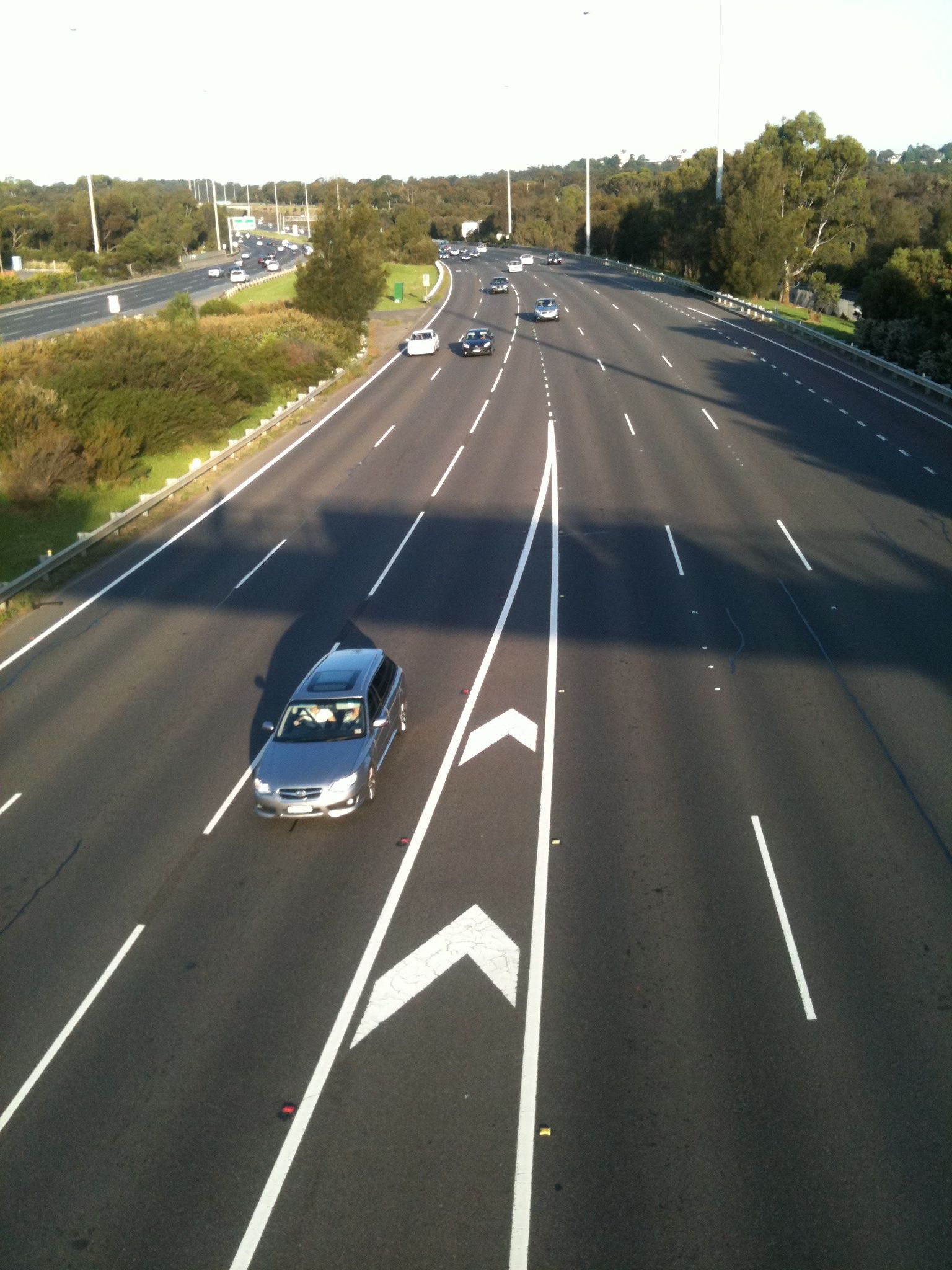
The best way to fix Australia’s road and rail might be out of left-field.

Australia has a problem with Infrastructure. We keep building the wrong things.

We spend a huge amount of time developing proposals that have benefit cost ratios less than one. Then, for want of alternative proposals, we turn those proposals into reality.

There are many reasons for this – politicians serving certain electorates, powerful lobby groups, bias to action, and inability to fix infrastructure through pricing .

But part of the problem is a lack of options. We build the East-West tunnel in Melbourne because it is the only idea that’s been properly developed and discussed. We put Sydney’s new airport at Badgery’s Creek because it’s the one location that has been kicked around for years. We plan a light rail line up the middle of Canberra, because that concept has been publicly flogged since Burley Griffin.

To find one great infrastructure plan, you need to discard 99 good infrastructure plans. But Australia doesn’t have 99 to throw away.

There’s a lot of talk about developing a “pipeline” of infrastructure ideas. But politicians are very risk averse, and big infrastructure companies don’t want to waste money on business plans. So our pipeline is the diameter of a carpet python, with a couple of big lumps where it has been fed an approved mega-project.

Computers could do this part.

Infrastructure Australia was set up by the Rudd government to try to help develop a pipeline of ideas, and independently test them. But it only has a few staff, and its leader was recently fired by the Abbott Government. Just as that was happening, he took a stand, publicly saying ”Entrenched truculent bureaucracies have impeded progress… It has been heard that some good ideas cannot go ahead because they would set ‘precedents’. Among other things, this implies knowledge of, but unwillingness to address, widespread deficiencies. Such wilful attitudes test the patience of our elected masters, industry, and the public.”

Even with this courageous bureaucrat in charge, the old Infrastructure Australia was unable to renew the infrastructure planning system. With his blood all over the carpet, the new Infrastructure Australia is cowed.

Even if it makes our political leaders uncomfortable, Australia desperately needs a truly independent infrastructure development and analysis capacity. But how?

I think the answer is not a bureaucracy. I think the answer is by using technology. The same technology that has helped humanity create the biggest encyclopaedia in history and a hugely detailed map of the entire world.

A Wiki.

Imagine a website where you can start a page for any infrastructure project you might dream of.

  • You want to extend a train line by a few kilometres? Start a page with a description and a map.
  • You want a helicopter pad installed at the local sports ground? Start a page with a project description and a map.
  • You want to build a very fast train between Melbourne and Brisbane? Start a page with a project description and a map.

Each page would be able to be edited by absolutely anybody. There would be a section for environmental impacts, a section for cost estimates, a section for estimating time for planning and building, a section for land-use changes and implications, a section for creating a cost-benefit analysis.

flinders st w bikeMost pages would be the hare-brained schemes of the lone wolves of suburbia. The pages would be underdone and silly. But by asking the community to rate each page, the better ideas would attract contributions from a range of talented people and rise out of the muck.

This could bring unforeseen solutions out of obscurity.

For example, when I was writing about the ridiculousness of the state government’s plan to put a new railway station in South Melbourne, right on top of an existing tram stop and miles from the new development it ostensibly serves, I found in the depths of the internet forums the suggestion that the problem could be solved better with a train line that runs from north-east to south-west.

Fisherman’s Bend should be on a new line from Merri (Northcote) to Newport (Wydham Vale – Mernda line).”

This idea may have a cost-benefit analysis ten times better than all the existing plans. But how would we know? There is a choke-point for shining light on new ideas, and its name is the Department of Transport. Risk-averse and slow-moving, DoT can only be expected to properly consider a few ideas that it thinks the government is interested in.

Choosing between a big group of well-developed projects that each have a range of intriguing benefits and positive cost-benefit analyses is going to be difficult, politically. But it’s a better problem than the one we have now, which is a small group of infrastructure plans that mainly look like wastes of money. (I refer here to Melbourne’s East-West tunnel and airport rail, but an honourable mention should go to the plan for a very fast train up the east coast)

If you want to find one project with a cost benefit analysis good enough to build, you need to look at 100 or 1000 projects across the country. The current pipeline is starved of proposals, so it is no wonder the infrastructure policy space is so sickly and anaemic.

train pic b and w

PROBLEMS:

1. The majority of analyses on the wiki would be defective. But the community should privilege the ideas that have the most potential and these should attract rational people to contribute. I expect projects will be submitted with wild underestimates of their cost, and there will be a push by more rational people to actually use cost estimates that reflect realistic Australian pricing. On the ‘discussion’ pages  I imagine there would be fierce argument about why it is we can’t have projects delivered at the prices that apply in China, America, etc. Projects with decent estimated benefits should be most willing to use realistic pricing.

2. Monorails and personal rapid transit. It’s going to be hard to keep really wild ideas out of there, but perhaps that’s the point.

3. Splintering into too many pieces. Every little change in a proposed plan (should this freeway have an exit here or here?) would potentially lead to a new page being created, with a new set of costs, environmental impacts, etc, etc. Conventions and rules may need to be developed to guide when a change is big enough to warrant a whole new entry. But wikis are good at developing cultures and rules that make them effective.

4. The whole thing would be at risk of being ignored if there was no suggestion governments would at least look at it. The project would be a really great thing to seed with some official resources, for example, freely available mapping software for wiki users to use, some models for doing traffic and demand forecasting, recommended ranges for cost per kilometre of roads, bike lanes, tram lines etc. I’d like to see it hosted at infra.wiki.gov.au to give it a sense of official imprimatur and encourage involvement. Perhaps the government could loose a few bureaucrats or pay a few infrastructure experts to play with the wiki to get it started, anonymously having them make edits and bring in a bit of rigour.

So, is this a good idea or a mad one? Is there some aspect of wikis I have overlooked or some problem I’ve not foreseen? Leave a comment below or hit me up on Twitter!


What happens to stolen bikes?

Bike theft now out-strips car theft in a range of inner-city Melbourne suburbs.

The Age has a nice interactive map, here.

In my postcode, 463 cars were reported stolen in the last five years and 394 bikes. But I’m pretty sure the reported statistics aren’t reflective of reality. More bikes would have been taken than cars.

Bike thefts would be unlikely to be reported to the police except when the bike was expensive enough to be insured, or when taken as part of a burglary. Simple theft off the street rarely gets reported, I bet.

Selling a stolen bike can’t be lucrative. But because bike thefts are rarely solved, the risk-return trade-off is good. This is explained beautifully in the graph below, taken from the excellent economics blog Priceonomics.

why nick bikes

But where do bikes go?

Sometimes stolen bikes are just sold on the street, as in this convoluted story that involves a man being arrested for not even stealing a bike.

But plenty of people are selling bikes on Gumtree.

Some of them are selling the whole contents of their house. That’s not suspicious.

Some of them are selling just one bike, with a big write-up and lots of pictures.. That’s not suspicious.

Then there are people selling an odd mix of bikes, often at a low price point and with a cursory write-up, like Nico, Mario, Jimbo, Joe and Carlo:

http://www.gumtree.com.au/s-seller/nico/1000852052

http://www.gumtree.com.au/s-seller/Mario/66632785

http://www.gumtree.com.au/s-seller/Jimbo/1005849263

http://www.gumtree.com.au/s-seller/Joe/1003315143

http://www.gumtree.com.au/s-seller/carlo/1000313405/date/1

Gumtree

(To be clear, for anyone interested in libel laws, I totally and fully and absolutely believe all these people are completely law-abiding citizens.)

I imagine a cheap stolen bicycle should sit in a shed for six months or so before being sold. Eager victims might scour the internet for their bike for a month or two. Doing so for more than that would be unusual.

An expensive stolen bicycle might even be thrown in the back of a truck and sold in another state. Swapping out the parts on an unusual bike might make it even harder to identify. And if you’ve got a shed full of bikes you got for free, a bit of mix and match wouldn’t be hard to do.

Apparently the one thing you can do that might change the trade-off depicted in the graph above is engraving your bike. If you put your drivers license number onto the frame somewhere, it can checked if the bike is sold. That might deter thieves. (Although exactly how you would engrave a carbon bicycle, I’m not too sure!)

Buy Australian: About as sensible as F*ck Off We’re Full.

Dick Smith Foods is at risk of closing down. 

The not quite-iconic Australian brand has seen sales halve and its future is cloudy. But Aussies are voting with their feet. They are happy to buy from overseas.

Is this bad? Shouldn’t we buy Australian?

australian mde

I say buy it if the quality or price is good. But not if you have to trade off price or quality. I think this is an example of how global markets are actually a powerful force for good. Let me explain.

I like to think of myself as socially aware. But I take a Rawlsian approach to social justice. I think support is wasted unless it is aimed at the worst off. The very rich giving money to the merely rich is not really charity, in my view.

This is why I support the charity rating system Givewell. And also why I support global trade.

Trade with poor countries helps people who might otherwise live on $1 day, while buying Australian might be the difference between someone driving a car and catching the bus. Trade has helped 1 billion people move out of poverty in the last 20 years.  Those people aren’t under our nose, so its easy to forget about them when you’re considering whether to buy jeans made in China or jeans made in Australia.

The only reason to value the welfare of Australians above those of foreigners is unexamined subconscious bias. I think that bias should be brought into the open and tested for how it impacts our actions and how our actions impact the lives of others.

Here’s a little argument I got involved in online today, in response to someone noting that their crumbed fish fillets had been caught in NZ, crumbed in China and sold in Australia.:

A: Apparently that is cheaper than just doing everything in the same country

B: Oh nooooo, that would be more jobs for our people, and we’d have to pay them gasp!

Me: “our people”

C: Get back to us on this when you’re a gen Y uni graduate with no job, work experience or any connections.

So, Do you buy Australian? Why or why not? Leave a comment below.

A Harvard Professor has two big reasons China will crash (and wreck your personal finances)

China’s economic growth has been very strong for a decade, making Australia one of the richest countries in the world. China has buffered us from the GFC, boosted exports, lifted house prices and invested in our businesses.

Forecasts are for more of the same: At Budget time, Australia predicted growth of about 7 per cent for China until 2017.

But Harvard Professor Lant Pritchett is doubtful about those forecasts. The economic development expert has published a working paper full of reasons why China is far more likely to come to a bust than continuing boom. If he is right, the Australian economy will be stuffed (a technical term) and we’ll probably all lose our jobs.

“History teaches that abnormally rapid growth is rarely persistent.”

This is the unique angle of his story. Pritchett doesn’t purport to analyse China in depth. He looks at economic history, comparing China’s streak of success to other countries’ growth spurts, and predicts reversion to mean.

“regression to the mean is the empirically most salient feature of economic growth. It is far more robust in the data than, say, the much-discussed middle-income trap.”

I’m inclined to think this approach has strengths. The current trope about Chinese policy-makers is that they simply set the level of economic growth that they want.

If this is true they are the only country in the world with that power.

What do we really know about the Chinese economic policy-making apparatus? We know only that it has been very successful, according to its own statistics. And everyone acknowledges those statistics are rubbery.

Pritchett compares betting on China to investing in the best-performing managed fund – past performance is no guarantee of future performance, he cautions us.

“The lack of persistence in country growth rates over medium- to long-run horizons implies current growth has very little predictive power for future growth”

Pritchett, it turns out, really hates extrapolation:

“Paul Samuelson’s textbook predicted in 1961 that there was a substantial chance that the USSR would overtake the United States economically by the 1980s. There was a widespread view right up until the end of the 1980s that Japan would continue to grow and outcompete the world. Or in the opposite direction, consider the pervasive pessimism of even a decade ago regarding Africa. Since then, African countries emerged as a majority of the world’s most rapidly growing nations.”

His paper shows the correlation between growth in one decade, and growth in subsequent decades is low: from 0.3 for adjacent decades, down to around 0.1 for decades separated by 20 years.

“The median duration of a super-rapid growth episode is nine years… China’s experience from 1977 to 2010 already holds the distinction of being the only instance, quite possibly in the history of mankind, but certainly in the data, with a sustained episode of super-rapid (> 6 ppa) growth for more than 32 years.”

Pritchett instead suggests China will grow at an average of 3.3 per cent a year over the next decade. That means China’s GDP will be about half of what it would have been by 2033 than if it grew at 7 per cent.

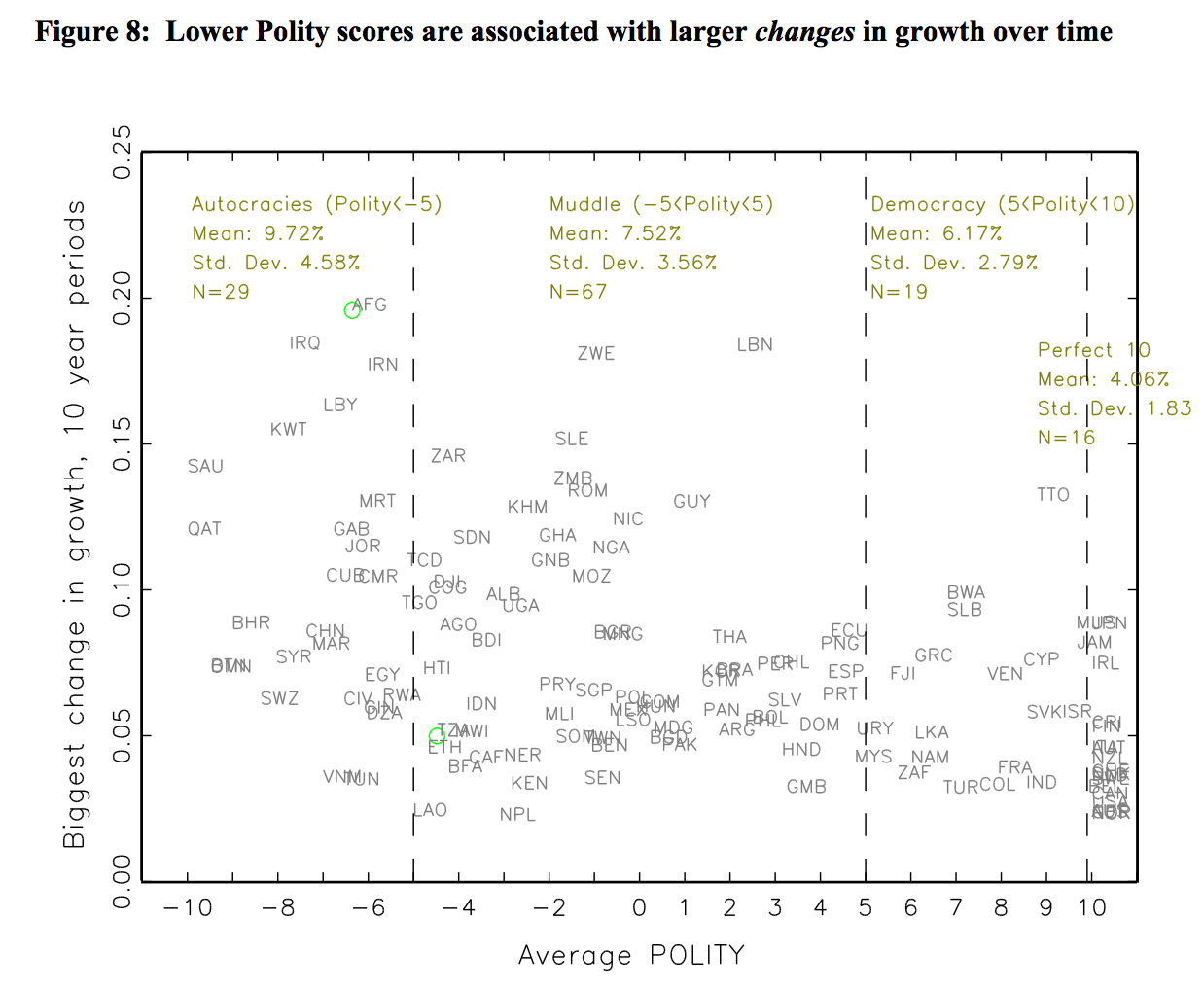
Pritchett does make one concession to analysing China itself, and that is to note that growth is, on average, less variable in countries that are more democratic.polity and growth changes

“For China, continuing to have rapid economic growth while maintaining its current level of democracy (as proxied by its Polity score) … would make it more and more anomalous.”

So if China crashes, what should you do?

1. Have a job that doesn’t depend on China (BHP bad, Qantas bad, universities bad, milk exporters bad. Doctor and primary school teacher probably safe.)

2. Have a job that can survive in a downturn. (BMW retailing bad, electricity retailing good)

3. Get out of shares. Australia’s corporate profits depend on Australia’s growth, which depends on exports to China. A China collapse and a stock-market collapse would look like that Olympic event where the two divers leap from the platforms at the same time.

4. Sell your property. China props up our house prices directly (by bidding on them) and indirectly (by making us wealthy). When the firecrackers stop popping in Beijing, auctions in Australia are going to be cold and quiet for a few years.

5. Put your money in a government guaranteed deposit account (and get ready to get very little interest indeed, because the RBA will be busy cutting rates to near-zero.)

In summary, let’s all hope Mr Pritchett is really wrong.

Why the Nobel Prize is worth a little less this year.

This year’s Nobel Laureates got a raw deal.

The prize of 8 million Swedish Kronor was the least valuable prize awarded since 1990. Eight million Swedish kronor is worth $1,280,000 in Australian dollars, which is nice, sure.

But it’s not that rich when you consider the 2001 prize was 10 million krona, worth over $A1.9 million.

nobel 2012
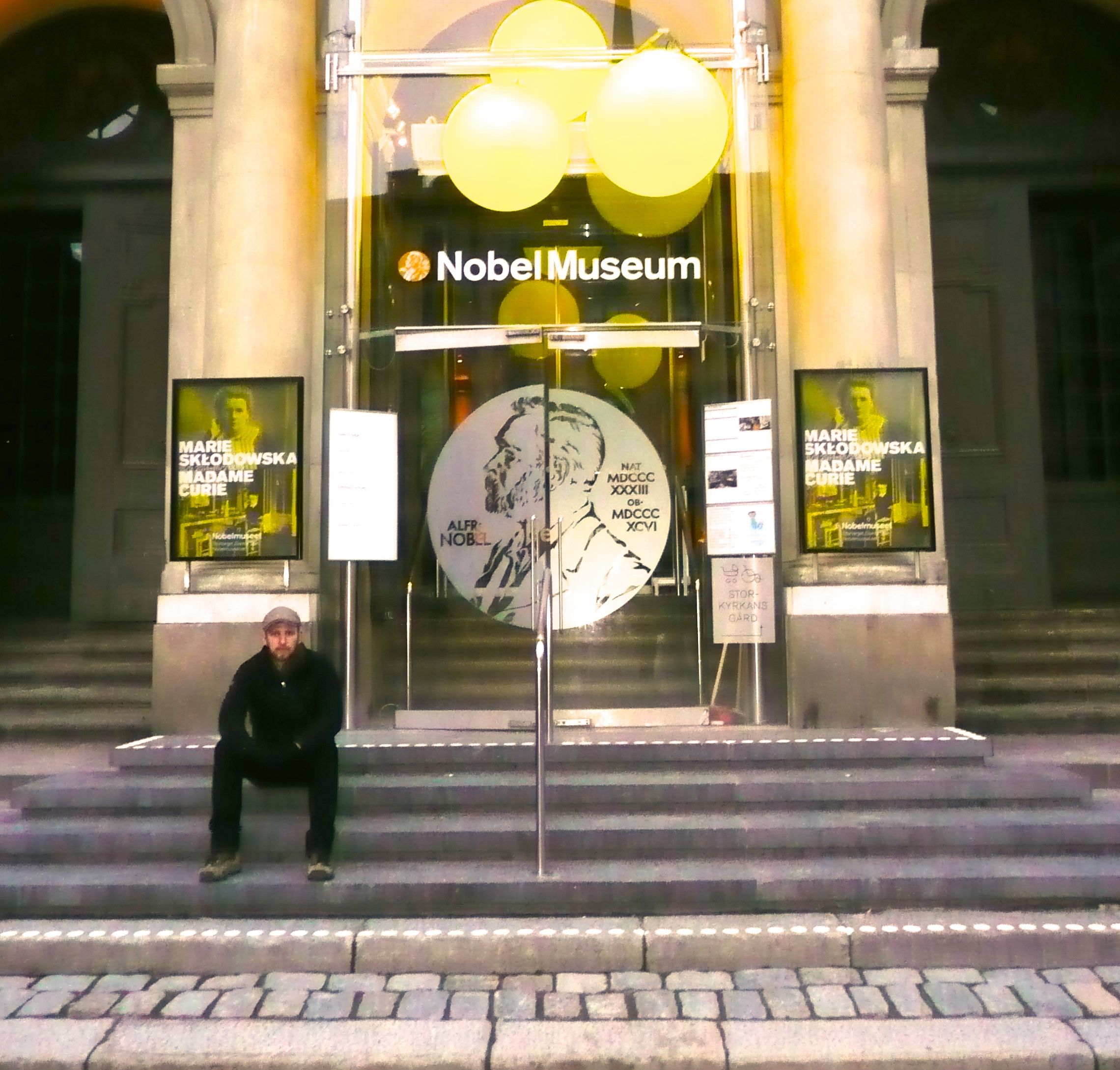
Me, Stockholm, 2012

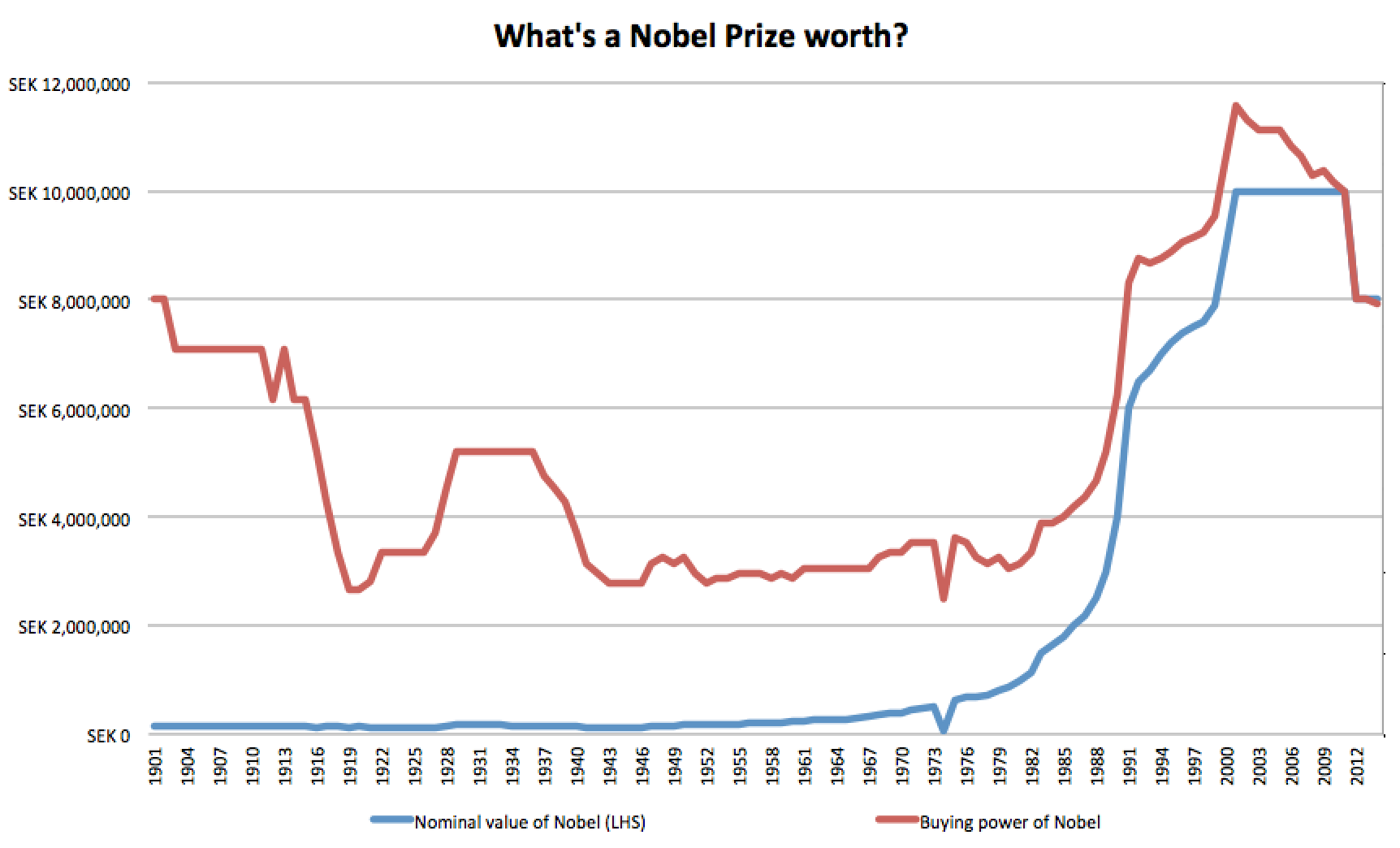
The value of the Nobel prize has varied a lot over time. Alfred Nobel gave the Nobel Foundation 31 million krona in his will, with instructions to give prizes to those who have conferred ‘the greatest benefit on mankind.’ The first prize was 150,000 krona, (worth 8 million krona in today’s money.)

nobel value

As the graph above shows, the foundation did a pretty bad job of protecting the buying power of the prize. The value of it fell steeply pretty much straight away. Some of the investment downturns coincided with World Wars and the Nobel Prize reached a low ebb in 1945 when its buying power was less than 30 per cent of in 1901.

Of course, that was the lucky year for Australia’s Howard Florey. Not only was his prize worth the least ever, but he also had to split it with two others, Fleming and Chain. That’s what you get for inventing penicillin.

The Nobel Foundation now has a very large sum of money. They turned the initial 31 million Krona into over 3 billion today, and give away just about a quarter of a percent of that total for each prize (of which there are six).

fund
There is detailed data only on the first year and then years since 1975. I interpolated some data after 1901 for illustrative purposes.


Nobel instructed the money to be invested in “safe securities.”

The wild variation in the blue line above suggests that is being interpreted fairly liberally.

And when we dive into the Nobel Foundation’s annual report, we can see they are invested quite aggressively.Screen Shot 2014-10-14 at 9.48.28 amSo if you have a Nobel Prize winning discovery, my advice is to save it up and release it in a year when the global stock-markets are doing well.

What will you buy more of when you are rich?

Want to know what you’d do if you suddenly got rich?

One way to find out is to listen to rappers.

Iggy Azalea’s track Fancy suggests the money of a wealthy Australian rapper goes on booze, clothing, watches.

“Cup of Ace, cup of Goose, cup of Cris
High heels, somethin’ worth a half a ticket on my wrist”

A very nice new dataset from the ABS allows us to check whether Iggy is reppin in a way that is actually representative.

Alcohol spend

Data confirms Iggy is legit. Rich people spend more on alcohol. The top quintile by equivalised disposable income is spending 3.5 times as much on booze as the bottom quintile.

As for high heels and watches? Clothing shows a similar pattern, but not as pronounced. For every dollar a poor person spends, a rich person spends three.

Unlike alcohol spending, the expenditure shares are skewed to the very top. Someone in the very top quintile spends 34 per cent more on clothes than someone in the second top group.

Clothing So rappers seem to be a good subsitute for data. What about cartoonists?

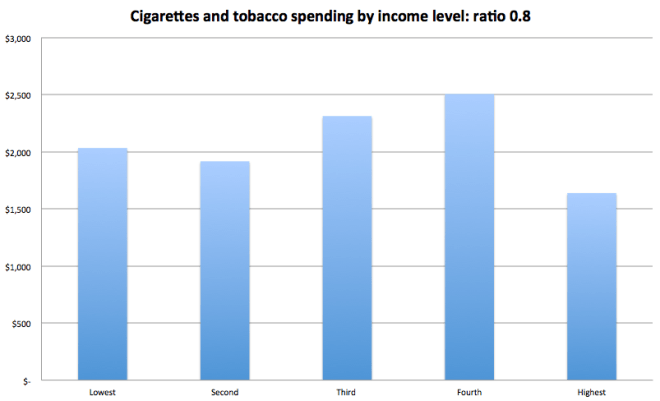
Cartoonists often show the rich smoking cigars – they’re a classic trope.

cigarettes spend

Sadly this depiction is not backed by the data. When you’re in the top quintile by equivalised disposable income, you’re actually going to spend less on smoking than anyone else. So if you’re trying to fake it before you make it, don’t trust the cartoonists – throw out those Romeo y Julietas. 

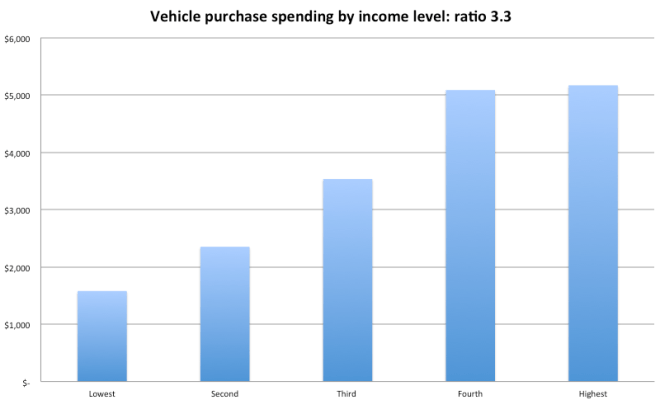
What about TV shows? Can we trust their depictions of the lives of the wealthy? In The Slap – perhaps my favourite Aussie TV show ever – the richest character is Harry, who has a fancy house and a nice german car. Is that accurate?

vehicle purchase spend

The rich buy nicer cars. Far moreso than the poor, with a ratio of 3.3. But notably, not much moreso than the next bracket down. If you want to really foretell how you will spend when you are truly rich, you have to look beyond the driveway to the house itself.rent spend

If its rented, that’s a fair sign you’re not in the top bracket. The richest income bracket spends less on rent than the poorest.

But they spend more, a lot more, on housing overall. (Note the scale on the vertical axis. The ratios may be less dramatic but the raw numbers in this graph are the biggest).

imputed rent

(This graph shows imputed rent, which allows comparison of owner-occupiers).

So thanks TV for being careful with your depictions of the wealthy. The classic big car and big house are true signs of wealth.

But they are not the category that shows the most dispersion. The truest single sign that you’re now loaded is that you get your shampoo out of a tiny little bottle.

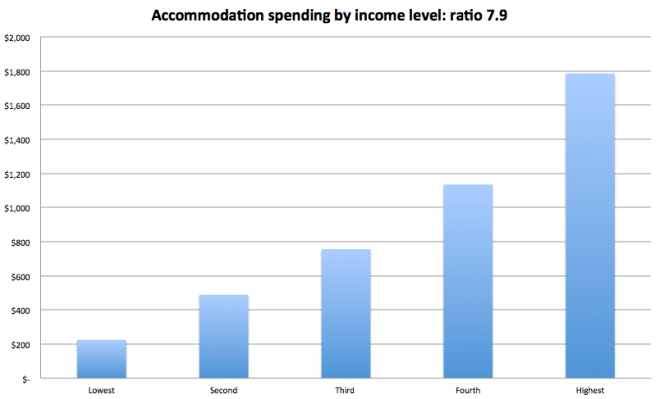
Accommodation spendWhen you are rich you might have a lovely house (or two), but you will spend a lot more time in hotels. The ratio of 7.9 between the richest and poorest quintiles is the strongest difference of any of the categories.

Globally, the super rich even live permantly in hotels. In LA, the Chateau Marmont is famous for having celebrities check in for years at a time. And don’t forget Coco “The Ritz is my Home” Chanel.

The second sharpest spending difference between rich and poor is in a category I’ve never seen mentioned on TV and a category only one rapper I know of has ever mentioned, and that’s insurance.

Insurance spend

Kanye West name-checks Geico insurance in the 2005 track Gold Digger. it’s not sexy, but there you go. More money, more problems, and more insurance against all those problems.

So that’s a summary of where your disposable income will and won’t be going when you’re loaded. But it’s not the end of the story. Because some of your income isn’t disposable. To find out what I’m talking about, let’s check in with poet/musician/millionaire, George Harrison, and his 1969 song Taxman.

tax spend

Australia in 2014 might not have a 95 per cent wealth tax like Britain did in the 1960s, but the wealthy still pay a lot of income tax. We’ll know Iggy Azalaea’s not just faking being rich when she channels her George Harrison and releases a song about Treasurer Joe Hockey.

“Degrowth” to save the world: is there any merit in the idea?

The Conversation has published an article by a Research Fellow at the Melbourne Sustainable Society Institute, entitled “Life in a de-growth economy and why you might actually enjoy it.”

I saw it get some approving shares on social media, and it has collected a bunch of adulatory comments.

The topic is close to my heart- the costs and benefits of economic growth. This is surely one of the biggest issues in social science right now and I am delighted to see it get an airing. The piece also touches on the limits to growth, which I am fascinated by.

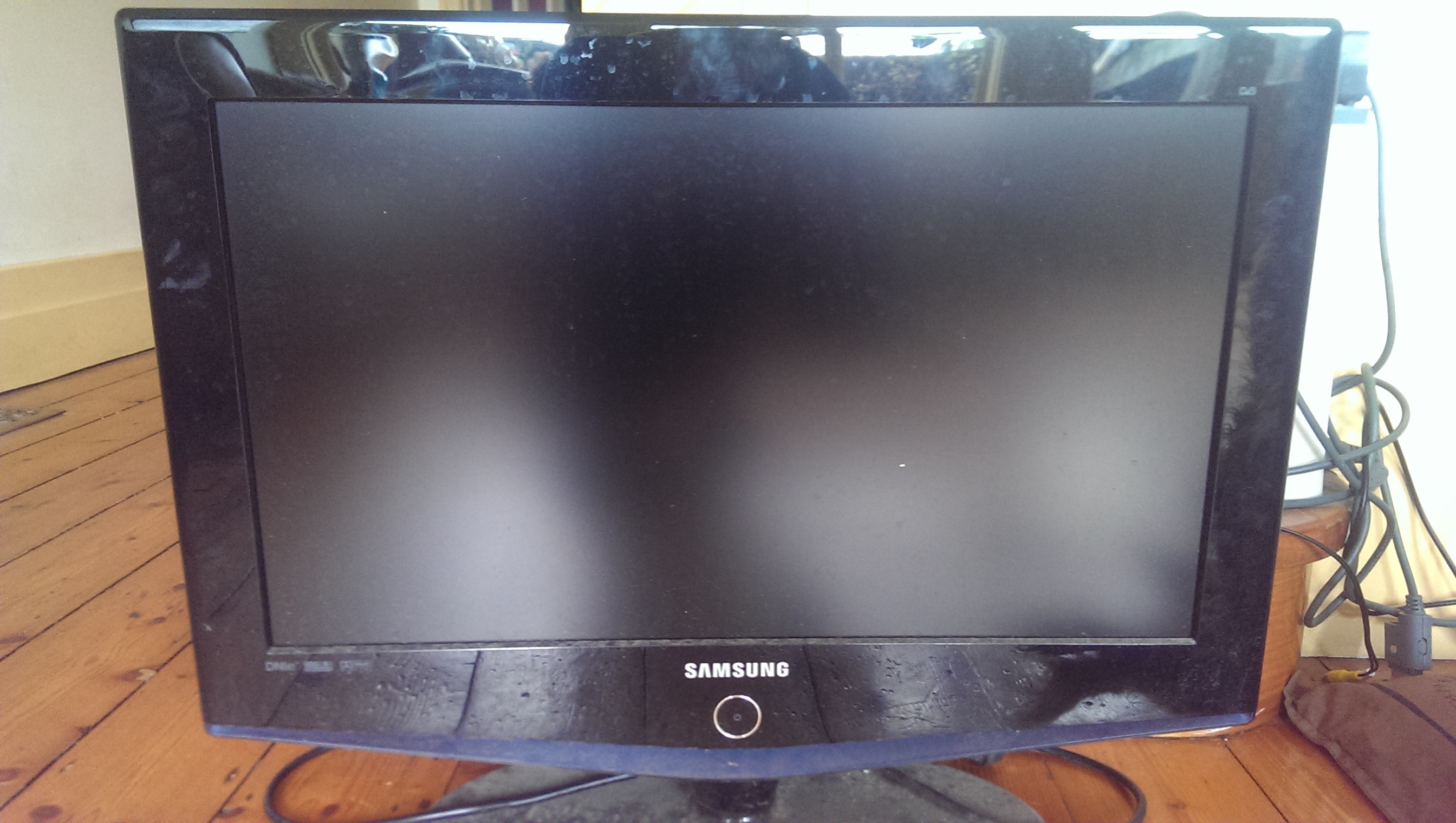
This week I found a flat screen TV sitting forlornly in a pile of hard rubbish. I took it home and plugged it in. It works. The level of affluence we have and our willingness to throw things out is, to me, confronting.

Dusty but functioning...
Dusty but functional…

So I am primed to hear someone ask the tough questions of our economic system. However, the level of analysis in this report is … *cough* … uneven.

“Degrowth would liberate us from the burden of pursuing material excess. We simply don’t need so much stuff – certainly not if it comes at the cost of planetary health, social justice, and personal well-being. Consumerism is a gross failure of imagination, a debilitating addiction that degrades nature and doesn’t even satisfy the universal human craving for meaning.” 10/10 True. 

“To be distinguished from recession, degrowth means a phase of planned and equitable economic contraction in the richest nations, eventually reaching a steady state that operates within Earth’s biophysical limits.” 10/10 for the desirable endpoint.

“Degrowth, by contrast, would involve embracing what has been termed the “simpler way” – producing and consuming less. This would be a way of life based on modest material and energy needs but nevertheless rich in other dimensions – a life of frugal abundance.” 0/10 How the living heck do we get from here to there.

“In a degrowth society we would aspire to localise our economies as far and as appropriately as possible. This would assist with reducing carbon-intensive global trade, while also building resilience in the face of an uncertain and turbulent future.”

minus 10/10 Don’t blame trade. Shipping is the most carbon efficient form of transport and contributes just 3 per cent of global carbon emissions.

In fact, trying to cut emissions from trade probably hurts the environment. The carbon effect of trying to produce locally is often worse:

“One recent UK report found that the greenhouse gas emissions involved in eating English tomatoes were about three times as high as eating Spanish tomatoes. The extra energy and fertilizer involved in producing tomatoes in chilly England overwhelmed the benefits of less shipping. Even New Zealand lamb produced less greenhouse gases than English lamb. Berkeley graduate student Steven Sexton estimates that an American switch to more local corn production would require 35 percent more fertilizer and 22.8 percent more energy.” [source]

The problem with the degrowth argument – as presented in this piece – is that it has no sense of the dynamics of an economy. Motivated by a clear vision of a utopian alternative, it simply flicks the pages of the book until we are at the end.

The closest it gets is this:

“Actions at the personal and household levels will never be enough, on their own, to achieve a steady-state economy. We need to create new, post-capitalist structures and systems that promote, rather than inhibit, the simpler way of life. These wider changes will never emerge, however, until we have a culture that demands them. So first and foremost, the revolution that is needed is a revolution in consciousness.”

Here are the problems I foresee with trying to set up “post-capitalist structures”:

1. When the economy is in a sharp growth phase, it tends to deliver wealth to the rich first, then spread the benefit. When the economy is in a sharp contraction phase, it tends to be the poor that are hurt. I’d be very surprised if “planned and equitable contraction” were even possible without spreading shortage to the people who could least manage it.

2. The governmental resources required to supervise the economy on such a scale remain unknown. What policy levers need to be pulled? If you need to expand the government to effectively supervise the shrinking of the economy, do you not need profitable businesses to tax?

3. Gucci handbags come with influenza vaccines in them. (Metaphorically speaking). Growth is not just wanton consumption. It’s also improved infant mortality rates, more recognition and better treatment of mental illnesses, better educations.

4. But even wanton consumption has positive side-effects. China’s adoption of capitalism has lifted hundreds of millions of people out of abject poverty and given them hope for a better life. That growth is due in part to rich westerners buying frivolous Chinese-made goods. De-linking the rising affluence of the poor from the rising affluence of the rich is to miss cause and effect. We’re all in this together.

5. Global coordination. Attempting to institute post-capitalist structures single-handedly leaves you a bit like North Korea.

6. Population. If growth cuts fertility rates, what effect will de-growth have? Would a Chinese style population policy be required to prevent global population growth from accelerating?

7. Economies are amazingly tough. If you try to squash them, they’ll just keep on bobbling up. If you outlaw them, they’ll survive. A de-growth economy is going to have to be enforced in a coercive fashion, and exist alongside a thriving black market.

So, having given the “de-growth” idea a kicking, do I have anything positive to add?

I think I do.

It sounds prosaic, but the answer to the very real problem of environmental degradation exists and does not require inventing a whole new approach.

The solution is in raising the cost of harmful activities until they are performed only at acceptable levels.

Policy actions like instituting a carbon tax are within our grasp. We’ve already cut emissions of chlorofluorocarbons. We can police water pollution and  the fishing of dwindling populations and the elimination of natural habitat.

The problem of equality can be solved too, using the awfully yawn-inducing tools we already have in our grasp: Things like land taxes, income taxes, tax credits, and publicly funded schooling are enough to shape the world into a more desirable form. To think we’ve exhausted their power is to think small.

But I can see a role for the de-growth movement.

A movement for social change will be more radical than the changes it is able to effect. If de-growth were to become a more popular idea, it would provide serious impetus to the sensible solutions I mentioned above.

So I won’t think less of you for promoting de-growth – so long as you don’t believe in it.

The Australian dollar has just tumbled. How should that make us feel?

The Australian dollar has just tumbled. How should that make us feel?

Well for starters, you should feel poorer. If you have any positive number Australian dollars, they are now worth less in international markets.

AUD SEpt
Source: RBA

That’s a 6.2 per cent fall against the USD and a 4.5 per cent fall against the trade-weighted index during the month. That makes imports more expensive

If electricity prices or taxes went up that much, we’d have hyperventilating shock-jocks all up in our front pages. But when the dollar moves that much, the silence is tangible.

That’s actually crazy. We spend far more of our money on imports than we do on electricity. We spend a similar amount on imports as on taxes.

share of wallet

If there is no locally made equivalent for what you like to buy (e.g. a laptop computer, quality coffee, petrol, most clothing) you’re just stuck paying more for what you love. But before your weeping becomes unconsolable read on: a lower dollar could actually do some good, eventually.

The benefit to the Australian economy works in two ways:

1. Australian exports start to look cheaper, and they sell more.

The upside will be extra apparent to you if the company you work for does exporting. Exporting is rarer than you might think. Just 2 per cent of Australian firms export (although obviously they tend to be bigger firms with more employees).

If you work for BHP Billiton, CSL or a school that teaches English to international students, your employer should find sales lifting without any extra effort, and you should find that the payrises start flowing a little more easily. Beauty, mate!

2. Consumers start buying Aussie products, not the imported equivalent.

If the product your company makes competes with foreign imports (including overseas travel), the fall in the dollar will help. Maybe your company is in food production or owns hotels on the Gold Coast. If so, plan for better times ahead. But don’t get overexcited.

The time it takes for a lower dollar to flow through to higher-priced imports can be long. While some things like petrol are traded frequently on world markets, most imports have their prices locked in well in advance.

So, on balance, how should you feel about the lower dollar? It depends.

  • If you’re a big fan of buying Australian made and you think foreigners should be too, happy days are ahead.
  • If you’re a connoisseur of foreign made products or a fan of international travel, then it’s more gloom and doom.
  • If you work in the Australian economy, then you can (gradually) start to whoop it up.
  • If you’re retired and you mainly consume the output of the Australian economy, then things look less rosy.

This is at once the blessing and the curse of writing about economics. It’s the Kurt Vonnegut effect: there’s no simple story – no absolute doom and gloom.

Every change in price that hurts someone helps someone else. Even if this seems like a windfall to you, the polite thing to do is re-arrange your face into a neutral position and carry on with your day.

RBA calls it: Australia’s housing market has gone horribly wrong.

“Unbalanced” and “out of proportion” are the words they use in a brand new report out today.

“Recent housing price growth seems to have encouraged further investor activity. As a result, the composition of housing and mortgage markets is becoming unbalanced, with new lending to investors being out of proportion to rental housing’s share of the housing stock. “

Do not get the impression the RBA thinks this will be a minor:

“In the first instance, the risks associated with this lending behaviour are likely to be macroeconomic in nature rather than direct risks to the stability of financial institutions.”

nb. “In the first instance…”

Who knows what sort of calamity could follow a macroeconomic event associated with a big house price fall? And if you think not owning a house makes you safe then you are wrong.

“…a broader risk remains that additional speculative demand can amplify the property price cycle and increase the potential for prices to fall later, with associated effects on household wealth and spending. These dynamics can affect households more widely than just those that are currently taking out loans: the households most affected by the declines in wealth need not necessarily be those that contributed to heightened activity”

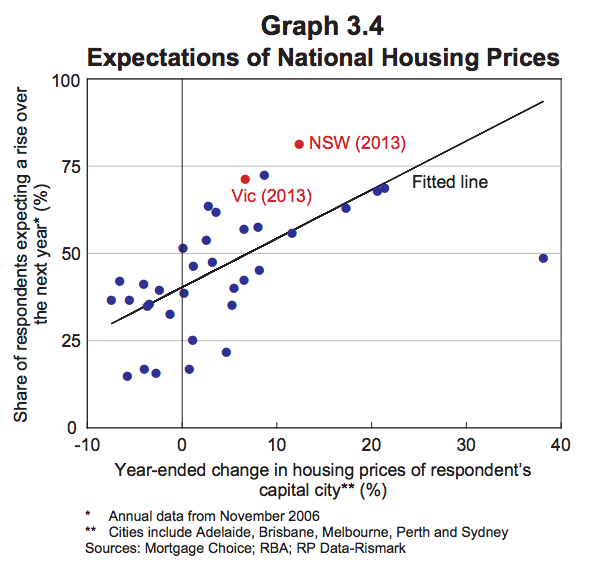
This chart got the RBA concerned:


house price expectations

“… expectations of future housing prices seem to be influenced by the recent past (Graph  3.4). This tendency was stronger than average in New South Wales and Victoria at the end of last year. The risks associated with this behaviour are likely to be macroeconomic in nature if households were to react to declines in their wealth and any repayment difficulties by cutting back their spending. “

The recent rise in interest-only loans (yellow line below) also has the RBA worried about whether speculation is rife.

Interest only loans

They are so worried about house prices they are cracking open the weapons safe and rustling around for some ammo to try to scare off packs of hungry investors.

“The Bank is discussing with APRA, and other members of the Council of Financial Regulators, additional steps that might be taken to reinforce sound lending practices, particularly for lending to investors. “

The most likely step is not to mimic NZ and try to control Loan-to-Value ratios (as you can see in the above graph, LVRs seem to be under control). It is to make banks add a bigger buffer to their lending criteria. Currently they add 2 per cent to the existing interest rate. That might rise.

The last warning the RBA delivers may be important for anyone considering buying a small apartment in central Melbourne:

“A speculative upswing in demand can also be damaging if it brings forth an increase in construction on a scale that leads to a future overhang of supply. This risk is more likely to arise in particular local markets than at the national level.”

CAVEAT: The RBA points out that housing market dynamics are most skewed in Melbourne and Sydney. I’ve noted myself that buying in Brisbane looks like a pretty clever move.

FULL DISCLOSURE: The author is not invested in property.