A huge housing surplus is coming. People are really excited by housing abundance. However this surplus? It will not be good.
As usual, the future is shown to us by Japan. Japan has run through the 21st century at 2x-speed so the rest of us can see what will happen.
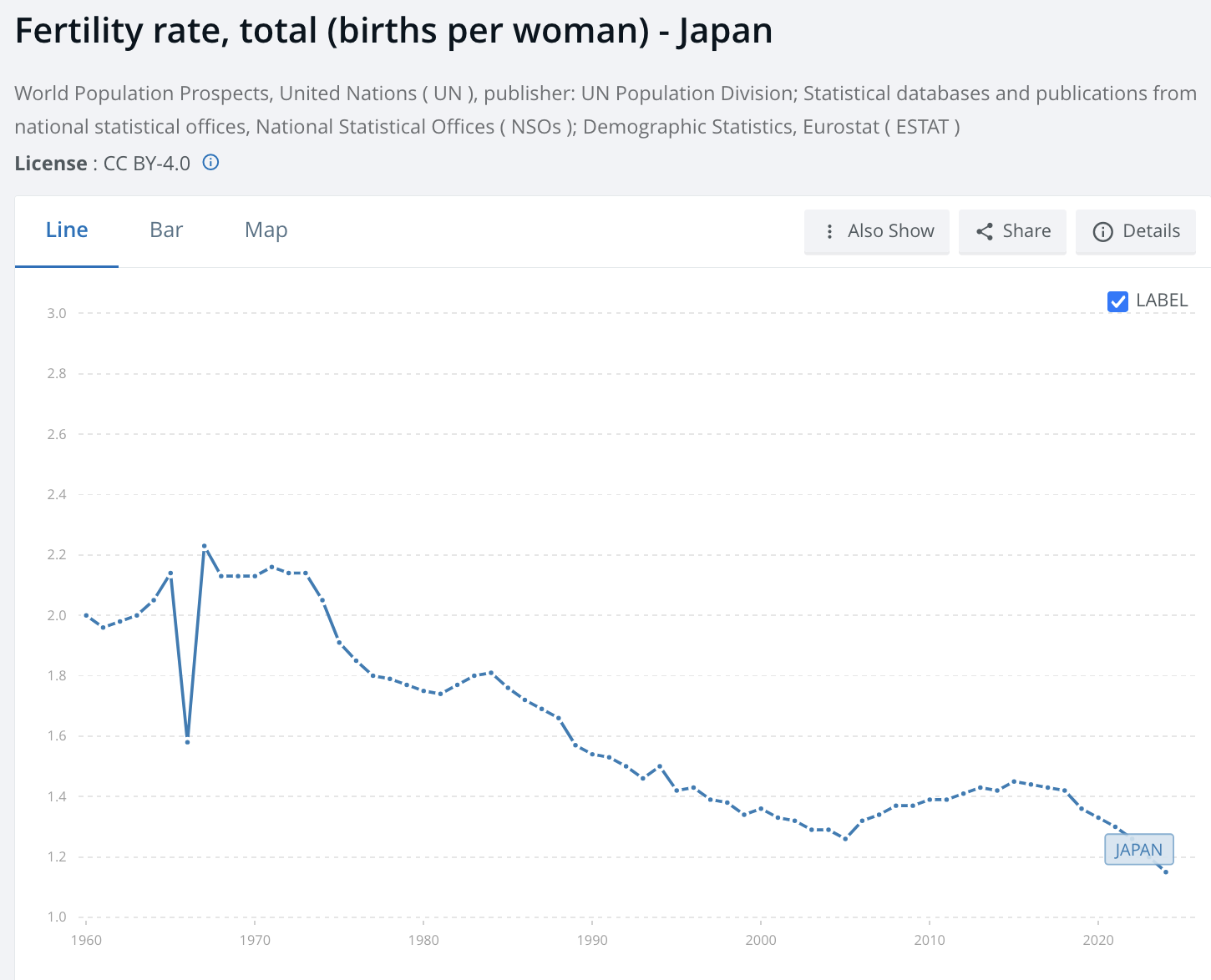
First the fertility rate fell.
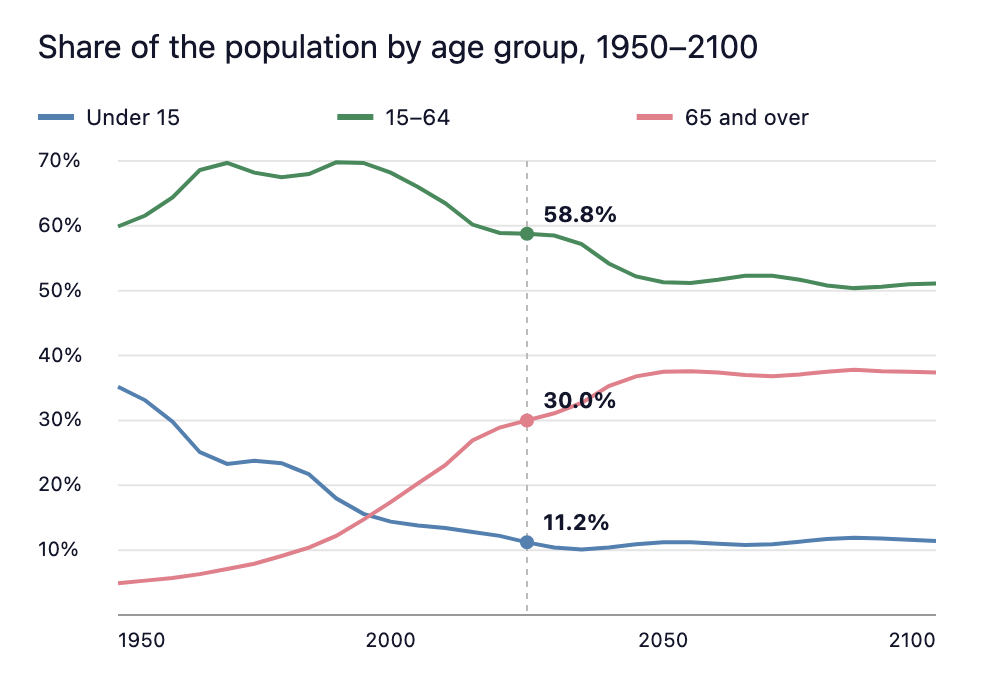
Then the population aged.
And finally the population fell.
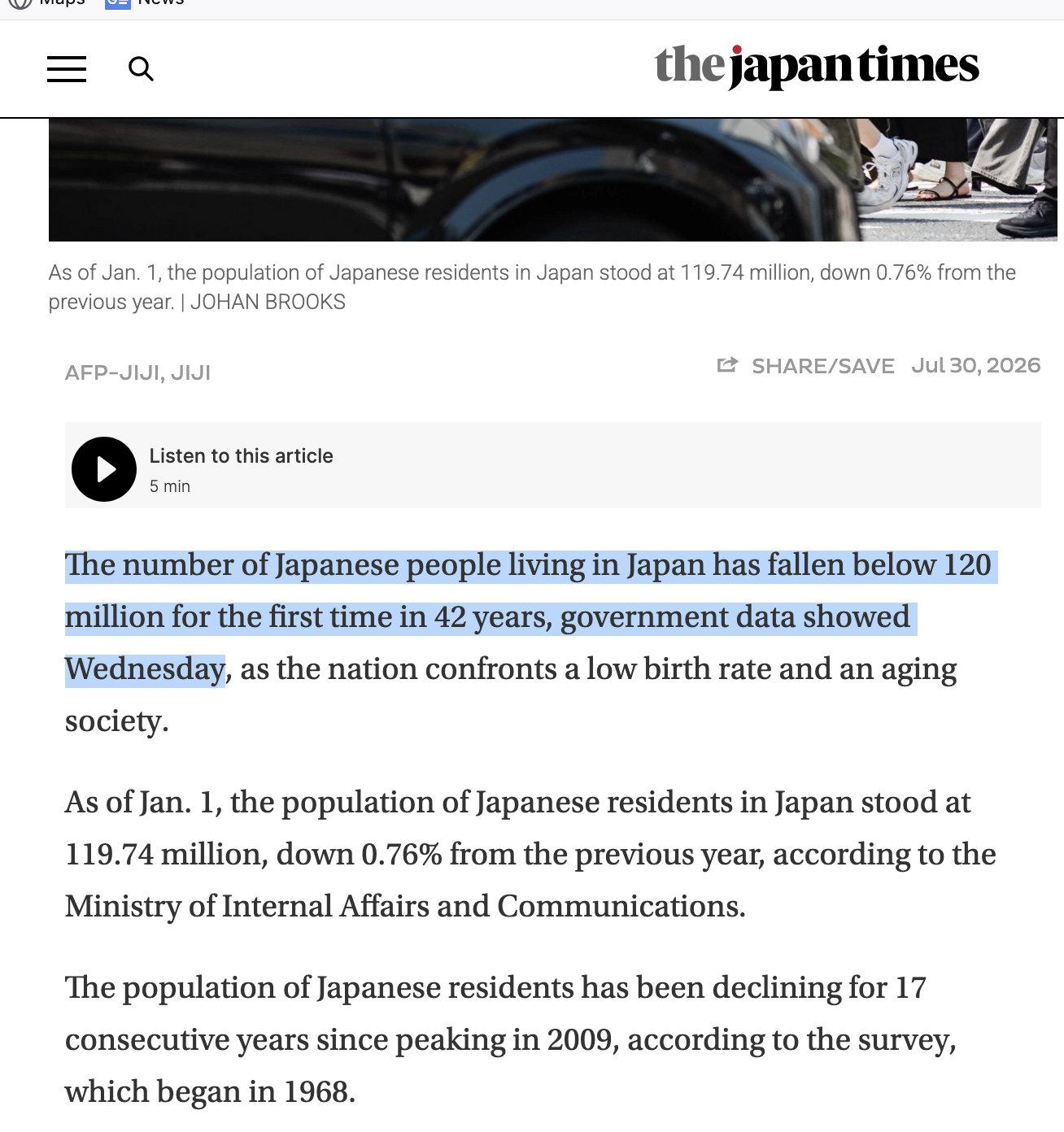
Migration was tried. But it was not popular. An anti-immigration leader now occupies the Prime Minister’s office.
So now the population fall is locked in.
GDP per capita continues to grow. But overall GDP is flat. Infrastructure investment is low, meaning buildings in Japan are old and tired, inside and out. The Ginza district of Tokyo should be a showcase for one of the richest cities in the world. But it is drab. You’d find more zing in a mixed use development in Colorado.

A chart of building in Japan shows a steady decline in new floor area being built. https://www.e-stat.go.jp/en/stat-search/files?page=1&layout=datalist&toukei=00600120&tstat=000001016965&cycle=1&year=20260&month=11010301&result_back=1&tclass1val=0
This is 100 per cent rational. Why build new when so many old buildings are unused?
THE AKIYA TRAP
I got excited about Japan’s old buildings for a while there. I took a holiday to the place where they host the Fuji Rock festival, a short shinkansen ride from Tokyo. In winter, it is a ski area. I discovered apartment blocks dotted around where you could sometimes see an apartment offered for under Y100,000. Around A$1,000. My head filled with fanciful dreams of buying these places up.
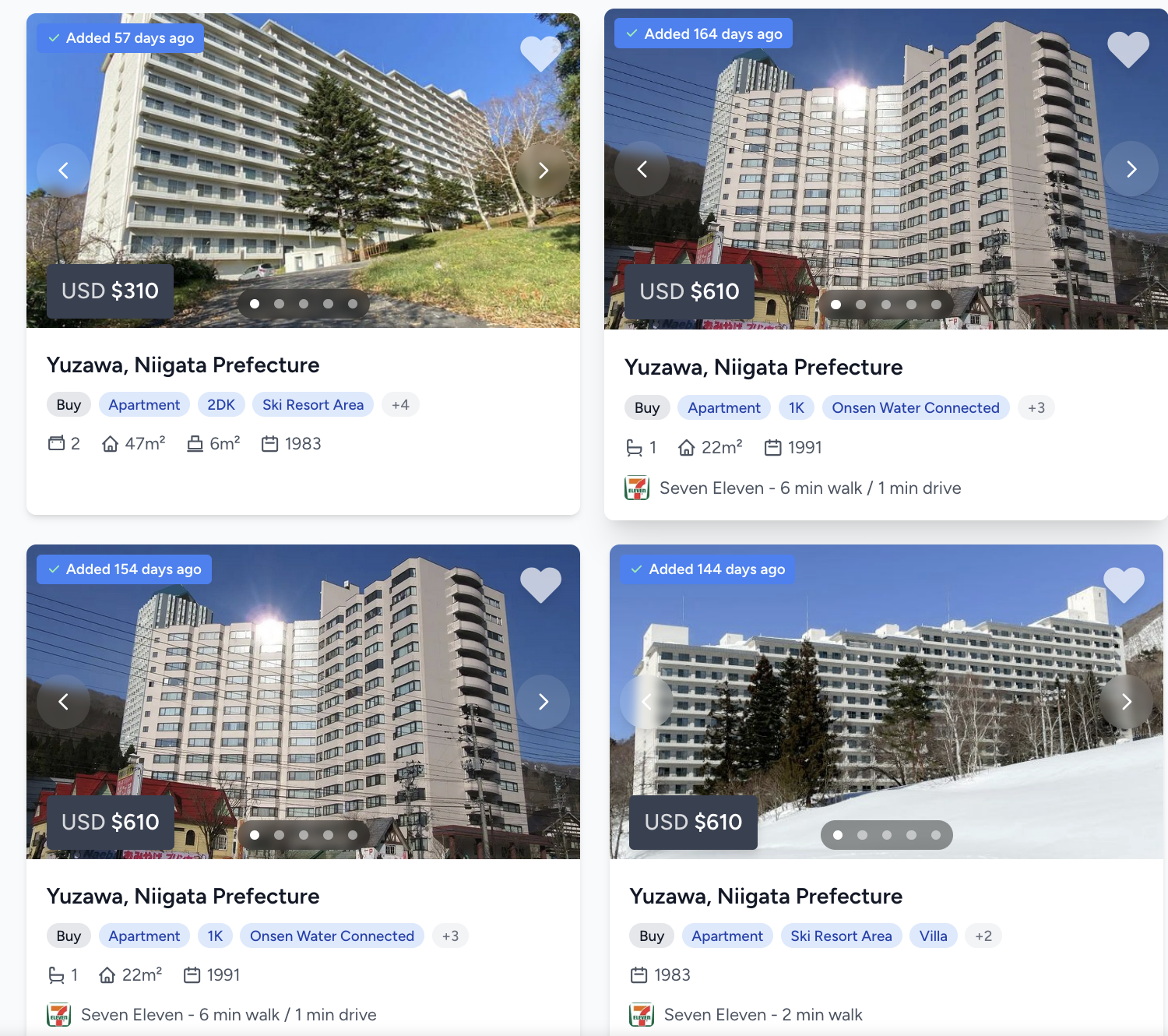
Millions of foreigners have had the same dream. There’s a big industry around Akiya – Japanese abandoned homes – being marketed to foreigners like me.
It sounds genuinely fun to buy and renovate an akiya. A series of engaging challenges. If you want to encounter “a tangle of geckos that tumbled to the ground in a writhing mess” and depend on woodfire to heat your bathwater, a rural akiya could be for you!
But eventually I came to a realisation. This is not a fire sale, a temporary shock situation that forces a blin-and-you-miss-it sale. These places are cheap for a reason.
Japan has more than enough homes for its people. And it has a shrinking number of people. Meaning it will continue to generate surplus homes for a long, long time. Developments are rotting all over the country.
Very soon there will be more abandoned homes in Asia than there are people in Australia. A leaky structure near an overgrown ricefield may be beautiful but is not going to be a trophy of any kind. Living out there among the remaining octogenarians might not be any fun at all.
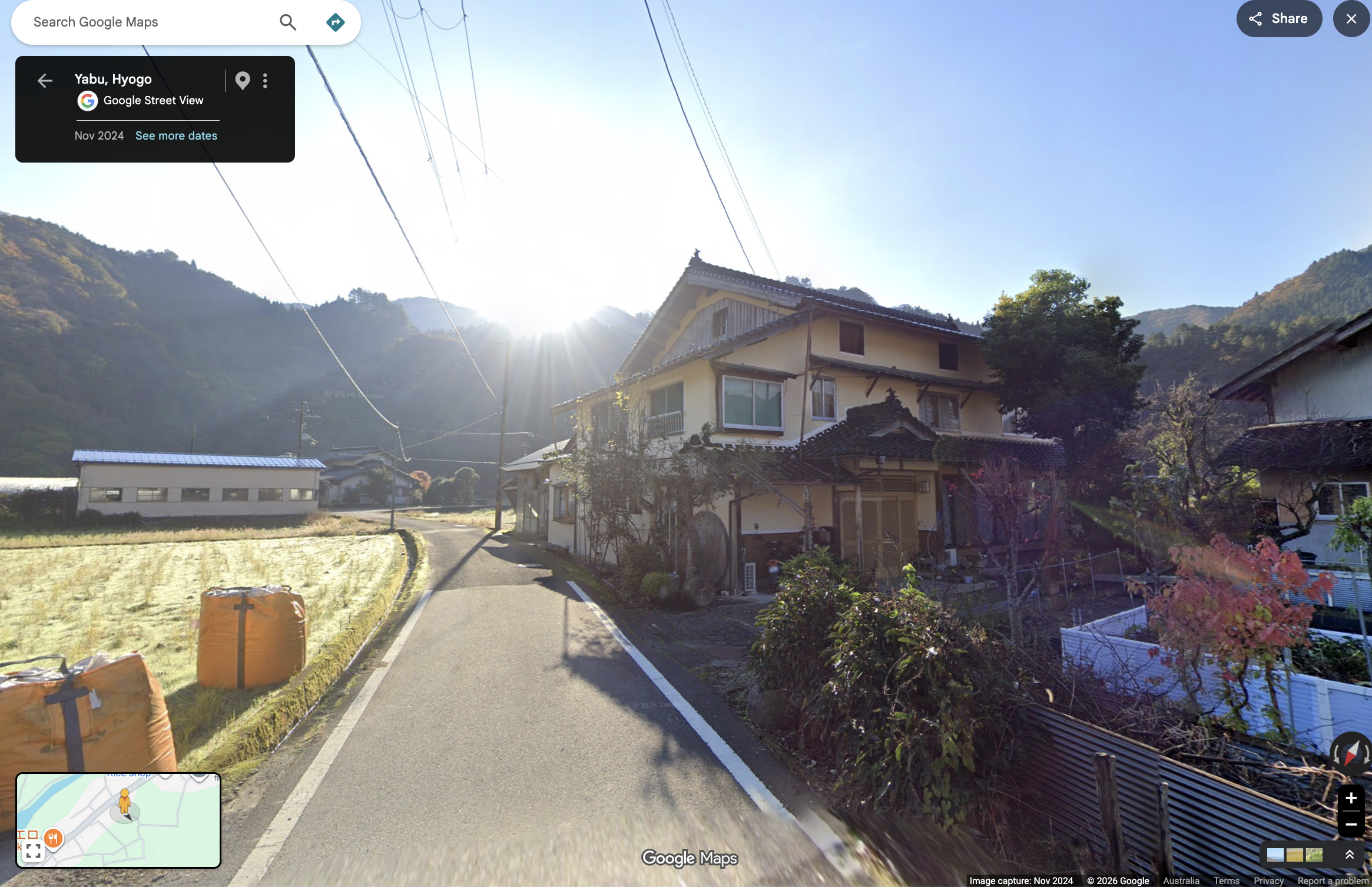
I’d go to a contemporary art exhibition of the nicest vistas captured by StreetView. This might be one.
THE AKIYA TRAP
It’s worth noticing how this works. People flee the shrinking periphery for the core. You can buy a place on Japan’s rugged north west coast – far from a Shinkansen – and live there. By all means renovate. But don’t expect to ever find a buyer. The market dynamics we are used to in the UK, USA and Australia simply do not apply in these parts of Japan.
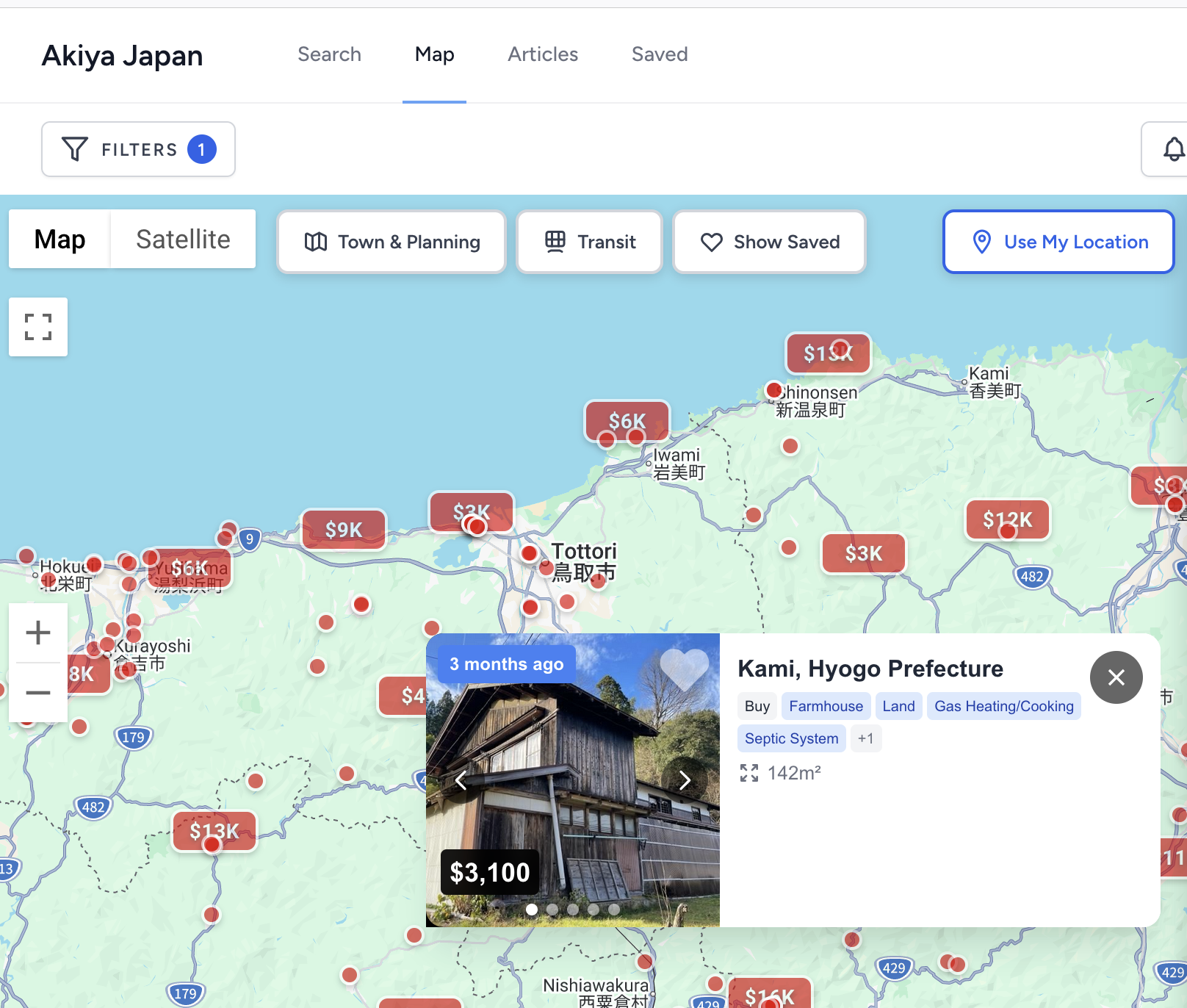
They may still apply in Tokyo though. Tokyo is the only prefecture in Japan still reliably growing.
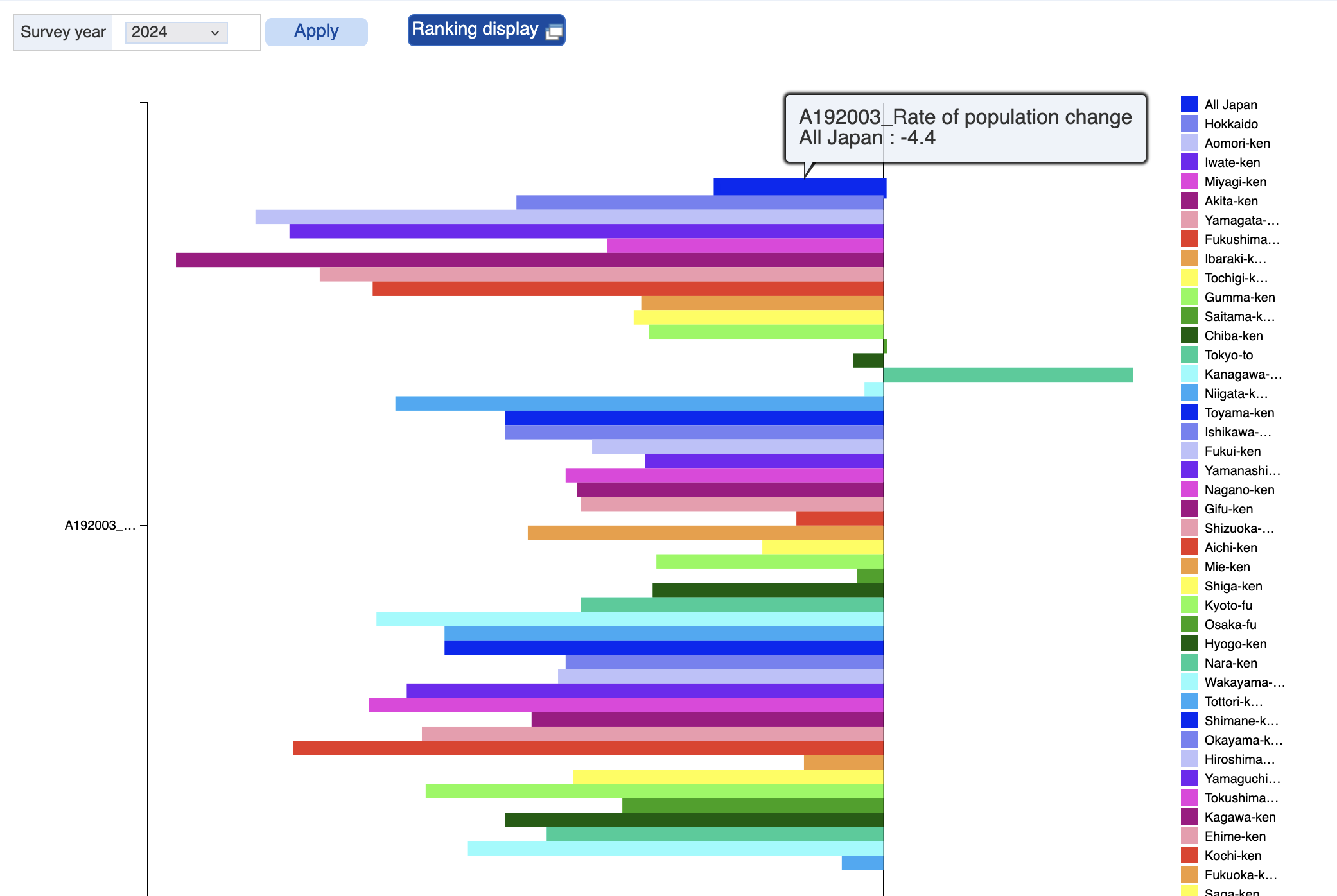
Researchers have described the process of population loss as “profoundly spatial.” Tokyo will continue to thrive, they predict, even as it comes to be one of the last functioning parts of Japan
This affects perceptions – people who want to buy are often still competing for scarce homes. The giant housing surplus does not feel like abundance. People want to live in the growing place, not the shrinking places, so the surplus homes are kind of irrelevant to their purchase decision.
JAPAN IS NOT THE END OF THE STORY
Japan is not the only country with a plunging birthrate. The Akiya story has already played out in southern Italy, where you can buy a crumbling home in an abandoned village for 1 euro. There are 13 countries in Europe with falling populations, mostly in the east, but also Italy.
If you added all those countries together, however, they would not even get close in size to China. China is the big issue here. China is what turns this from a story about a place with a shrinking population, to one about a planet with a shrinking population.
I have, for about a decade, maintained a strong belief in the Chinese government. Not its goodness, mind you: its power. Decades of relentless economic growth convinced me that when they want something, they get it.
Is that still true? I was sure they would not let the Chinese population collapse. But I have recently stopped scoffing at the idea. That ship has sailed.
The trouble with population is it works like compound interest. Population growth begets population growth, and the reverse is true, as well.
The longer you wait to create interventions that tempt people to have kids, the better those interventions need to be.
Here’s the rough maths of it:
Young Chinese families would need to have three (3) kids each to keep China’s population at its current levels. But Chinese families have one (1) kid each. The gap between one and three is a gigantic chasm.
Doubling the number of kids per household would be an unheard-of success in the world of fertility interventions. It has never happened. Current Chinese policies have done nothing. So tripling? Simply impossible.
Which means China is stuck in a downward spiral, and the best they can hope for is to shrink a little more slowly. Lifting the fertility rate from 1.0 to 1.2 would be a triumph for them.
What about migration, I hear people ask? That is a category error. Migration can make a big difference to the population of a small country. China is in a different basket. It is too big for migration to change the population size materially.
FERTILITY INTERVENTIONS
Nothing works. Actually, we will talk more about this after the next section.
GHOST CITIES
A decade ago I didn’t think the Chinese ghost city idea was an issue. Enough of the Chinese population lived in the country that I believed building apartments in the cities would eventually pay off.
Now I have changed my mind. I am convinced ghost cities are coming, or at least ghost villages. China’s population peak is here. If urbanisation fills those empty apartments it will be by leaving vast numbers of houses elsewhere with one or two aged parents in them. Which eventually become empty homes.
When a country as large as China has a falling population, the raw numbers are huge.
China will lose an entire Australia worth of population by 2033, just seven years away. Its population is due to fall from 1.4 billion to 1.372 billion according to World Bank estimates.
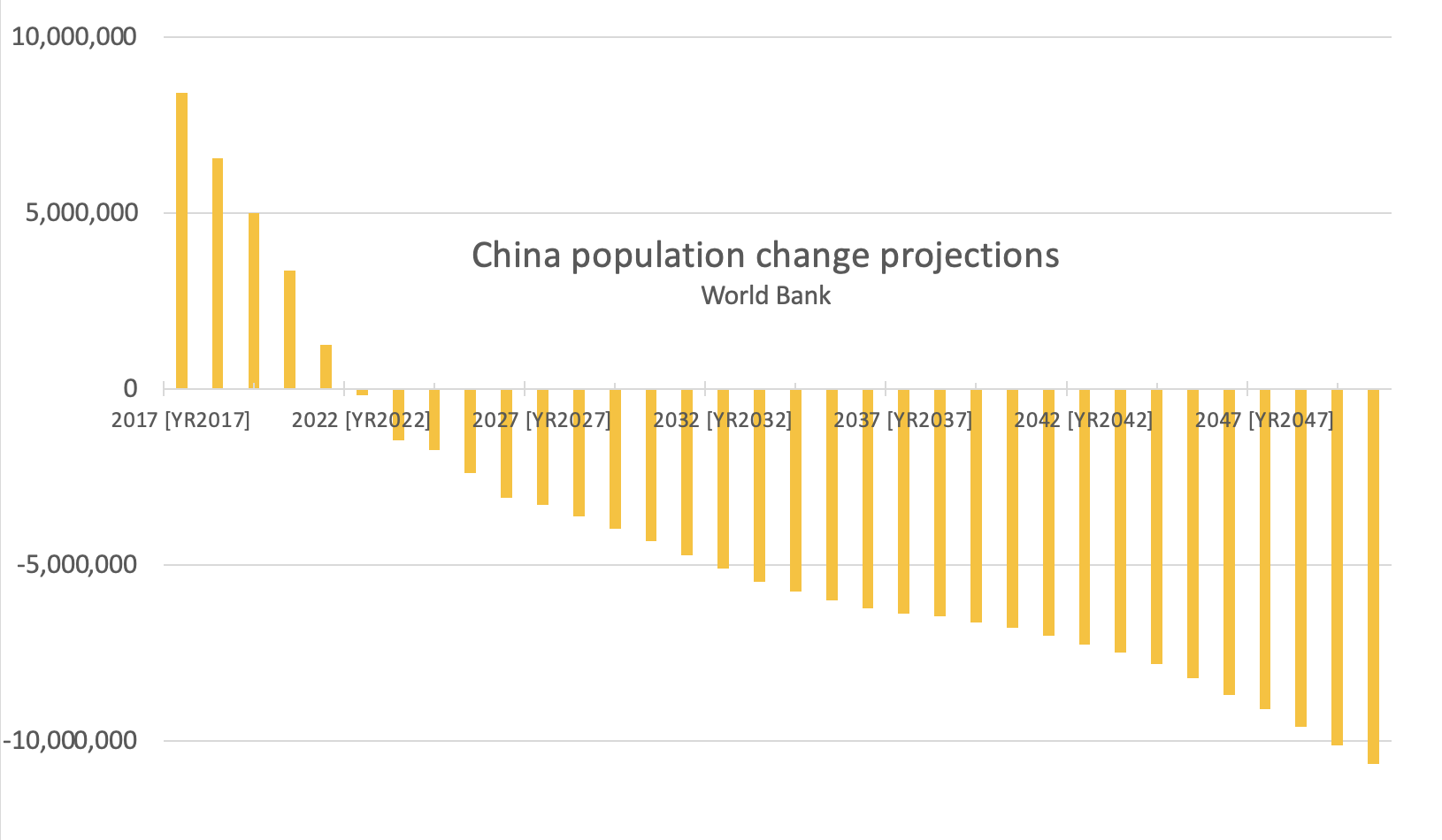
After that? The fall accelerates. Before too long the country will be losing 10 million people each year. That’s a lot of empty homes. Not in Beijing or Shanghai, mind you. Out in the places few tourists visit – that is where vines will grow into elevators shafts of abandoned developments.
First people will flee to local hubs, provincial capitals. Then to national-level cities. The abandoned homes will dot the map in places people don’t wish to visit. Even deep into the population collapse, Beijing and Shanghai will stand tall. Don’t expect bargains there any time soon.
I believe housing availability and size is probably a big input to family size choices. We don’t understand all the dynamics, but big cheap houses probably lead to big families, on average. If you know you can own a three bedroom place, more or less paid off, by age 45, on one-and-a-bit incomes, you can probably feel comfortable starting to having kids in your 20s. Which raises the chances of having two or three kids.
The housing surplus that I used to title this post, however? It is not going to lift the birth rate. Because the cheap, surplus homes will simply not be in places where work is abundant and raising a family is easy.
POLICY INTERVENTIONS
There’s two countries that have increased their birth rates recently. Kazakhstan and Uzbekistan. I was puzzled. What can we learn? What are these countries doing differently? I dug in.
The reason, it turns out, is largely a change in population mix. Millions of Russians have been repatriated from Kazakhstan. People who identify as Russian / European left. Kazakhs are now a majority in Kazakhstan again. (Uzbekistan never had quite as many Russians but the same pattern applies.)
The indigenous population of both countries was always more traditional and had more kids. As they become a larger share of the population, that pushed the national fertility rates up.
The result is they tend to stand out on any chart of fertility rates. They are risers amid a sea of fallers.
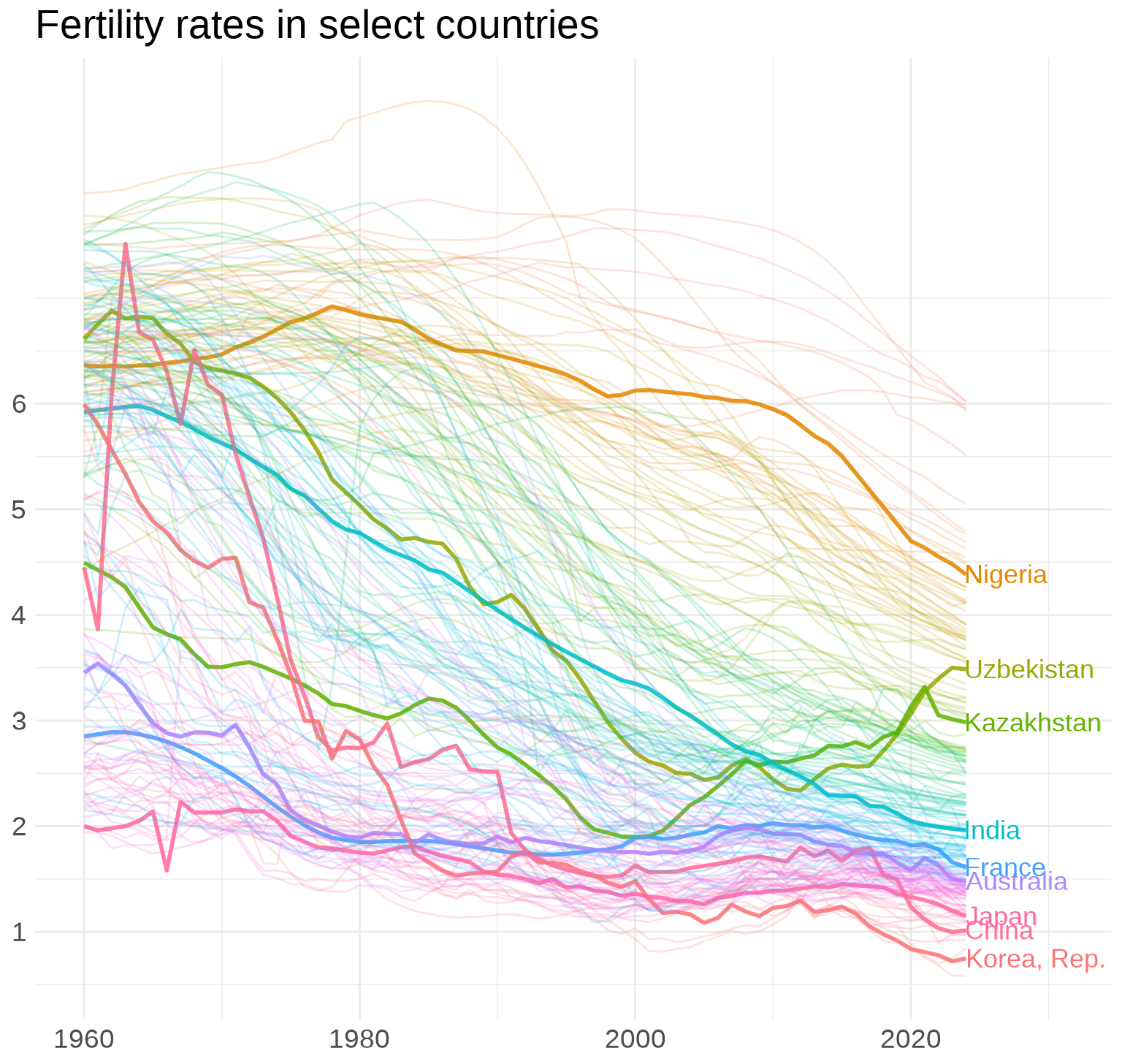
So there is no policy lesson here we can replicate. It shows that only extraordinary events can lift fertility.
China is actually trying hard: laws encourage big families. There are cash payments. Local politicians face incentives. But the trend is a downward one. Experience so far tells us not much can be done.
Some combination of social, cultural and economic factors makes this trend extremely prevalent. It is not about conditions exclusive to China. It is happening everywhere. India’s fertility rate is now under two. Even sub-Saharan Africa has falling fertility rates.
Sidebar: When you look at a map of Nigeria, it’s hard to understand why it has supposedly got the largest population in Africa by a huge margin (238 million vs Ethiopia’s 135 million. Not a particularly big country. Not the only lush one with ample rivers. Not the only one with a colonial history.
Looking at Lagos on Google satellite view, it doesn’t seem especially outsized. It is hard to figure out why it supposedly holds 10 times as many people as Accra in nearby Ghana.
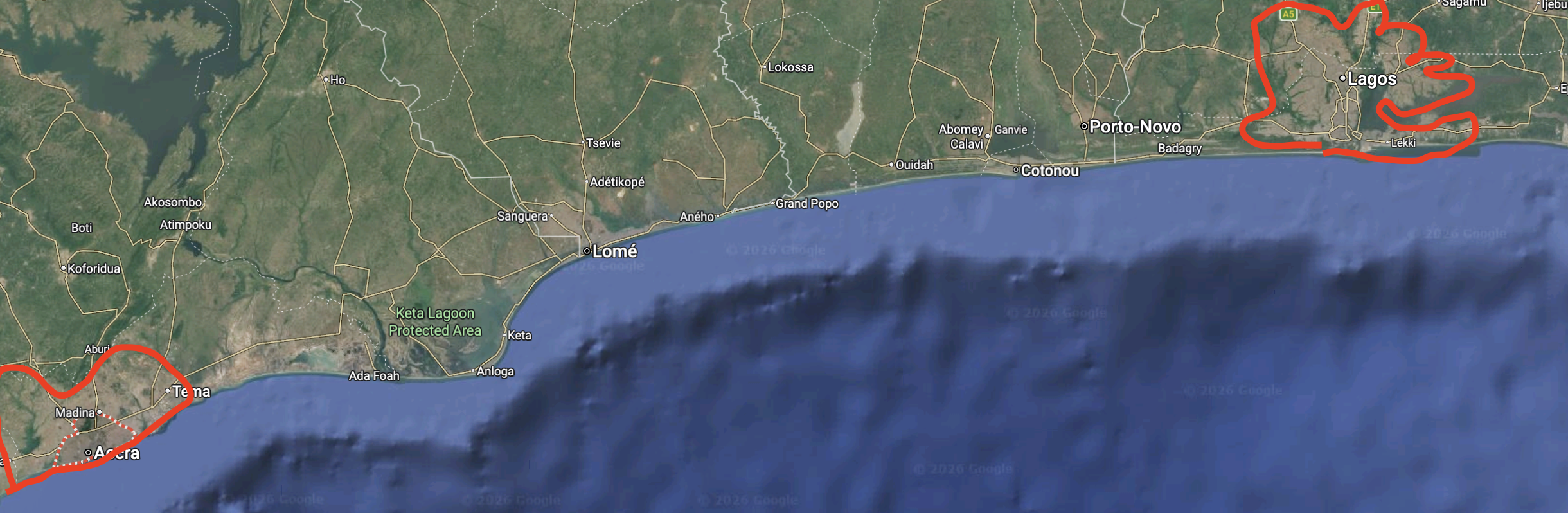
But I read an interesting piece recently suggesting Nigerian population statistics should be viewed very skeptically, because of the way budget is dispersed according to population inside its federated system. There are incentives to fib about local population.
It’s possible Nigeria’s population is not growing at the rates we think. If so, the world population will peak sooner than we expect. But even if Nigeria’s numbers are sound and Africa keeps growing, the world population will shrink. That shrinking will start this century. The UN forecasts a peak in 2084, but they are conservative and the estimate predates the latest fertility data. I doubt we will need to wait that long.
IMPLICATIONS
A piece like this should end with implications. I’ve spelled out what I think will happen in local areas. We already see slow accretion of crumbling homes in rural Japan. Homes you should not buy, no matter how cute they look. Many more such homes will accumulate in rural China. South Korea too.
I predict waves of migration from shrinking rural areas to the major cities. This will be a stabilising force, helping working-age people find good jobs, while insulating the major cities from the effect for a long time. The perception among the elites in these cities will be of business-as-usual. Plenty of buyers for their homes. But outside the city walls, their country is atrophying.
Per capita growth may continue, but aggregate growth is likely to slow and to stall. That means less capital investment. The shiny veneer that makes China seem futuristic right now is about having all-new infrastructure. Japan had that sheen too, once. It fades under a falling population. Roads will crumble. Facades will look tired. Occasionally, bridges will collapse. Relevant to Australia: A country that is not building has much less appetite for importing commodities like steel.
MIGRANT FLOWS
Birth rates are falling worldwide. Will there be more or less migration from slower-growing countries to the rest of the world, compared to current rates?
You could argue people will flee economic stultification. But I would expect less out-migration, simply because young people migrate and the population pyramid will be so thin at the base. What’s more, if you’re an only child, the personal cost of migration is probably higher. Leaving aged parents behind, alone, would be wrenching, presumably. Certainly data shows younger siblings migrate more than older siblings, which may imply that only children migrate least. And in China, at least, most people are only children. I expect less migration from China. Perhaps less from India too.
A migrant shortage would be rare and extraordinary. To my eye, one interesting aspect would be if migrants start to become scarce and desirable and xenophobia – in both the east and the west – becomes too costly to endure.
If that happens, countries like Australia, UK and America, with strong histories of accepting migrants from all over the world, are going to be far better placed than countries like Japan, China and South Korea.































 Remember that despite the importance of CBDs, most jobs are still in the suburbs. If we know one thing about CBD jobs – especially nine to five CBD jobs – it is that they tend to be the good kind.