Work: nice to have. But not all the time.

Work. It’s a chore, isn’t it? If Australians can get out of it, they will.

The latest unemployment data are out, and they show this : Labour force participation has fallen to its lowest level since April 2006, and male labour force participation has fallen to its lowest level since records began, 71.0 per cent.

Look at this graph:

Image

Participation counts those working and those looking for work. It excludes those studying, retired, backpacking round Europe, unable to work, etc.

In the short run, labour force participation falls because there are not enough jobs. Unemployment has risen to 5.8 per cent, from under 5 per cent in April 2011. But look at the big picture.

What startles me is that since February 1978, the total labour force participation rate has risen only 3 percentage points. Despite massive changes in economic structure, labour laws, flexibility and social pressure to wear neckties, work is almost as distasteful as ever.

Total participation has risen from 61.3 per cent, to just 64.6 per cent. That means male disengagement has matched female engagement engagement practically one-for-one.

That massive surge of female empowerment has been met with a deep sigh as men settle onto the couch.

Why has participation not surged over the long run? Perhaps it is because Australia is rich. We can afford to retire earlier, and even take a few mini-retirements mid-life, such as long stints backpacking, or extended periods of parental leave.

Image
Source: ABS National Accounts, Sept 2013

Stagnant labour force participation is conventionally seen as bad news.

If you are a good Treasury alumnus, like me, your brain is seared with three Ps. Productivity, population and participation. These are the three factors that make sure enough productive activity occurs to keep us all in the lifestyle to which we are accustomed.

But let us be totally frank. While productivity gains are a free kick meaning we do more with less, the other two create trade-offs.

Increasing Australia’s population is a costly way to increase the labour force. We need to build a whole lot of extra infrastructure to accommodate extra people. 

And increasing participation also comes with trade-offs. Work is called work for a reason. Unless you are a professional sportsman or a clown, work is not really much like play. If people can avoid it, they often will. That’s what this graph makes abundantly clear.

If you leave your job aged 55 and still have the legs for ten years of golf, or if you take a year off to be with your young child, opting out of the workforce could be as much a contributor to national well-being as GDP is.
Why house prices are going to do what you least expect.

Image

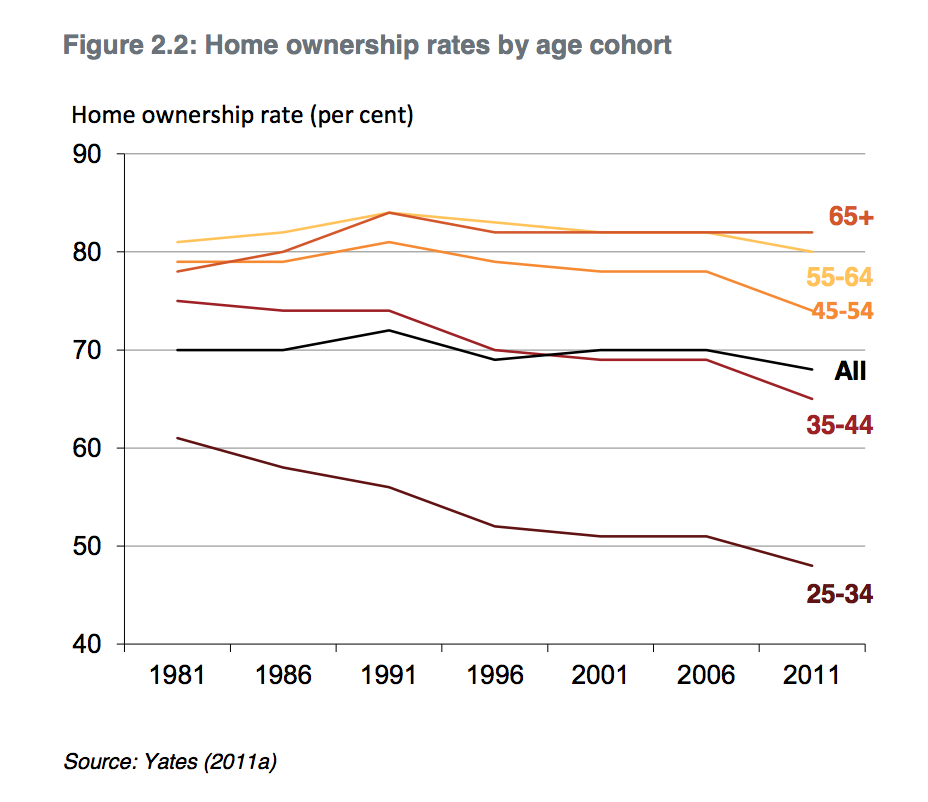
This chart from a Grattan Institute report was used as a hand grenade in a war over house prices on Twitter a couple of days ago. Union economist Matt Cowgill argued house prices may be too high if they are pushing people out of the market.

Another economist, Stephen Koukoulas, argued everything was fine and you should just go and borrow from the bank since interest rates are at record lows.

(Just as a declaration of my interest, I’m 32 years old and do not own property.)

Some people argue house purchase has simply been delayed, just like moving out of home, getting married, and having children

This is a pretty good theory to explain the above. But it doesn’t do such a good job of explaining the declining rate of first home purchase. That has hit a record low of 12.3 per cent in the most recent data.

Image

You have to assume that low – which coincides with recent house price growth – is temporary. So what will give?

Will we observe a quiet tsunami of saving that allows first home buyers to collect together huge deposits, then climb back into the market with heaps of spending power?

Bad news if you are relying on that. Gen Y is not scrooging it up.

Image
Household net worth, where reference person is aged 25-34. source http://www.ausstats.abs.gov.au/ausstats/subscriber.nsf/0/FB162A8CBB41033DCA257BCD001A5725/$File/65540_2011_12.pdf

While young people’s net worth rose around 25 per cent in this period, the price of established homes rose 40 per cent.

The average value of the savings of people aged 25-34 (bank accounts and shares, not including super) has risen from $11,000 to $16,300. It’s not nothing, but it’s not exactly a deposit on a house, either.

So will the 65+ demographic eventually be forced to release their vast real estate holdings onto an anaemic market?

Image

Can we conclude that house prices are going to fall?

Not necessarily.

The x-factor in Australia’s housing market may be off-shore buyers. Chinese wealth is pouring into the market at both ends, propping up the value of both million dollar mansions and cheap apartments.

One real estate agent recently told the ABC that 90 per cent of homes were selling to Chinese investors. Hyperbole, obviously. But even 1 per cent is cause to pay attention.

Economists understand that markets operate at the margin. It doesn’t matter what most people do so long as at the margin there is one bidder with deep pockets.

Foreign investment in Australian real estate rose from $41.5 billion in 2010-11 to $59.1 billion in 2011-12. Fast-growing China was the 3rd biggest source, behind the USA and Singapore.

Image
Location, Location, Location.

So long as foreign wealth, and especially Chinese wealth keeps accumulating, domestic dynamics are only part of the picture. I intend to return to this topic soon, because the pace of accumulation of Chinese wealth is now not just a historic record but a gigantic outlier. Whether it can continue is of intense relevance to all of us, and there’s plenty of people who think a crash is coming soon.

I want my MTV (to be a force for positive social outcomes)

In the silent, fluorescent-lit halls of the University of Maryland’s department of economics, someone has been running regression models over the MTV show 16 and pregnant.

Here’s one of the models:

Image

The paper is called Media influences on social outcomes. The impact of MTV’s 16 and Pregnant on teen childbearing.

And here’s a sense of the show. In this episode from season two, 16 year old Ashley from McKinney Texas says things like “My boyfriend Justin and I recently broke up…. It’s funny to think I’ve been pregnant longer than Justin – the baby’s father – and I were even together.”

But here’s the thing. The regression models show a powerful effect. The show actually discouraged teen preganancies

The show led to an increase in google searches for birth control and abortion. which is merely circumstantial evidence, but it helps support the next finding.

Teen births fell 7.5 per cent a year since 2009 – the period in which 16 and Pregnant and its offshoots, the Teen Mom series, were showing in the US. This represent a rapid acceleration of an existing trend that saw teenage motherhood decline. The authors estimate the show is responsible for one-third of the decline, equivalent to 20,000 births in 2010 alone.

They controlled their study for factors such as a greater interest in that show in places where the teen birth rate is rising.

The study is important because a previous research effort found 16 and pregnant could be glamourising teen pregnancy in some cohorts.

Image
Social policy lever?

In Australia, teen birth rates are lower than in the US, at 16 per 1000 for the 15-19 cohort, compared to 29 per 1000 in the United States.

In 2012, Australian mothers aged 16 bore 887 children and mothers aged 17 bore 2037 children. That equates to fertility rates of 6 per 1000 at age 16 and 14 per 1000 at age 17. [405 children were born to mothers under the age of 16.]

Teen pregnancy is not as significant an issue here as in the US. But we are not without social problems, and if people avoid what they see it is possible reality TV can create great social change:

Will the Great Australian Bake Off prevent thousands of unwanted collapsed sponges?

Could Being Lara Bingle discourage thousands of incipient modelling careers?

Is Big Brother Australia responsible for the rising rate of people living alone?

Might the Biggest Loser be the televisual equivalent of lap-band surgery?

Monstered Trucks: Are food vans history?

I love Melbourne’s food trucks.

Image

In theory.

In reality I went to the Taco Truck one time when it was parked in Fitzroy North, not so far from me. I felt like I was getting ripped off paying $12 for three little tacos and left hungry.

But today, shock! A report suggests the whole food truck movement is coming apart at the seams. Melbourne now boasts 52 food trucks, Good Food claims. Seven are for sale according to the story. (I could only see two, including this coffee van for $179,000.)

ImageThe report follows a series of articles in The Age in which they claimed Brunswick Street was a “struggle street”. The same journalist, one Alana Schetzer, wrote that story, scraping together 13 Brunswick street venues that had closed in a four year period. In a street that must have a hundred eating places, that’s actually pretty good going.

This latest story does not suggest the death of the truck. Far from it. 

If you look at the statistics for Victoria, they show a healthy scene is driven by fierce natural selection. There were 9100 cafes and restaurants operating at the start of the most recent financial year for which there is data. 1560 closed their doors. 1930 opened up. 

Image
Like a phoenix. From the ashes of one hospitality dream rises another.

Victoria also had 6700 take away food shops. 1220 closed and 1210 opened.

What’s happened with food trucks is simply the maturation of the scene. Next, the weakest competitors will be replaced by savvy operators with actual hospitality experience. Jacques Reymond isn’t doing anything, for example.  The next food truck could be a Rolls Royce. 

Ball Kid Boiling Point: Child Labour Shock Hits Melbourne.

It is 2014.

And yet, in contravention of the guiding principles of the ILO Convention on Child Labour signed 40 years ago, hundreds of youth under the age of 15 are being employed by a major and highly profitable Australian enterprise.

The ILO convention states:

“The minimum age specified in pursuance of paragraph 1 of this Article shall not be less than the age of completion of compulsory schooling and, in any case, shall not be less than 15 years.”

Worse, they are without pay despite doing tough physical work in conditions of searing heat.

Unpaid work in searing heat, anybody?

Tennis Australia, which earned $1,600,000 in profit in 2012-13, accepts ballkids agd 12-15.

These embattled and un-unionised “volunteers” must complete a multi-month training schedule to secure their unpaid roles:

“Australian Open Ballkids will also be required to participate in tournaments outside of the Australian Open as part of a compulsory training requirement. These events are scheduled to take place between November and December.”

They share the court with line judges (paid around $200 a day) with chair umpires (paid around $400 a day), with overtime.

Or perhaps they will be on court with Novak Djokovic. In 2013 he secured the winners cheque of $2.43 million with 18 hours 16 minutes of court time. Call that $132,800 an hour or $2,213 a minute.

Sure, the kids seem to like it. “I’ve enjoyed it every single year so far,” 15-year old Mitchell Riley told the Herald Sun recently. “It’s great getting up so close to the players.”

But is it really fair? Prior to 2009, the Australian Open handed out $42 a match to ballkids. Someone has made the decision to cut that to nothing.

Surprisingly it is America where there has been most rancour over tennis officials pay. Half the world’s top umpires boycotted the 2011 US Open in protest at the conditions And in 2012 the US Tennis Association was sued over pay and conditions.

Meanwhile the home of the 35-hour week, France has an all-unpaid ballboy force, working up to 11 hours a day, as recorded in this Economist article


Would it be possible to organise a ball-kid strike? I’d love to see the players collecting their own wayward shots and fetching their own towels. Maybe 2015…

Legal Marijuana is coming to you

Imagine all the laws in Australia. Some are obviously very good, like the prohibition on killing other people. Others are defintitely pretty good, like the law against stealing – you may be able to think of some exceptions to the law, but it’s sound. Then there are laws that are distinctly marginal.

Consider driving on the left. it makes no difference compared to driving on the right. We’d be no worse off driving on the right. But there is no push for change. How would you make the case that the benefits overcome the cost of changing?

There’s lots of little rules like this. They are marginal rules that have counter-arguments as strong or stronger than the arguments for them, but they stay the way they are. Like lowering the voting age or changing the retirement age.

Image

You have a lot of policy settings that are stuck the way they are because of what we may term path dependency. Once you make a decision, you are stuck with it. Path dependency is like the slippery slope argument, but inverted – a sticky slope?

But the graph above is not set in stone and path dependency is not forever. It remains definitive only so long as other elements of the environment are the same.

In the United States, a pervasive marijuana culture led to the availability of medical marijuana, and now two states have made sale of recreational marijuana totally legal. Check out this shop in Colorado, the 3D Marijuana dispensary.

Image

Prices are sky-high, and so is demand. It is remniscent of the Netflix argument. People will pay a premium to access something free.

It’s not just Colorado. Some other very influential states have legalised marijuana. Not just Washington State, which will follow Cololrado in allowing retail stores in 2014, but since 1996 also California, where medical marijuana is freely available (certain doctors hand out prescriptions willy-nilly).

New York is also moving to be in line with 19 other US states and make medical marijuana legal.

This is relevant to Australia. We are not about to take the lead of Portugal, where decriminalised drug possesson is hailed as a success. That is practically not even a developed country! But New York, that’s different. That’s the sort of precedent that will make a difference in the Australian debate.

In fact, the Help End Marijuana Prohibition party has already used the American precedent to help get an article published in that pinko rag, The Australian.

The Cancer Council of NSW supports legal medical marijuana. A NSW parliamentary committee recently got multi-party support for medical marijuana too.

Do not forget Professor David Pennington called for the regulated supply of marijuana as long ago as 1996, in a report written for the Liberal government of Victoria. This is not a fringe policy position.

Legally, the status of marijuana is a state issue. Legal supply (whether medical or a free-for-all) could happen in the ACT or the South Australia, where the drug is decriminalised. Once one state does it, the cost for the rest of maintaining prohibition becomes much higher and they will have to question the benefit.


The Alt-Tab Productivity Crisis

There is a puzzle at the heart of our economy. A conundrum profound and deep.

But it is one we can solve, if we are honest with ourselves.

The puzzle goes like this: Computers have made doing things a LOT easier. No more do you have to go to the fax machine and dial someone’s number if you want to send them a document. A million little tasks are now so easy they’re not even tasks.

Check the meaning of a concept? 10 seconds via Google. Invite someone to a meeting? 30 seconds in Outlook. Etc. Etc. You get my point.

So where the &^%! is our productivity boost? You look at data since the dissemination of the personal computer and all the millions spent on IT, and there is nothing special about it. You could be forgiven for thinking we’re still dipping quills in ink-wells.

Screen Shot 2014-01-08 at 12.23.41 PM

This is known as the Productivity Paradox. But the answer should be obvious to any economist.

Underpricing will lead to overconsumption. And nothing is more underpriced than content on the internet.

The internet is not a double-edged sword. It’s a giant swirling blade made of blades. And it’s coming right at us.

Every swivel-chair jockey knows about the internet. *Flinches at gross understatement*. I know you know far more than you’d ever let on.

Nobel-prize winning economist Robert Solow said in 1987 “You can see the computer age everywhere but in the productivity statistics.”

No doubt, even that giant of macroeconomics has Alt-Tabbed to watch a few kitten videos on YouTube. Here’s a funny one of a cat and a vaccum cleaner. I bet Solow laughed until tea came out his nose.

In fact, if we look at Em.Prof Solow’s publication record – dormant since ’01 – he may as well have been immersed in LOLcats since he pocketed that Nobel prize in 1987. (Joking. The man is 90.)

The reality is that if you have a computer jobs, there’s a great deal of stuff you have to do on the internet. And there’s a great deal on the internet that looks like something you could justify looking at for work, but really isn’t.

Now, some jobs don’t have this aspect. Surgeons for example, don’t find themselves in a Wikipedia worm hole halfway through a colectomy. Bricklayers neither. But us, the knowledge-economy types, the kind of people who are reading this blog, some of the most highly skilled among us, are essentially free to spend as much of the day as we can get away with puddle-ducking on the internet.

There’s your productivity crisis right there.

Also, the internet has taken our attention spans and tortured them until they broke. The idea of working on one thing for an uninterrupted eight-hour stretch is utterly laughable.

In this vein, I give to you the five biggest enemies of progress

slate.com

reddit.com

play-dune.com [Dune 2, now in your browser!]

theage.com.au

twitter.com

Go ahead, click on them. You’ve earned a break.

One good teacher.

Ask someone the highlight of their school education.

They won’t mention learning cursive writing. They won’t mention timetables. They won’t mention learning cellular respiration, renaissance history or trigonometry. 

They’ll say something like this:

“I remember my grade 9 English teacher. She really believed in me.” 

This is the sort of memory that has inspired a whole genre of films. From To Sir with Love (1967) to Dead Poet’s society (1989) and Freedom Writers (2007), the one good teacher that can change your life is a truism of modern culture. It’s part of the sales pitch for programs like Teach for America and its local knock-off Teach for Australia.

Image
Me, teaching English in China, 2003.

Now a bunch of economists have done the work to measure the influence one good teacher can have.

They had a sample of one million students and found that the ones randomly assigned to high quality teachers were “more likely to attend college, earn higher salaries, live in higher SES neighborhoods, and have higher savings rates” [link to paper]


These graphs tell the story better than words:

ImageImageImage

There is a catch. The quality of teachers as measured above is in their ability to contribute to results in standardised tests. (they use the term value-added)

That’s not the sort of thing you can make an Oscar™-winning Picture about…”Starring Sean Penn as Mr Brown, who drills his students on multiple choice questions every day in lieu of teaching life lessons.”

I tend to disagree with the merits of using narrow standardised tests to rank teachers.

The saying “if you can’t measure it, you can’t manage it,” has a flipside. People obsess over the things they can put metrics on. You can’t measure the subjective benefits of a good teacher. Nobody denies the importance of all the non-academic work teachers do, but it can’t be measured so it is not addressed. 

Nevertheless there is an important point to make here. Teachers are important. Far more so than society gives them credit for. And teaching is not rocket science, it is harder.

Wooing Clive: How to suck up to a *really* rich MP

Australia’s richest-ever member of Parliament could introduce a novel influence-buying dynamic into federal politics, new research suggests.

Clive Frederick Palmer, member for Fairfax, has been confirmed as a billionaire. The leader of the Palmer United Party has made his outsized wealth a political issue.

He claims:

“I’m not offering myself for service to the nation to increase my income… I’m incorruptible – you can offer me a billion dollars and it won’t change my views on something and it won’t mean much to me either.”

The argument is plausible. The theory of the declining marginal utility of money suggests Mr Palmer would be less tempted by a million bucks than other MPs.

But a new paper from the United States National Bureau of Economic Research hints that is not the end of the story.

Berkeley economics professor, Stefano DellaVigna and colleagues, have found “[w]hen a politician controls a business, firms attempting to curry favors shift their
spending towards the politician’s business.”

Professor DellaVigna’s paper, Market-based Lobbying: Evidence from Advertising Spending in Italy, uses the reign of Silvio Berlusconi to show that companies increased their advertising spending with his media companies.

“We document a significant pro-Mediaset bias in the allocation of advertising spending during Berlusconi’s political tenure. This pattern is especially pronounced for companies
operating in more regulated sectors, as predicted,” DellaVigna et al write.

Mr Palmer may not be Prime Minister, as Berlusconi was, but after July 1, his party will control the balance of power in the Senate.

Will Australian companies start doing business with Mineralogy, Palmer’s main concern? Bluescope Steel, perhaps. But it is doubtful many regulated companies can use a lot of iron ore or nickel.

Palmer’s interests run deeper and broader than that, according to the register of Member’s Interests. [.ashx link]

He owns over 80 private companies in Australia, and nine private overseas companies. That’s without considering his directorships and companies owned through trusts or other entities in which Mineralogy has shares.

The one that jumps out in this context is Coolum Resort.*

Screen Shot 2014-01-06 at 11.48.25 AM

The former Hyatt resort – which Palmer bought in 2011 for an estimated $80 million – has already got a load of free publicity.

If you are the sort of person that gets invited to conferences and summits, don’t be surprised if you end up among the Tyrannosarus Rexes at some point in 2014. (The resort features 160 fibreglass dinosaurs)

It may have been described as “a five-star version of Fawlty Towersbut entities that plan on lobbying this term of government would be mad to book anywhere else.

*I do not suggest booking a conference at Coolum necessarily constitutes corruption or influence-seeking, neither do I suggest Mr Palmer’s votes or views would be influenced by who books at his resort.

January weight-loss challenge

UPDATE: check my progress via this link!

I want to lose four kilograms in January. I’m old enough to realise that midriff fat is not only unsightly but a health risk. I think I know the incentives that will make losing it a cinch.*

That’s not to say that losing 4 kilos is easy. But I have a three-pronged strategy that I believe will work on me.

1. Cash incentives. Humans hate losses more than they enjoy gains. I pledge to pay $500 in penalties if the 4kg is not lost by the morning of February 1. This is the concept behind the website stickk, set up by Yale Economics Professor Dean Karlan, which currently has $16 million of incentives pending. Enforceable contracts are powerful incentives.**

2. Writing down everything I eat, and its kilojoule content. I’ve done this before when I’ve wanted to lose weight. It works in two ways – I learn a lot about portion sizes, and what snacks are “bad value”; it also discourages me from eating something, because I know I will have to write it down and add it up at the end of the day.***

3. Transparency. I will create a separate page on this blog in which I will place a daily photo of my scales. Public enforcement alone can be insufficient, as News Limited economics editor Jessica Irvine so publicly proved at Dietonomics. The long-abandoned blog’s three weeks of sad posts stands as testimony to the difficulty of losing weight. But I think it will add to the power of the other two prongs

But that’s not all.

Just to ramp up the suspense, the donation I give if I fail will be to the Motoring Enthusiasts Party.  “Ugh!” I hear you say. “You are a sicko… Why would you want to donate to them?”

My response: “Precisely.”

Image

The Motoring Enthusiasts could not be further from my affections. The thought of a slice of my recent redundancy payment going to them will be a strong motivator in case anyone opens a Haighs Dessert Block in front of me during January. The Motoring Enthusiasts will not see a cent. This is my pledge.

If you would like to get involved, please do so! Pledge a goal and an incentive and I can report your progress too. Doesn’t matter if you’ve missed the start of the month.

Image
Weight Dec 31: 78.5kg

*Classic economic models of human behaviour do not make such a distinction between short-run and long-run incentives. Economics says if you are a bit overweight, that reveals a preference for being fat. Thomas the Think Engine adopts a more nuanced theory of human behaviour, including the possibility of hyperbolic discounting.

** This blog is run on these methods. As a self-manager, I know I want to post daily by 12.30pm. But my tendency is to procrastinate. So I must pay a $60 fine to my significant other if the blog is not updated by that time. Works a treat.

*** I’ve done this before when I’ve wanted to shed a few kilos, and I’ve learned a lot of very disappointing things about cheese.

EPILOGUE: I made it. See my progress at this link!

My last ever story at the Financial Review

Was in the summer “bumper edition”. It’s a fun one about the reason we wait so long in airports. It was not out of the paywall then, but now the Financial Review is doing its free summer promotion, so you can get a month of access to the whole site, gratis.

Sign up here: https://subscribe.afr.com/afr/offers/summer/

Then, read my story here, free!

waiting in airports

Gold, frankincense and anti-parasitic interventions. How to really give this Christmas.

At Christmas, it feels good to give. 

But the wrong sort of charity can be a disaster. Even if you have millions of dollars and can control the way it’s spent, you can go wrong. See Madonna’s school building attempts in Malawi.

The world is full of people sending clothes to Africa. For example, NPR’s economics blog, Planet Money, recently found a t-shirt for sale in Kenya labelled Jennifer’s Bat Mitzvah, 1993 and tracked down the original Jennifer.


No doubt throwing away clothes is wasteful. No doubt people in Africa would like a cheap or free T-shirt. And sure, if someone’s been hit with a typhoon, giving them food and clothes helps. But if they are working in a textile factory, bombarding their country with millions of tonnes of donated clothes every year can be harmful.

Image
Charity grinch: Pouring cold water on your good intentions

In this case, it’s not the thought that counts.

There are charities sending food to Africa,  sending bicycles to Africa, sending iPods to Africa. In each case the people donating are the kind of good-hearted thrifty people who care about others and hate to see things go to waste. 

They are exactly the kind of people who should be open to critically examining their giving.

That’s where Givewell comes in. It compresses your warm fuzzy feelings into solid bricks and feeds them into the fire of critical analysis.

Set up by a Harvard university graduate and former hedge fund guy named Holden Karnofsky, Givewell now employs eleven full-time staff trying to figure out where you can invest your charity dollars without wasting them.

If this blog is sure of anything, it’s that human reasoning is weak. Especially where emotions are involved. That’s why this sort of effort is important.

Givewell is ruthless. Charities that don’t measure their own efficacy are not in the running. Charities that are not focussed on the world’s worst off are not in the running. They scoff at the idea of using the proportion of funds spent on administration as a measure of effect. They measure charities ability to absorb more money (their scalability) and cut them from the  list when it is exhausted.

They espouse a commitment to extreme transparency, which includes a prominent link on the front page of their website: Mistakes.

Givewell reviewed many charities in 2013 and recommended three. Two are programs that deworm children in Africa, and one makes direct cash transfers to the very poor in Kenya and Uganda.

Givewell is not above criticism (1, 2), and it has competitors, including Aidgrade. But if you want to buy a present that make the recipient happier than the gift giver, $50 for a single mother in Uganda will go a lot further than a couple of DVDs for your dad.

Image

Media and IT are the future, they said.

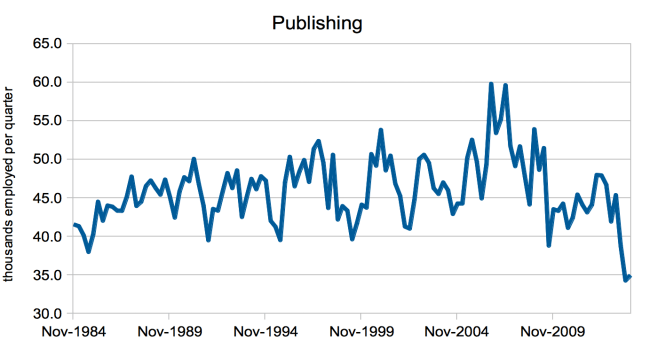
The total number of people employed in Information, Media and Telecommunications is the lowest since 1999, according to new official data from the ABS. In the last three months, under 200,000 people were employed in the sector, down 23 per cent from the peak over over 250,000 in 2006.

That got me interested. I recently left a job with a major media organisation, at the same time as some heavy hitters (1, 2). How bad was it getting?

The answer: REAL BAD. In the publishing game (books, newspapers) employment fell during 2013 to the lowest since records began in 1984.

Image

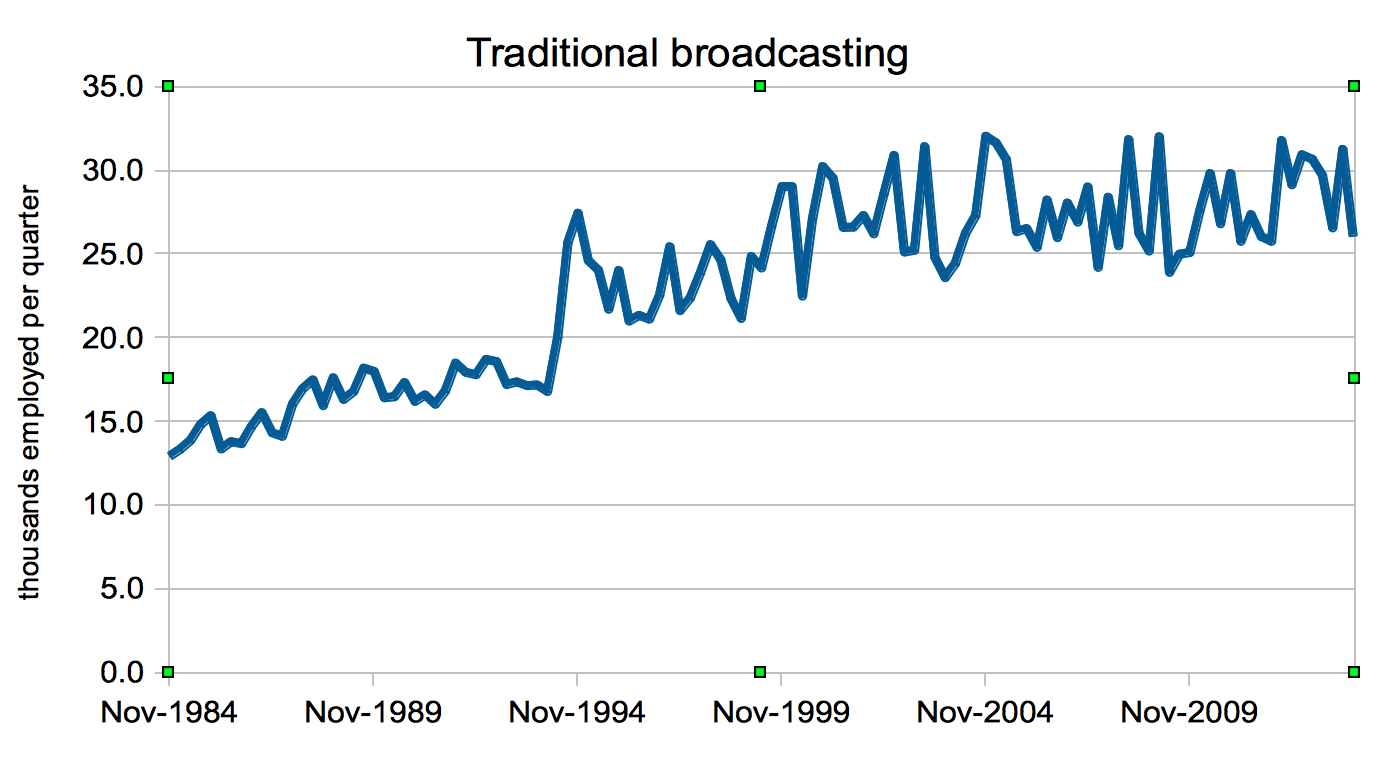
[All data from the Detailed Quarterly Labour Force series, Nov 2013].

Publishing is not the whole story.

Employment in traditional broadcasting has also seen very little growth. There were more people employed in the sector in one ebullient quarter of 1994 than during the most recent three months. (In 1994, SBS was finally available in all capital cities, but it broadcast the test patten for hours every day.)

Image

That all makes sense.

Online, the classic economic distinction between work and leisure is shaky. People work on the internet for free.

The proponent of the idea is a man called Clay Shirky, and I have written about him here. He claims people would happily give up TV watching for something a bit more active and participatory, and so free content is booming. Content is not just blog posts like the one you are reading, but Youtube videos, Wikipedia, Reddit, Open source software and more and more #doge memes.

Also it’s hard to charge for things online.

So far so good.

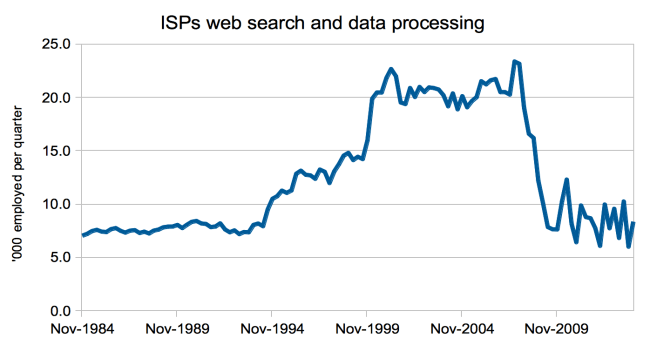
But thanks to the mysterious ways in which ANZSIC standards move, folk who work in communications are included in the information and media statistics. This shocked me more. The way this little sub-sector has collapsed puts the newspaper game to shame.

Image

This next graph may look less dramatic but the numbers of people involved are far greater. The communications sector is now employing fewer people than it has for ten years.

Image

See that steep ramp-up in 1999? That was the year I started university.

I had long hair, I was 17 and I weighed about 60 kilos. I was getting paid $8.50 an hour in my part time job bussing tables at a very busy Cafe in the local shopping centre. I was studying economics and politics – which I loved – but I had a nagging feelings of doubt.

All the headlines were pointing to IT being the great gold rush.  In 1999 the Nasdaq index rose from 2200 to 3700. Another undergrad friend of mine became an executive in an online company that was apparently booming. I felt like I had missed the plane.

Boy, am I glad I studied economics and politics.

Who is making us rich?

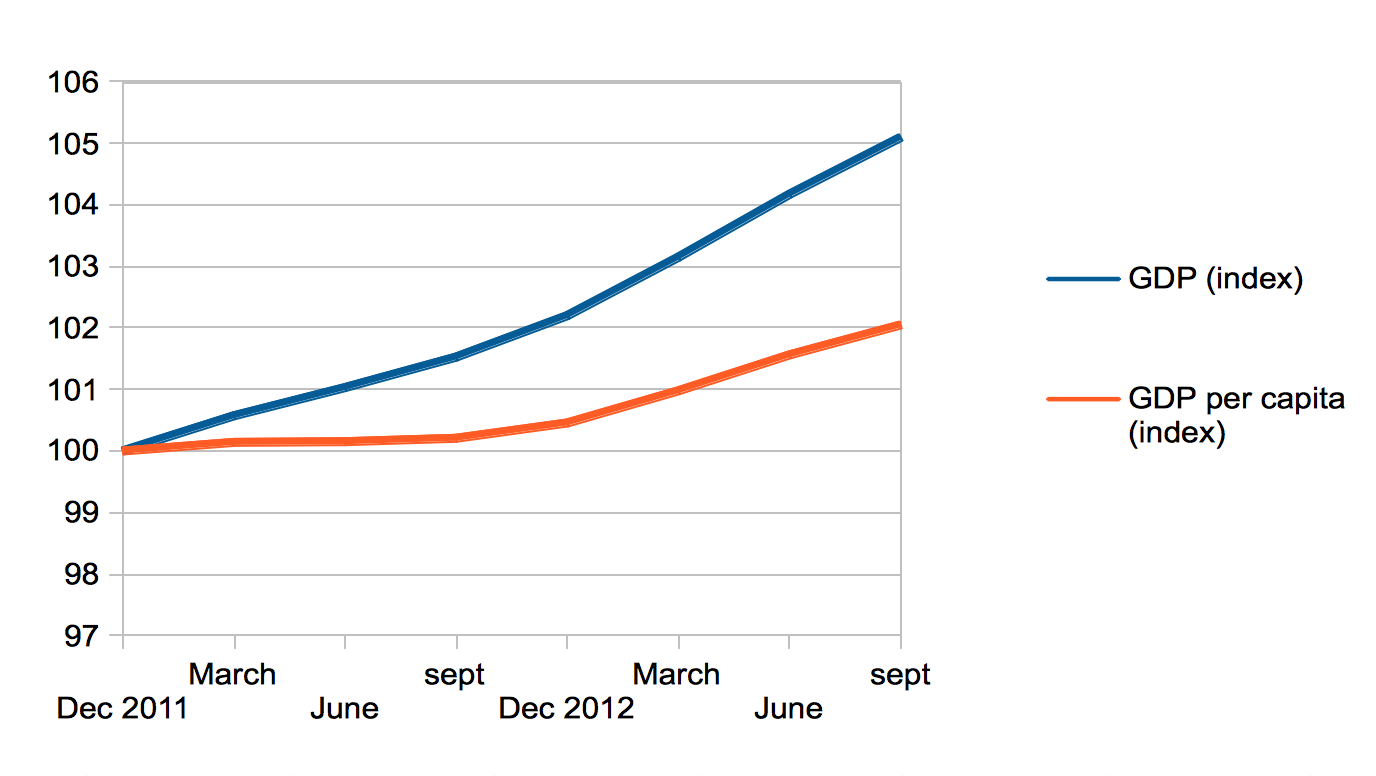
Australia’s GDP is soaring. But per capita GDP is not.  

Image
Source: ABS National Accounts

If the total income of the country is rising faster than the income of the individuals in it, that is because of population growth.

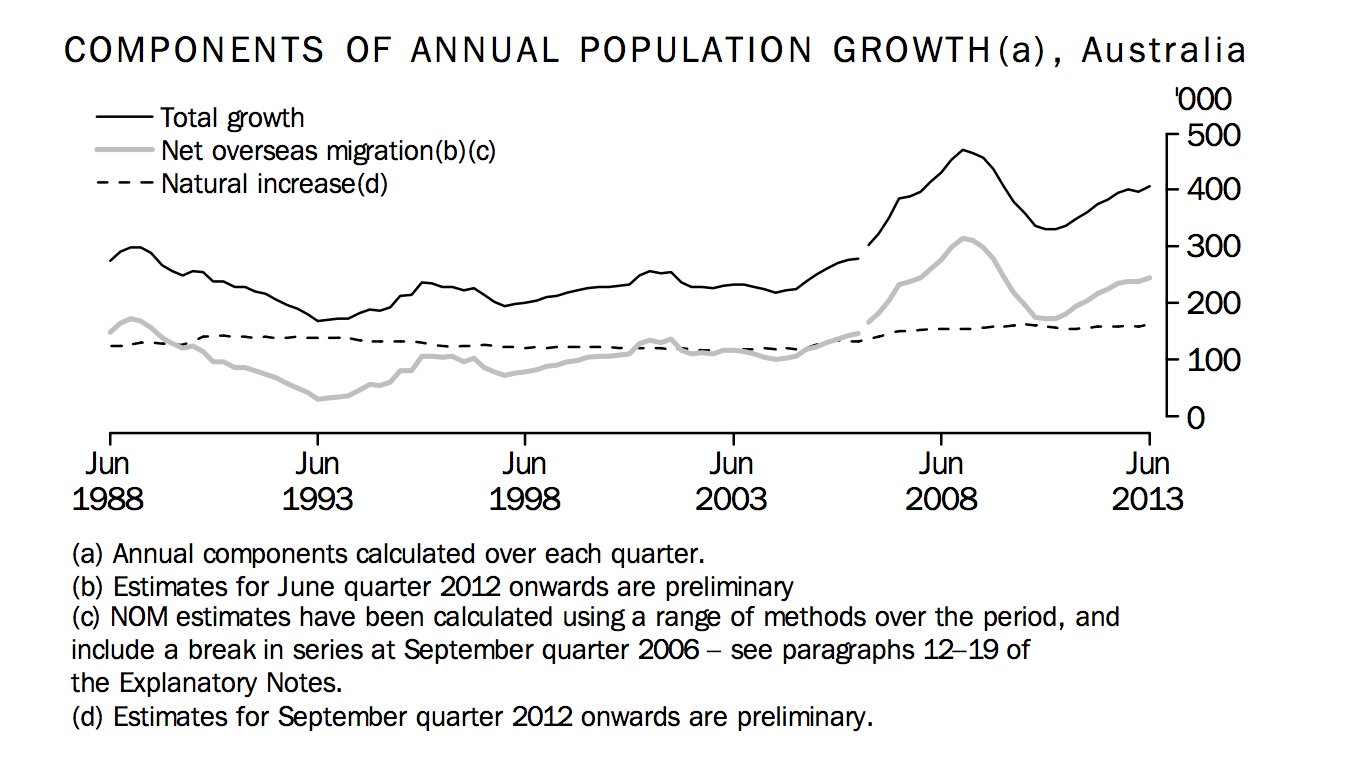
Where does Australia’s population growth come from? The ABS makes answering this question easy. Migration beats babies and has since around 2005.

Image
Source: Australian Demographic Statistics


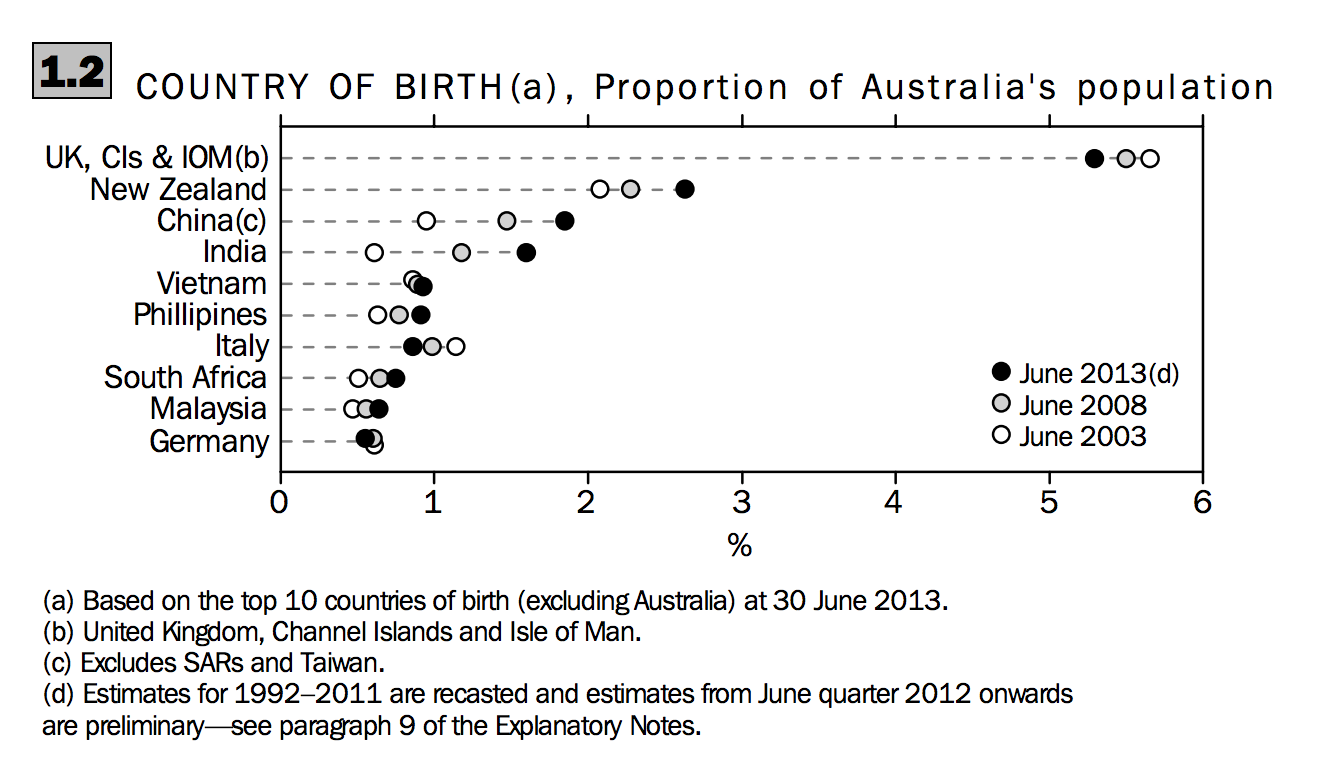
Specifically, China, New Zealand and India.

Image
Source: ABS Australian Demographic Statistics

The boom in population is not working to increase per capita GDP. But there is a political consensus around strong migration. Wonder why?

Image
Source: ABS Household Income and Income Distribution


One answer is that in the absence of strong productivity growth, we need population growth to prevent unemployment. The other, equally true answer is that immigration appears to benefit the rich.

It’s hardly surprising new arrivals don’t capture for themselves their contribution to national income. That necessarily flows to business owners and those already established here. It’s not surprising. Next time someone complains about immigration, feel free to pass them this link.

Debt, deficit, and political death by a thousand cuts

The Government’s latest budget update is part of the political plan but could also be its undoing.

The Mid-Year Economic and Fiscal Outlook’s shock projections of $667 billion in debt and deficits until 2023-24 lays the groundwork for the Commission of Audit.

The Commission of Audit is the government’s major economic ambition for its  first term and its job is to find ways for the government to save money. Mr Abbott has been promising it since March 2012.

Hockey and Abbott want the Commission to have the most receptive environment in which to publish its plans (the Interim report is due in January, the final report by the end of March).  So they need the intense sense of a budget emergency.

MYEFO “will show the Australian people the problem we’ve inherited, and the budget will deliver the solution,” Treasurer Hockey said in November.

Cuts a-coming.
Cuts a-coming.

Rudd tried reform on the tax side.  Disastrous. So this government is prioritising reform on the expenditure side. (The Government has promised a white paper on tax reform within two years – a softer pledge). From an economic perspective that is fair. But it raises political questions.

What is the last “cut” that is heralded as a major political reform? Howard strangled the dole payment down below some estimates of the poverty line, but that’s oddly omitted in his hagiography. Even right-wing economist Judith Sloan has argued the dole should now be raised.

When we list the economic reforms that have made Australia great we include microeconomic reform, floating the dollar, an inflation-targeting central bank and the GST.  Not cuts.

If the Abbott government first term economic reforms can mainly be labelled “cuts”, what will be its legacy? It needs to frame these cuts in a positive way. But that is not easy.

Business council chief executive Jenniffer Westacott has a suggestion. She called the Commission of Audit a “once-in-a-generation opportunity to fortify Australia’s budget foundations and set in train a much-needed reform agenda to keep our economy strong.”

Reform is hard enough to justify on its own. Using reform to justify cuts is going to be a very hard sell indeed. Ms Westacott is not a politician.

When the Commission of Audit presents a menu of reforms, the government will have to read the mood of the nation and of opinion leaders.

Will the government be able to identify which cuts use least political capital? When Rudd picked the eyes out of the Henry Review, he thought the public would support a tax on rich miners and was proved quite wrong.

Abbott has a massive parliamentary lead, but Newspoll shows his government lagging, 48-52. The recommendations of the Commission of Audit will be picked through with an eye to 2016.

The further behind in the polls the government is, the more it will tread softly. Bill Shorten’s mouth will be so tired of using the terms “cut” “slash” and “hack” that by 2016, it will probably go on strike.

Media-savvy?
Media-savvy?

If the Government is too selective with the reforms, it will face accusations of having no backbone, and lose some of the most strident support from its barrackers in the News Corp press.  Far better, the Government may think, to be seen as having the courage of convictions even if it means putting some of its vast parliamentary majority to the sword.

But that is a gamble on the reputation of the political right. Too much cutting could poison the Liberals’ reputation as a party that builds the nation.

Can the government create clamour for cuts? Only if the narrative from this Daily Telegraph story sticks in the public’s mind:

“Australian families to wear the pain of Labor’s massive debt bomb, Joe Hockey warns”

UPDATE: I now read that the Tele is Australia’s least trusted news source according to a new survey. Dire warnings indeed.

How to think clearly about skyscraper proposals.

A new 50 storey building is being planned at Melbourne’s highest point, next to a park called Flagstaff Gardens in the centre city. Continue reading How to think clearly about skyscraper proposals.

My economic philosophy

  1. Free markets are the best way to allocate scarce resources.
  2. Markets need to be free of market failures – not just free from stifling regulation – to work best.
  3. Allocating scarce resources is not the only function of a society.

Continue reading My economic philosophy

Oh Mo! Laundry powder cartel reveals the stain that won’t come out of free markets.

The ACCC is fighting a washing detergent cartel. Turns out Colgate-Palmolive, Cussons and Unilever may not be so squeaky clean! Continue reading Oh Mo! Laundry powder cartel reveals the stain that won’t come out of free markets.

Why the Treasurer should celebrate higher labour costs

Holden is going to shut down in Australia, blaming high labour costs. The Holden 2011 EBA allows for trade employees to be paid between $1147 and $1547 a week, before allowances. Scarcely a fortune, but much more than the car industry pays workers in Thailand. Continue reading Why the Treasurer should celebrate higher labour costs