The government offers new parents 18 weeks parental leave paid at the minimum wage. It’s worth $11,500. Until now that policy was available to everyone. But the government will now retract the offer for people whose jobs offer them parental leave.
I can see the attraction of cutting it, to save $1 billion. And I don’t expect vast waves of public sympathy for the kind of people who have good employer parental leave schemes. These people are wealthier and well-attached to the labour force.
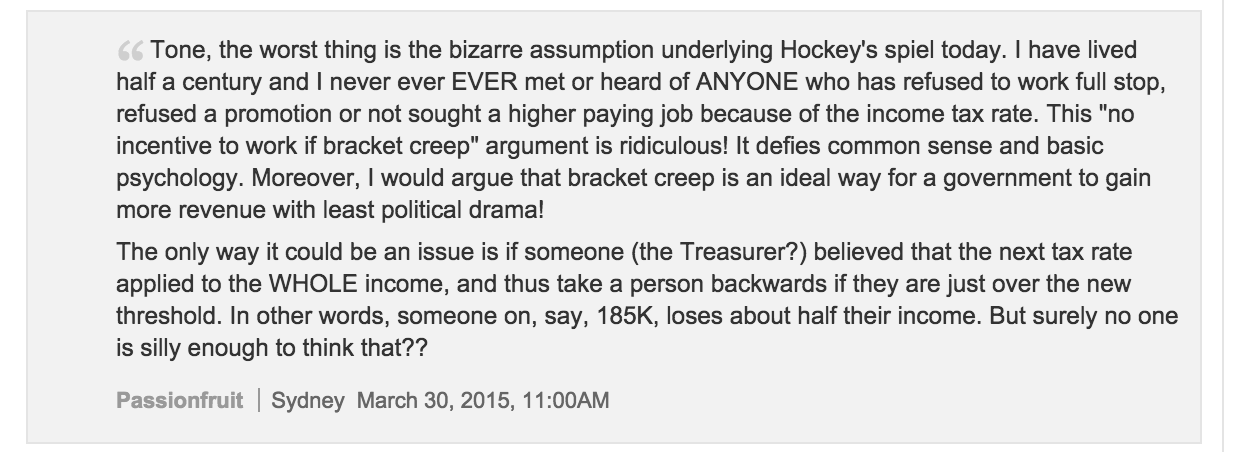
“At the moment people … are effectively double dipping — we are going to stop that,” – Treasurer Joe Hockey.
Looking at it like that is insufficient. The question is complex. How to take away government services as the private sector provides them is one of the trickiest parts of any policy sphere.
In some policy areas, no matter your private endowments, the government provides. Public transport is available to people whether or not they own cars. Medicare is universal – even those with private health insurance can use it.People with Foxtel are still able to tune into the ABC. Public schools are not reserved for those who can’t afford private ones, etc.
In each of these cases, a range of questions comes to bear. Is the offering in question a universal right, or a safety net? Is it very expensive to provide widely without means-testing? Is it advantageous to have public and private provision alongside each other? And what will be the effect on private sector provision if the government means-tests?
For most companies, I expect they will see that their expensive-to-provide policies are offering little or no net benefit to their employees, so they will have no reason not to cancel them.
This policy might actually provide savings to employers, but it will lead to a real fall in the amount of paid time new parents can spend with their children.
Instead of drawing on both, parents will then draw on only the government scheme and there will therefore be a drop in the amount of parental leave taken.
Faced with this shorter period of parental leave, parents will then choose whether to return to work. It could even cause some new parents to sever their connection to the workforce. The consequences could be further reaching than they seem.
Unlike its pineapples, this country likes its businesses best small.
The federal government continually showers the small business sector with largesse. One of the most-publicised announcements next Tuesday is a tax cut for small businesses. Tony Abbott is spruiking that 95 per cent of businesses will access the tax cut. Which is true, because most business are small.
But most business is done by big businesses. That’s where more people work. And they thrive despite much tougher regulatory and tax standards. Small businesses get an easy run on labour law and tax law. They’re not eligible for the special tax Mr Abbott introduced at the last election to fund his parental leave scheme.
I know – I run a (very) small business as a sole trader and I don’t even have to collect GST. It’s actually administratively very simple.
But how good is this for the economy? Should we encourage small business?
A huge number of small businesses just disappear. Every single one of them represents disappointment and sorrow, and probably years of work and capital equipment that now is useless.
Small businesses come with real economic and social costs. You might support small business if they reliably turned into big businesses.
But even the ones that survive simply hang on. Of the 500,000 small businesses that employed 1-4 people in June 2013 and survived the year, most did not fare well.
52,000 of them now had no employees – about 10 per cent.
423,000 were the same size.
And just 34,000 got bigger. (Of those, 1000 now employ more than 20 people and 27 more than 200 people.)
Government woos small business because there are so many of us. We’re a voting bloc. But economically, it makes little sense.
Yesterday, the stock market tanked, having its worst day in two years. Meanwhile, interest rates are at new record lows.
The “search for yield” is no longer just the refrain of central bank governors. Today, a real person with a self-proclaimed ignorance of economics asked me this:
If I can’t put my money in the bank, and I can’t put my money in the share market, where can I put it?
The short answer is I don’t know.
I’d be more confident about Australia’s medium-run growth prospects if there was not such strength in the property market. But the risk I see is of a property market correction. That makes me nervous about property.
A fall in property prices would crimp consumer spending and hurt the stock market. So I’m nervous about stocks.
But the risk of a property correction is just one of the factors that makes me nervous about buying into Australian companies. I’m also worried about China. On anyone’s terms China has had a remarkable run. What happens when that ends?
Overall, as an Aussie, we’re very exposed to Australia as it is. Our employment prospects hinge (primarily) on the economy here. Should our investment returns be correlated with our employment prospects? It would seem unwise. So we turn our gaze overseas.
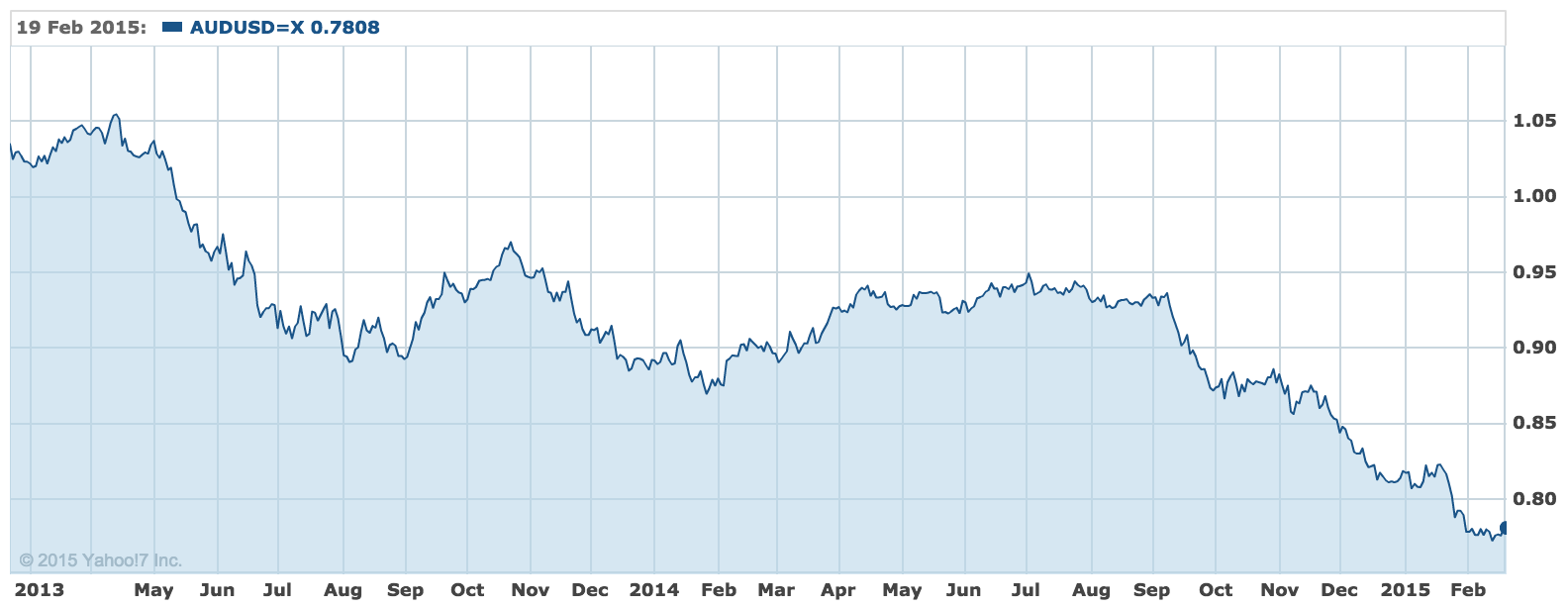
But investing overseas looks relatively wise. If you think the global economy is normalising, you may be more inclined to bet on the Aussie dollar falling rather than rising. By buying foreign assets now, you gain the chance to get some positive returns in the foreign exchange market.
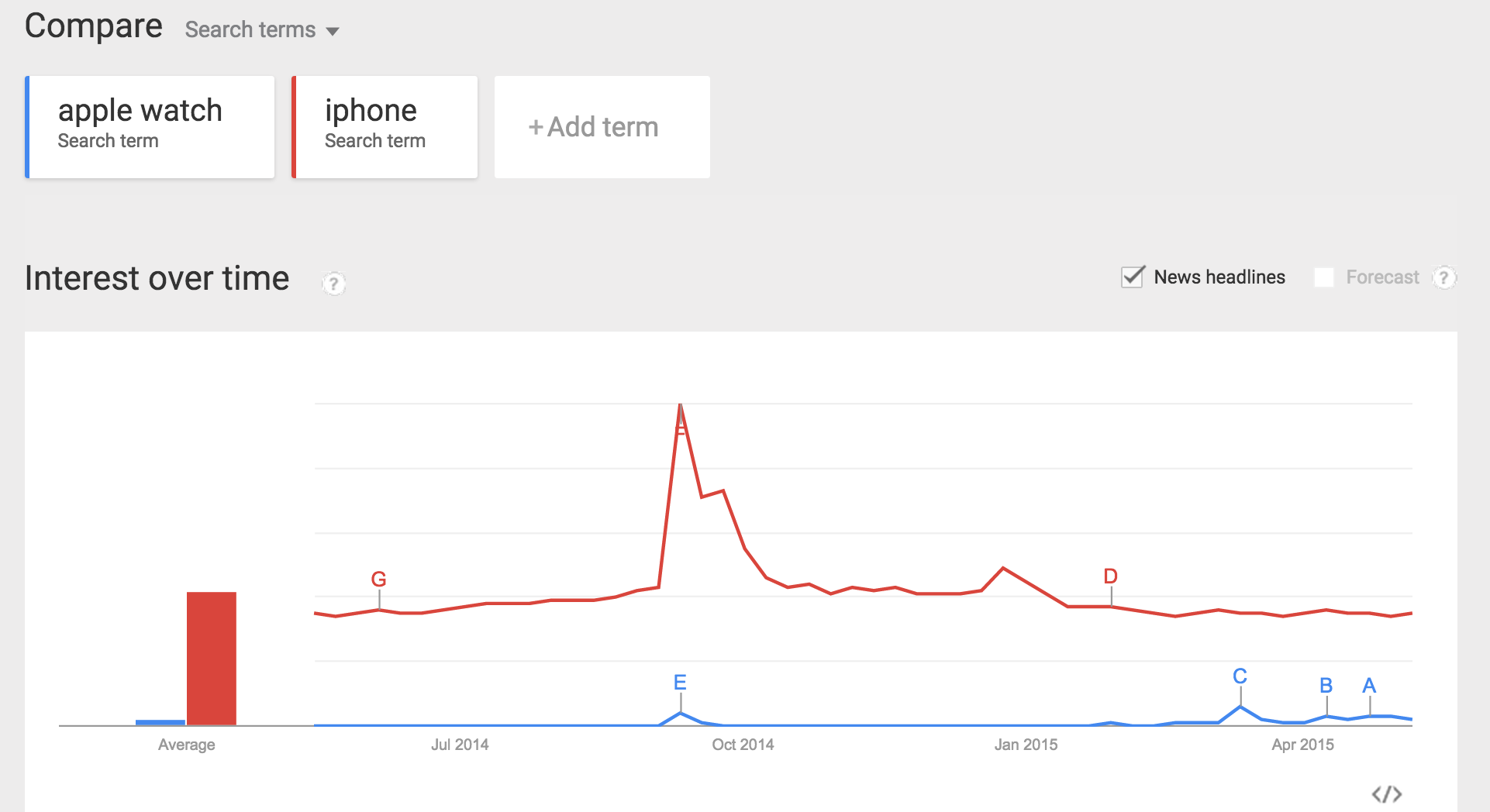
I personally wouldn’t buy Apple shares, because even though they have a lot of cash, I think they’re out of a far more precious commodity – ideas. The Apple watch is a giant distraction from the fact Apple depends almost entirely on the iPhone, a category where people replace their products every few years.
Google trends data – this watch is not the saviour Apple wanted.
America is not completely devoid of investment opportunities though. A company that can benefit from a lower oil price might be a good safe buy. Perhaps an airline.
Nevertheless, upsides will be limited when buying established companies. Those with appetite for risk might be looking at other options.
I’ve been following Bitcoin for a few years, and while I remain skeptical, I think the hype-to-potential ratio is as good as it has been in a long time. Bitcoin’s price has stabilised (well, stable for Bitcoin) in the mid-US$200s.
Bitcoin will live and die on its technical usefulness in transactions. I don’t think volatility is the problem. Bitcoin’s price can be unstable across a week or a month, but it won’t matter if people can buy some, transfer funds, and then sell it a few minutes later without accepting too much risk.
If there is a constant supply of people wanting to use it for transactions, then demand will be strong. Other people will hold it as a longer-term investment. The more this latter category grows, the fewer Bitcoins will be in circulation for transacting, and the more the price will rise.
The key will be simplifying the interface so people can use Bitcoin easily and safely.
The biggest risk Bitcoin faces is regulatory. Its appeal to organised crime makes it a target for governments, and so it remains an option only for the bolder investor. (I haven’t got any yet, but I am considering doing so. If I do I shall write up my experience).
So dear readers, if you want to dispute my assertions, share any stock tips, or provide investment wisdom, please leave a comment below!
Last night, the television program QandA invited renowned philosopher Peter Singer onto the program. (I normally don’t watch QandA because I find it too stressful/annoying and end up yelling at the TV. Last night, for some reason, I watched.)
In the context of debating philanthropy, Singer said something that makes perfect sense to me. I paraphrase:
If it costs $20,000 to train a guide dog in Australia, and $100 to prevent a case of blindness in the third world, should we not consider giving nothing to guide dog charities, and instead giving that money to a charity preventing blindness?
So I was quite surprised when another panellist immediately leapt to the defence of guide dogs.
Don’t stop giving to the guide dogs! said Amanda Vanstone, a former government minister.
Ha! I thought. That’s weird. Doesn’t she see she’s tacitly condemning poor people to blindness by saying that?
But you know, I like fluffy yellow puppies as much as the next person, so I can understand why people might get confused on this topic in the heat of the moment.
Then, this morning, I opened the website of my favourite newspaper to see the debate being rehashed again, by senior journalist Neil McMahon
In essence, [Singer] suggested that the costs of funding guide-dog training in the wealthy west compared to the cost of donating to save someone in a developing country from becoming blind in the first place made the latter a better use of your charity buck. “It’s a matter of getting the best value for your money,” Singer said. ‘What’s better – to prevent someone becoming blind or give a dog to a blind person?” The obvious question – can’t we do both? – didn’t come up.
McMahon says we should simply do both!
Does he know that to do both would require doubling our charitable giving?
It is as if the concept of opportunity cost is completely invisible to him. When a charitable dollar is expended in one task, it is not there for another task. The way such choices are made is therefore really important.
With apparently wilful blindness about opportunity cost racking our society, is it any wonder that our society makes so many bad choices, from building very expensive freeways, to how and where we build our submarines to whether or not to feed $10 billion into pokie machines a year.
I’ve tried to write about opportunity costs of purchases in lurid ways, for example:
Why is opportunity cost so counter intuitive? I’m tempted to spend a dozen paragraphs speculating. But alert to the opportunity cost of having you read on, I’ll stop this post here.
Written by respected economics journalist Peter Martin, it makes some very bold claims without any sourcing. For example:
“Concern about a deteriorating economic outlook and a resurgent Australian dollar will force the Reserve Bank to cut interest rates on Tuesday, taking the official cash rate to an all-time low of 2 per cent and discounted mortgage rates to just 4.55 per cent.”
How could he know? Normally, such a story obsesses on the implied chance of a rate cut, quotes experts and goes out of its way to show where all the ideas in it come from. Take this Peter Martin story from January for example.
“Inflation is simply not a concern, the Bank’s decision in February need pay no heed to the consequences for prices,” said BT Financial Group economist Chris Caton…
But futures traders marked wound back their bets on a February interest rate cut, cutting the implied probability from 84 per cent to 66 per cent. “The underlying inflation figure came in just above the market’s expectations,’’ explained NAB currency strategist Emma Lawson. “That allowed some pricing of the expected cut to be taken out of the market.””
This new story lacks a single quote, but it isn’t marked as an opinion piece either.
It is hard to avoid the conclusion the RBA is briefing key journalists on what it will do next.
Two key questions occur to me.
1. This is a big new deviation in the RBA’s communications strategy, which until now had relied on officials making public speeches. Speeches have the advantage of being clearly attributable. If definitive information is being given out, why not give it out in a transparent way?
2. If the RBA can brief journalists on what it will do five days in advance of the board meeting, what exactly is the board meeting for?
The RBA board is stacked with high-flying people chosen for their ability to contribute to the making of monetary policy.
As well as the RBA Governor Glenn Stevens and his 2IC Philip Lowe, the board table has
John Akehurst, director of CSL
Roger Corbett, chairman of Fairfax
John Edwards, director of the Committee for the Economic Development of Australia
Kathryn Fagg, director of Boral
Heather Ridout, chair of the Australian Super Trustees Board
Catherine Tanna, managing director of Energy Australia.
John Fraser, Treasury Secretary
Are these great loci of business and economic acumen merely a rubber stamp for the calculations of the RBA?
I suppose it’s obvious that the RBA drives the meeting – it has the staff working on the question of rate cuts month in and month out. They provide the chair, set the agenda, and doubtless distribute packages of graphs to all present.
But now I wonder if the board meeting is really a discussion at all, or whether the gathered brains chew sandwiches while the RBA shows a power point presentation, concluding by presenting the next movement of the official cash rate as a fait accompli.
If that’s the case, ought we have a board and a board meeting at all?
They say people who live in glass houses shouldn’t throw stones. I say, but I’ve amassed a small pile of rocks! What else do you expect me to do with them?
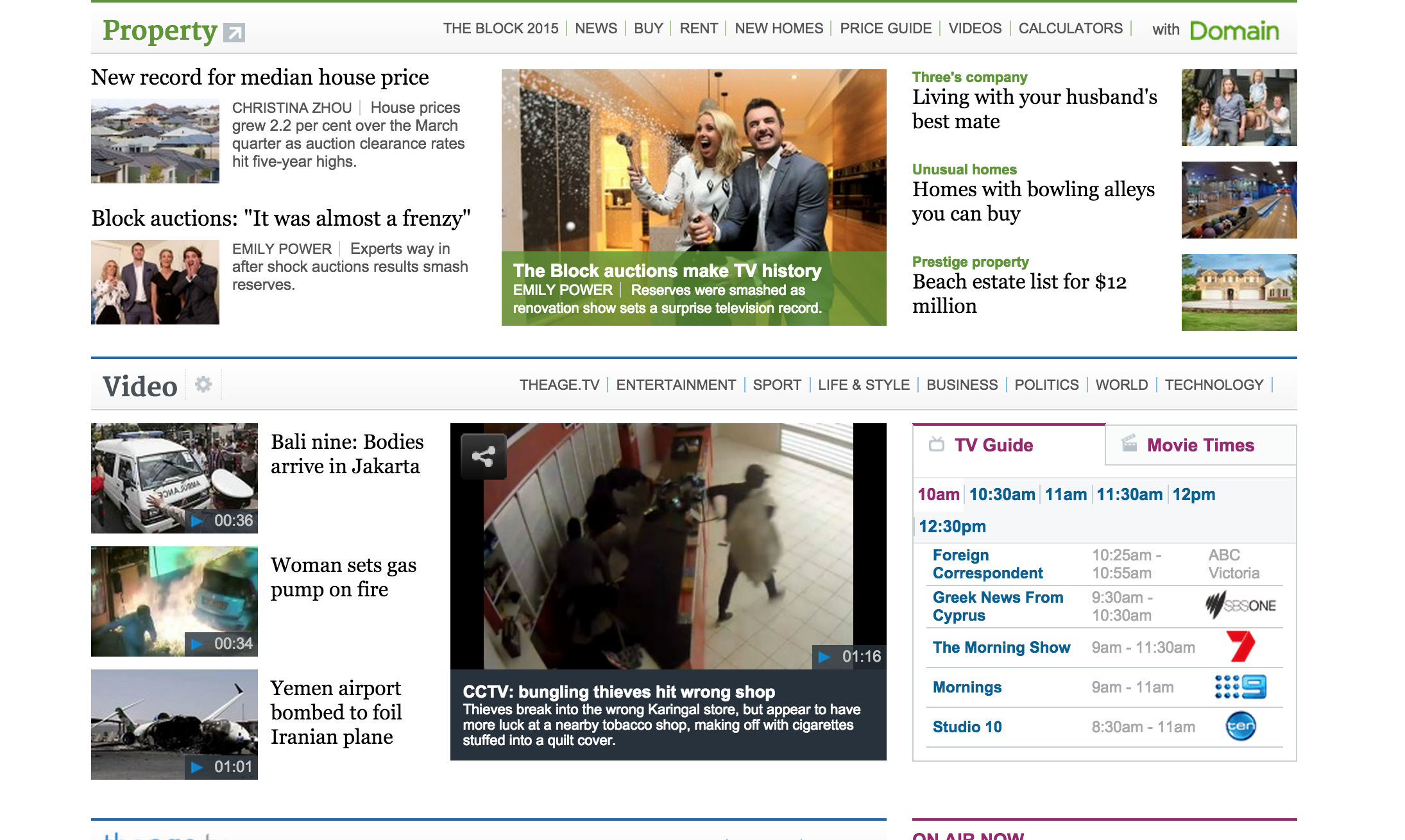
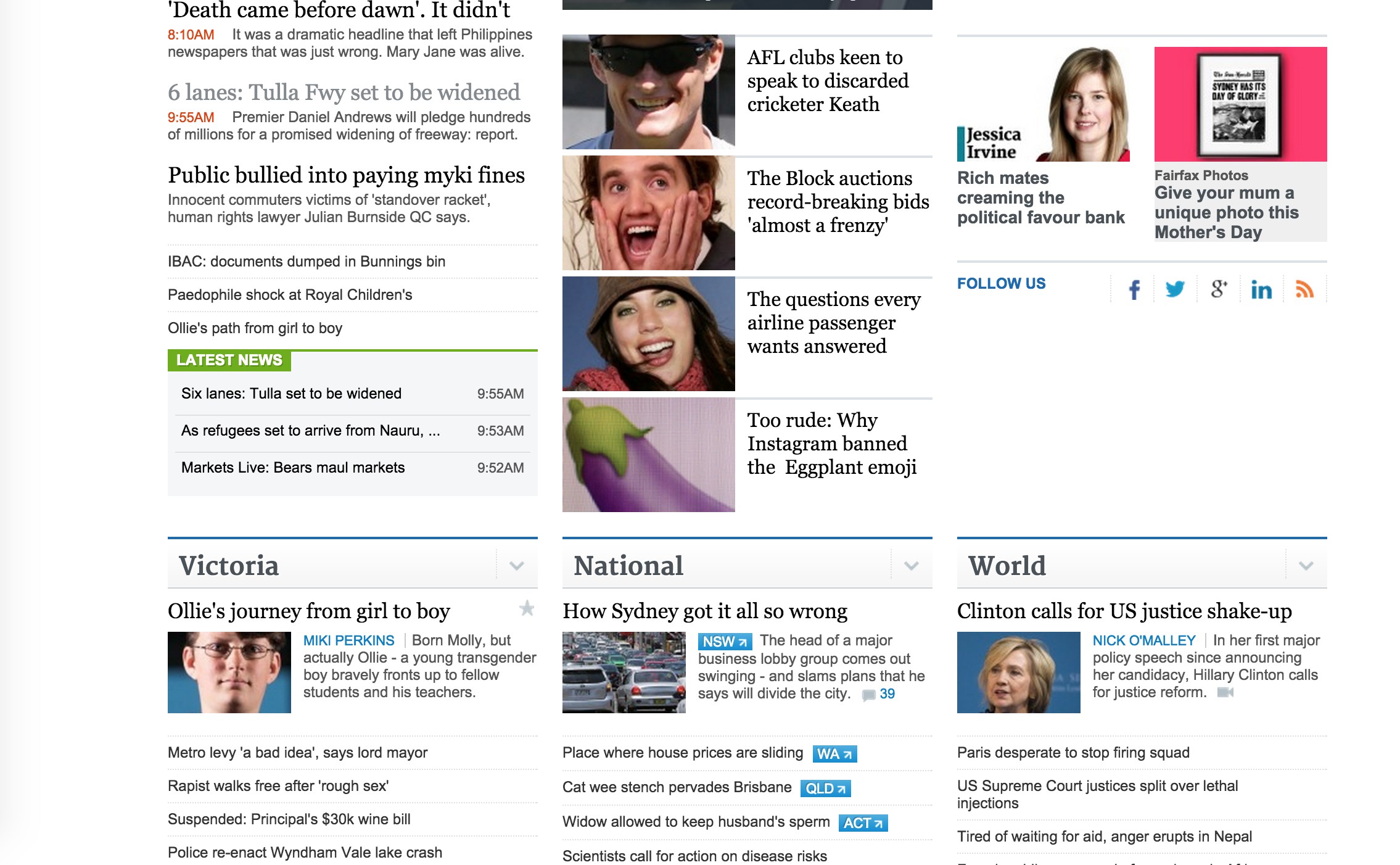
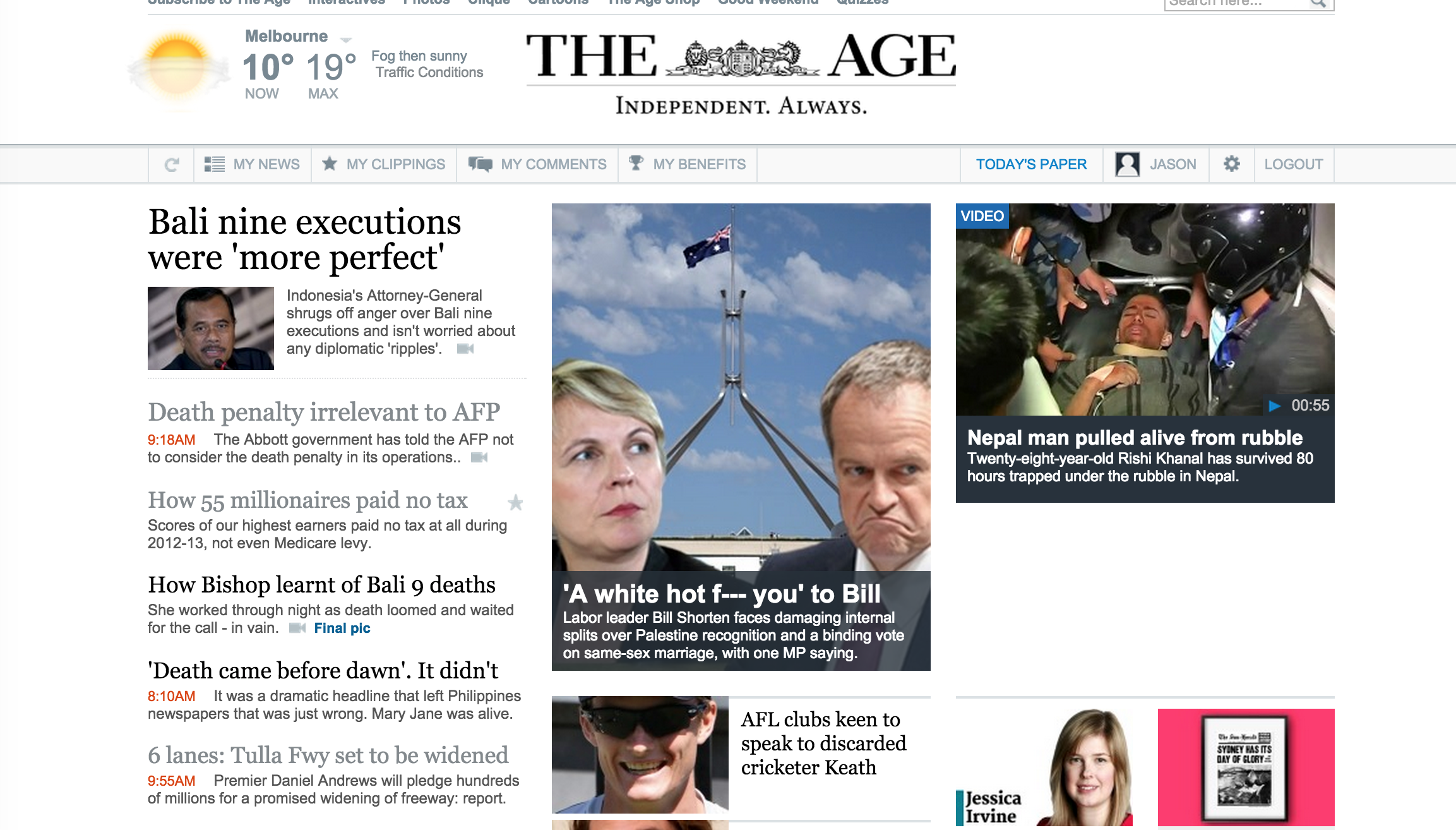
I subscribe to The Age. Mostly I forgive the mistakes that plague the website. But today I decided I’d do a quick count of screw-ups, and found more than I expected. Just scanning the front page, without even clicking on an article, I got to ten. There may be more.
Here they are, from bottom to top.
The sports section was quite clean. Headlines get to be quirky so we will let ‘Mayweather looks to cash‘ slide by. Let’s also assume that Adelaide’s sensation six were touchy-feely, not sensational.
The lifestyle section has also done an okay job. But the headline on the “ghostly” photos story has a redundant apostrophe-s in that’s. This one is especially galling as that is not breaking news. It has been in the fluff section for several days.
The Entertainment section looks to have been partly scrubbed by a sub-editor. I’m guessing the original headline was “Are Block couple our biggest TV winners?”
A vigilant sub-editor has decided couple is a singular entity, changed Are to Is and left winners dangling there. Wrong. I’d permit: “Is block couple our biggest TV winner?”
Also, is it possible the sub-editor is Russian? That might explain why Le Nevez is breaking “the hearts“, not just hearts.
The property section is almost a frenzy of typographical misadventure. “Way in“?? That’s the only one on the whole site I can’t forgive (the expression is weigh in).
Special mention to auctions results (should be auction results), and sets in the sentence ‘Reserves were smashed as renovation show sets a surprise television record.’ (It should be set.)
Let’s ignore the capitalisation of the word eggplant, and focus on the headline that left the Philippines newspapers. It presumably left them looking foolish before an editor changed the second half of the sentence. Now the publication that is “just wrong” is The Age. The best resolution I can see is It was a dramatic headline in Philippines newspapers but it was just wrong.
The best news gets rushed out, and as such the top of the page is where most typos are found.
On the right, might the “Nepal man” be Nepalese? Or is it supposed to be Nepal: Man pulled alive from rubble?
The write-off for the political story is also quite a cliff-hanger. “… with one MP saying.” It raises all sorts of questions, especially who and what?
There are also two full stops on the write-off for the second story.
The problem for newspapers that have sacked in house sub-editors and outsourced/off-shored sub-editing is that typos still matter to some readers. Research suggests typos erode trust.
“Apart from typos. and homophone errors, there is also the utter failure to write grammatically correct sentences which often means having to reread something several times – a) what was written, b)what was, possibly/probably meant, c)what the journo. thought they meant and d) asking the budgies if they mind such drek being put into their cage – the cat now refuses to use its tray with SMH liner and goes out to the garden even in the rain.”
This is an economics issue – sometimes an entity needs to invest in costly signalling techniques that don’t directly add value to users but help form their beliefs. It’s like McDonalds cleaning their front windows – it makes you think the kitchen is clean. It’s like showing up to a job interview with shiny shoes. It’s like a lawyer getting a gold-embossed business card.
Investing in these ancillary items all signal that the product in question is of high quality.
Dear reeders readers. I know most of you are typo tolerant if you frequent this blog. But do you think major news sites have an obligation to be typo free? Share your thoughts below.
ALSO: $10 bounty if you find a typo in this blog post! I’ve tried my best to be perfect!
At the RBA, this word would have been behind glass, marked “use only in case of emergency”. Exuberance, in financial circles, is a word that goes along with irrational.
But at the same time, he keeps cutting interest rates. That’s maybe necessary as the economy is so crappy at the moment.
But it drives up housing prices. There’s a bit of schism in property commentary, with a lot of chat about immigration and land availability, and less about how much people can borrow. We should never forget: the market for housing is as much credit as about land and structures.
While land is hard to get and housing construction has been more expensive during the mining construction boom, credit markets are loose as a goose.
Last time you could have got a cheaper loan was back in 1967. [RBA data]Let’s look at how interest rates make a difference.
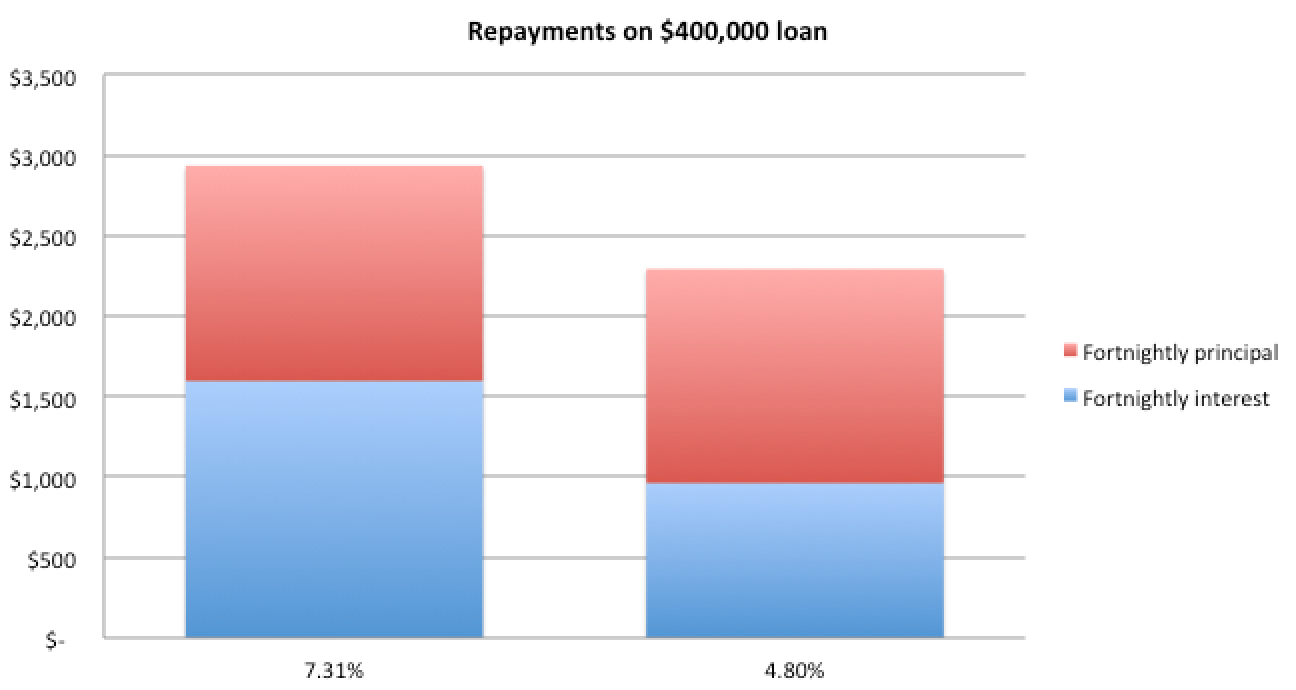
If you borrow $400,000 at the current standard discounted home loan rate of 4.8 per cent, you must pay back $687,597 to the bank over 25 years, in 300 payments of $2,292. That’s 42 per cent interest, 58 per cent principal.
If you borrow $400,000 at the average standard home loan rate of the last two decades (7.3 per cent) you must pay back $872,013 to the bank over 25 years, in 300 payments of $2,907. That’s 54 per cent interest, 46 per cent principal.
The repayment is 27 per cent bigger if and when rates go back up. You’re going to want to be richer to pay back that 400k loan then.
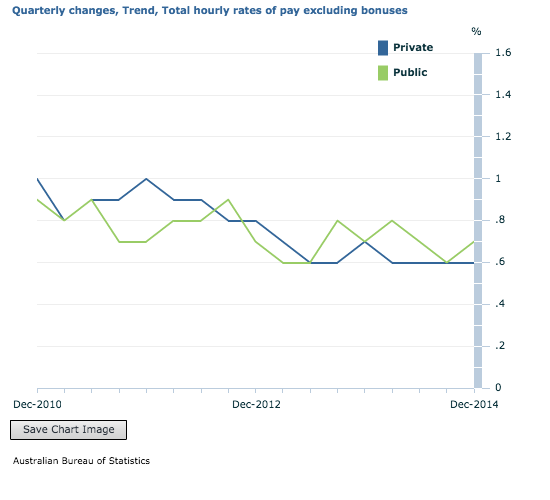
Do we see wages rising fast enough for that to happen?
Not really. Wages growth is a miserly 2.5 per cent annually, just one per cent above headline inflation.
It’s also worth noting many house purchases are not funded with wages alone, because they are investment properties. If mortgage repayments rise, will landlords be able to raise rents? Not if those renters aren’t also enjoying pay rises.
If investors start selling those homes, it could start a rush.
However, In New Zealand, the Reserve Bank has started raising interest rates, from 2.5 per cent to 3.5 per cent. And house prices are still rocketing in Auckland. So simply starting to raise interest rates won’t be enough to trim house price rises. Rates will need to hit a threshold where they start to sting.
That threshold may be some way away, but it surely exists.
The Victorian government today cancelled the contract for a road, and agreed to pay the winning bidder $340 million for their trouble. Is that a good deal?
Prima facie, $340 million seems a lot.
Despite that the reaction to the deal has been positive, with people describing the deal as a good one.
“I can imagine Lend Lease and the infrastructure minister sitting in a room right now, amending the cancellation provisions. $100 million? Why not $500 million? … We rely on their good citizenship not to do so. A flimsy protection indeed.
At that stage a payout of several hundred million dollars seemed ludicrous. The reason it now doesn’t is due to a psychological effect called framing.
Framing is why restaurants put a $50 steak on their menu, why apartment developers put a $2 million penthouse atop their building, and why TV marketing channels say their $9.99 item is a $20 item at 50 per cent off.
In each case, the context of a higher price makes the smaller sum you are about to pay more palatable. Some excellent work on framing has been done by Nobel winning economist Daniel Kahneman.
Melbourne’s contracts existed for only a month before the government changed and the future of the project was put at risk. If the consortium spent a third of a billion dollars in that month I am impressed at their efficiency. If they spent it after the election, I am shocked at their boldness.
So the $340 million dollars is probably not all costs. More likely, most is compensation – probably dressed up as costs plus a “fair markup”.
The reason it is not called compensation is that suits both sides. Labor leader Daniel Andrews looks like a master negotiator, and the companies – at risk of seeming to be blackmailing the state – look reasonable.
The Eastern Freeway running smoothly.
We should be angry at paying so much. The payout goes straight to the consortium’s bottom line. The longer the project ran, the higher the chance that the consortium made a loss. Cutting out early guarantees that won’t happen. Despite the high volume whining, this outcome has its upsides for the consortium – it banks a profit and puts its engineers onto another project.
Is this good bargaining by the state Government? I don’t know. The consortium seemed to have a great legal position. But the state government actually holds a pretty big stick. They could whisper that companies involved in demanding compensation will never win a bid in this state again unless they pull their heads in. Hopefully they bargained hard, but we shall never know.
Emphasising that these public monies have been wasted – ultimately our money that we paid in GST – is not an exercise in blaming the current government.
Their efforts – however imperfect – are absolutely glowing examples of good policy compared to the previous administration’s deliberate sabotaging of the state of Victoria. Including the kill clause is a stain on their legacy that should be remembered for a long time, and they must bear the blame for the size of today’s compensation package.
Businesses who stand to lose from policy changes kick up a fuss about how they’ve been blind-sided. All too often we are taken in by their sob stories. And we retreat from making policy changes we want.
Is this pretending part of the cut and thrust of political debate? It surely is. And yes, we can still make change over the sounds of protest when we really, really need to. For example, the government reintroducing fuel excise levy indexation.
Furthermore, change iscostly. If we changed the rules every five minutes, that would make life hard for everyone. There has to be a balance.
But the pace of change in our society could be too slow if we take every business complaint at face value. Many business models depend on the status quo. This graph is a mock-up of why they might defend that status quo, and why that might be less than ideal for society at large.
The horizontal axis shows rate of change. Think of that as bills passing the Senate. The vertical axis shows the payoff.
This graph shows a world in which policy change happens too slowly if we let businesses with an investment in the status quo drive policy.
So how do we bridge this gap? We want businesses to invest based on the current laws. But we also want the freedom to change those laws as soon as they are no longer useful.
I think there is a case for policy change insurance. That way if a law is changed that puts a business in the red, they can be compensated, but the taxpayer doesn’t have to be on the hook for it. If they don’t buy policy change insurance? Well they obviously weren’t too worried about that particular law!
Policy change insurance would be cheap to come by for laws that are rock solid. $0.01 a year would buy insurance against the government appropriating your land.
Prices in the insurance market would signal to firms what laws are more likely to change. Insuring against a one percent change in tax rates would be expensive. Insuring against a 20 per cent change would be cheaper.
That price signal should mean much less complaining when dubious programs are axed, and also signal to government which laws business honestly thought were steady. It makes both sides more honest.
The existence of this market should allow society to change its laws more often, if it wanted. In some ways I can’t believe it doesn’t already exist. You can buy Sovereign Risk insurance if you operate in especially heinous jurisdictions, but there seems to be nothing for Australia.
(Perhaps it doesn’t exist because there’s no actual demand? That’d suggest we put even less stock in the bleating of ACCI et al.)
Further savings would come to businesses because they could sack their lobbyists. Of course, the ultimate lobbyists in this new model would be the insurers. They would become the most conservative institutions in history. Every law change would rip money straight from their pockets Strict laws against political donations from insurers would have to be enacted. Laws would also have to ban former MPs from ever working for insurers, etc.
Does this model make sense? Are there any reasons why policy change insurance wouldn’t work? Or reasons why it doesn’t exist already? Is it just simpler for government to pay compensation instead? Is my basic thesis that the pace of change is too low completely wrong? Please share your thoughts below!
But Aldi is famous because it is extremely tightly focused on costs inside its own business.
These numbers made-up to serve as an illustration.
The savings at Aldi come from a lot of things – visible and invisible – they do to keep costs down.
THE CHEAP WAY
One of the most visible examples is making you pay for a trolley. To get one you must insert a gold coin, which is refunded when you return the trolley. That way Aldi doesn’t have to pay young people to hang out in the carparks retrieving scattered trolleys.
That’s just one example of how Aldi makes life a bit more difficult for customers, in order to keep prices down.
You may have also noticed that they make you pay for plastic bags. Aldi has been doing that since before the Greens political movement took off (coincidentally, also in Germany), simply because it saves money.
They have only 900 core products on offer. Every item a supermarket stocks costs them money in managing supplier relationships, in accounting, etc. The small selection means small stores, which means less rent.
Similarly, you may have noticed that Aldi doesn’t have an “8 items or less lane” at the checkout, saving on staff. They also make sure products have multiple barcodes or enormous barcodes, so the check-out person needn’t fumble and fuss to scan the item.
baaaaaaaaaar coooooooooooooode
Aldi often employs only two or three staff at the entire store. The guy with the mop could easily be the assistant manager. (They pay those few staff very well however, with assistants getting $23.40 an hour, and assistant managers $76,000 to $84,000.) The stores are open less than 12 hours a day (8.30am to 8pm), however, so Aldi spends less on labour and lights, etc.
Those are just the things you probably already noticed. There are also less visible things Aldi does differently.
They forced pallet-maker CHEP to invent a “multi purpose beverage tray” that can go from the factory to the truck to the supermarket floor without being unpacked. It can store 1.25L bottles or 2L bottles.
You spend less on shelf stackers if you don’t need to stack shelves.
Aldi also operates on a Just-in-Time system. Storing inventory is a big cost for businesses. Having goods arrive right when the previous batch runs out means Aldi spends less on behind-the-scenes space, and has less money tied up in owning stock.
Aldi also makes sure cereal packets, etc, are full. The trend to sell half-empty packets to convince consumers they are getting a lot when they’re not is incompatible with Aldi’s hyper-efficient supply chain. [source]
One other invisible innovation is especially welcome…
Unlike the major companies’ incredibly annoying jingles, you probably don’t remember seeing an Aldi TV ad.
Only a handful have gone to air in Australia – even having TV ads is pretty radical for this company. In fact, the only public statement company owner Karl Albrecht ever made was this one, in 1953:
Aldi has been around since Albrecht brothers Karl and Theo took over their father’s store in Essen, Germany, in 1946. The name stands for Albrecht Discount and the thirst for efficiency goes to the very heart of the business. The brothers were famously ruthless, according to this article in German newspaper Der Spiegel.
“High-ranking executives would dig old pencils out of their desk drawers whenever one of the brothers paid them a visit, just to avoid causing any suspicion that they were wasting office supplies.”
Aldi’s maniacal focus on prices has had spill-over effects in Australia. An investigation by the ACCC found that prices at Coles and Woolworths were lower when an Aldi store was nearby.
Sounds good! But Aldi’s effect has been more complex than that. The lower prices at Coles and Woolies have caused problems with suppliers. And the deluge of home-brands those big supermarkets now own can be traced back to Aldi’s entrance into the market.
This clip from the excellent Mad as Hell shows just how the home brand revolution is working out:
Aldi must bear some responsibility for that. But it never had real brands, so it can’t be found guilty directly.
Aldi claims it wants “to suck the profitability out of the [supermarket] industry in favour of the consumer.”
That’s pretty radical for a business in the current era. Most businesses are ultimately about shareholder value, not consumer value. It is likely Aldi’s claim is marketing spin. Likely. But not certain. Aldi is not a publicly-owned business, and if it wants to pursue goals other than pure profit maximisation, it absolutely can. Giving up on profits would certainly help explain the low prices!
If Aldi changes, or makes a mis-step, it need not be the end of German discount retailing in Australia.
Lidl is ready to open stores in this country. Lidl is even older than Aldi and has reportedly opened an office in Australia and registered its business name. In the UK it has proved even more popular than Aldi, with a business model very similar to the Aldi model.
Under the pressure of a bit of direct competition, Aldi might become even cheaper.
Shoppers like me will rejoice. But whether that is a good thing will continue to be debated. Can supermarkets be run with even fewer staff? Will rumours of widespread unpaid overtime intensify? Might Aldi be forced to tighten the screws on suppliers just as Coles and Woolies have? Is there a point where your yoghurt and lamb is too cheap? Or is that idea a middle-class affectation?
Confession time: I’ve started listening to the oldies stations more.
And Gold 104 is not the worst of it. I’m ashamed to admit Smooth 91.5 is pre-programmed in the car. I’ve even strayed onto the AM dial and enjoyed a few hours of Magic 1278, where the ads are for dentures and funeral insurance!
Is that smart and wise? Or a sign that I’m a total dork, with any remaining dregs of cool banished completely from my existence? Hmm… This seems like a question I can answer with analysis!
Is the optimal strategy to listen to new music, or to dredge the archives? We can break the question down by looking at a couple of models.
MODEL ONE
Let’s start by assuming music quality has only one cause – genius.
Genius is only going to come along at random.
And even geniuses are only at the height of their powers for a brief period.
In summary, music made with genius is uncommon.
It would be easy to have a year in which very little music is released that meets the standard of being genius. For example, 1986.
If you listen to stations (or listen to Spotify playlists, or whatever) that focus on brand new music, you get the cream of this month’s output brought to you.
There are 500 albums selected by Rolling Stone on their best albums of all time. Listening to each one just once would require listening full time for 25 days. Appreciating them would be a lifetime’s work.
As I read through the top 100, I see not just albums but even bands I’ve never heard of. As a music fan, it strikes me as a matter of urgency to take these recommendations on.
Looking at music in this way, it would seem crazy to listen to new music. And it would be crazy to even start a band.
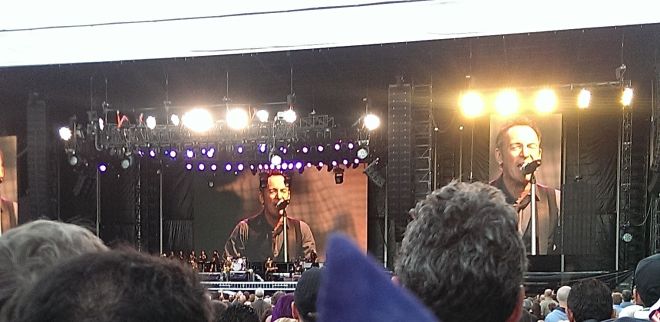
So, you’re planning on competing with The Boss? Let us know how that goes…
The longer history goes on, the more the stock of geniuses accumulates. The more the pile of amazing tracks and albums grows. And the chance of making a piece of music that compares well shrinks to nothingness.
–
This is the only outcome if we make the assumption that the only factor in music is genius. But that seems to lead to a stale and conservative outcome where new creativity is increasingly pointless.
MODEL TWO.
Let’s assume something different for a moment. Let’s assume the only thing that matters in music is learning. Each musician listens to the bands that go before them. They hear what works. They see what doesn’t work. They gather information and skills.
In this model, music is more like technology:
Pink Floyd are like a payphone, and Alt-J is your smartphone. The latter has absorbed the ideas in the former, and expanded on them.
You’d be silly to listen to the old stuff, because it’s all there – reflected, distilled, improved – in the new stuff. When you do go back to the old music, it seems like a pale imitation. Stevie Nicks sounds like an also-ran version of Lana del Rey that didn’t quite have the right stuff. Neil Young sounds like a shadow of Ryan Adams, etc.
–
To be honest, there are times when I have felt this – sometimes a band accused of being derivative is actually an improvement on the original. Sometimes technology is making possible music that would never have been heard before. But far more often, the new stuff is being hyped by the industry because it can make money.
CONCLUSION AND CAVEAT
So which of these models is Truth?
Once you break it down, the answer is the same one you’ve been learning since childhood. The same message carried by Goldilocks, the Buddhists and the Food Pyramid. You need a balance. Old and New. Listen to a bit of both!
Music is part genius, part accumulation and learning. And seeing the links between the old and new is fun. The best way to decide which venerated hero to explore next is by hearing your favourite new artist cite them as an influence. The best way to catch onto a new act is to see them supporting your favourite old band.
So I don’t just listen to Golden Oldies. I flick through community radio and Triple J in order to stop getting too crusty and stale. I particularly like Double J, which plays a mix of old and new (recently, AC/DC, Alabama Shakes, Sonic Youth, St Vincent.)
This is sometimes not easy – the risk as you age is in wanting to just hear music that makes you feel comfortable.
But if there is one thing that should tip the balance against bunkering down and getting settled with your record collection, it is this: If you want to go to live shows, you need to be across the new acts.
The Mowgli’s, as seen in Austin Texas in March.
Getting the most out of a live act normally means knowing a few of the songs in advance. If everything you like is from your youth (or before), shows will come round annually at best, be at arenas, and cost over $100.
Great moments in music come with a great act at a small venue. That act could top the greatest 100 list published in a decade’s time. And this is your chance to hear them first! That’s one reason at least to embrace something new.
Whether you start with Courtney Barnett or Taylor Swift, YouTube does a pretty good job these days of taking you on a tour of songs you wouldn’t otherwise have heard. Enjoy.
Taxing education has the potential to make Australia’s GST fairer. Perceptions that it is unfair are a major impediment to reforming the GST.
The GST is regressive. (nb. I had to figure this out the old-fashioned way after being unable to find a single publication that contained this data.) Lower income households pay more of their (equivalised disposable household) income in GST than higher income households, according to my calculations.
Calculated using ABS 6530.0 Household Expenditure Survey, Australia: Detailed Expenditure Items, 2009-10; ATO GST rulings; 6523.0 Household Income and Income Distribution, Australia, 2009-10
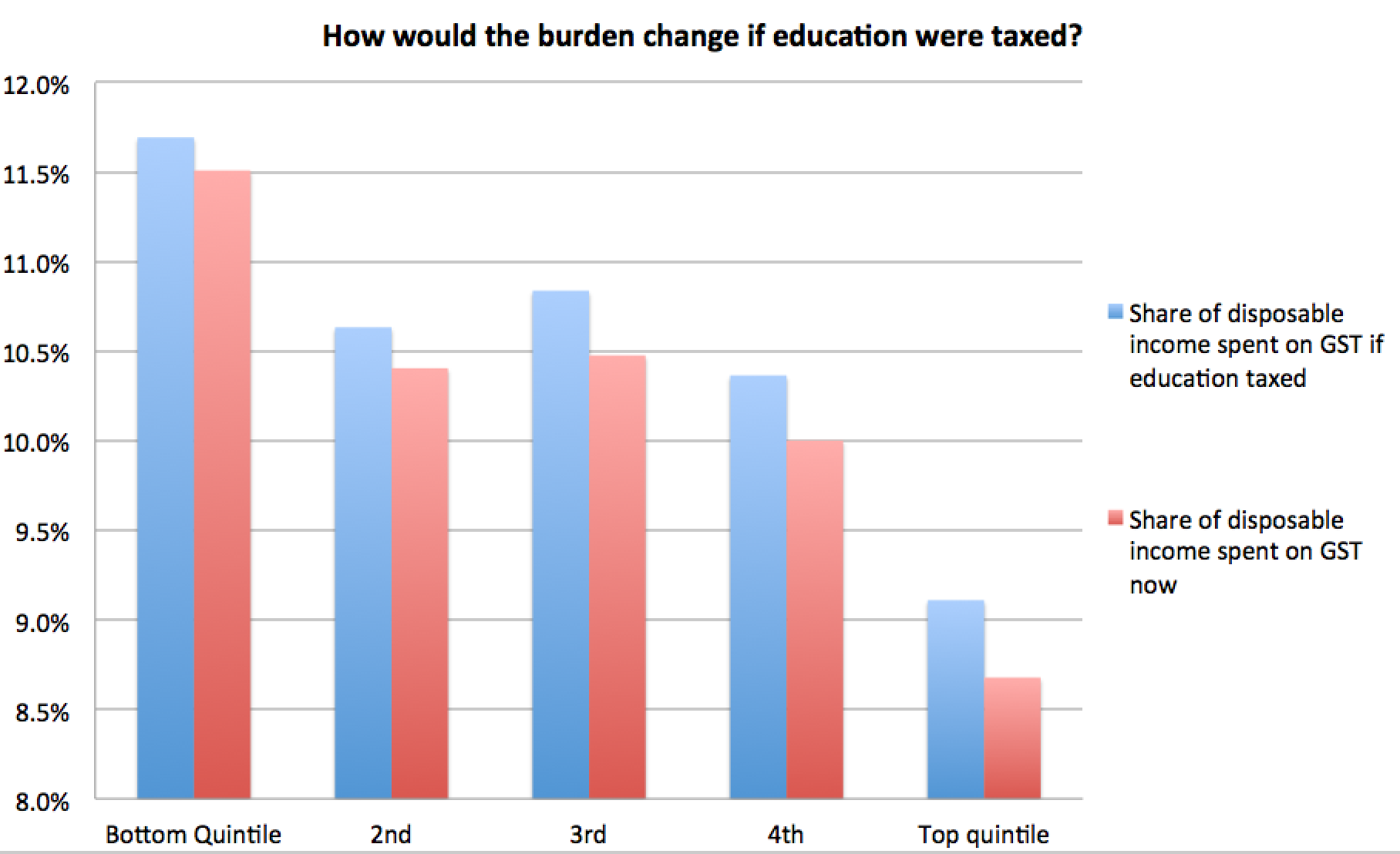
Lowest income households pay 11.5 per cent of their income in GST (higher than 10 per cent because some spend more than they earn). Highest income households pay 8.7 per cent.
In absolute terms, this means the highest income households pay four times as much GST ($148/week) as the lowest income households ($36/week). They can do so because they have 5.5 times the disposable income ($1704 vs $314).
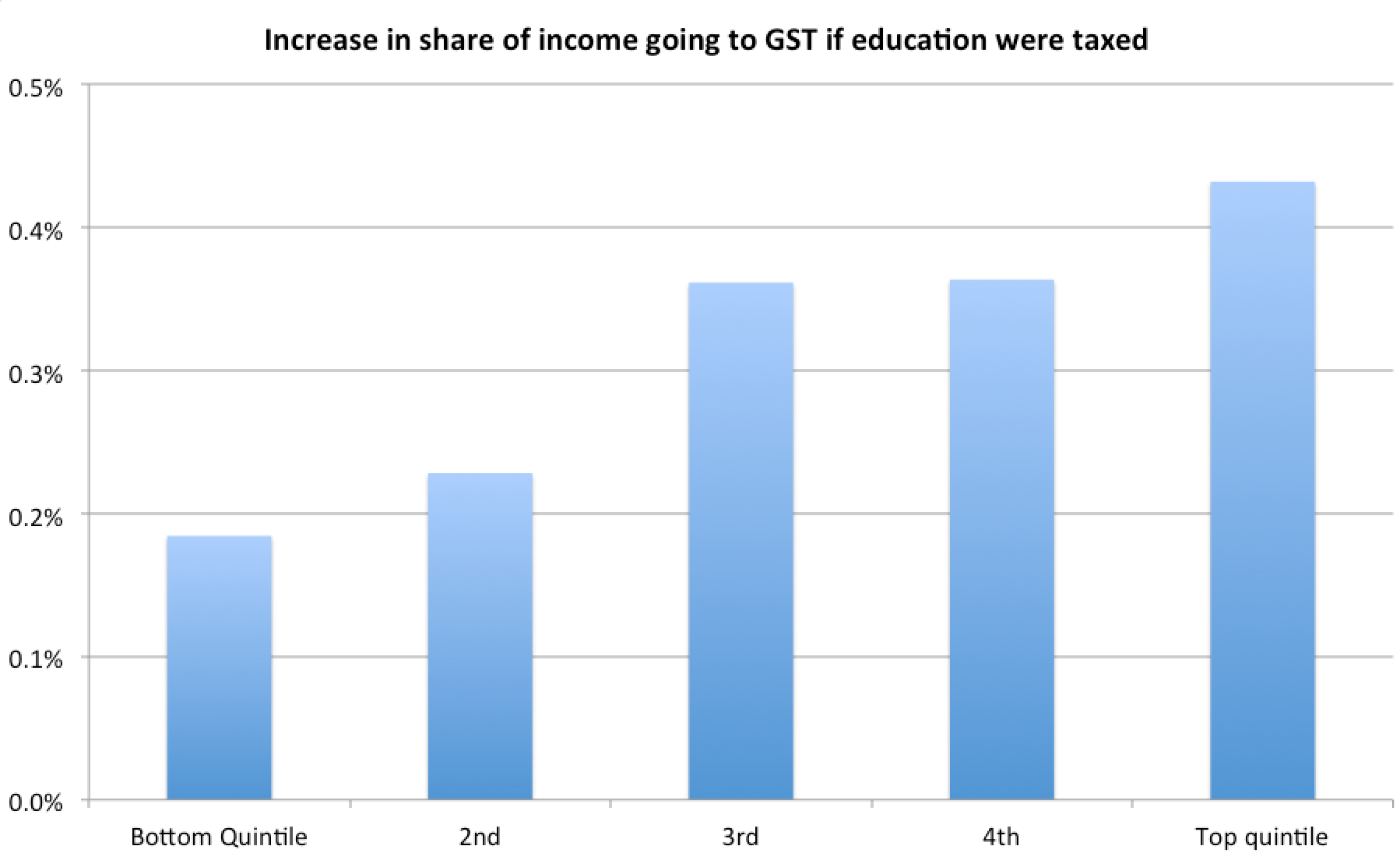
This is not quite as regressive a tax as I had assumed. The exemptions agreed by the Democrats and the Coalition in 1999 make a difference. Without exemptions, the GST would be even more regressive.The definition of a progressive tax is one where the rich pay more as a percentage of their income. Levying GST on education will not turn the GST into a progressive tax. But it moves it in the right direction.
Those are percentage points on the vertical axis.
You can see the comparison a different way in this next graph.
The estimated revenue gain of taxing primary, secondary and tertiary school fees would be around $1.2 billion.
Two caveats remain.
One is pure politics. Education is seen as A Good Thing. Even though Australia would continue to provide free and universal school education, a decision to tax education expenditure would cause confusion and dismay. I wrote just yesterday about how insufficiently distinguishing sin taxes and revenue taxes causes trouble, and this would fall right into that trap. This government would also face the problem that its supporter base are more inclined to be patrons of private education. (I should note here that I am not biased against private schools, having attended one myself.)
The second comes to the exact question of fairness that prompted my investigation into how GST could simultaneously be extended and made less regressive.
The association between education expenditure and household earnings is not simply a matter of wealthy people sending their children to private schools. The period of peak earnings in a person’s life is also commonly in their 40s – the period where they have children in secondary school. In other words, the statistics insistence that education spending is a luxury good could be more of a life-cycle artefact.
Nevertheless, the same is true of many types of expenditure, and an opportunity to plug a hole in the GST – and do so fairly – is rare enough to be worth grasping.
It is true, but not a great argument when the government is going soft on tax dodgers. It simply encourages people to say we should enforce our existing taxes. [They’re right, we should. But we should have land tax too.]
Today the SMH economics guru Jess Irvine wrote a long and very welcome piece about land tax. But it conflated the hard-to-grasp concept of a low distortion tax with the easier-to-grasp concept of a tax that’s hard to “dodge.”
“Land tax is one of the most efficient taxes for precisely the reason it is unpopular: it is hard to dodge. They know where you live. You can hire as many accountants as you want, but it is difficult to hide that mansion in Point Piper.”
I found myself wondering why land tax is not on the agenda. And I think I’ve figured out why. The conceptual framework you need to grasp its benefits is not commonly shared. And you can see that by flicking to the hundreds of comments that followed the article.
The comments on the article were almost exclusively focused on fairness. Fairness is just one of the keys to good tax policy. Efficiency is the other. And there is a gulf of understanding between economists and the general public on tax efficiency, with economists to blame.
To get land tax out there you need to teach people why distortion is bad.
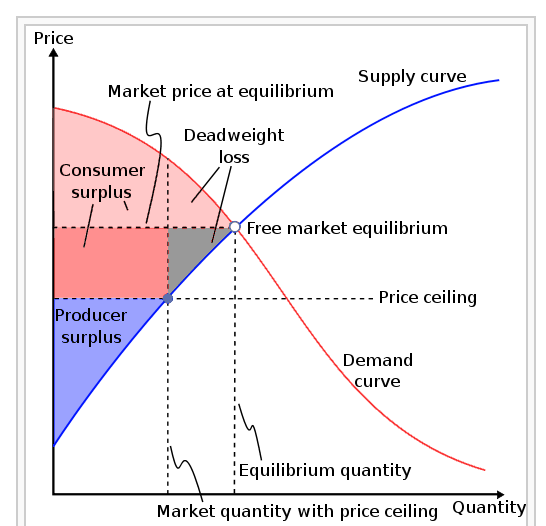
Economics students learn about a model of the economy like this: Trade is mutually beneficial. Taxes prevent trade. Therefore taxes prevent that mutual benefit. The amount of prevention (aka the distortion) is called deadweight loss.
Deadweight loss from a price ceiling works much the same as a tax. From Wikipedia
The distorting effect of taxes is one of the great insights of microeconomics. It is counter-intuitive and hard to see, because deadweight loss is always a counter-factual. But can we transmit this flash of inspiration and insight from economics to the general public without messing around drawing supply and demand curves, or measuring utility?
A stumbling block is that the purpose of current taxation is so muddled.
We use taxes on “good things” to raise revenue. And we use taxes on “bad things” to change behaviour.
From observing the tax system, it may be unclear why smoking and working are both taxed. Does the government hate work?
The progressivity of the tax system – which I emphasise I support – doubtless contributes to this confusion. Being a low-wage worker, buying healthy fresh food and education attracts lower rates of tax. Being rich, buying luxury cars, eating at restaurants and making capital gains in shares attracts higher rates of tax.
It would be easy for some to see the tax system as a kind of moral agent, punishing bad behaviour and rewarding good. In this scenario, land tax makes no sense.
Explaining that taxes distort behaviour – but we want to minimise that! – is going to be a hard sell when the public sees we use taxes to distort behaviour all the time.
We tax all these things, and you want me to believe that’s because you want to stop some of these things, but you don’t want to stop others?
Fixing this will be hard. The terminology is a good place to start.
It cannot be helpful to use one word – “tax” – for both imposts on activities we actually want to encourage, like work, buying goods and services, making profits and owning land; and for things we actually want to discourage.
I’ll accept suggestions for how we could rename these taxes – Maybe they could be divided into Detrimental but Oh Well, it’s Necessary Taxes and Useful Pricing Taxes (DOWN and UP)?
This distinction would help plant the seed that some – but not all – taxes should be designed in a way that minimises distortion.
The journey to give land tax a fighting chance will be a very long one. The first steps in that journey will be to help give people the capacity to grasp why land tax might be desirable.
Melbourne has too much parkland and we should build apartments where there are currently trees.
I am serious. But I am also going to add nuance to that statement…
People who care about cities agree surface carparks are bad. They are dead empty spaces that reduce density. They ruin walkability and limit the agglomeration effects you can get when businesses locate in close proximity.
Many of these same people gush about parks and would chain themselves to trees if I were put in charge.
But there are parks that operate just like carparks. They’re eerie, bleak and deserted. They add to walking distances between destinations. They’re antithetical to the basic function of a city, which is to put humans into contact with each other.
Not all parks are like this. Some are popular destinations in their own right. They are busy and valuable. But others are black holes in the universe of our city.
The biggest example of such a bad park sits right at the centre of Melbourne. Royal Park. It is clearly too big and as a result, it is largely empty.
When we compare the scale of Royal Park to another very large, famous inner city park, we can see that it is around 50 per cent wider.
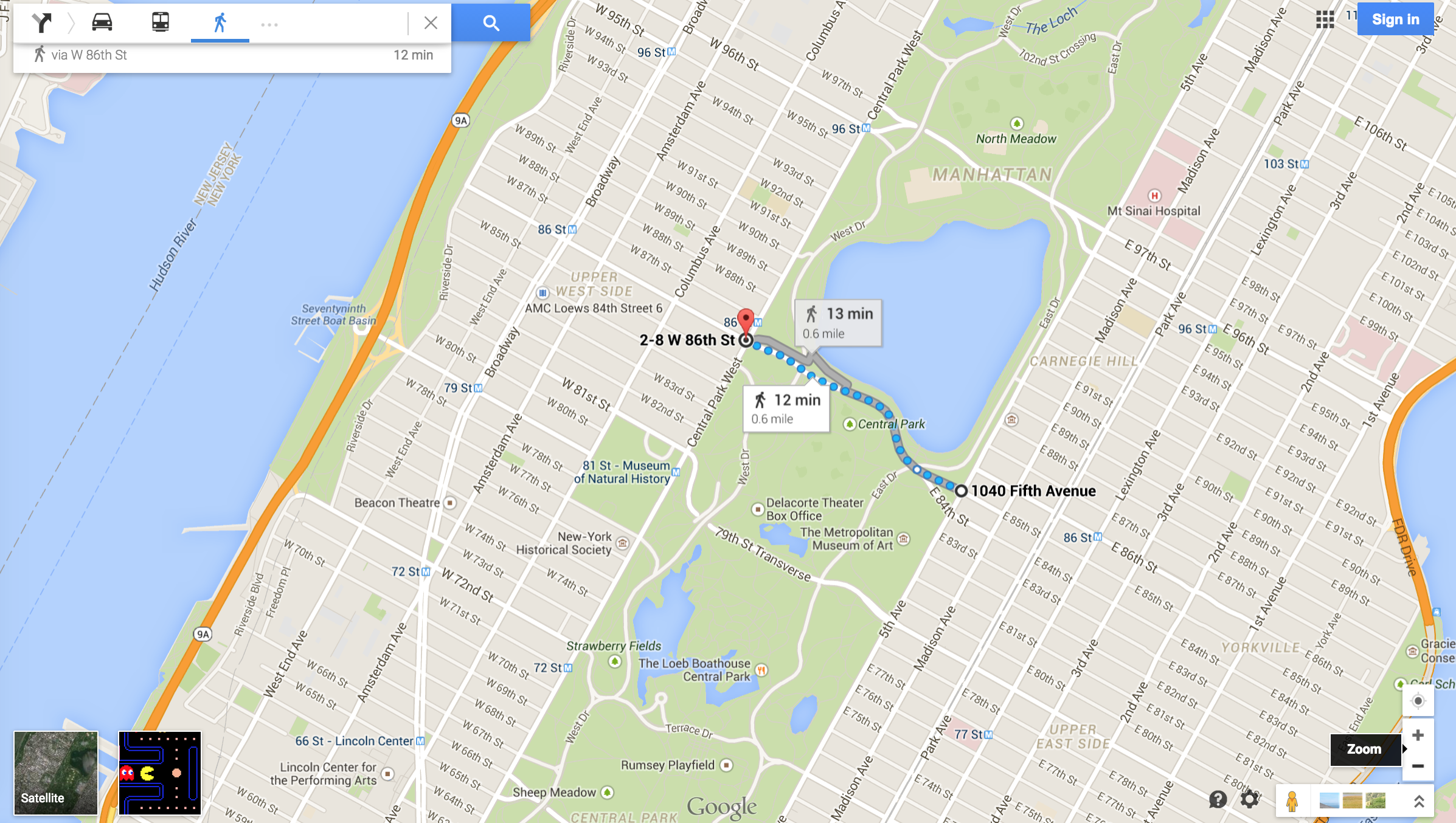
Royal Park: 1.4km across.Central Park, NYC. 0.6 miles or 960 metres across.
Royal Park and would take 17 minutes to cross on foot. It would take 8.5 minutes just to walk to the middle of the park, assuming you start from the very edge. If you lived 3 minutes from the park and planned to walk into the middle of the park, then home again, that will require at least 23 minutes of solid walking.
While we’re talking about New York City, it is probably worth quoting history’s most famous urbanist, New York’s Jane Jacobs. (Economics readers who haven’t heard of her can think of her as a sort of Adam Smith of urbanism.)
“In orthodox city planning, neighborhood open spaces are venerated in an amazingly uncritical fashion, much as savages venerate magical fetishes. Ask a houser how his planned neighborhood improves on the old city and he will cite, as a self-evident virtue, More Open Space. Ask a zoner about the improvements in progressive codes and he will cite, again as a self-evident virtue, their incentives toward leaving More Open Space. Walk with a planner through a dispirited neighborhood and though it be already scabby with deserted parks and tired landscaping festooned with an old Kleenex, he will envision a future of More Open Space.
“More Open Space for what? For muggings? For bleak vacuums between buildings? Or for ordinary people to use and enjoy? But people do not use city open space just because it is there and because city planners wish they would.”
Parks are an asset to a city. We can appreciate them by looking out on them. We can appreciate them by simply knowing they are there. But mainly we appreciate them by being in them. That’s their primary function.
An empty park is a failed park. These are not like National Parks, designed to preserve an eco-system for eternity. Royal Park is described by its defenders as bushland, but I’ve been to the bush and it isn’t. The modest scattering of trees were probably planted to hide how empty the place is. But it just makes the park more vacant seeming and less useful.
Central city parks should function for people. Design is part of that. Lighting is important. So is seating.
But the most significant determinant of how people use parks is proximity. Central Park has literally millions of people within walking distance. The shape of the park optimises the amount of people nearby – it is long and thin.
By contrast, Royal Park is almost round.
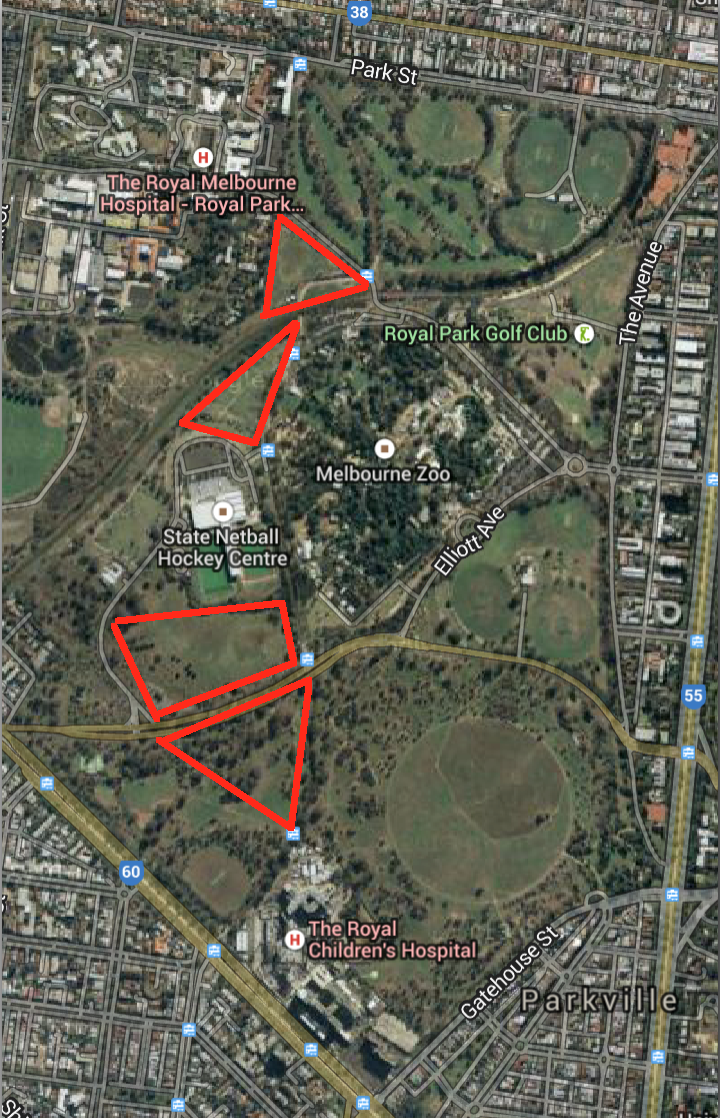
Furthermore, Royal Park is surrounded by other parks! (I’ve marked them in red).
A good park – a necessary park – is surrounded by people who crave access to parkland. Royal Park fails on this criteria.
The only times I’ve ever gone to Royal Park by foot, for reasons other than organised sport, has been in the company of people living in that small, highly-desirable sliver of Parkville on Royal Park’s east. By contrast, I’ve spent many many hours running, barbecuing, football kicking and frisbee throwing in Princes Park, which is basically across the road.
Why would the residents of the dense areas east of Princes Park cross it to visit Royal Park? They wouldn’t and they don’t. That starts a virtuous circle where Princes Park is lively and desirable. Meanwhile Royal Park’s grass grows long and few people notice.
I love parks and I think I have a feeling for what works best. Too small, and they are no fun. I lived in West Melbourne at one stage, and they only have those little pocket parks, built on old vacant blocks. They’re not very desirable to sit in, too small to kick a ball, and not big enough for a dog to run round in.
This park is about 600metres north-south, 500 metres across, and it is ALWAYS busy.
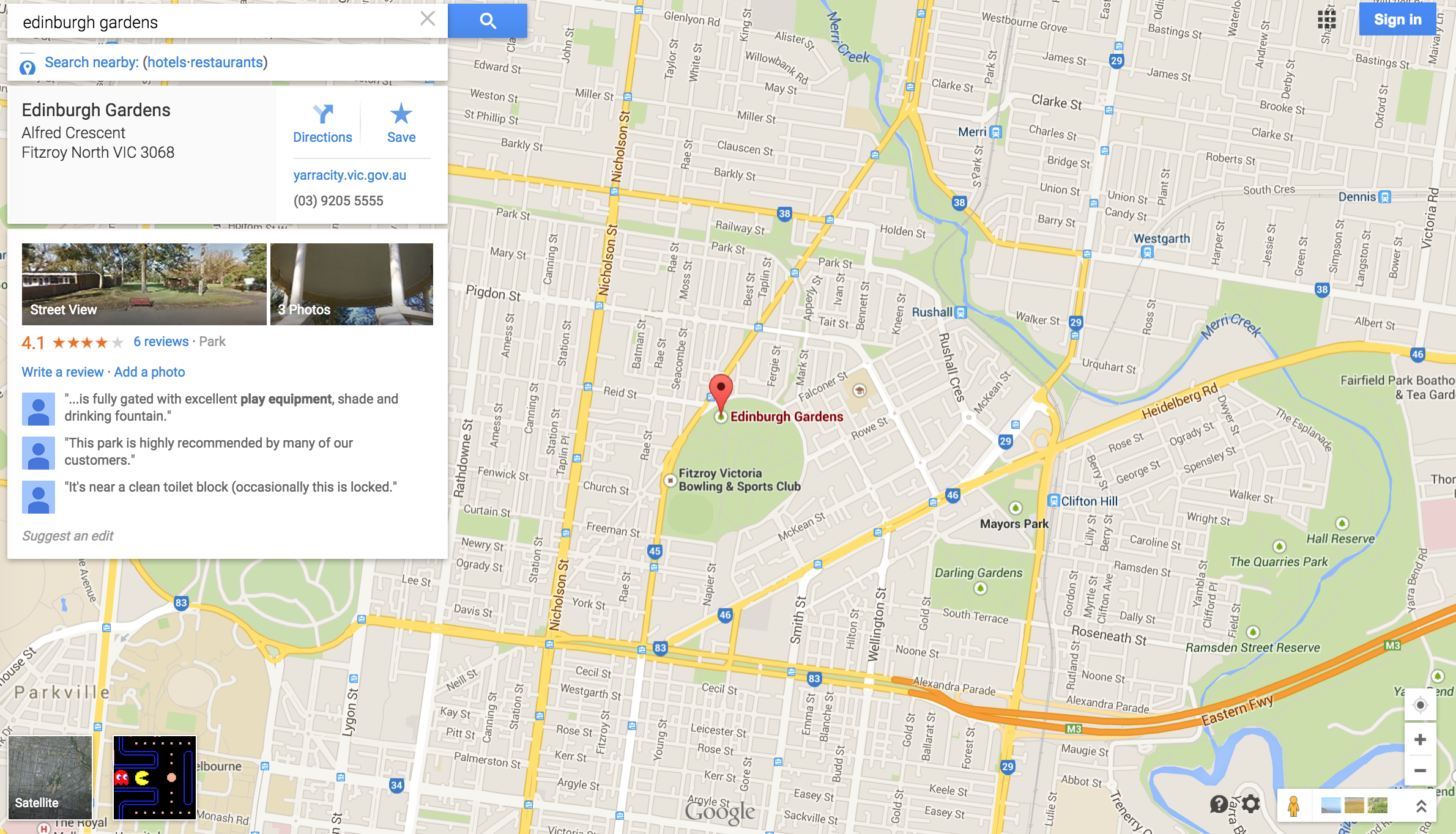
A good example of a successful park is North Fitzroy’s Edinburgh Gardens. Big enough to have a couple of football ovals in it, and surrounded by medium density housing.
So. With these ideas in hand, how would I fix Royal Park? I present below a fairly modest proposal to split the park along its north-south axis by building high density housing along the tram line.
With these red areas full of homes, Royal Park might finally have a critical mass of potential users. I’ve cut the supply of park only modestly – the vast majority of Royal Park is protected. But by simultaneously increasing the potential demand for this park, it might start attracting a lot more people to appreciate its very real charms.
What’s the hashtag for the new tax review? There are several: #taxreview, #rethink, #bettertax, which means there may as well be none.
To describe Australia as excited for this review would be, shall we say, intemperate.
Was there a time when a major review was major? When the big splash of a report launched a thousand editorials and inflamed as many angry talk back callers?
It’s easy to imagine the answer is yes. But that is probably based on us remembering the big ones, the ones that cut through. Plenty of reform drives run out of fuel.
It is early days, but this review seems to be sputtering. Yesterday morning at 9am The Age had up two stories about the review by Economics editor Peter Martin. One reporting, one editorialising.
By 12.17pm they were both gone from the front page.
Surprised, I went hunting around the net at that time to see what other coverage I could find. Both the Australian and the AFR had the tax review as their top story. But The Age had the Uber story in the 7th spot on its site, and the Herald Sun offered me over 100 links before I found a Breaking News section right at the bottom of the page where, in tiny font, there was mention of the tax review.
The tax paper itself worried about this on page iii.
“To deliver lasting, workable reforms, the community needs to be on board and engaged in the conversation.“
Is this one of those articles that says “social media is making us dumb!”? Then spends a few paragraphs yearning for a golden age that didn’t exist, before vaguely hoping everyone will “grow up”?
No.
I see people discuss policy all the time. Online and off. Social media can be a powerful force for good, when people care.
So why has this review not engaged us yet?
I see three big reasons, two of which represent mistakes by a government I believe is sincere in its desire to achieve something – anything! – before the next election.
1. The discussion paper contains a headline idea that is undeliverable. Nobody need worry about the government raising the GST.
They lack political capital to do things that should be much, much easier. Like passing their first Budget. Seeing this idea revivified once more just gives people license to pay no further attention.
Props to Mr Hockey for ruling nothing out of this tax paper. It’s brave and principled. But is it wise? I’m unsure.
2. Treasury wrote the discussion paper. This .pdf lacks gravitas, has no imprimatur. If you want people to pay attention to something, it is helpful to have a name behind it. The Henry review had weight because at the time, Henry himself was extremely influential. The ideas in and implied by this discussion paper lack a visible patron.
3. Partly, I think people are disengaged about tax reform because they do not see tax as an input to economic activity. We see tax as something that happens after. We make money, then we pay income tax. We buy food, then we pay GST. We don’t observe all the dissuaded activity and so fail to grasp the systematic effect of taxes, i.e. the link between tax and growth.
Most public discussions I see on tax reform focus on the fairness aspect – who should pay from a justice point of view – not from a growth point of view. This is a shame, because it leads parts of the public to assume Treasury doesn’t care about fairness. I believe they do care, but they are also trying to optimise the effect of tax on growth.
The links from tax to growth are highly debatable – plenty of rich countries have higher aggregate tax takes than us, and plenty of rich countries have different ratios of consumption to income taxes.
“each additional $1 collected by way of company income tax reduces the living standards of Australian households by around 50 cents in the long run because of reduced investment.”
I’d like for everyone to be talking about that idea, which rests on assumptions about the mobility of capital. But 99% of the public discussion is about revenue adequacy and fairness questions. If the frameworks people had for discussing tax were the same as the frameworks Treasury was deploying, a more fruitful discussion may take place and Chart 2.9 – marginal excess burden – would be a national obsession.
—
This discussion process is only just beginning, and I hope I’m wrong that people have already tuned out.
I guess it is the role of the public sphere – including humble blogs like this – to try to bring ideas in these reviews out of the tarpit and spray them with the hose, in order that they may be introduced to wider society. I shall try to write more about the tax review in coming days and weeks!
My recent travels through the USA took me to Austin, Texas in the middle of March. At that time Austin is taken over by the festival known as South by Southwest (SXSW). This was no coincidence. We went especially for the music part of this festival and were ready to be blown away.
I wrote in 2013 about my first SXSW experience, and this time was definitely different. The festival had returned to its roots – eschewing big names in favour of exposing new bands. This meant the bills were filled with names we did not know, and gave us more freedom to choose venues at random, without expectations.
The music was often great, and despite never having heard the tracks before, we regularly left gigs with a hook on repeat in our heads.
But there was one surprise. Time and again we found “bands” on stage that were not traditional bands. Many acts did their show on just a laptop and a microphone. We saw the Apple logo more often than the Fender logo.
That’s fun, but a traditionalist streak lurks within us. So on day four, the desire to actually see a big, proper band letting loose made us seek out an African/Carribean night at a smaller club. It featured acts from Cote d’Ivore, Nigeria, etc, and we expected something in the tradition of Fela Kuti.
But our search did not lead to a big band. Not a cymbal was struck in anger. Once more, we saw multiple acts featuring one microphone and one Macbook.
Serge Beynaud of Cote d’Ivoire. (It may look like there is a band on stage but those guys are roadies/photographers/loitering.)
It sounded great, the crowd was into it and we had a good time. But it got me thinking. In Cote d’Ivoire, how is a band starting out going to buy instruments? In Australia, people who are in bands work hard in traditional jobs to get the money to buy a bass, a guitar, and a drumkit, each of which can cost over $1000.
My friend the trumpet player, for example, is a vet.
It’s common knowledge that a band doesn’t make money in 2015. Not for the first few years, anyway. So they need a revenue stream. With the economic situation in Cote d’Ivoire, it’s probably not as simple as working in a bookshop to save for a new amp or some pedals. It makes sense most acts will be lean, streamlined, cheap to run. Expecting a full band is like expecting a grand piano. Not realistic.
That idea stewed in my mind for a while until I realised that it wasn’t just relevant to impoverished West Africa. It would apply in the rich world too.
Instrument choice could even explain success and longevity. Longevity and success are going to be linked in both directions. Because a good band will last, but a band needs to last to get good.
In the Western world, assume a share of bands start up with a traditional four or five-piece set up – more EADGBE than QWERTY, and a share of bands start up with a macbook they had anyway and a pirated copy of a music making program.
Who is more likely to get the 10,000 hours of practice they need before they crack?
iLoveMakonnen: A two piece featuring an MC and a DJ (who hasn’t touched an actual ‘disc’ in years).
While all bands suffer from entropy and slowly disappear, the effect will be more pronounced for larger bands with more expensive equipment. There are plenty of reasons for bands to split. But money-making is not the least of them.
If a big band does make a bit of revenue, the musicians will find it divided among many people, and soaked up by depreciation of the band’s material. They will start to see the band as an ongoing expense, not a money maker.
Perhaps in the 1980 and 1990s, bands endured this period with a little more hope of cashing in eventually. But in 2015 the idea of selling records is something of a joke. (Side note: at SXSW, the streets were littered with thousands and thousands of CDs that enterprising bands were trying to give away and punters couldn’t be bothered carrying home.)
In this scenario, bands with an upright bass and a trumpet are disappearing fast, while the number of bands using pirated software and a macbook shrinks at a lower rate. That means by year four or five, when all the skills are finally in place to write a song that’s genuinely awesome, the bigger, more traditional band’s songwriters are back at university, while the smaller acts are still plugging away.
It may be hard to justify a full band when you can make all those sounds through a computer. The main advantage of a proper band could be the richer stream of ideas that come with a meeting of minds.
Happily, there is still evidence of that happening.
Quality still wins out and the occasional seven-piece does make it through the cracks to become a viable band. Below is the Mowgli’s, who sounded great. Sure they’re white people from LA – one of the richest cities in the world – but at least that swirling moneypool is splashing some cash in the direction of old-fashioned music making.
I’ve been to Utah a few times. One thing I like to do there is attend an NBA game. The Utah Jazz play home games in central Salt Lake City.
In 2011 I wanted to go see the Jazz, so during the afternoon we made our way to the poetically named Energy Solutions Arena, to see about tickets.
Inside, a uniformed woman told us tickets would be $40. But outside, a significantly more casually attired man was able to sell us tickets and was willing to negotiate on price, down to $20.
That night, as we joined the purple-clad throngs filing towards the stadium, we saw many more people pushing tickets outside for low, low prices – including some shouting “free tickets!”. Prices don’t get much lower than that.
Mountains, as viewed from inside the arena.
Ticket scalping is a state issue, and it is not one the lawmakers of the mostly mormon state have sought to trouble themselves with. In the absence of any law, ticket scalping there is apparently totally legit.
Inside, it was clear why the man had been willing to negotiate our ticket prices. High in the stands where we sat, there were very few other punters. But we added our voices to the support for the Jazz (hilarity ensued as we convinced one Australian basketball ingenue that it was completely normal and in fact expected to yell Slammer Jammer! after every dunk).
So when I returned to Salt Lake City in 2015 I knew I would go back to Energy Solutions Arena to see the Jazz play, and I knew tickets should be damn cheap. I was googling to see if scalping was still happening, hoping I might get my hands on some of those free tickets I remembered so vividly.
But my googling soon led me to a whole different marketplace. Online ticket re-selling. Within moments I was on the website of SeatGeek.com, where tickets were going for an amazing range of prices. You could pay over $200 to sit behind the benches, or as little as $10 to sit high up in the stands.
The SeatGeek interface
This felt substantially better than transacting on the street. For one thing, I had more information about the range of prices for different games (Thursday’s game’s lowest seat price was $10, Tuesday’s game was $7) and for different parts of the arena. I also got the guarantee that the seller would refund me if there were any problems. Unlike the dodgy guy who’d sold me the tickets in 2011, I was confident I could find SeatGeek.com again if I needed.
And this, surely, was good for the game. Empty seats make for a bad experience for everyone, especially those who paid $200 to sit closer, but also the fans and the TV stations trying to give the impression that this sport is exciting.
Smatterings in attendance for pre-game pyrotechnics
Where we sat, the crowd was full of families with plenty of children, and groups of unaccompanied teens. In Australia, these demographics would not be found at most professional sports events, because the price is such a barrier. What does that mean for attendance at live games in 20 years time? Will kids raised with sports on TV suddenly want to pay to attend once they become rich enough?
But back to Utah on a Thursday, where the arena ended up about three-quarters full and the mascot worked hard to keep the crowd engaged as the Rockets capitulated pitifully. The focus of scalping laws is normally on those popular events where ticket prices are high. Economists bravely defend tickets going to those who can afford the highest prices.
But might scalping not be just as useful – and even more morally defensible – in games where ticket prices are low?
In Australia, scalping is not allowed, and the AFL often sees tiny crowds limp in for games in giant arenas, all the while keeping ticket prices at astronomical levels. Members and those who’ve bought season passes often let their seats lie vacant.
I wish SeatGeek would arrive in our market and allow a bit of price discrimination – and I wouldn’t be surprised if the big sports leagues actually found it was to their advantage too.
I haven’t posted for a while, because I was overseas. A good holiday should refill the tanks of any economics blogger with ideas and stories, and this trip – to the USA – was no exception.
The story I will tell today was about an economic concept I never expected to think about. Timeshare.
We were in Utah about three weeks ago, walking up Main Street in Park City, after a delicious dinner of ribs. The Main Street there is the beneficiary of generous heritage laws that preserve the low-rise, weatherboard feel of the mining town Park City once was.
These days, the town mines wealthy visitors for their gold, a vein that has proved far deeper and richer than those geological deposits long since exhausted.
Past the galleries and fine dining establishments we sauntered until we came across a storefront featuring an ugly yeti sitting in a busted-up old armchair. The yeti was so out of place among the aura of refinement that I stopped and looked at it. It plays no further role in this story, but it serves as a sort of turning point, because the yeti explains why I was stationary long enough for a salesman with a lazy eye and a flat cap to entice me inside his storefront.
“Want some free ski passes?” he yelled out. In this environment awash with expensiveness (we had just split a $29 plate of ribs between two at the restaurant, braving the wrath of the service staff) the prospect of saving a few dollars seemed wise. We stepped inside to learn more.
The salesman, named Gino, managed quite easily to convince us to attend a timeshare presentation two days later, with only a modest amount of stretching the truth. In return for an hour of our time listening to the amazing deal offered by the Hilton Grand Vacations Club (he eventually conceded it would be 90-120 minutes), we would be given two free tickets to the ski resort of our choice.
We had planned to ski at the swank resort of Deer Valley, and the tickets there cost $114 each. The payoff looked good. Gino promised a car would collect us from our accommodation to take us to the timeshare presentation. That was attractive because the presentation was at a resort we wanted to go to, which was a bus-ride away. Right at the end of his sales pitch, he revealed that there was a forfeitable $20 deposit that we would pay in cash now and receive back at the end of the timeshare presentation.
By this stage the decision had been made and we handed over a greenback. The whole deal was formalised on a contract on Hilton letterhead, with the time our driver would arrive, promises that we met a certain minimum income level, and our reward of free ski passes.
As we left Gino and his yeti to lure further punters, we seemed to have executed quite a coup! We were obviously never going to buy the thing. And Gino said the timeshare presentation would be replete with refreshments.
But later that night, back at our accommodation, Google put the frighteners on us.
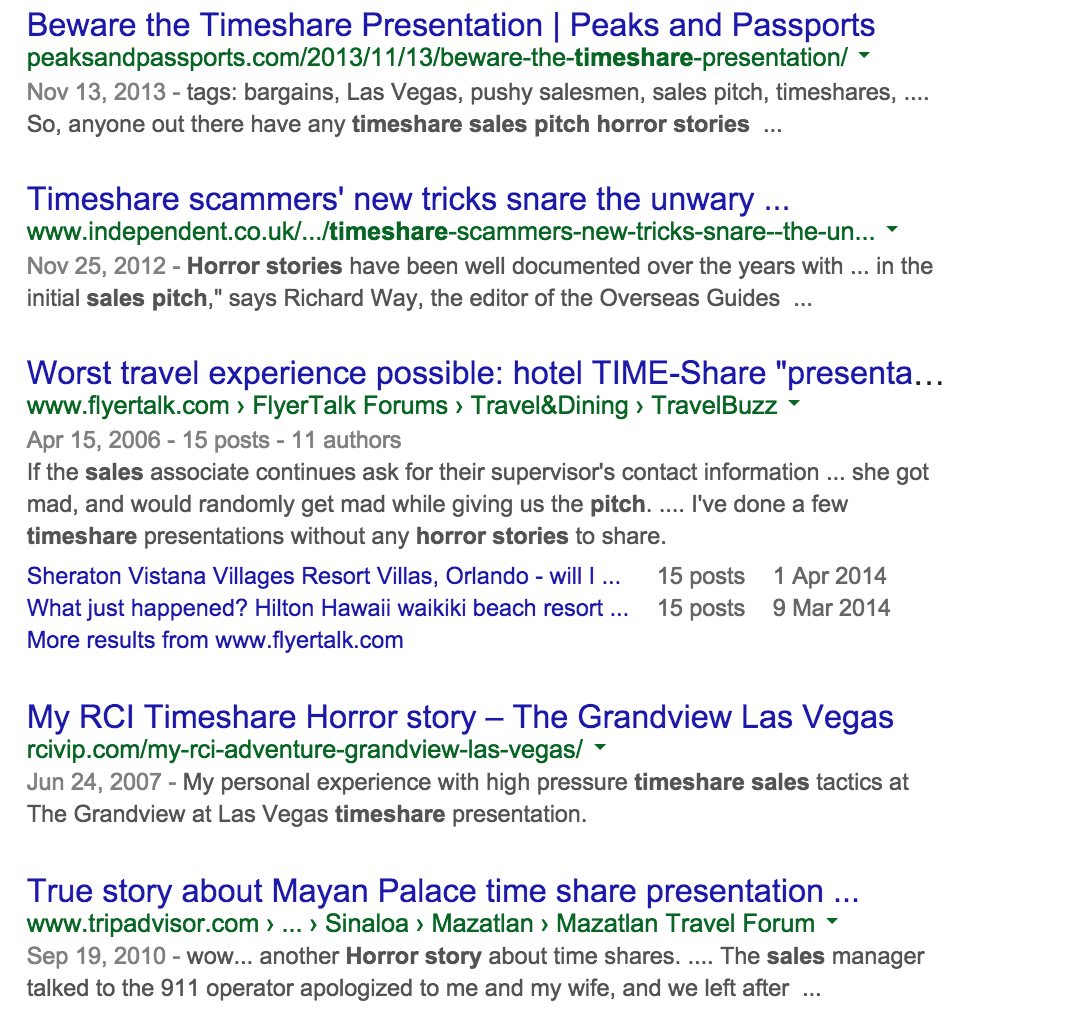
We read of timeshare presentations that would last for four hours. Of intimidation, bullying and lies. Of being bounced from salesman to salesman each time they said no. Of people buying a timeshare just to bring the experience of the presentation to an end. Horror stories filled the Google results.
I lay awake thinking of strategies that might convince the salesman we truly didn’t want or couldn’t afford the thing. The irony of missing a day’s skiing stuck in some ridiculous presentation in order to gain a free day of skiing was abundantly clear.
When the day dawned and our big white GMC SUV came to collect us at 8:30am, as promised, I had a strategy prepared.
The driver delivered us to the Hilton property at the Canyons ski resort exactly as promised. The vibe in the foyer was weird. The sales staff were loitering around and they looked professional. These were not young people moon-lighting in the game. They were old white men who gave the impression of having sold thousands of timeshares each. As we helped ourselves to the promised refreshments (juice, coffee, pre-packaged danishes – all a bit disappointing) we overheard the oldest salesman, aged perhaps 65, lecturing a man of about 55 on the appropriate length for his hair (shorter.)
Our salesman was named Sy. He was perhaps 45, and his name-tag said he was from Las Vegas, Nevada. We went from the plush foyer to a much more mundane office area, with many small cubicles purpose-built for selling timeshare. Other couples wandered round after their salespeople, as if in a daze.
Sy seemed open and honest. Early in the piece I rolled out my managment strategy – one of total honesty. I told Sy about the yeti, about Gino the salesman and his promises of free ski passes, about our excitment and then our nervousness when we read the horror stories on the internet.
Sy took this in his stride, promising to have us out of there within two hours. He wanted to know our professions, he wanted to know how much annual leave we got and he wanted to know how much we were paying for our accommodation in Park City. Our answer on this latter point visibly shocked him, because I had spent a lot of time shopping around for a good deal, and booked a place that seemed like it had been unrenovated since 1965.
This antique vending machine from the foyer of our accommodation was indicative.
Sy very much enjoyed multiplying things together on his calculator, and he showed us that if we spent that much on accommodation for two to three weeks every year for 40 years, we’d have spent tens of thousands of dollars. Lucky for him we did not mention the trip we took to China 18 months ago where we got double rooms in youth hostels at about $50 a night, because that would have ruined his sums.
The way the timeshare works is – of course – complicated. You can enjoy it in the classic sense, by simply showing up to the same location at the same time every year, but the sales pitch steers you away from that idea with the promise of points.
These points are granted every year, and appear to offer greater value when deployed staying in other properties globally (there seemed to be about 50) as detailed in a very glossy brochure.
Instead of one week in Utah, we could get three weeks in Italy, or about 20 weeks in Las Vegas in the off-season. Points could be shifted forward or back one year, but would, after two years, expire if unused. Except they wouldn’t actually expire! They’d turn into Hilton Honours points and be spendable at an even greater range of properties, as detailed in another very glossy brochure.
The right to the timeshare would exist in perpetuity, and never expire. Our grandchildren’s grandchildren could still be enjoying a week in Utah every year, Sy insisted.
I wanted to know more about the money side of things, and hear less about the points, but those figures would not be revealed until after the property tour. We set off.
It was opulent beyond belief. These were not standard hotel rooms. Sy said the development had been built as condos and then the whole thing was sold off in the GFC when the developer went under. Hilton snapped them up. He claimed they were being rented for $2000 a night in the high season, and I believed it. They were giant.
Inside the palatial rooms with our salesman, Sy.
Finally, 100 minutes after our arrival, we started talking money. I’d been wondering at the buy-in cost and had no sense of whether it would be $10,000 or $200,000. It came in at the lower end of my guesses, at $43,000 for a two bedroom property (with two kitchens, so it could be split into two normal size hotel suites).
There was, of course, an annual maintenance fee of $1200, to keep the property looking Hilton quality. The maintenance fee actually seemed pretty good to me, given the places were fully furnished, stocked with cutlery and crockery, etc. There were also booking fees of $60 or so if you wanted to use the property. And if you didn’t have $43,000 now, you could pay it off with finance at a rate of 5%, plus a closeout fee of around $1000 when the mortgage was done.
But where Sy’s calculator heroics really turned me away was when he tried to account for inflation.
He asked me what I thought was a fair rate of annual inflation and applied that to the expected accommodation expenditure stream over 40 years that we had estimated before.
But did he use it as a discount rate? No. He actually tried to inflate my expenditure stream over 40 years to make it look even bigger than the present day expense of $43,000.
At that point, I understood. Timeshare is for people who don’t understand the time value of money. Future expenditure is worth less, not more, than current expenditure.
Also, paying upfront for holidays depends on bad reasoning about the stability of your demand for holidays over time – and also your ability to pay for them. Lives can change in a way that make regular holidays a distant memory.
Timeshare also depends on misunderstanding the stability of the hotel business. If Hilton goes bust, or decides to close its timeshare operations, the value of the property will sink.
Furthermore, nowhere in the entire presentation was there anything about the rate of return you could expect if you never used the property and simply rented it out. That’s a flashing red warning that the rate of return starts with a minus sign.
Sy also mentioned that if you wanted to sell the property, Hilton had first right at buying it back. This made sense given what I’d read online, which was that second-hand timeshares sold at significant discounts to the sticker price.
After this sales pitch – which felt like an endurance race – finally got to the end, I rolled out part two of my salesman management strategy.
I repeated the key parts of his presentation back to Sy so he couldn’t get the impression I didn’t understand. Then I clearly and politely made an unambiguous statement: “There is absolutely no way we want to buy this.”
Right then, Sy handed over an envelope with two free ski passes and our $20 in cash, and let us go! It had been, in the end, far easier and less stressful than I expected. I attribute that in part to clever management by us, and in part to the selection bias for horror stories on the internet that had shaped my expectations.
Two hours work, for $114 value. Plus free coffee and juices and a free ride in a car. So, is sitting through a timeshare presentation worth doing in the middle of your holiday?
That depends on how you value your time on that particular day. But one thing is clear – agreeing to endure the sales pitch is much better value than agreeing to buy the actual timeshare.
3. International tourism is understood to have public good aspects (e.g. brand Australia) that warrant some public spending on attracting visitors. Tourism is also a public policy issue because regulations around immigration and customs, aviation and airports can determine the cost effectiveness of a trip to Australia.
But at this crucial moment for the industry, government funding for Tourism Australia has gone from $132 million in 2012 to $129 million in 2014. That’s a fall from $21.29 per visitor to $19.64.
4. The Government does not have a minister holding the title of Minister for Tourism (they do have a Minister for Sport). The Trade minister has tourism in his portfolio. But he has been accused of “neglect” for the sector.


































 Thomas the Think Engine