Latterday Knight Fever: the economics of prestige

The Abbott government has announced it bringing back Knightoods and Damehoods to Australia. Each year, four people will arise with the title of Dame or Sir.

Of course, the whole thing is a retrograde step taken by a man with, by George, a madness for kings. Knighthoods were first axed by Whitlam in 1975, reintroduced by Fraser in 1976 then axed again by Hawke in 1983.

In one way, I like it. The old honours system which topped out with ACs and AOs was both sterile and opaque. The Sir and Dame system is one that people can grasp. From Sir Lancelot to Dame Judi Dench, people see and understand. If a comprehensible public honour is not the point of an honour system, I don’t know what is.

(One also can’t deny it’s a political football that you kick up into the sky when you want to distract attention from something else, in this case the fact the Assistant Treasurer is featuring in a very unflattering way in a corruption inquiry.)

But the real question for an economist is why would people value a knighthood. It doesn’t come with a free horse and castle. It doesn’t get you a discount at the shops. In some ways it’s less useful than a seniors card.

While the income bump from winning an Oscar has been comprehensively studied, old-school conventional economics has little to say on the matter of awards for public service. Luckily our friends in the fields of behavioural economics have tuned their antennae more closely toward the workings of the human mind.

These Knighthoods and Damehoods are the ultimate in positional goods. A positional good is one whose value comes from the fact that others can’t consume it too. Being the richest person in the world, or gold medallist in swimming, having the best address in the best neighbourhood or a degree from the most elite university. The values of these goods “depend not only on the amount the individual consumes but also the amount others consume.” 

At my old employer, Fairfax, the publication of the BRW rich list was an event that carried huge importance. As if the money was not reward enough, certain business people would contact BRW to make sure their assets were sufficiently valued that they would feature prominently in the list. Being on the list did not increase the value of their money in a consumption sense, but it strongly increased its positionality.

Positional goods are theorised to create negative externalities for the many while benefiting the few (See paper from Brookings Institute.) And the giving of medals, etc. is not without negative externalities. Here is Churchill acknowledging that fact:

“A medal glitters, but it also casts a shadow. The task of drawing up regulations for such awards is one which does not  admit of a perfect solution. It is not possible to satisfy everybody without running the risk of satisfying nobody. All that is possible is to give the greatest satisfaction to the greatest number and to hurt the feelings of the fewest.”

In the case of Australia’s newest old-fashioned honour, just four will be handed out per year. Something so rare will indeed have cachet to spare.

The honours are apparently designed for public service, so the tabloids obsession with a Sir Shane Warne may never materialise: “My intention is that this new award will go to those who have accepted public office rather than sought it and who can never, by virtue of that office, ever entirely return to private life,” Mr Abbott said.

Such prizes may be efficient. In a world where tax dollars are not exactly overflowing from Treasury coffers, the government can use prizes as compensation for jobs that would otherwise command a lot of pay.

As Bruno Frey notes in his paper Knight Fever (which title I happily stole for this post) “The material costs of awards may be very low, or even nil, for the donor, but the value to the recipient may be very high.”

Where you can pay someone with a reward that costs you nothing, it would be economically unwise not to do so.

Phaleristics is the study of awards. There is a strong economic literature on the merits or using awards as motivation. From the merits of prizes in furthering science to prizes for poetry and independent film. 

Awards litter most fields. They are especially prominent in fields where the best make a lot more money than the rest, such as acting, and in fields where the government pays the players (the military). These may be fields where contracts are especially hard to specify ex-ante.

Awards like sportsperson of the year carry less weight than Best Actor awards, because it is far easier to identify success in sport, so an award adds little marginal value. (Roger Federer does not always show up to accept the Swiss Sportsperson of the Year award.) Similarly in fields where a free market determines the pay of participants, such as the private practice of law and business, awards are less visible and carry less prestige.

But the award benefits not only the recipient. Mr Abbott emphasises the reciprocal nature of these awards. They are intended in his mind not just as reward for service, but are in fact a payment for keeping mum:

“If you’ve been the Governor-General or a Governor, there are certain things that you can never really do again. You can never really be as free with your opinion as might otherwise be the case. There are certain jobs that you could never really do again because of the position that you’ve occupied. Ditto for a Chief Justice. There is lots of legal work, for instance, that a former Chief Justice could never really do. If you’re a former Chief of the Defence Force or a former Chief of Army, there are lots of issues upon which you can never really comment by virtue of the position that you’ve held. I think when someone does accept a position of such importance and gravity in our system, it is perfectly fitting to honour them in this way.”

When it comes to creating new awards, there may be motivation on the part of the giver, too:

“The institution (or person) bestowing an award can be taken to be a principal who maximises his utility by inducing the agents, as the recipients of the awards, to behave in his interests,” Professor Bruno Frey argues. He continues:

“The whole area of awards is very vague. The semantic is unclear and the various types of awards are not well defined. There is, for example, no clear distinction between orders,  decorations or medals, and they can go with or without titles and money. It will be argued in this paper that these unclear distinctions are no accident, but an important feature of awards. The suppliers of awards have an incentive to differentiate awards at many different levels and to continually create new awards.”

Managing to keep Australian knighthoods and damehoods to just four a year may prove very challenging. And if it can be done, might such an exemplary public adminstrator not be rewarded with the creation of a still higher honour? Time will tell.

Thoughts on the economics of honours and awards? Further reading you’d like to suggest? Put your thoughts in the comments section below!

Economics of Murder in Mississippi

I got the new non-fiction book by John Safran for Christmas. Murder in Mississippi. It was a quick read and a good one.

The premise: Safran knows a white supremacist in Mississippi – when the guy gets murdered he heads over to write a true crime book. The story only gets better from there.

Now.

Perhaps I’ve been overs-sensitised to costs by working for the Australian Financial Review (“BYO phone”, “travel by bus”, “we’ve run out of pens”). But throughout the book, Safran incurs big expenses that left me wondering if he, or Penguin, were going to actually make money on the book.

Let’s have a look:

Expense 1. Travel. Jackson is halfway between Dallas and Atlanta, or if you like, halfway between Miami and Denver. Today, the cheapest flights Melbourne – Mississippi are $1642.

Expense 2. Living. When he moves into the Sleep Inn and Suites in Jackson Mississippi, they are brand new and the carpet, which he says “feels like minigolf astroturf,” squeaks. Its advertised price is now $79/night.

Safran writes that he stayed in Jackson from winter to summer. Penguin claims “Over six months, Safran got deeper and deeper into the South.” During that time, Safran also went off to other parts of America to make some TV.

He also stayed at the Ashford Place apartments (circa $1000/month.)  If we assume he spent 6 weeks in the first motel and 10 weeks in the second one, that’s around $6000 on accommodation. I’m budgeting $50 a day for food and drink, for four months. That’s $6000 on food.

[Running total $1642 + 6000 + $6000 = $13642]

Expense 3. Car hire. Unavoidable. Jackson’s public transport situation is the sort of unholy tangle that would make Jarrett “Human Transit” Walker apoplectic. Four months of the cheapest Hertz car on monthly booking adds up to $4000. Plus, say another $1000 for gas? (Mississippi gas prices are almost the lowest in the US, equivalent to $A0.897/L)

[Running total $1642 + $6000 + $6000 + $4000 + $1000 = $18642]

Expense 4. Bribing the incarcerated.

This is the one that really caught my eye. The book includes a series of trips to Walmart where Safran buys phone cards for the murderer. He also delivers some other goods on his behalf. I won’t spoil the book by telling you what they are.

At one point the murderer asks for $2500 and Safran says “I can’t give you $2500. I don’t have much money left.”

Click here to see the murderer’s facebook profile (friends include one J.Safran!).

Assuming the items mentioned in the book are everything, that’s around $2650.

[Running total $1642 + $6000 + $6000 + $4000 + $1000 +$2650 = $21292] 

So. Twenty-Two Thousand Dollars. Quite the bill.

It is probably more than he budgeted. The book reveals he didn’t expect to spend so long in Jackson. He’s barely been in the place a few weeks when the expected trial is delayed.

murder in M

Safran is a big name as these things go, and I guess he was spending an advance he got from Penguin.

Instagram reveals that around the time the book was launched, Safran visited a whole heap of bookstores and posed for photographs with the proprietors. He did shows in Melbourne and Sydney to promote the thing.

Penguin is working hard to sell the book. There’s even been posters up around the place, as though his book was a rock act coming to town.

As author Ian Irvine explains here: “The promotional budget for your book is, generally, directly related to the size of the advance.”

Advances vary a great deal.

Melbourne internet publishing impresario Mel Campbell got $5000 for her book Out of Shape. Flinders University student Hannah Kent got over $1,000,000 for a two book deal, after writing one about an execution in Iceland. (!)

Safran is probably in the middle. I’d guess his advance is around $60,000. It is his first book and he’s got no form as a writer. On the other hand he is a publicity machine, especially among those who would buy non-fiction.

If I am right, that means he made $38,000. He could make more if and when the royalties cover the cost of the advance.

But he had to take time off from his radio show. Even if he got a $100,000 advance, and pocketed a large chunk of it, missed wages are a major cost of the book.

(Money would be scant compensation for hanging out in Jackson, which seems like the worst of what’s bad about America.When I dragged and dropped the orange Street View man onto a random corner of inner-city Jackson, I found myself on a huge roundabout with multi-lane roads in all directions, and no buildings in sight except a church.)

Quantification and snark aside, the book is pretty terrific, and I am insanely jealous. You have to invest to make something like that happen.

As his friend Lally Katz says to him in an email at the start of the book:  “What an exciting thing to do. You’d have such a great and sometimes dangerous adventure.”

Here’s the real economics of it all. A true adventure like that is scarce and therefore valuable. Of course it is worth it. Getting paid to adventure is every man’s dream. Speaking of which, The Economics of a Great and Sometimes Dangerous Adventure sounds like a book people would read. Any publishers reading who feel like commissioning that title?

People before what kind of profit?

Profit may be the most emotive and most disagreed-on word in the modern political lexicon.

Screen Shot 2014-01-25 at 3.09.41 pm

For some people, it conjures up a deep positive energy. It’s the lacquer of success that tells you your life has not been in vain, a thank you message from the universe.

For others, it’s a totem of greed. It’s the fuel barbarians pour onto the  bodies of the civilised before they burn them all, throw back their heads and howl as the smoke covers the moon.

Both can be right.

Whether you drive a Rolls Royce or a 1990 Subaru with a bumper sticker that says People Before Profit, you need to know this.

There’s two types of profit.

Economic profit (bad), and accounting profit (fine).

(for more: 1 2 3 )

Let me explain.

Accounting profit is what a business makes after it has paid all its staff, all its bills, but before it pays the people who put the money into the business. People who funded the business to start up need a little bit of sugar to keep their money in there instead of putting it in the bank.

Imagine a small business person who delivers things you buy on the internet. She buys a van, putting $30,000 into the business. If that money was put in the bank and got 5 per cent return it would make $1500. So the small business needs to make at least $1500 in accounting profit, on top of paying wages and bills, to compensate the person who funded the business.

That accounting profit is necessary for the business to run. If there’s no accounting profit, the delivery business will shut down, as the delivery woman realises she should sell the van, put the money in the bank, and work for someone else.

(In reality she should be looking for slightly more than $1500 in accounting profit, to help compensate her for the risk of running a business, which is much higher than plonking your cash in a government-guaranteed deposit.)

So, accounting profit is necessary for businesses to exist. The alternative is the business shutting down.

When you see Woolworths Limited reporting a before-tax profit of $3.4 billion on sales of $58.5 billion, some of that is the accounting profit necessary for the share to be worth anything at all.

But some of it might be economic profit. Let’s go back a step.

Us economists think accountants are simpletons. We like to think about opportunity cost.  We think that you should measure your ‘profits’ against the next best use of your money. So economic profit is not the little bit extra you need to pay back the person who funded the business. Economic profit is extra on top of that. If you make a lot of economic profit, something has gone wrong.

Some businesses make enough money that their owners don’t just get a nice 5 per cent return on their investment. They make enough that it rains cash. That’s often economic profit, and it’s a bad sign.

Unfortunately, it’s not always clear if a company’s profit is simple accounting profit or the extra economic profit.  When an company reports profit, it includes some that is necessary to cover the cost of capital, and the gravy.

PROFITLESS

Here’s the thing: under the assumption of perfectly competitive markets, there should be no economic profit in the long run. Businesses should make enough to cover their cost of capital and not any more.

It’s only during deviations from perfect competition, or when market failures creep in that economic profit can occur. Sometimes firms can create economic profit for themselves by behaving in an anti-competitive way. They have an incentive to do that, which is why we have to have competition law.

The most obvious market failure is market power. If a company is part of an oligopoly, or worse a duopoly (Hi Woolworths), or worst of all, a monopoly, then economic profit can be expected to ensue.

CBAThis is why we can be fairly sure the profits of Australia’s big four banks are not simple accounting profits. They operate in a protected space under the four pillars policy.

Australians think there is far more bank competition than there really is.

Of course banks should make enough to compensate the people that own the capital that allows the bank run. But should they make more?

Commonwealth Bank, Australia’s biggest, made $7.7 billion in profit last year.

The value of the Commonwealth Bank is $120 billion at time of writing. It was, at least until recently, in the top ten biggest banks in the world by value, even though it is not in the top ten by assets.

Any industry where all the competitors are making  extra profit on less assets should ring alarm bells. There is almsot certainly economic profit being made, and it is being made at the expense of the customers.

IS THERE NOTHING WE CAN DO?

I’m glad you asked.

A tax design idea is floating around – currently out of favour – called allowance for corporate equity. It is gentle to accounting profits, and starts to snarl and salivate when economic profits are made. As the name implies, it would allow profits to cover the cost of equity [that’s the money the owner put in, or the $30,000 van in the example above]. After that, taxes rise.

Another way of putting that same idea is to say ‘take the mining super-profit tax and apply it across all industries.’

Here’s an excerpt from the Fairfax press, quoting one of my old lecturers, John Freebairn.

“At the tax summit, Melbourne University’s John Freebairn, a former research director of the Business Council, said Australia’s super-profits tax rate might be ”more towards 40 or 50 per cent”. It would only be paid by companies earning ”monopolistic-type rent”. ”And let’s rub it into the banks,” he added. ”They seem to make much higher returns than anyone else.””

But that would not be popular. It’s one reason Wayne Swan ran from the Allowance for corporate equity idea when it had a brief resurgence a few years ago.

But recognising the difference between the types of profit is crucial for anyone who wants to make a difference to society. Tax policy makers know better than anyone else that companies making a super profit are probably managing it at the expense of the consumer. We should not stint from hitting them with extra tax.

“I know the RBA sets interest rates but I’m embarrassed to ask why.” An explainer

“I know the RBA sets interest rates but I’m embarrassed to ask why.”

Someone said this to me at a party recently. In trying to explain interest rate policy by shouting over Daft Punk I achieved simultaneous pedagogical and social failure.

This setting, I hope, is a more appropriate place to provide the answer.

The Really Simple Version:

Interest rates are the brakes on inflation (price rises). When the RBA changes interest rates, they are trying to control inflation.

Higher interest rates slow inflation down.

If you notice the price of a sandwich keeps going up, the Reserve Bank is probably getting worried about high inflation. The RBA watches price rises by looking at the consumer price inflation data. If inflation is getting too high they will raise interest rates.

Lower interest rates speed inflation up.

On the other hand, if shops are having big sales that suggests prices are falling. The RBA is probably worried about low inflation. It might cut interest rates.

The RBA’s job is to keep consumer price inflation between 2 per cent and 3 per cent, annually. If price rises are above 3 per cent, they will raise interest rates. If price rises are below 2 per cent they will cut interest rates.

How does that work?

High interest rates slow down spending.

  • For people: If interest rates go up, it makes sense to put more money in the bank, not spend it.
  • For companies: If interest rates go up, you won’t borrow money to build a new factory. You’ll try to pay back your loans.

Low interest rates do the opposite.

  • For people: If interest rates go down, it makes sense to take your deposits out of the bank and spend them.
  • For companies: If interest rates go down, you can borrow to build a new factory.

Spending matters because the rate of spending affects the way companies set prices. If items are not selling, companies will put them on discount. If they are selling out, they may even put up prices.

This is the basic lesson. The RBA is controlling interest rates, to affect spending, to affect inflation.

The fairly simple reason we care about inflation:

Too much inflation can be bad – it means the money you have saved buys less and less.

But we don’t aim for no more price rises ever – because price rises can be good.  Inflation can be good because it CAUSES spending. I know we just said spending causes inflation. But it works both ways. Think about this:

If inflation is high, your money is losing value, so it makes sense to spend it. If $100,000 will buy you a Mercedes today, but it will cost $105,000 next year, it makes sense to spend the money now. That spending will pump up the economy.

If inflation is low, however, it makes more sense to save your money. Of course, if everyone saves, the economy suffers.

i.e. The way people react to inflation (spending/saving) is important to economic growth.

The RBA tries to balance the speed of the economy so we get the right amount of spending and saving to keep the economy growing. Inflation is kept between 2 and 3 per cent, because we’ve decided that is a good range to keep spending and saving in balance.

Why do we care about growth? Growth affects unemployment, and thereby people’s health and happiness. That’s why the newspapers pay so much attention to it.

Advanced class: How does the RBA control interest rates?

The RBA doesn’t set your bank account interest. And it doesn’t set your home loan rate. So what is it controlling?

The one market that rules them all.

The overnight cash market is the shortest-term loan in the market. Big banks borrow in there for just a few hours.

Because you can make a year-long loan out of 365 overnight loans, targeting the overnight loan market affects all other loan markets.

So the RBA gets in there and plays. It literally buys and sells money in that market so that the interest rate does not deviate from the publicly announced official cash rate (at present 2.5 per cent).

(Interest rates are the price of a loan, so increasing supply of money in that market lowers interest rates, decreasing supply raises interest rates).

The RBA is damn good at getting the overnight cash rate to match the target rate.

#winning
#winning

PhD level: Does the RBA have to balance unemployment against interest rates?

In the United States, their Reserve Bank (the Fed) has what they call a dual mandate:

“maximum employment, stable prices”

In Australia, the RBA technically has a triple mandate.

The Reserve Bank Act 1959 says it must act to ensure:

  1. the stability of the currency of Australia;
  2. the maintenance of full employment in Australia; and
  3. the economic prosperity and welfare of the people of Australia.

But that has basically been waived. A statement is agreed between the Treasurer and the Governor of the RBA after each election, agreeing that the bank should focus most on inflation when setting monetary policy:

“…allow the Reserve Bank Board to focus on price (currency) stability, which is a crucial precondition for long-term economic growth and employment, while taking account of the implications of monetary policy for activity and levels of employment in the short term.”

Why not focus on employment too?

Back in the day, economists thought  you could have low unemployment if you were willing to pump up the economy enough to have high inflation. Now we know this is not true.

You get a short term bump in employment under high inflation because the wages are not actually worth as much as the workers thought they would be. Workers aren’t dumb though, so once they re-calibrate their inflation expectations, they stop being willing to work for those crappy wages.

That means solely focusing on inflation is the surest way to promote low unemployment.

That’s the end of the lesson on interest rates! I hope it was helpful. Now you can nod wisely when Alan Kohler does the finance news.
Why Bunnings prices are so damn clever.

Bunnings is more than a gigantic hardware store. Its canyon-esque aisles whisper to you of self-reliance and ruggedness, if not quite suggesting a log cabin of your own construction then at least the sort of Barbecue a man can be proud of.

Once you’re over about 26 it seems to slowly turn into a refuge, a bit like Thoreau and his woods.There’s always a sausage sizzle out the front on weekends and it has become an Australian institution.

Nevermind that it is based on an American big-box retailing model, or that it has only been a national chain since 1994, after it bought out McEwans hardware, closed most of the outlets, then sold itself to mega conglomerate Wesfarmers.

The reason there are now around 280 Bunnings nationwide is that the store is so good. We don’t begrudge the many hours spent lost in its chasms and nooks.  It’s like that because it is cheapest. Right?

A tentative Google suggests, um, well, :

Image
At Bunnings, $34.99
Image
Online, $27.50!

There are three big tricks that Bunnings uses to reinforce the widely-held belief they are so cheap.

1. They often choose prices that to the first glance look odd. For example, they sell hammers for $8.45, $37.97, and $62. Apparently the theory is a range of irregular and specific numbers make customers think the price has been ratcheted down as low as it possibly can be.

Rather than having all the prices in the format $X9.99, the prices imply Bunnings takes the trouble to price everything at its minimum.

2. Using people from the stores in the ads. (I thought they might be actors but the internet says no. There are 33,000 staff so I guess some must be able to pass a screen test).

The point is, this is signalling. Bunnings has ads on during high-rating shows – they are not stinting on their marketing budget.

But if they deploy great cinematography and a highly polished vibe, like you might see in a car ad, it creates the impression they are wasting money on ads. Instead the ads look cheap and cheerful. The same motivation is behind The Good Guys using their staff in ads even though they too are a heavy-hitting national chain. (Baker’s Delight use their staff in ads to signal something else – that the bread is made by real people, not a factory.)

The signalling effect even flows through to the way stores are designed. Here’s Cotsco founder Jim Sinegal talking about his store’s budget vibe.

“We try to create an image of a warehouse type of an environment … I once joked it costs a lot of money to make these places look cheap. But we spend a lot of time and energy in trying to create that image.

3. “Lowest Prices guaranteed” / “Lowest Prices are just the beginning.”

This slogan seems to have moved away from using the word “guarantee” recently. But the claim is still a strong one. The only way Bunnings can get away with it is their price-beat guarantee: “Find a lower advertised price and we’ll beat it by 10 per cent.”

That is an extremely clever business plan. While anyone might think they could mock up an ad that offers something very cheaply and trick Bunnings into giving them a deal, the reality is the store would happily accept being tricked to get the benefits of such an offer. They would probably rather more people took them up on the price-beat guarantee.

Let me explain:

The effect of the price-beating offer is to permit price discrimination. They can sell things at a higher price to people that don’t bother shopping around, and at a lower price to those that care about price. That means they charge different prices to different types of people, just like a hotel or airline does, maximising yield.

But the real killer of a price guarantee is the way it discourages other chains from discounting and promoting. If I run Think Engine Hardware, why would I put an ad in the paper telling everyone Cordless Drills – Now 30 per cent Off!? I know customers can and will still go to Bunnings. Offering to beat advertised prices is very close to being anti-competitive behaviour, as it can cause all firms to raise prices.

From the great knowledge fount:

“While a store with price matching guarantees has no fear of losing customers to rivals’ price cuts, it has every incentive to raise its own price to charge a higher price to its loyal customers. It is an anti-competitive tactic that warns competitors not to attempt to steal market share by undercutting prices.”

So, Bunnings is like any other retail operation, playing clever psychological games to disguise healthy mark-ups.

It had earnings of $900 million on revenue of $7.7 billion last year, and contributed 26 per cent of Wesfarmers earnings before tax, etc. Wesfarmers is currently working on “conversion of the property pipeline into trading locations at a higher rate than historically achieved” in order to help Bunnings contribute even more to its annual profits, which were, last year $2.2 billion.

Do Crime and Meth addiction have to rise in Geelong?

Economically, the end of aluminium smelting and car-making in Geelong makes sense.
Both are low-wage, dead-end industries propped up by government subsidies. They subtract from our net welfare, as a nation. That’s the meta view. The view from space.

You don’t need to be a social scientist to know that when industries close down, disadvantage gets concentrated. I wrote about this recently in the context of another Australian city, in this post: Detroitelaide.

Economists cover this issue in the term “transition costs”, but that doesn’t really tease out how painful they are

Bruce Springsteen’s whole career is built on reflecting the suffering of the US rustbelt, where manufacturing’s long decline has hurt generation after generation.

From his 1983 song My Hometown:

“Now main street is whitewashed windows and vacant stores
Seems like there aint nobody wants to come down here no more
They’re closing down the textile mill across the railroad tracks
Foreman says these jobs are going boys and they aint coming back to
Your hometown, your hometown, your hometown, your hometown”

to his 2012 song “Death to My Hometown

“Now, no shells ripped the evening sky
No cities burning down
No army stormed the shores for which we’d die
No dictators were crowned.
I awoke on a quiet night, I never heard a sound
The marauders raided in the dark
And brought death to my hometown
They brought death to my hometown
They destroyed our families, factories
And they took our homes
They left our bodies on the plains
The vultures picked our bones”

Bruce’s songs resonate because these stories are real.

I have Springsteen on the brain but you don’t need to look as far as New Jersey to find pockets of suffering due to declining employment.

Victoria’s Latrobe Valley suffered a huge decline in employment in the 1990s when the State Electricity Commission was privatised. Towns out there are still setting records for socio-economic disadvantage:

So the citizens of Geelong must be worried. To lose Ford in 2017 was going to be hard enough. Will the 800 jobs at Alcoa prove critical? Luckily, Geelong is a much bigger city than any of the towns in the Latrobe Valley.

It has a university, a football team, an airport and a burgeoning market for tourism. The Government is likely to tip in money. There is a Geelong Investment and Innovation fund worth $25 million. Labor is agitating for that to increase to $100 million.

But even with that money Geelong will need to work very very hard or else its major export might end up being suffering. And singer-songwriters playing poignant minor-key rock anthems about it.

Small Business: Saintly and Ascetic?

In the wake of the Commonwealth government’s decision to not provide $25 million to Coca-Cola Amatil to revamp the SPC canning facility in rural Victoria, a particular sort of argument about small business seems to have gained currency.

“If a small business person runs their business badly, they personally suffer… Coca-Cola wants the taxes of small business people to subsidise their business failure.” Ken Phillips argued in the Australian this week.

On ABC TV’s Q&A, Yolanda Vega said this:

“We seem to keep making the same mistakes. There’s these massive businesses that keep getting bailed out, and yet the small business of Australia which make up 96 per cent – are completely ignored.”

Among the people apparently so busy ignoring small business are Commonwealth Minister for Small Business Bruce BillsonVictorian Minister for Small Business Louise Asher, NSW Minister for Small Business Katrina HodgkinsonWA Minister for Small Business Joe FrancisSA Minister for Small Business Tom Kenyon, and Queensland Minister for Small Business Jann Stuckey, not to mention an array of shadow ministers and small business commissioners.

Image
The tax on interrogative punctuation hits yet another local enterprise

Governments want to help small businesses so much it hurts, even if they don’t always know how…

Victoria has a small business commissioner, promising help in creating a fair and competitive environment; and another entity called Small Business Victoria. The state puts on a small business festival; small business workshops and seminars; not to mention providing help for small businesses through Regional Development Victoria.

When Yolanda Vega said small businesses were “completely ignored,” she obviously hadn’t seen this recent press release from Victorian Small Business Minister Peter Crisp, where the government committed to buying in consultants for 500 Victorian businesses. 

As the source who brought this to my attention says, “What a joke.” This “scattering bread to the pigeons” approach to business welfare is uniquely formulated in terms of its capacity to not be helpful in any strategic sense.

The State government also spent $70,000 recently on a study tour of Europe, designed to figure out the smart ways to support small businesses. (Manchester, London, Amsterdam, Berlin – at least it wasn’t Cannes, Monaco, Sorrento, Santorini).

Image
Small business policy is wigging out

The federal government doesn’t want to be left behind either. Competition laws are being shaped to give small business a better run, and the government is funding a superannuation clearing house to reduce compliance costs for businesses with less than 20 staff. The ATO has recently launched an app for small businesses too.

I crossed paths with Small Business Minister Bruce Billson at a Real Estate agent in suburban Carnegie late last year. He was eager to cast everything the Abbott Government was doing, including removing the carbon tax, as a response to the needs of small business.

Small business account for ten percent of the tax take, but more than that in terms of votes. The idea they play under the same rules and fight on the exact same terms as big business is untrue.

No business is easy, but no business should be easy. Competitive markets should have business owners – whether they are shareholders in a major miner or baristas at a minor cafe – worried about the medium term future and working hard to secure it.

The help big business gets might be news-worthy and include big dollar figures, but the narrative that only small business represents some sort of Ayn Randian ideal of free enterprise should be quashed.

How Fairfax helped kill car-making.

Toyota is going. And yet the government is barely sweating. They stand at the dockside, waving their hanky, thinking of something else. Not even a crocodile tear in their eye.

This, in an environment of rising unemployment, is politically shocking. How has it happened the populace apparently no longer wants this key industry saved? The answer is not that the Australian people have suddenly swallowed an Economics 101 textbook. It is just in the “national mood.”

And that mood is still shaped by the media…

One could trace the beginning of the end of support for Australian car manufacturing to 2011. The economics editor of the Australian newspaper was a man called Michael Stutchbury. A man with ambition. Fiery and with salt and pepper sideburns, “Stutch” put his hand up for a new job that was going across town.

He wanted to be handed the editorship of the Australian Financial Review – Australia’s only business daily. A paper loved and feared in decision-making circles. 

The top echelons of Fairfax considered the CV of the man. He was a man of strong views, sure, but the Fin Review had floundered under middle-of-the-road helmsmanship, so perhaps that was not just desirable, but necessary.


Image
Source: The Australian

Stutch arrived at the Fin amid a surge of excitement, armed with a two-word slogan: Agenda-Setting.

“I think we can turn it into a growth story by reinvigorating the journalism, concentrating on news breaking, going back to setting the agenda,” he told ABC business reporter Ticky Fullerton at the time of his appointment. The move to agenda-setting came with an advertising campaign too, that made the odd choice of appropriating some classic communist propaganda tropes.

The newspaper proceeded to take a far sterner line in deciding what was and wasn’t news. But it went a step further than that. The paper made some things into big news. 

Stutch’s sharp news-sense, formed at the Fin Review but forged in the right-wing foundries of The Australian, combined with his purist views of the government’s role in the economy, meant the car industry was a prime topic. I personally spent hours camped out front of Toyota’s Altona factory getting soundbites from workers, hours trawling through the car statistics to find an Australian manufacturing angle, hours looking into the history of government assistance to the industry.

I even interviewed motor-racing legend Dick Johnson about the possible end of the Falcon, a story idea I was told came from the very top. (Johnson said: “Australians have an affinity with a front-engine, rear-drive car [and] a medium to large body size . . . But it may only be my generation that sees that.” The paper printed the story and a picture.)

Anything with a car industry assistance angle was easy to get past the mid-level editors and into the paper, because they knew Stutch would love it. So he didn’t have to personally demand every single story that the Fin published. The car industry was hot, and everyone knew it.

Image
The Melbourne Bureau, 2013.

Not long after Stutch got the job, Tony Abbott announced cuts to car subsidies. 

Would the government keep this risky promise? The issue remained firmly on the agenda. I wrote at least ten stories on the topic, (1 2 3 4 5 6 7 8 9 10) and I was perhaps only the fourth reporter in line to write car stories, behind Mark SkulleyPeter Roberts, and Lucille Keen

(Three of the four reporters listed above no longer work at the Fin.)

But once set, the agenda doesn’t stay inside just one newspaper. If the Fin is in a lather about the car industry, then the Age gets a bit of froth on it too, as do the Sydney Morning Herald, the Herald Sun and the Advertiser. The tone of coverage nationwide took a subtle turn.

Now, newspapers can push barrows without getting anywhere. What gave the AFR barrowload so much momentum was the political gradient. Labor was clearly sliding out by 2013, and the Coalition was ascendent.

Stutch’s steadfast campaign was given legs because it coincided with a Productivity Commission report and a bright new political day (not to mention political capital in the shape of dozens of one-term backbenchers).

Newspaper editors are powerful people. The Abbott Government is emboldened to make the decisions it is making – decisions its predecessors were unwilling or unable to make – because the prevailing climate is one in which they can expect some media support for the decision. Neither national paper is going to crush the government for cutting the funding which kept car manufacturing here.

I can’t help wondering how Stutch feels today, with the end of Australian automotive manufacturing a reality.

Perhaps I am naive but I can’t quite imagine champagne corks popping. I prefer to imagine him slightly frightened. As in, “Jeez, I can’t believe I just did that!” Like the start of a superhero movie. In that context, here’s a quote I think worth remembering for newspapers editors everywhere: “With great power, comes great responsibility.” 

Rent, buy, panic? Auckland’s House Prices now Higher than Melbourne

We have got so used to leading New Zealand in all matters (possibly excluding rugby) that the facts of New Zealand’s economy break into our consciousness only slowly. 

Image

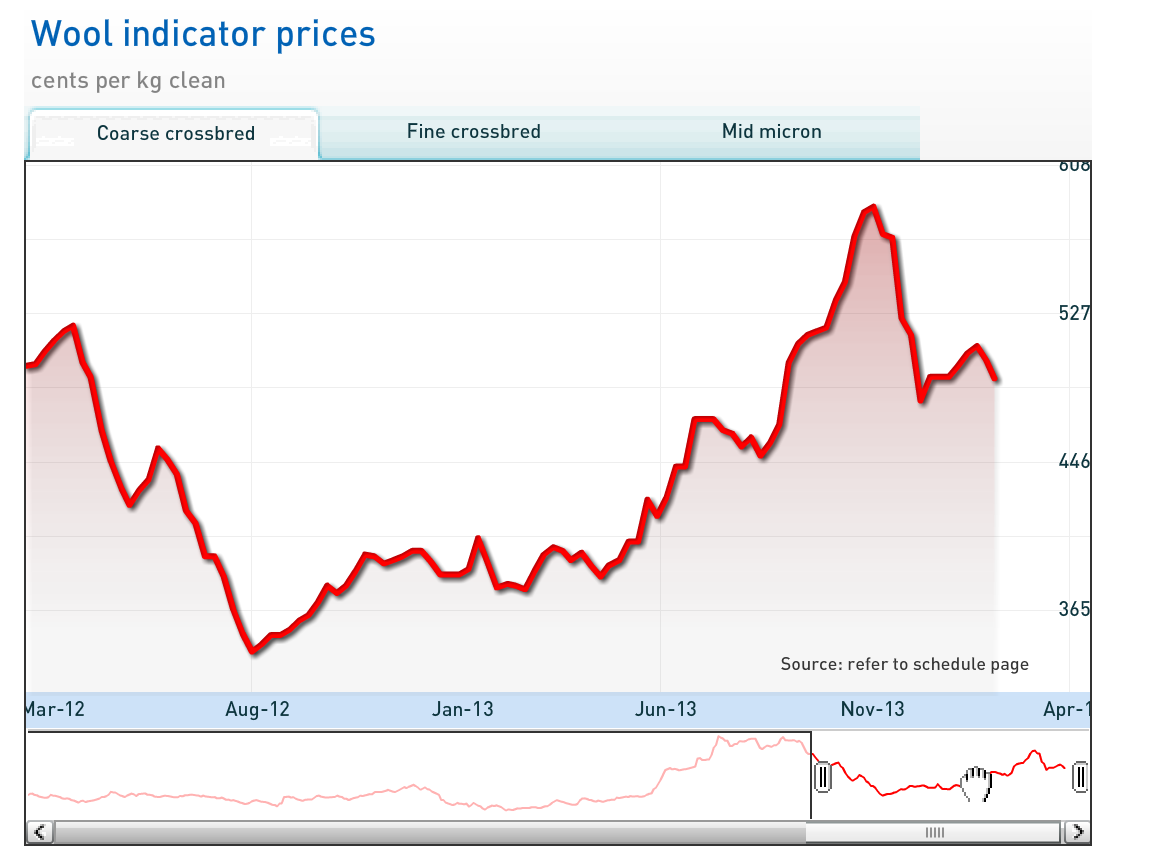
But here is the truth: New Zealand’s wool industry is a golden fleece and its dairy industry is a cash cow. The Chinese consumer’s taste for consumption is fuelling demand for soft commodities that is making Aotearoa like Perth. They are enjoying a “dining boom” just like our mining boom.

That’s happening at the same time as free-market policies pushed by right-wing Prime Minister John Key, so that New Zealand is coming out of the GFC far richer than it went in.

The rum in the punch at this prosperity party is Auckland property prices, which have risen wildly in the last two years.

Image


If you’re a beneficiary of the great kiwi boom, you might like this “choice as” property offering:

Image

The property price boom is spreading even to the unfavoured areas of Auckland.

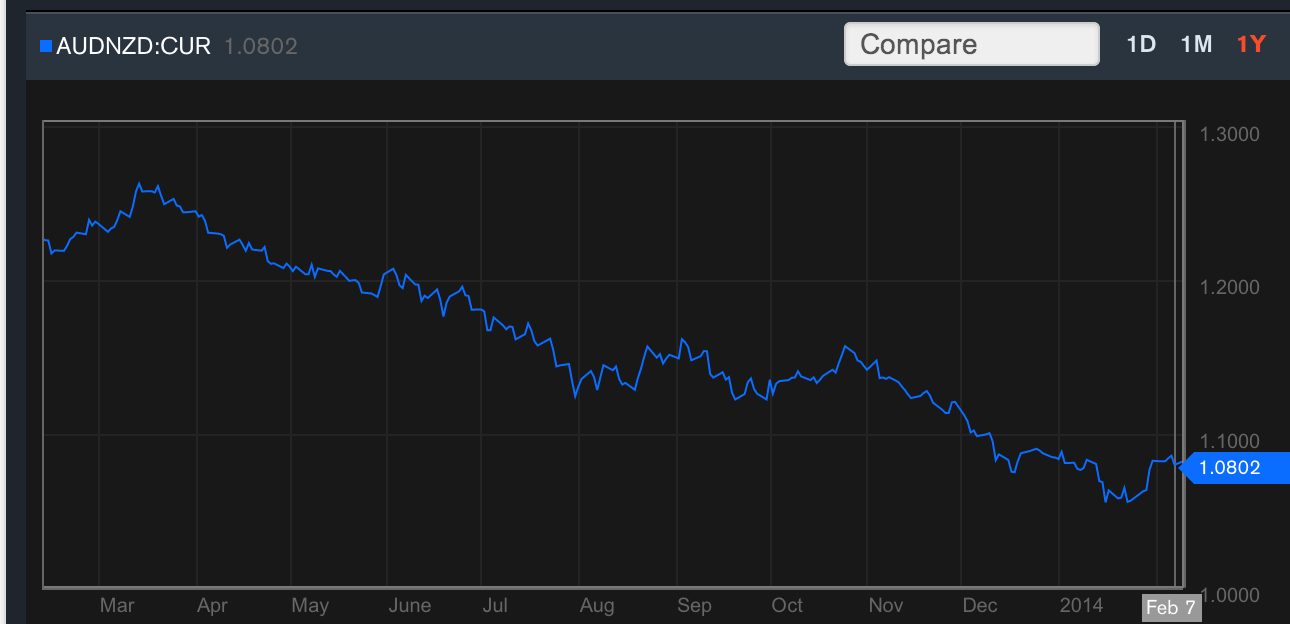
Another sign of the booming Kiwi economy is their dollar. We may soon be on the wrong side of parity.

Image

And it’s not just Auckland where house prices are booming. Ordinary homes in out-of-the-way parts of the South Island are also priced oddly high.

Image


The other great explanation for this is low low interest rates. Australia got its official cash rate down to 2.5 per cent just last year. New Zealand has had rates at that level since March 2011.

The rise in house prices has been so marked that the government introduced special laws to try to cap price rises. They have tried to limit the value of loans going to borrowers with low deposits.

So can these high house prices be justified?

New Zealand is still not as rich as Australia, minimum wage there is $13.75, compared to $16.37 in Australia. Average and median earnings are lower too – Kiwis earn 26 per cent less.

It is concerning.

When I think about New Zealand’s housing market, I get the feeling it it is self-evidently frothy. That the bubble will pop. That the end of all this Will. Be. No. Good. 

That is almost exactly the same patronising attitude all these flown-in experts have when they talk about the Australian market. Here’s the latest one, printed just hours ago.

So what can we learn here? That an outside perspective on house prices can feel very different from an inside perspective? That rapid growth should ring alarm bells? That the Chinese demand may not be as guaranteed as the Kiwi market seems to believe? Or just that we should have bought in Auckland two years ago?

The decline of economics?

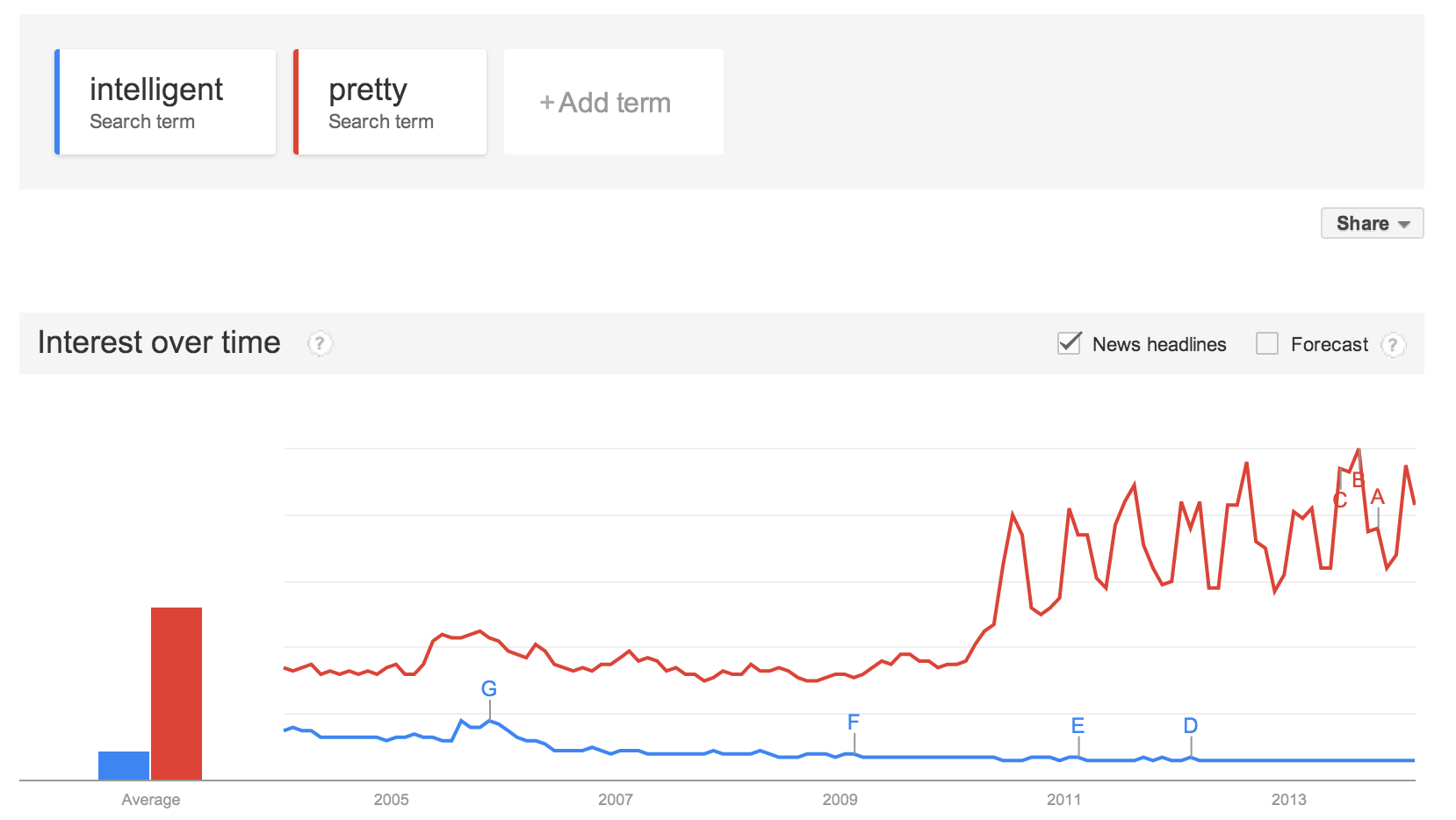
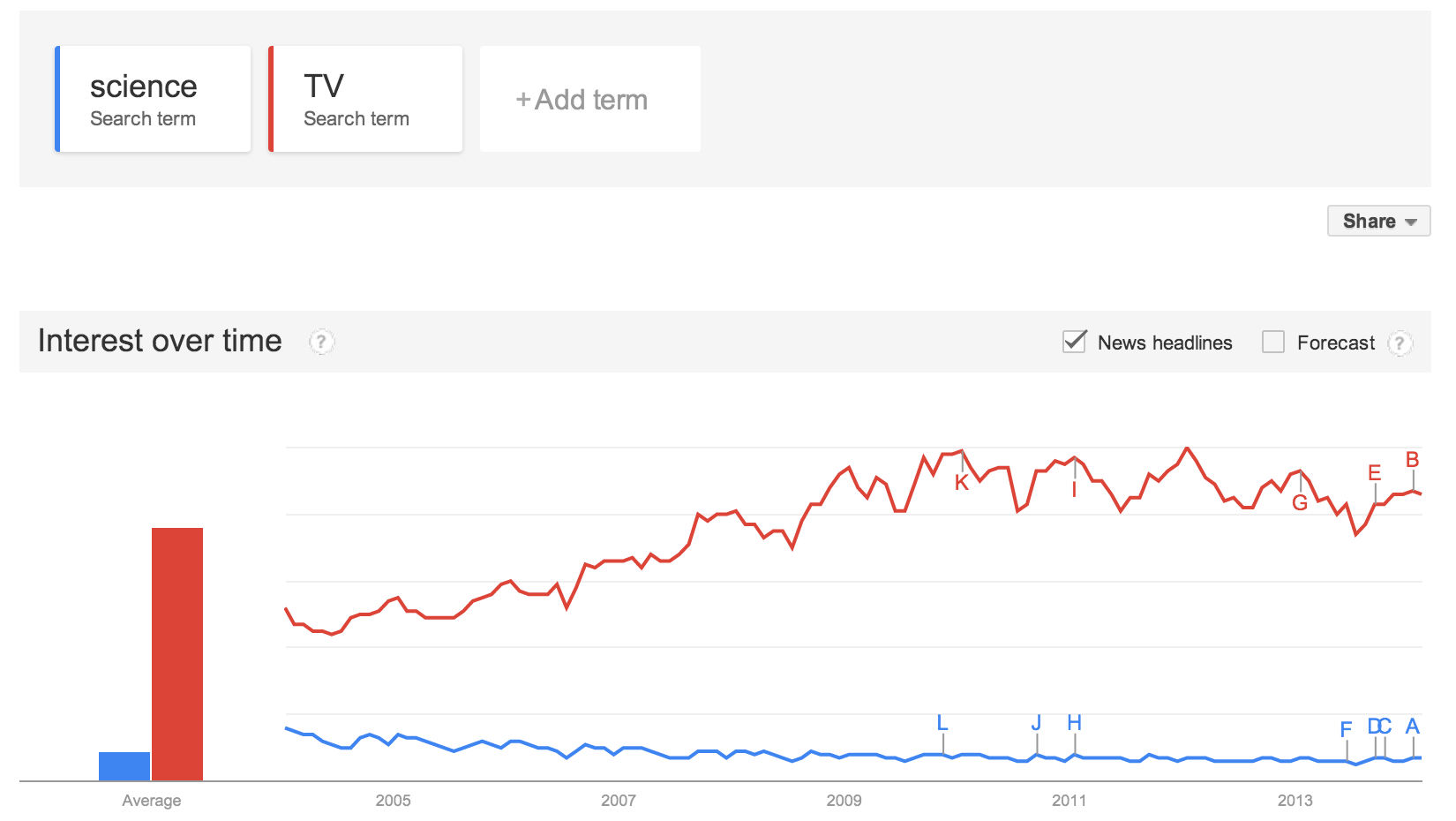
Google trends showed me this.

Screen Shot 2014-02-07 at 8.47.01 am

That graph shows that economics share of total searches is in big decline.

I was worried. Not only was my discipline apparently out of favour, but I was re-launching this blog in a climate where its subject matter was of fading interest!

I pondered. Could the global financial turmoil of previous years set people against the study of markets in a formal way? Was economics unfashionable because of rising inequality in the first world – the rise of the 1 per cent? Was the world turning its back on economics after the roiling controversy of Rogoff and Reinhart making an elementary Microsoft Excel error in a crucial paper?

I was about to set up a multivariate regression to try to nail down the true cause when I had a thought. Perhaps economics wasn’t declining per se, perhaps everything else was on the rise?

Witness the democratisation of the internet, wherein the information tubes are wrested from the sole control of the nerds.

Screen Shot 2014-02-07 at 8.48.04 am

This is why it seems like the internet has been dumbed down. (I’m referring to you, Youtube commenters.)

Screen Shot 2014-02-07 at 12.40.13 pm

Screen Shot 2014-02-07 at 12.41.59 pm

The internet is increasingly just as smart as the real world, no more, no less. That’s why we have Buzzfeed Australia now, I guess, serving up articles like this one, about people mooning a train. But we shouldn’t forget that we also have things like Reddit’s economics page, where the content is given over, for today, wholly to submissions from economics journals.

The internet is still as good as ever, you just need to know where to look.

When job hunting is an endurance sport.

Image

Unemployment in Australia is rising, and economists are relaxed about that generally, because it coincides with the end of the mining boom.

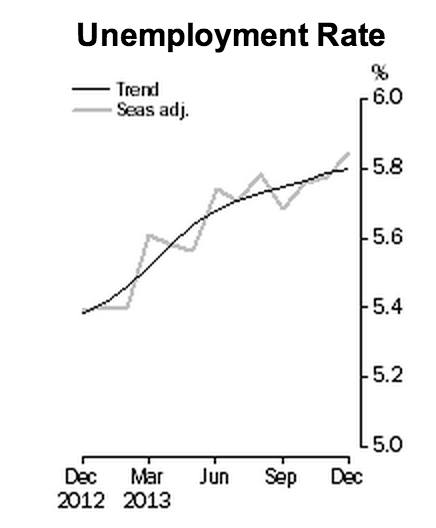
But new data out today show there is a hidden group for whom relaxation is just a dream – the long-term unemployed. The unemployment rate now sits at 5.8 per cent and rising, up from below 5 per cent in 2011. Getting a job is proving harder and harder:

The number of people starting new jobs (in the 12 months before the survey) is falling. It was 1.69 million in 2012, but had fallen to 1.67 million by 2013.

What that means is more and more people whose work skills are atrophying.

The proportion of unemployed people who had been looking for work for over 12 months has risen from 19.2 per cent in 2011 to 20.8 per cent in 2013.

And not all long-term unemployed people will show up in the figures. Some people will give up and disappear from the statistics if they stop seeking work, for example if they move onto the pension.

This is very bad news. Unemployment rates tend to rise sharply and fall slowly:

Image

[It’s possible my entire interest in economics and statistics is because of the spike in the middle of the above graph. My first awareness of anything called the “economy” was the 1990s recession, which was also when I first heard the word “unemployment” and heard job losses discussed in hushed tones. I remember seeing newspaper articles about 11 per cent unemployment. Then my whole secondary schooling and university education coincided with the long, slow reversal of the unemployment caused by that short sharp recession.]

Unemployment is very hard to remove because of a concept called Hysteresis. It basically says that high unemployment is sticky – the economy “gets used to” functioning with more people out of work.

What that means is that a period of high unemployment is not just bad in the here and now. Its effects echo down through time in the shape of higher unemployment rates.

Image
Like the top of the Rialto, jobs can be hard to find

The Australian situation is still the envy of the world. Our unemployment rate is well below that in the US. But that is cold comfort when you are scanning the job ads for the 53rd luckless week in a row.

The data also contain another interesting tidbit:

66 per cent of people look for job ads in the newspaper, but 84 per cent of people look for job ads online.

But young people use the internet more, with 85 per cent of them looking for jobs online. But for the first time even those 45 years and over reported they are now most likely to look for jobs online, with 79 per cent scouring Seek, Monster, etc. (And that’s why the newspaper business is in so much strife)

January weight loss wrap-up and future pledge

Many readers of this blog will be aware of the weight-loss challenge I undertook in January – to lose 4 kilograms.

The challenge got interesting because of the unusual motivation I chose. If I failed to shed the flab, I would owe the Australian Motoring Enthuisasts Party $500.

A lot was on the line. I updated my daily weight loss page, and even the Guardian took an interest, publishing a story I wrote about the challenge.

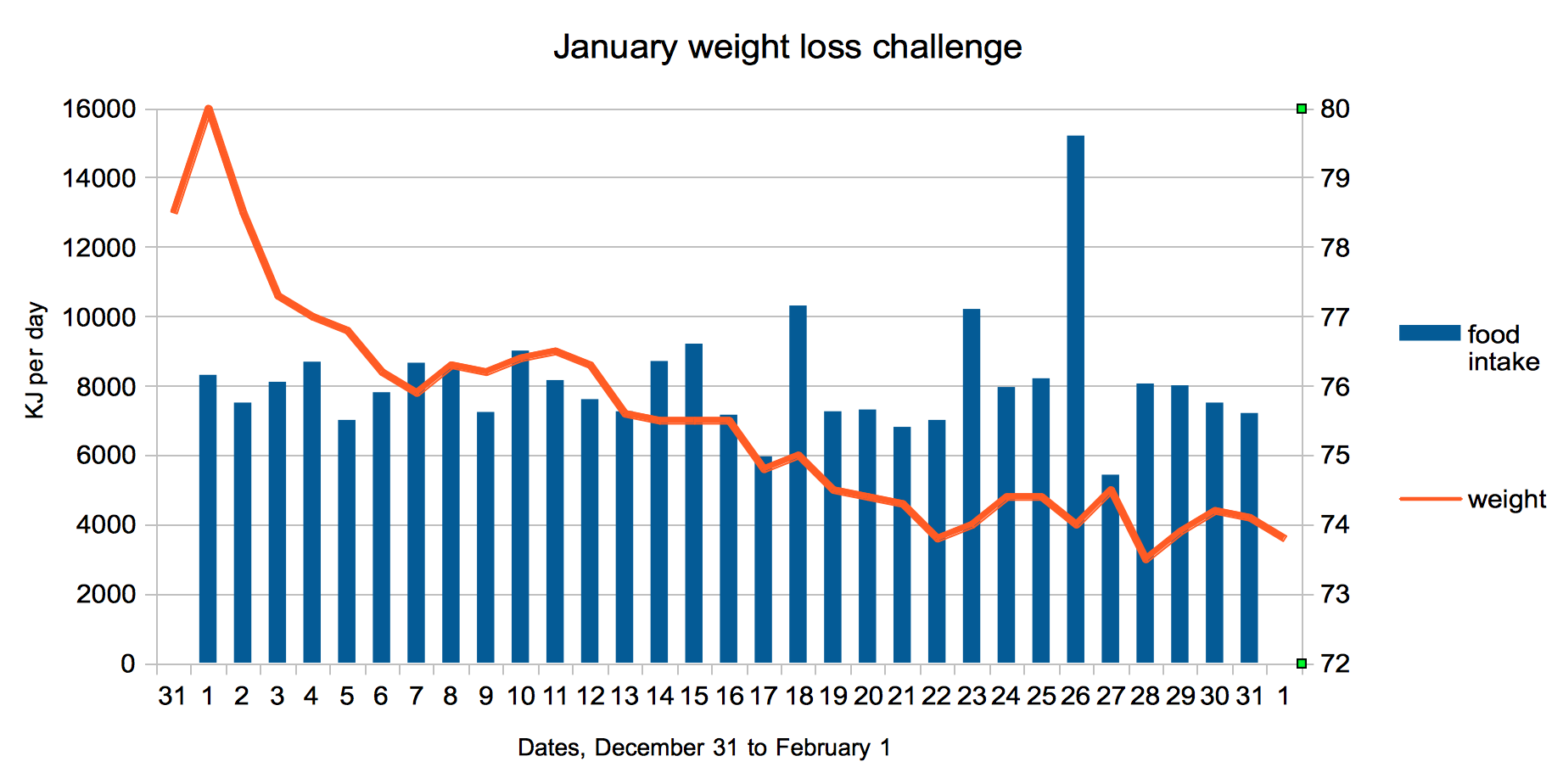
So it is with pleasure that I announce that the challenge has been successfully completed. I had to get from 78.5 kg to 74.5 kg, and I surpassed the goal.

Image

The blue bars represent my daily food intake in KJ. I averaged just under 8000, a big discount on my real-life intake of probably closer to 12000-15000. There was plenty of cycling, walking and strength exercises during the month too. But of course it was easier to lose the first few kilos than the last few. And the peaks of the blue lines toward the end show that superhuman feats of self-control are hard to keep up, especially on Australia Day.

The use of the Motoring Enthusiasts Party as a motivator was a spectacular success, the only downside perhaps being a commentator on the Guardian Piece who wrote:

“I pledge to give $2,000 to the Australian Motoring Enthusiasts Party if Jason Murphy looses weight this month.”

Nevertheless, his pledge did not impede me and I trust his cheque has already arrived at AMEP HQ.

Now the challenge is to not put the weight back on. To that end I make another pledge. To weigh less than 74 kg (i.e. my current weight) at the end of February.  I will put $100 on the line this time and I open up the comments section to suggestions on who the money should be kept from…

The story of McCafe: when competing on price can fail

US McCafe is failing, according to an article in Bloomberg today that quotes McDonald’s executives conceding Starbucks has them on the ropes. It also cites market analysts who say the attempt to move into coffee is hurting their burger business.

This is despite a McDonalds latte costing only around $2.50, compared to around $3.50 for a Starbucks latte. But that price is hurting them – McCafe in the USA is seen as too cheap, too nasty.

From that Bloomberg article:

“Pushing coffee is “probably a good idea if they can get their customer to buy more of it,” said Peter Saleh, a New York-based analyst at Telsey Advisory Group. “I don’t think they’re going to be attracting the Starbucks customer to go there — I really don’t.””

Why is McCafe unpopular? For the same reason people won’t buy a suit at KMart – because coffee is a social signifier.

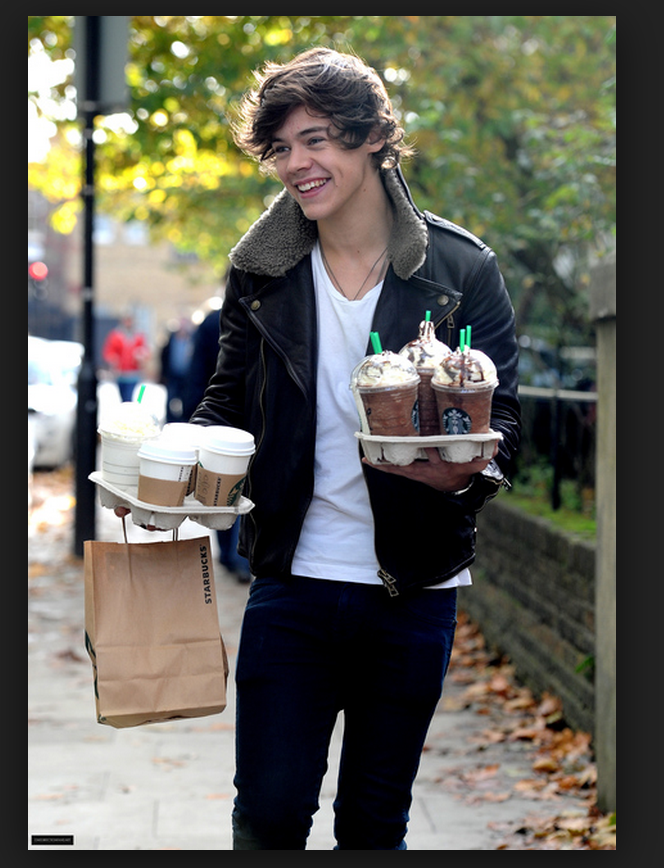
Coffee is not just a drink over there. It is redolent of sophistication. And Starbucks is Louis Vuitton. It would be shocking if a celebrity was papped without at least one mermaid-emblazoned frappuccino.

Image
Frappucino Styles

If you think that there’s no prestige in something produced by a global chain, look in your cellar. See any Moet? Look in your wardrobe. See any Nikes? Just because in Australia we think we value independent coffee does not mean we can sneer at “masstige“.

But this is not just an American story or a business story. It’s a personal story. Melbourne is a coffee town. When McDonalds launched the McCafe in 1993, they launched it in Melbourne.

I remember when they opened a McCafe near my school. I drank their $1 cappuccinos, and it was good. There may not be a lot of quality there, but there was a lot of value. I have a soft spot for McCafe that I will never have for Starbucks.

And McCafe Australia is thriving.

Image

Wait! What? Why is McCafe succeeding here but not America? I thought we were the sophisticated ones!

Pradoxically, the success of McCafe in Australia is because of our well-developed market.

Image
I bought this McCafe latte today in the interest of research. At $3.55, it was too hot and overpriced. The longer I sat the better the coffee tasted – the beans were fine. But sitting in McDonalds – with the TV blaring and the bland-on-bland decor –  palled fast.

Latte-sipper was an insult once, a signifier of being a toff or a snob or a Vaucluse doctor’s wife. Now baristas are taking complaints that their latte ‘had shit mouthfeel’ from blokes with prison tattoos.

This is not despite, but because we have a more developed coffee culture.

They call it product life cycle. Something new starts off as being for just the few. A mobile phone, for example was once a sign you were or aspired to be Gordon Gekko. But if that product is good it will spread to all comers. They call that maturity, or saturation. The reason Australia can support both Seven Seeds (“carefully sourced single origins” $4+) and 7-Eleven (“freshly ground beans: $1) is that the market for coffee is … everyone.

Melbourne has had espresso for fifty years, since the first espresso machine was installed in Lygon St, at the venerable University Cafe.

Maccas has strived to keep themselves just out of the reputational gutter. In 2011 they issued a public apology for their coffee and pledged to train up baristas.

That depth of history means there is a strong bottom end as well as a strong top end in Melbourne’s espresso market. (But no room for a brand that peddles a unique combination of expensive and ordinary. In 2008 Starbucks announced it would close three-quarters of its 80 stores and it is still waiting to make an official profit.)

Not like America, where Starbucks is expanding into tea (and also expanding people’s body sizes. Starbucks offers a drink that, at 30.9 ounces, is larger than the human stomach.)

What American McDonalds needs to do is this:

Stick at it.

Eventually US coffee culture will mature. Espresso drinks will become a staple not a luxury. Then their years of offering McCafe will pay off.

As for me, after visiting a McCafe today in the name of research, I pledge to stick with Melbourne’s independent scene for the rest of my life.

Paid Parental Leave – worth cutting eligibility to $100,000?

Tony Abbott’s paid parental leave policy is one of the most expensive pieces of social policy Australia has been offered recently. It is a $5.5 billion scheme funded by a 1.5 per cent levy on big business. It proposes full replacement salary to new mothers, for six months, up to a maximum of $150,000.

But nobody thinks the PPL scheme is well-designed or good value for money.

The jaw-dropping part of the scheme is the $150,000 salary cap, which works out at a maximum rate of pay of $600 per weekday. That’s wildly expensive childcare – even in Sweden, people taking parental leave get only €105/day.

If this policy had been proposed by the Motoring Enthusiasts, the Greens, or the Palmer United Party, everybody from Janet Albrechtsen to Ross Gittins would be arguing they had no concept of how the economy works and were demonstrably unfit to govern. Arguably, Albrechtsen, Gittins et al would be right.

But would cutting the generosity of the scheme deliver a big saving? The Coalition thinks not. This quote is from an article by Phil Coorey, of the Australian Financial Review.

“The difference between a $100,000 and $150,000 salary cap is not seen as a major impediment to reaching a deal because about 90 per cent of women of child-bearing age earn under $100,000.

The Coalition has been looking at ways to make its policy more affordable and dropping the salary cap to $100,000 was not deemed worth it in terms of savings.”

The truth is that while plenty of Australians make over $100,000 – over 837,000 people, statistics say – only 18 per cent of them are women.  And of course, earning power tends to increase with age.

Screen Shot 2014-01-29 at 10.53.24 am
Number of women earning over $104,000, sorted by age and state. (Incidentally, in WA and QLD, women aged 15-24 are more likely to make the big bucks than those over 65. One guess why.)

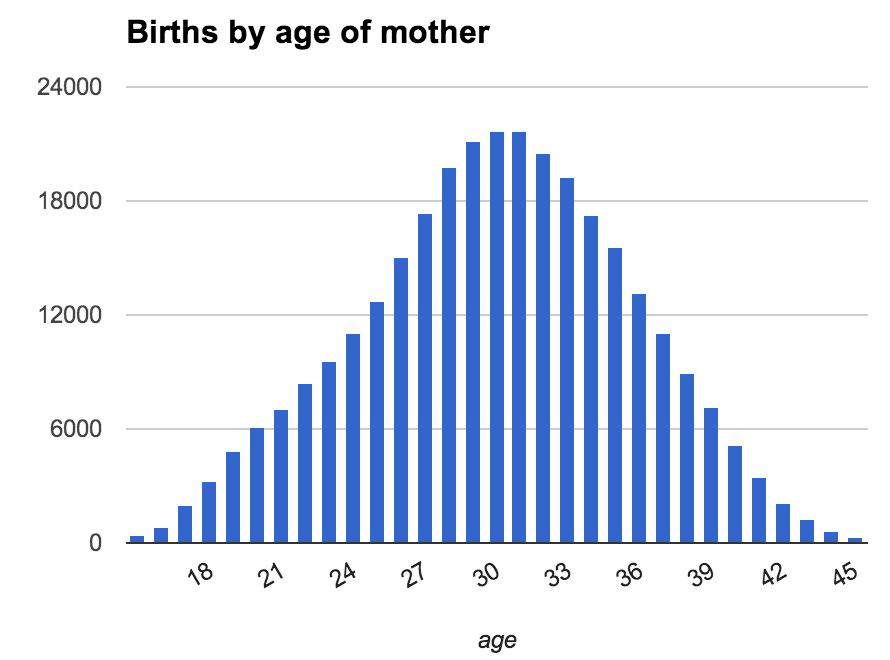
Women’s earning peak happens after their fertility peak. Earnings peak around age 40, while the most common age to give birth is 32.

Screen Shot 2014-01-29 at 10.11.29 am

That means only 5,400 women earning over $104,000 would be eligible for the payment each year, according to my calculations. [Don’t thank me for making the data category end at $104,000, thank the ABS.]

Births, categorised by state of residence and age of mothers

[This link will take you to a big google drive spreadsheet where you can check my calculations and see some interesting graphs.]

The Greens are proposing a similar policy to the Coalition, but with a $100,000 eligibility cut off.

So what would be the saving of cutting eligibility to $100,000?

Assume the average claimed salary is $130,000. The net cost of 6 months extra pay is $15,000. 5,400 births @ $15,000 =

Just $81.2 million, or 1.48 per cent of the total cost of the $5.5 billion scheme. (Likely a conservative estimate, given some assumptions I had to make.)

That’s a rounding error in the Australian Government’s social policy budget. Do we just blink and move on?

I say no. The Commission of Audit is currently moving through the Government’s books, trying to find savings everywhere. They are likely to have a very fine-tooth comb. An $80 million saving is one they would pocket with delight. The government also has a social welfare review running, looking at Newstart and the Disability Support Pension.

Politically, $80 million seems like a small price to pay to garner headlines and combat a “women problem.” But from a policy perspective it makes sense to cut the rate. If you frame the question as “how can the Australian people best spend a spare $80 million,” the answer is never “funnel it via the government to the very rich.” 

Realistically, Paid Parental Leave is unlikely to be introduced in the same format it was sold to the Australian people.

If I was advising the government, I’d say: pledge to introduce it slowly. Start off paying up to a salary cap of $60,000 and say you intend to ramp it up by 10 per cent a year.

Then wait.  Something will come up for which there is great public support. It might be rebuilding after a flood. It might be sending troops off to the South Pacific to help restore stability somewhere. It might be a surge of support for pre-K education. Then you can raid the PPL cookie jar to fund that.

Farewell, America?

Aussies love the United States.

Ezekiel
Sure, go on and eat that atheistic All Bran. Enjoy being regular in HELL.

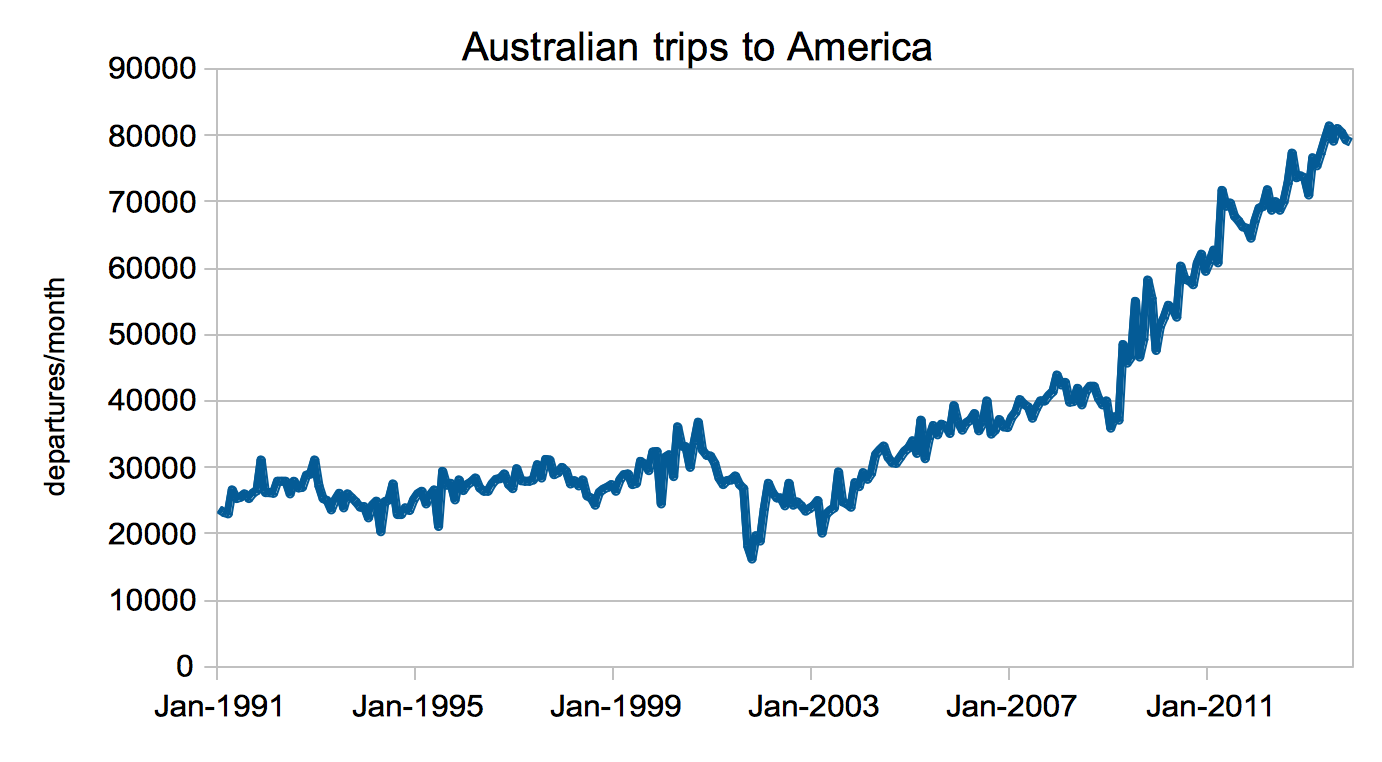
I’ve been three times in the last four years. And I’m not alone.

Screen Shot 2014-01-28 at 11.00.59 am

Part of the attraction is flights that are suddenly very very cheap. When the Qantas/United duopoly on the Sydney-LA route was broken in 2008, the price of flights halved.

home of the brave
Life, Liberty and the Pursuit of Horned Things.

When V Australia entered the market in 2008, their killer price offering was $1899, 16 percent below the existing lowest price. I’ve since seen return flights below $1000.

You can still buy a flight Sydney-LA for just a little over $1300 if you are bold and foolish enough to trust your travel to United. [My last trip to the States involved an unscheduled night in Sydney when someone crashed a luggage cart into our United Jet. Their initial compensation offer was accommodation in Woolongong and a flight 3 days later…]

California is... different
California is… different

At $1300, the appeal of a trip to the US is strong. The politics may be stuffed, but much like China, that doesn’t ruin it as a place to visit. I have been there more than any other country, without feeling like I’m running out of towns or states I want to go to.

mericuh
Where freedom is just a bail bond away!

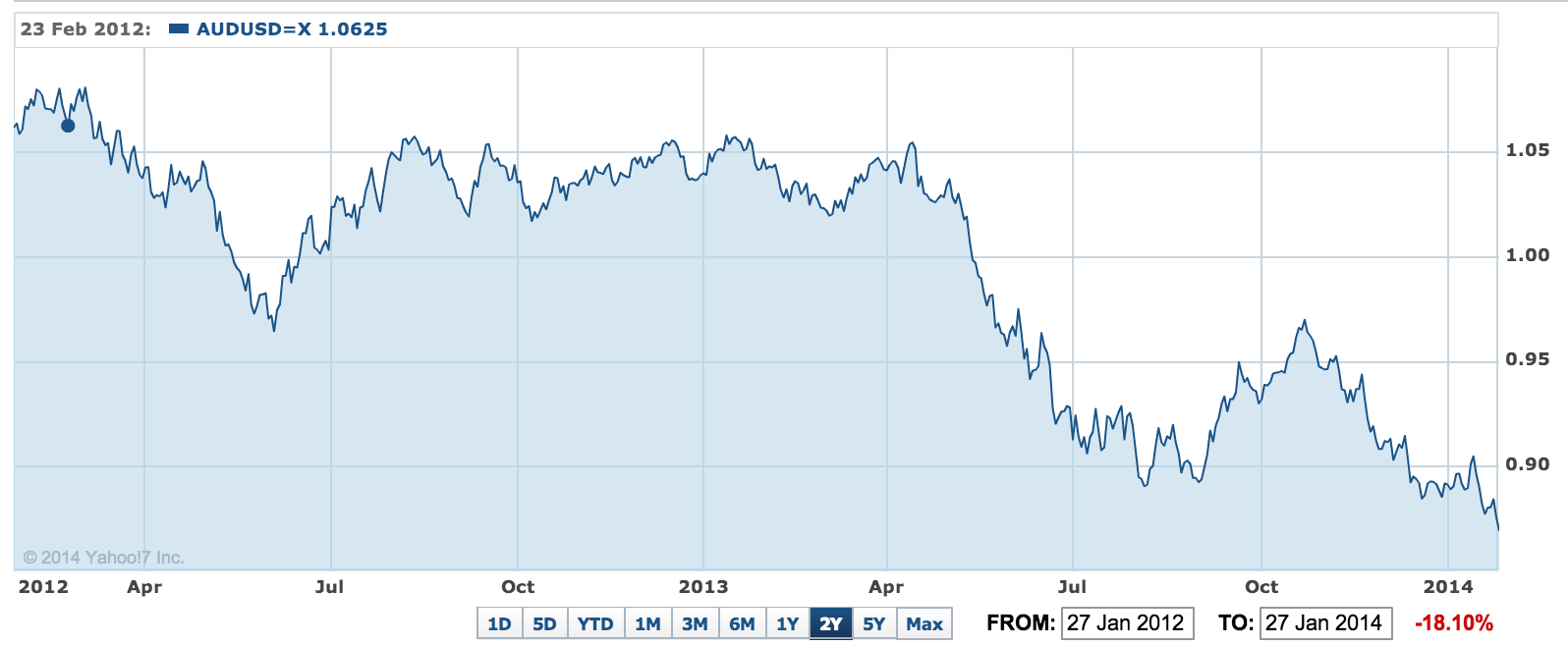
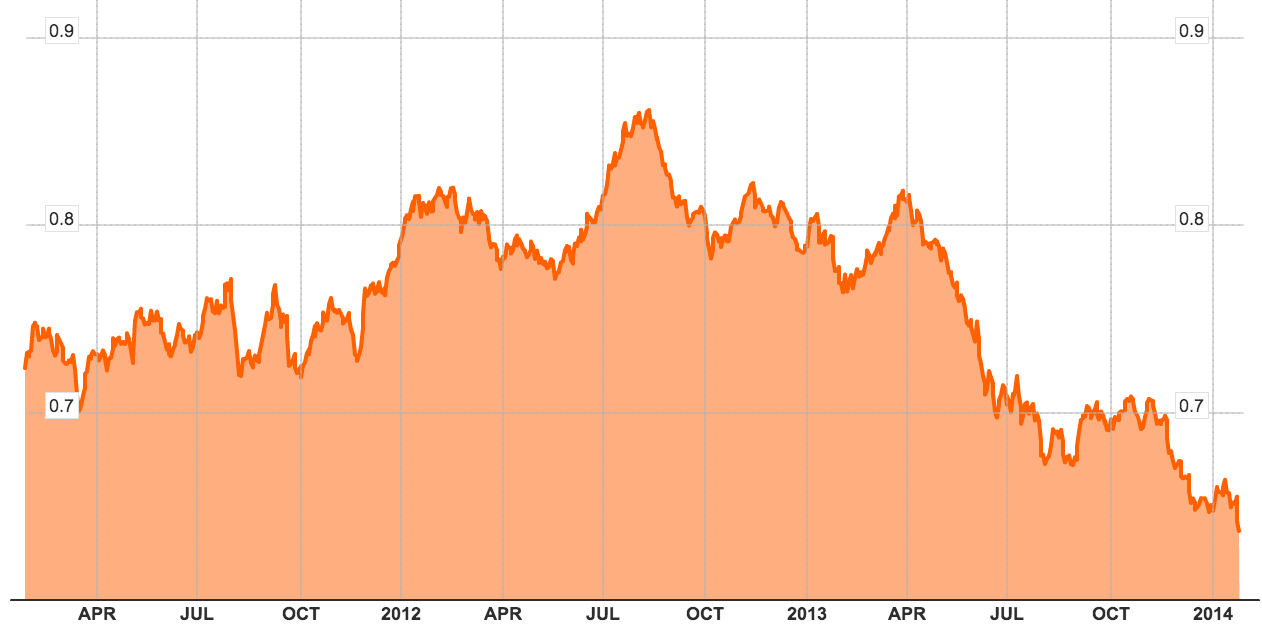
But, sadly, the best time to visit America is now past. The weird period in global financial markets is over, and US quantitative easing is heading (slowly) for the exit. Our dollar might be lucky enough to get back over US90c, but the word parity can now safely be taken by currency writers and put in the top cupboard, along with “gold standard” and “the great moderation“.

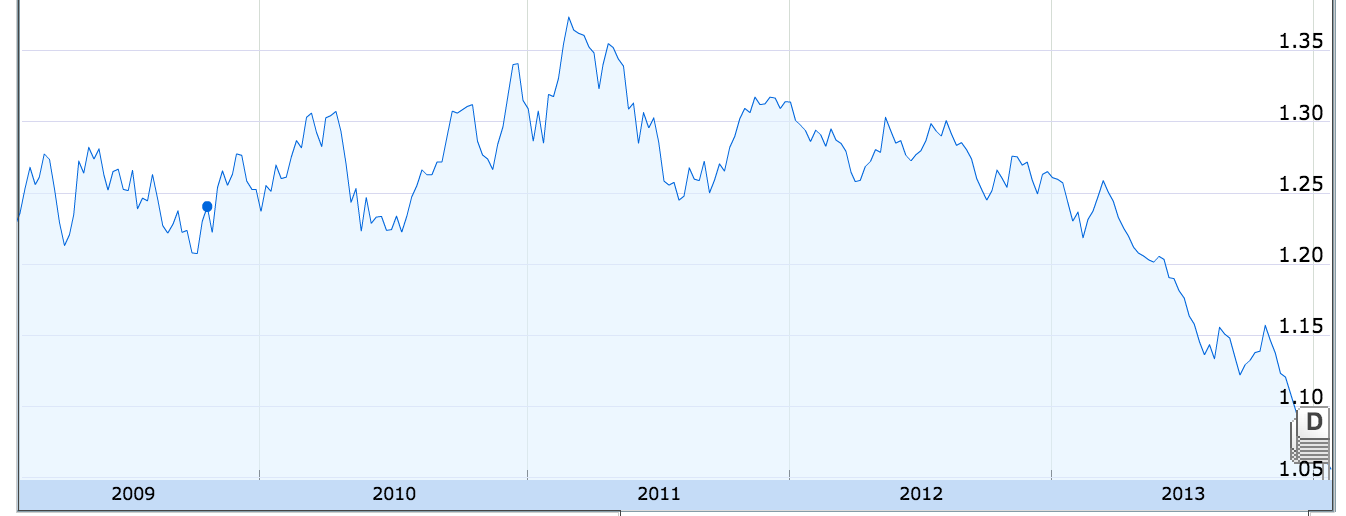
Late last week, the Aussie dollar dipped to a its lowest level since 2010: US86.5c.

Screen Shot 2014-01-28 at 11.39.58 am


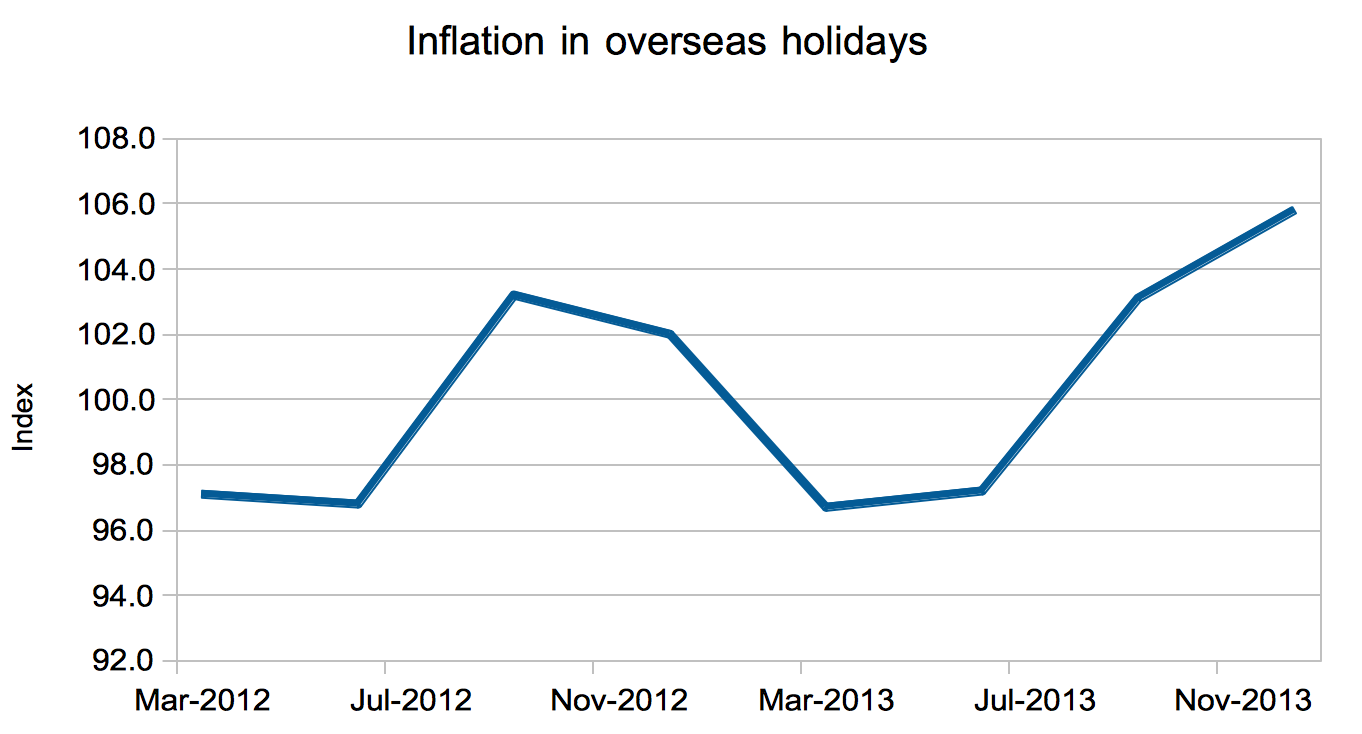
The effect of the falling Aussie dollar is already showing up in the ABS inflation statistics. There is likely to be a lag too, so that might not be the end of it.

Screen Shot 2014-01-28 at 11.45.21 am


So, it’s farewell America.

America, the wind beneath my wings
You were the wind beneath my wings. *sniff*

So what are our alternatives?

New Zealand is also going to feel more expensive than it has in years.

Screen Shot 2014-01-28 at 11.56.22 am
AUD v NZD

 Europe is just as bad.

Screen Shot 2014-01-28 at 11.59.02 am
AUD v EUR

But luckily, the second-top holiday destination for Australians has  a currency that’s even less popular than ours. In November 2013, Indonesia pipped the US as our second-top travel destination. I predict that by November 2014, there will be daylight between them.

Screen Shot 2014-01-28 at 12.03.33 pm
AUD v IDR

Or, I suppose, if things got desperate, you could always take a holiday in the place where the exchange rate is always 1:1.

sydneyI hear it can be quite nice.

China Series Part 4: City-shaping

This is Part 4 in this week’s China Series. You can see the previous parts here: Part 1 Part 2 Part 3 

China has learned many valuable lessons from its growth. Among the biggest: you can’t just respond to demand for a certain kind of transport.

beijign traffic sunset
Too much of a good thing

Beijing built a series of ring roads between the 1980s and today. There are six in the city.

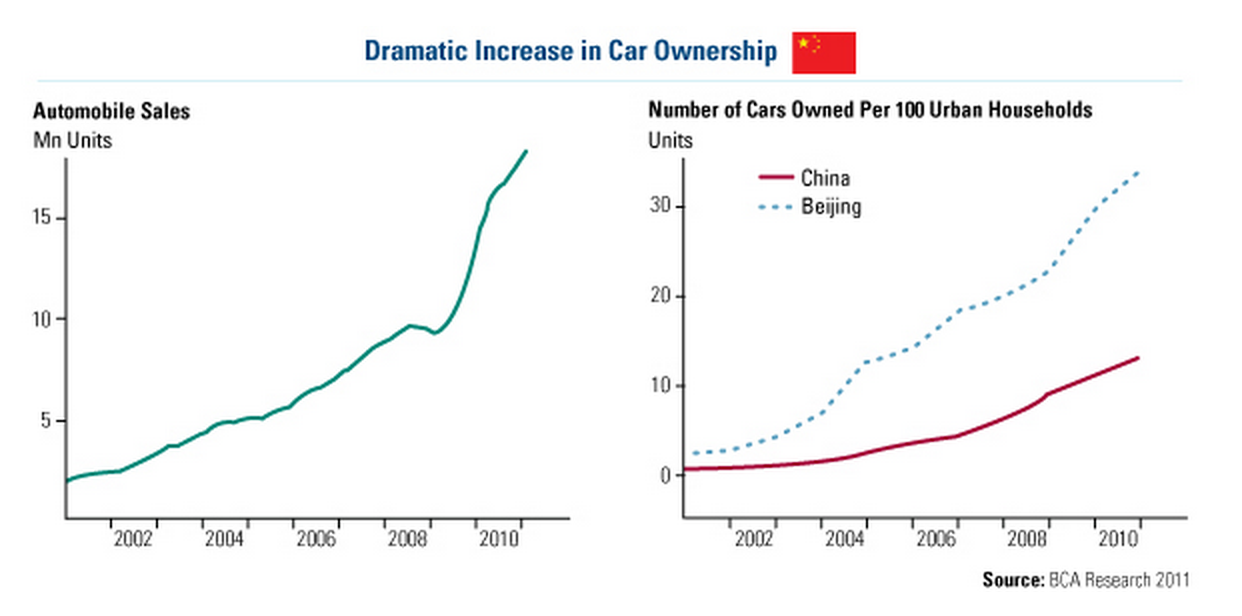
Loads of new tarmac coincided with a boom in wealth. That meant an explosion in car ownership and traffic that got out of control.

Screen Shot 2014-01-23 at 11.48.34 am

China has tried to respond with rules to limit traffic and car ownership, such as quotas. But they have not always worked.

killer smog
Killer smog, 2013

beijing subway interior

But that does not mean Beijing has given up. When I was in Beijing in 2003, there were just three subway lines. Now there are a dozen.

New stations are popping up everywhere like a game of whack-a-mole. On our holiday in 2013, we picked up a subway map (actually it said subwang) at our accommodation, and it was already out of date.

beijing subwang

This is something Australia could learn from. When you build a road to solve a traffic jam, that road will likely last until the collapse of the civilisation it supports.

Sydney’s George St is now over 200 years old. There are just a handful of examples of freeway removal worldwide. A road lasts longer than a building, longer than the technology that uses it, longer by far than the average road engineer.

What you are doing –  in the long run – is not “solving a traffic jam” but shaping your city.

People like to talk about induced traffic from new roads – “if you build it they will use it.” I don’t doubt this is partly true, but I think the long-run effect of a new road is far greater than whether or not you get your traffic jam back within 18 months.

This is why I am so excited about the prospects of improvements to rail networks. They can also last a very long time, and have long-run positive effects, not least of which is discouraging the building of more roads.

train stations beijingBut while Beijing’s improvements are underway (see right), Melbourne’s are just on paper.

The city-shaping effects of an efficient metro system in Melbourne would be huge. But a great deal of political change will have to happen for it to get built.

China series part 2: The coming crash

This is the second in a five part series on China. You can see part one herePart three is here.

Chinese growth is steaming along.

Source: World Bank
Source: World Bank

But the thing about growth is it seems to lead to imbalances. There’s always something funny building up in the economy and/or financial system.

In 2008, it was US subprime loans that proved the spark for a big global recession.

The 1990s “recession we had to have” was also driven by an asset price bubble following the long boom of the 1980s.

In China, I’m worried about property prices.

China’s property prices have grown incredibly fast. Here’s an article reporting 20 per cent growth just last December.

If you think you can sell property at high prices, you build a lot of it. The world’s media has gone crazy for the side-effect of this: ghost cities. Vast towns where there are buildings but not enough people to live in them.

On my recent trip I was gobsmacked by the number of buildings going up in China.

bulding 5
North Beijing
Way outside Beijing
Way outside Beijing
Just off the Bund, Shanghai
Shanghai
Shanghai
Shanghai
Shanghai

Economists are trained to be cautious around their intuitions and gut feelings. The best bits of economics are, after all, counter-intuitive.

But I couldn’t help wondering what would become of all this building. A lot of old buildings are being knocked down, sure, but if the replacements for two storey courtyard houses are 20 storey apartment blocks, and there is no population boom afoot, the risk of over-building is real.

If China’s property boom turns out to be a bubble, and Chinese growth slows or reverses, the effect on Australia will be nothing short of a calamity. The mining industry and the housing market will do a simultaneous nose-dive. The biggest companies in our stock exchange will lose a lot of their value. Wealth will be crushed, spending will stop, bankruptcy will be rife, firings and downsizing will follow. In short, a recession.

(And if we have Tony Abbott and Joe Hockey in charge at the time, we are unlikely to get an adequately Keynesian response)

One closely watched canary in the coal mine is the interest rate between Chinese banks.

It spiked in JuneDecember, and again this week. The precise meaning of that is uncertain. But it certainly looks like the central government trying to discourage cheap capital flows. So far, each spike has been short-lived.

Here’s a quote from a guy who claims not to be worried, Hermes Fund Managers Gary Greenberg.

“Yes, the property market has overheated in certain areas and yes, perhaps property prices will come down, but it won’t necessarily have a major detrimental effect on the banking system, primarily because the banking system hasn’t been the main funder of property prices.”

The thing about the Chinese financial system is that because the banks are so regulated, people lend money through the “shadow banking” system. That name sounds a little spooky, and so it should.

The Alibaba group offers a savings product that pays 6.7 per cent, compared to the official banking rate of 3 per cent. Managed funds like this have reportedly doubled inside 6 months.

That reminds me of the Pyramid Building Society, which went broke in the 80s. Crazy high rates can genuinely prove too good to be true. If Alibaba is raising capital at a high rate, and lending to property investors, it is worth asking if it could end up insolvent when property prices fall. And it is worth asking if that might spread.

Here’s Ben Bernanke earlier this month reflecting on his big mistake – being sanguine on property prices.

“[O]ur expectations about the possible macroeconomic effects of house price declines were shaped by the apparent analogy to the bursting of the dot-com bubble a few years earlier. That earlier bust also involved a large reduction in paper wealth but was followed by only a mild recession. In the event, of course, the bursting of the housing bubble helped trigger the most severe financial crisis since the Great Depression. It did so because, unlike the earlier decline in equity prices, it interacted with critical vulnerabilities in the financial system and in government regulation that allowed what were initially moderate aggregate losses to subprime mortgage holders to cascade through the financial system. In the private sector, key vulnerabilities included high levels of leverage, excessive dependence on unstable short-term funding, deficiencies in risk measurement and management, and the use of exotic financial instruments that redistributed risk in nontransparent ways.”

China’s shadow banking system has helped propel the country’s debt-to-GDP ratio over 200 per cent. The biggest burst of economic growth in history stretches back to 1975. It will end one day. Probably not in 2014. But it will be worth being prepared when it happens.

Work: nice to have. But not all the time.

Work. It’s a chore, isn’t it? If Australians can get out of it, they will.

The latest unemployment data are out, and they show this : Labour force participation has fallen to its lowest level since April 2006, and male labour force participation has fallen to its lowest level since records began, 71.0 per cent.

Look at this graph:

Image

Participation counts those working and those looking for work. It excludes those studying, retired, backpacking round Europe, unable to work, etc.

In the short run, labour force participation falls because there are not enough jobs. Unemployment has risen to 5.8 per cent, from under 5 per cent in April 2011. But look at the big picture.

What startles me is that since February 1978, the total labour force participation rate has risen only 3 percentage points. Despite massive changes in economic structure, labour laws, flexibility and social pressure to wear neckties, work is almost as distasteful as ever.

Total participation has risen from 61.3 per cent, to just 64.6 per cent. That means male disengagement has matched female engagement engagement practically one-for-one.

That massive surge of female empowerment has been met with a deep sigh as men settle onto the couch.

Why has participation not surged over the long run? Perhaps it is because Australia is rich. We can afford to retire earlier, and even take a few mini-retirements mid-life, such as long stints backpacking, or extended periods of parental leave.

Image
Source: ABS National Accounts, Sept 2013

Stagnant labour force participation is conventionally seen as bad news.

If you are a good Treasury alumnus, like me, your brain is seared with three Ps. Productivity, population and participation. These are the three factors that make sure enough productive activity occurs to keep us all in the lifestyle to which we are accustomed.

But let us be totally frank. While productivity gains are a free kick meaning we do more with less, the other two create trade-offs.

Increasing Australia’s population is a costly way to increase the labour force. We need to build a whole lot of extra infrastructure to accommodate extra people. 

And increasing participation also comes with trade-offs. Work is called work for a reason. Unless you are a professional sportsman or a clown, work is not really much like play. If people can avoid it, they often will. That’s what this graph makes abundantly clear.

If you leave your job aged 55 and still have the legs for ten years of golf, or if you take a year off to be with your young child, opting out of the workforce could be as much a contributor to national well-being as GDP is.

Why house prices are going to do what you least expect.

Image

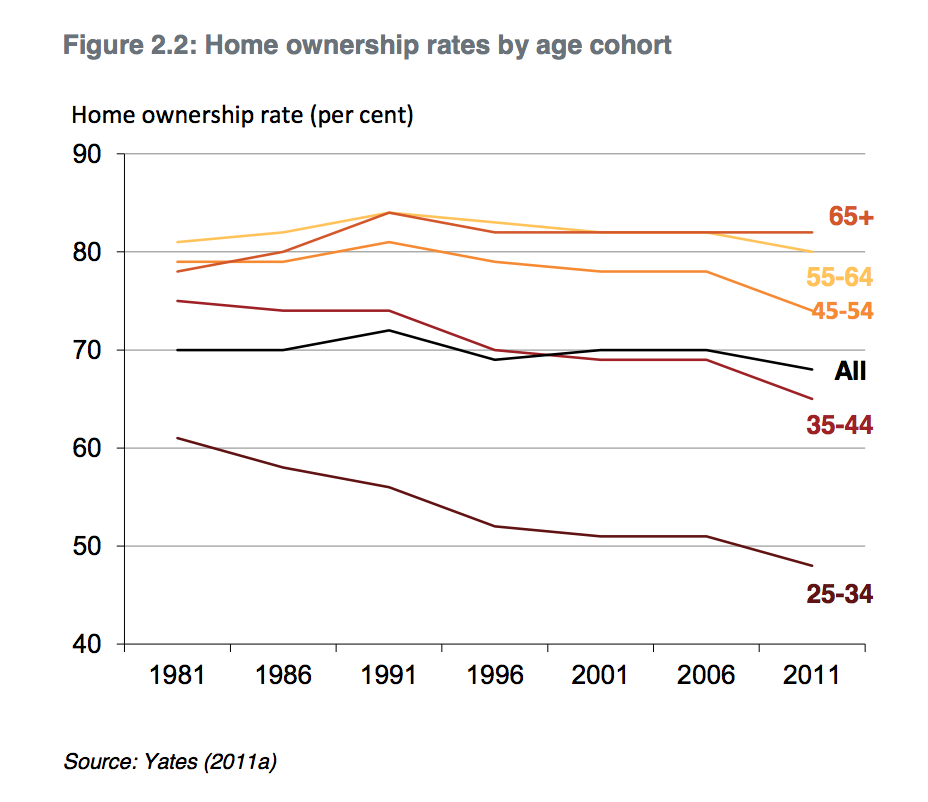
This chart from a Grattan Institute report was used as a hand grenade in a war over house prices on Twitter a couple of days ago. Union economist Matt Cowgill argued house prices may be too high if they are pushing people out of the market.

Another economist, Stephen Koukoulas, argued everything was fine and you should just go and borrow from the bank since interest rates are at record lows.

(Just as a declaration of my interest, I’m 32 years old and do not own property.)

Some people argue house purchase has simply been delayed, just like moving out of home, getting married, and having children

This is a pretty good theory to explain the above. But it doesn’t do such a good job of explaining the declining rate of first home purchase. That has hit a record low of 12.3 per cent in the most recent data.

Image

You have to assume that low – which coincides with recent house price growth – is temporary. So what will give?

Will we observe a quiet tsunami of saving that allows first home buyers to collect together huge deposits, then climb back into the market with heaps of spending power?

Bad news if you are relying on that. Gen Y is not scrooging it up.

Image
Household net worth, where reference person is aged 25-34. source http://www.ausstats.abs.gov.au/ausstats/subscriber.nsf/0/FB162A8CBB41033DCA257BCD001A5725/$File/65540_2011_12.pdf

While young people’s net worth rose around 25 per cent in this period, the price of established homes rose 40 per cent.

The average value of the savings of people aged 25-34 (bank accounts and shares, not including super) has risen from $11,000 to $16,300. It’s not nothing, but it’s not exactly a deposit on a house, either.

So will the 65+ demographic eventually be forced to release their vast real estate holdings onto an anaemic market?

Image

Can we conclude that house prices are going to fall?

Not necessarily.

The x-factor in Australia’s housing market may be off-shore buyers. Chinese wealth is pouring into the market at both ends, propping up the value of both million dollar mansions and cheap apartments.

One real estate agent recently told the ABC that 90 per cent of homes were selling to Chinese investors. Hyperbole, obviously. But even 1 per cent is cause to pay attention.

Economists understand that markets operate at the margin. It doesn’t matter what most people do so long as at the margin there is one bidder with deep pockets.

Foreign investment in Australian real estate rose from $41.5 billion in 2010-11 to $59.1 billion in 2011-12. Fast-growing China was the 3rd biggest source, behind the USA and Singapore.

Image
Location, Location, Location.

So long as foreign wealth, and especially Chinese wealth keeps accumulating, domestic dynamics are only part of the picture. I intend to return to this topic soon, because the pace of accumulation of Chinese wealth is now not just a historic record but a gigantic outlier. Whether it can continue is of intense relevance to all of us, and there’s plenty of people who think a crash is coming soon.

Ball Kid Boiling Point: Child Labour Shock Hits Melbourne.

It is 2014.

And yet, in contravention of the guiding principles of the ILO Convention on Child Labour signed 40 years ago, hundreds of youth under the age of 15 are being employed by a major and highly profitable Australian enterprise.

The ILO convention states:

“The minimum age specified in pursuance of paragraph 1 of this Article shall not be less than the age of completion of compulsory schooling and, in any case, shall not be less than 15 years.”

Worse, they are without pay despite doing tough physical work in conditions of searing heat.

Unpaid work in searing heat, anybody?

Tennis Australia, which earned $1,600,000 in profit in 2012-13, accepts ballkids agd 12-15.

These embattled and un-unionised “volunteers” must complete a multi-month training schedule to secure their unpaid roles:

“Australian Open Ballkids will also be required to participate in tournaments outside of the Australian Open as part of a compulsory training requirement. These events are scheduled to take place between November and December.”

They share the court with line judges (paid around $200 a day) with chair umpires (paid around $400 a day), with overtime.

Or perhaps they will be on court with Novak Djokovic. In 2013 he secured the winners cheque of $2.43 million with 18 hours 16 minutes of court time. Call that $132,800 an hour or $2,213 a minute.

Sure, the kids seem to like it. “I’ve enjoyed it every single year so far,” 15-year old Mitchell Riley told the Herald Sun recently. “It’s great getting up so close to the players.”

But is it really fair? Prior to 2009, the Australian Open handed out $42 a match to ballkids. Someone has made the decision to cut that to nothing.

Surprisingly it is America where there has been most rancour over tennis officials pay. Half the world’s top umpires boycotted the 2011 US Open in protest at the conditions And in 2012 the US Tennis Association was sued over pay and conditions.

Meanwhile the home of the 35-hour week, France has an all-unpaid ballboy force, working up to 11 hours a day, as recorded in this Economist article


Would it be possible to organise a ball-kid strike? I’d love to see the players collecting their own wayward shots and fetching their own towels. Maybe 2015…