The 2014 Budget is the most significant in a long time. I have an eager – some would say obsessive – interest in federal budgets, and I cannot remember a Budget that has got as much attention as this one.
Today marks four weeks since the second Tuesday in May, and Budget headlines are still around. For example:
I went through the internet archive. It shows the 2014 Budget produced not only a much bigger spike in interest in the Budget, but a much longer tail. It is not common for budgets to be sparking discussion three weeks after they are released – people normally move on fast and a government only dreams about getting three weeks of “traction”.
The graph above compiles mentions of the word Budget on the homepages of The Age and The Australian in the month around the Budget. I did an analysis for 2008 too, because the first Budget of the Rudd government would be a good comparison to the first Budget under Abbott. The data is a lot more spotty, but the pattern is the same. In 2008, Budget headlines died out after no more than a week.
Google trends data confirms that this Budget was a whopper as far as public interest goes. The graph below shows share of searches from within Australia. (Google omits the vertical axis – I guess that’s proprietary data).
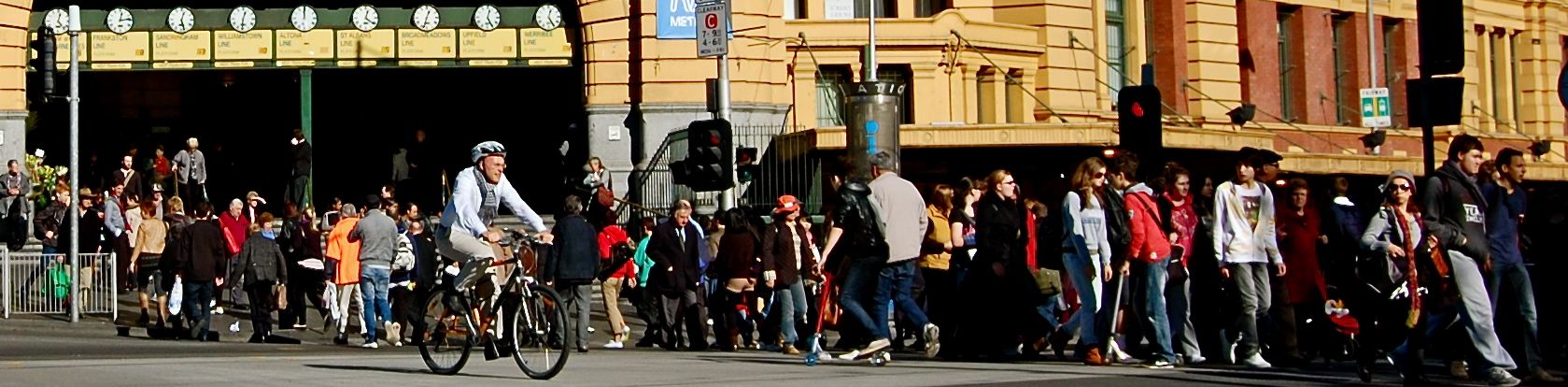
The shot tells a story of changes in technology and economics. For starters, there are four horse-drawn carts in the photo.
While a busy Friday night in 2014 might still see a horse and carriage at this intersection, in 2014 they’d be pulling regretful tourists, not valuable cargo. The decline of the horse and rise of the car coincides with the industrialisation of the fuel-making process. In 1927, oil company Mobil was just 16 years old.
The tram stops also tell a story of change, not so much in technology as values. The tram stops of the jazz age – located in the middle of the street, amid a stream of traffic – amount to little more than a bit of paint on the ground. That has changed. Tram stops now are highly protected from traffic, probably because the value society places on human life has risen along with wealth and productivity.
One familiar thing in the shot is traffic. We see cars stacked three across and two deep, getting ready to hook turn from Flinders St onto Princes Bridge in the foreground of the shot. (For non-Melbourne readers, the hook turn is a unique form of torture inflicted by this city on unwitting drivers, for the purposes of mirth.)
The street at the top of the photograph – Swanston Street – is now closed to car traffic. The externalities associated with car traffic are very clear in this intersection, as early as 1927. (I am referring not to pollution, but the way the presence of one car on the road slows down all the others.) The proliferation of cars in the last 90 years means these externalities would have developed to city-threatening proportions had the use of cars not been limited.
The crowds suggest patterns of work is much the same. But it doesn’t show the city at night, which would reveal far more differences in society, in dress codes, and the purchasing power of young people especially. Zooming in would also reveal big differences in ethnic composition, thanks to the ease of global travel.
There are no bicycles in the shot, which is a surprise to me. Standing at this intersection now, you’d struggle to frame a shot without a bike in it.
Apparently cycling was extremely popular in the 1890s. That enthusiasm has seemingly waned by the time film was exposed for this shot. Will Melbourne’s current love affair with bikes also prove transitory, or is this shot just unrepresentative?
There have been a lot of technology changes since the 1920s. One of the most dramatic is in construction. Despite being a shot of the city, this photo, repeated today, would not show any sky scrapers. This area has heritage protection. Perhaps there were height controls even then – the shadows reveal bigger buildings lurk just outside the frame.
Most of the technology changes since the 1920s are at a smaller, human scale. The contents of the pockets of the people in the shot is probably where the most dramatic changes would be evident. The one clue we have in this shot to that sort of technological change is the fact it is shot in sepia.
There are a lot of lessons in this old shot, a lot of differences. But the biggest single point is probably the similarity.
The crowds swarming across Flinders St look exactly as they do today. That suggests the patterns of life – catch a train into the city, go to work, go home – have not changed too much. And three of those four corners – the railway station, the pub and the cathedral remain the same. Only the old Princes Bridge Railway Station in the bottom right is gone, replaced with Federation Square.
Swanston Street 2014
The trams in the shot are cable trams – they are not powered by electric wires but pulled along by a cable that ran beneath the street. [edit: apparently cable trams were replaced by electric trams the year before this shot was taken.]
Despite the advent of electricity and computers, trams still follow these same routes.
This shows the way infrastructure and patterns of human life endure. Technology is often first used to do the same old tasks a bit differently. We don’t quickly end up in a Jetson’s future, but a sort of inverted Flintstones, where the objects are much the same and the technology behind them is different.
Economics says we must reward people for effort. If you train to become a teacher then work hard, society rewards you. This is both morally sound and economically important.
The flipside: if you could work but sit on the couch, you get nothing. This is both morally sound and economically important.
The moral and economic imperatives are aligned perfectly. Right up until birth.
Children crack the perfection of this theory. A child born into a poor household will be punished by material poverty they do not “deserve”. A child born into a rich household will be rewarded in ways they have not earned.
So we muddy the moral and economic imperatives for generation 1, in order to secure the moral and economic imperative for generation 2. A trade-off.
Decisions about this trade-off are shaped by a number of beliefs.
1. Does providing welfare hurt incentives for work?
2. Does raising taxes to pay for welfare hurt the economy?
3. Does welfare really help the second generation, or foster a culture of entitlement and dependency?
Just the other day I was snacking on this “coffee caviar” in a Fitzroy cafe, but this Budget doesn’t really hurt me. Does our society have its priorities straight?
The recent Budget by Messrs Hockey and Abbott reflects beliefs on all of these. It took an axe to welfare payments of all sorts.
So it was extremely timely to see new research (released May 12 by the US National Bureau of Economic Research) on the third point above – the effect of welfare payments on the second generation.
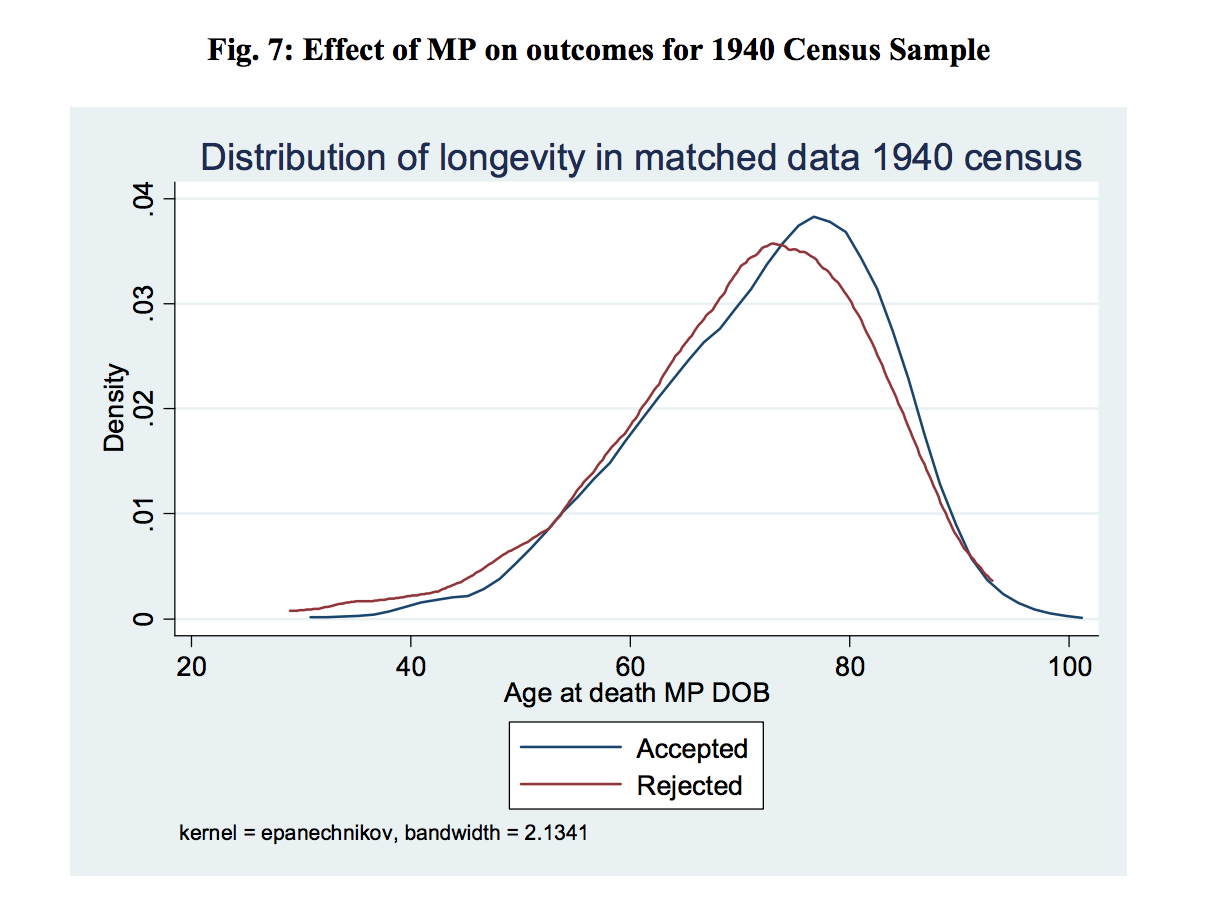
“Male children of accepted applicants lived one year longer than those of rejected mothers. Male children of accepted mothers received one-third more years of schooling, were less likely to be underweight, and had higher income in adulthood than children of rejected mothers.”
The positive differential comes despite the boys who were rejected from the program being slightly better off on average prior to the government intervention. That means the effects are, if anything, likely to be an understimate. (The research is unable to track results for females over the long run because of their tendency to change their names. The use of a very old program allows them to more fully collect data on longevity.)
“While conditions today differ significantly from those at the beginning of the twentieth century, three important similarities remain. Then and now, women raising children alone (whether divorced, unmarried, widowed, abandoned, etc.) represent the most impoverished type of family. In fact, the income gap between children in two-parent versus single-mother families has only grown over time”
This research is very timely.
The 2014 federal Budget cuts a payment that goes to single parents: Family Tax Benefit Part B. The government has not only capped the rate of the payment from 2014 but reduced eligibility. Parents will now be cut off when their youngest child turns 6, not when it turns 18.
The Budget replaces Family Tax Benefit Part B with a new allowance, worth $750 per child per year. That will work out as less for many smaller single parent families. Family Tax Benefit Part B was worth up to $4,172 a year.
Single parent families will “manage” – buying cheaper groceries, scrimping on clothes and driving less. But these impacts add up. The cut to their incomes will likely be felt by their children for a long time, in educational attainment, income, and even longevity.
Australia’s economy seemed to be repairing itself, right?
Unemployment was finally falling.
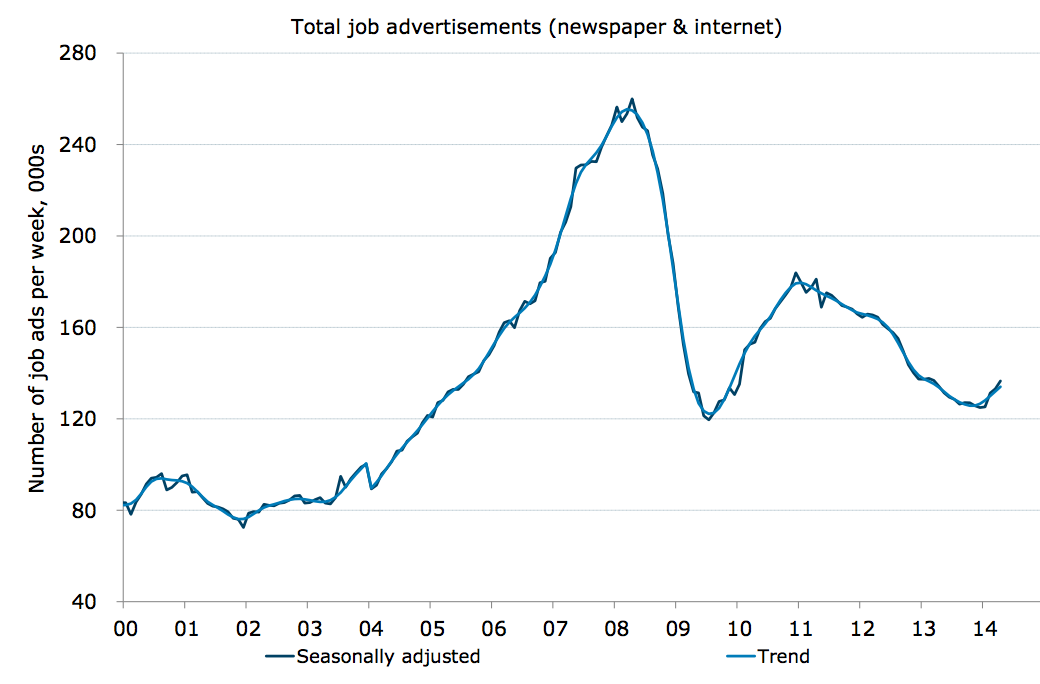
Job ads were rising.
Growth was out of the doldrums.
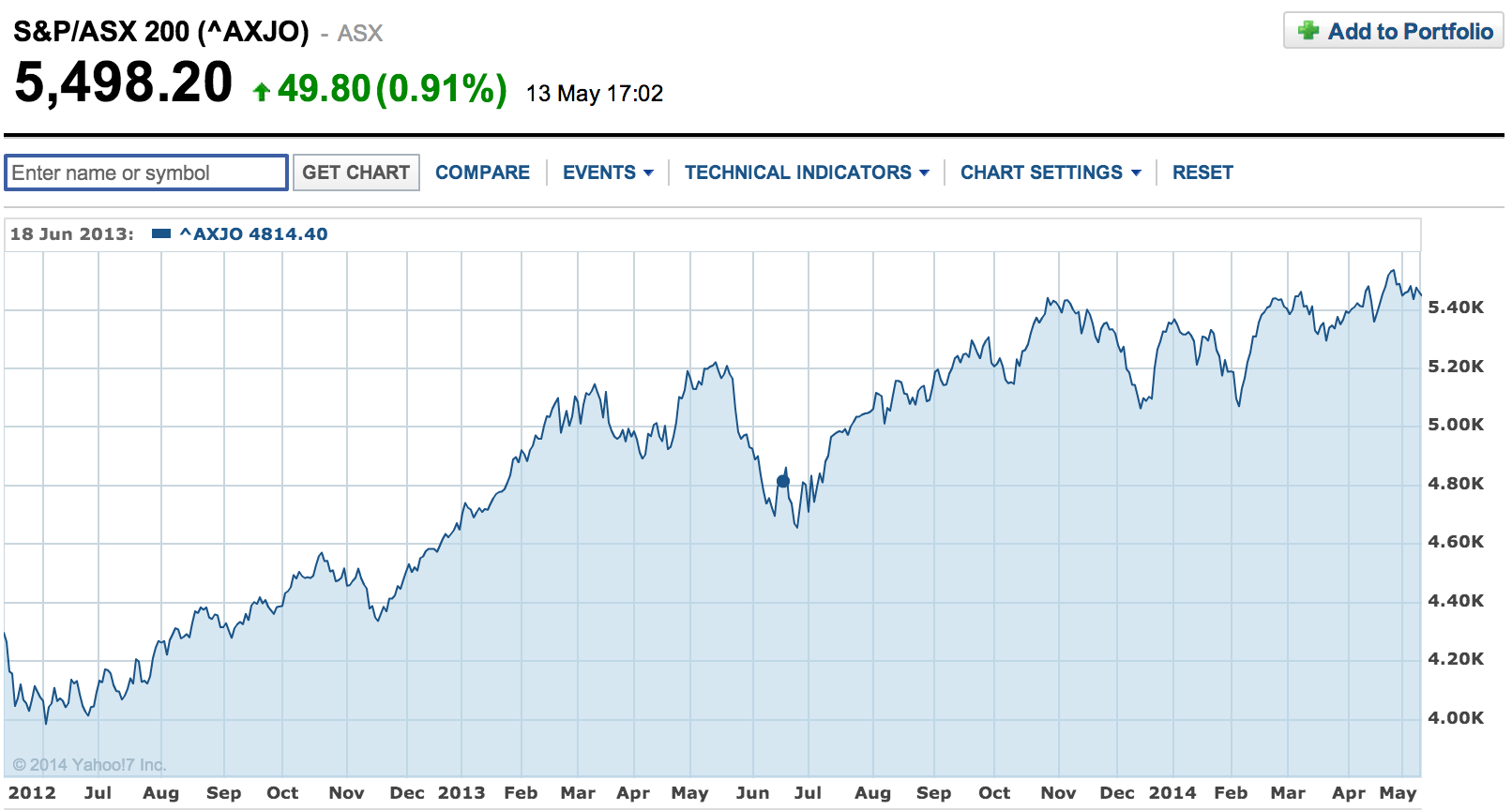
Corporate profits were rising and the stockmarket too.
So how come the Budget forecasts the unemployment rate to worsen?
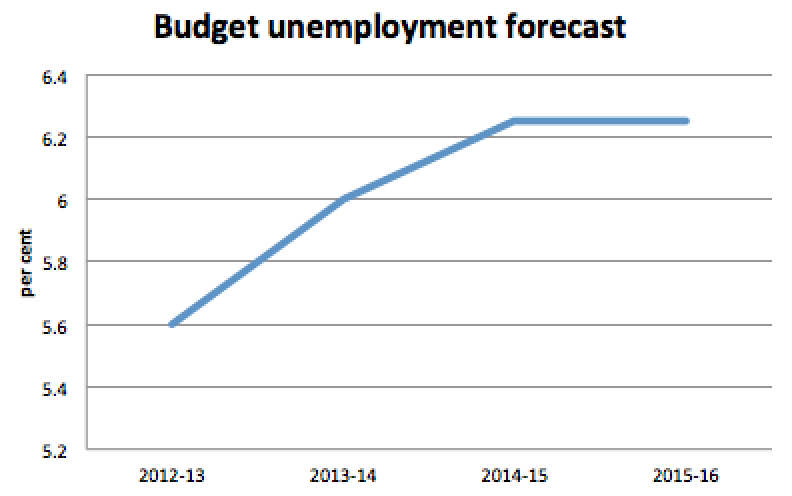
The documents released by Joe Hockey last night forecast unemployment rising from 5.8 per cent up to 6.25 per cent by 2014-15. That would represent around 50,000 people out of work.
It makes this forecast despite expecting a fall in labour force participation and a rise in growth in our “major trading partners,” from 4.6 per cent to 4.75 per cent.
There’s been plenty of good news recently. I thought unemployment forecasts might go the other way. In fact unemployment forecasts haven’t improved since MYEFO, despite this:
“Since MYEFO, the near-term outlook for the household sector has improved. Leading indicators of dwelling investment are consistent with rising activity, while household consumption and retail trade outcomes have improved recently, consistent with gains in household wealth.”
No change since MYEFO? That surprised me. Unemployment forecasts often change between a MYEFO and a Budget. For example, 18 months ago, that MYEFO tipped unemployment of 5.5 per cent in 2013-14. Twelve months ago – at the following Budget – the world looked worse and the forecast was 5.75 per cent.
This time, all the good news since MYEFO seems to be nullified by the government’s surplus rush.
The qualification in this sentence is perhaps important:
“The timing and composition of the new policy decisions mean that the faster pace of consolidation in this Budget does not have a material impact on economic growth over the forecast period, relative to the 2013-14 Mid-Year Economic and Fiscal Outlook (MYEFO).”
You could read that like this: ‘All the good news on the economy in the last six months is about to be wiped out by austerity.’
The Budget talks a lot about lower investment in the resources sector. It notes in passing that non-mining businesses are waiting to see what happens. It doesn’t note that a slashing budget might frighten them out of investing. (There are exceptions of course: a business selling new work outfits to School chaplains would be wise to get a new warehouse, ASAP.)
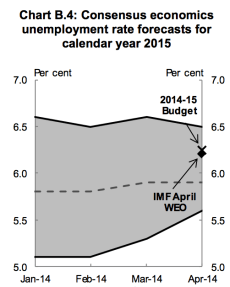
The Budget’s unemployment forecasts are higher than the consensus economics forecast (see chart at right). Perhaps because they wouldn’t cut so hard at the moment the economic recovery is gaining momentum.
All spending helps short-run growth, whether that’s government or private. That’s Keynesianism for you in a nutshell.
The government is apparently allergic to Keynesian concepts of economics. They rail against the spending that flowed during the global financial crisis: cheques for $900, funding for insulation, school halls. All they see is the years of deficits. They can’t see a counter factual where Australia’s economy hit the skids.
But this allergy is now apparently inflaming the ranks of unemployed.
This budget is austere:
“The headline annual pace of consolidation is 0.7 per cent of GDP over the forward estimates. Abstracting from the one‑off nature of the Reserve Bank of Australia transaction, the pace of consolidation is 0.6 per cent of GDP.”
If you’re thinking, “I’m okay because I have a job,” consider this:
“Subdued wage growth is expected to continue until the spare capacity in the labour market is absorbed. The wage price index is forecast to grow by a still subdued 3 per cent through the year to the June quarters of both 2015 and 2016.”
Also know that your taxes will pay more unemployment benefits. Despite cuts to access to the dole, total spending on it is forecast to rise because of the change in the unemployment rate.
Essentially the budget is pushing more people into a position where they need the dole, but then compensating by – for some – whisking it out of their grasp.
Sometimes I ask myself if market forces are broken. All over my suburb I get art, totally for free.
An army of workers accept nil pay, terrible hours, and poor conditions to head out and paint each night.
Not only do they work without pay, but they are forced to buy their own materials and if they get busted, the justice system is not kind.
I guess the economists whose models rely on rational actors maximising their consumption never woke up to find this on their back fence:
What motivates these characters? Is it the cash??
Once upon a time, the notion would have been ridiculous. Graffiti was a way to raise your status among people who never had the chance to finish school or get the Benz. There was no money in it.
The graffiti economy works for guys like Cope2, who grew up in the Bronx and illegally painted subway trains for 20 years before cashing in. He sells pieces for around €3000. Banksy is the other case in point – probably the most notable street art millionaire.
Sheaprd Fairey (the HOPE guy) has also cashed in big time with his OBEY clothing line. Even Justin Bieber is dabbling in “street art.”
Then there’s things like this:
Posh dinnerware company asks: has street art jumped the shark?
How has graffiti gone from definitely underground to potentially lucrative? The difference is in the web.
Then the internet came along. I contend that it has done for graffiti what radio did for music. Made some superstars.
The first Melbourne artist I really googled is Rone, who paints pretty girls all over the place and is kind of a gateway drug for graffiti appreciation
Rone and Wonderfresh mural, Wellington St, Collingwood
The guys who I first noticed up around Collingwood and Fitzroy are from the Everfresh Crew. They have an extensive internet presence and advertise services for rent. Oh yes, there’s money in them thar walls.
Collingwood’s Backwoods gallery is also in the game. They bridge “the gap between the street and the gallery wall, whilst remaining authentic to their artists’ history and vision,” by selling prints for around $100.
There’s not heaps of cash in it, but there is certainly the opportunity for travel.
It seems the internet lets the artists who patrol the night control their image, and helps make money from it.
So is graffiti just another culture co-opted by capitalism?
Jetso and Pzor
Not yet. Melbourne’s graffiti scene is arguably dominated by two names. Jetso and Pzor. And this is where you can go down the rabbit hole and end up like me, taking a photo of a dumpster.
If you start looking for them, they are everywhere. Their work tends not to be elaborate pieces but quick bubble-letter throw-ups, tags and stickers.
pzor left, jetso right
They have no website, no instagram, no representation in the gallery scene (as far as I know). Their art is not visually appealling at first. The art is in the effort. It’s hard to find a part of inner Melbourne, east to west, that shows none of their finger prints. Once you start to notice, it’s hard not to admire.
For these guys, there’s no money in it. And that tells you that for them, graffiti is not work. The question I asked above about market forces being broken is irrelevant. For these guys, painting is leisure. They’re doing it for the love of it. I respect that.
Melbourne is an amazing place, and it gets even better if you can appreciate the art that’s all around you. Here’s three amazing Melbourne graffiti artists you should know.
They compare the results in two types of local elections:
1. Where multiple candidates are elected; and
2. Where one winner rules.
In the latter, voters opt for clever moderates. But in the former, voters identify hard-cases and elect them.
“We propose a theoretical model where the difference in the quality of elected officials between the two electoral systems occurs because elected legislators have to bargain over policy, which induces citizens in (type 1) elections to vote strategically for candidates with more polarized policy positions even at the expense of candidates’ competence. Consistent with the predictions of the model, we find that elected officials in (type 2) elections are more educated than those in district elections and that this effect is stronger in more heterogeneous villages. We also find evidence that elected officials in (type 1) elections have more biased preferences.”
Negotiation is a staple of politics. Greek democracy was founded on the idea of thesis and antithesis entangling in order to forge synthesis. Our modern-day parliaments are the inheritor of this intellectual tradition.
But negotiating is tricky.
Coming to the negotiation table with a smile on your face and a sensible plan immediately marks you as the loser. President Obama found this out the hard way in his first term.
“When it came time to deal with the expiration of the Bush Tax Cuts, President Obama again immediately abandoned the liberal — and his own original — position of allowing all of the Bush Tax Cuts to expire and started negotiating from the centrist position of allowing only the Bush Tax Cuts over $250,000 to expire. By holding hostage the extension of unemployment benefits, Republicans quickly got their way in the tax talks.”
“I suppose what I could have done is started off with no tax cuts, knowing that I was going to want some and then let them take credit for all of them. And maybe that’s the lesson I learned.”
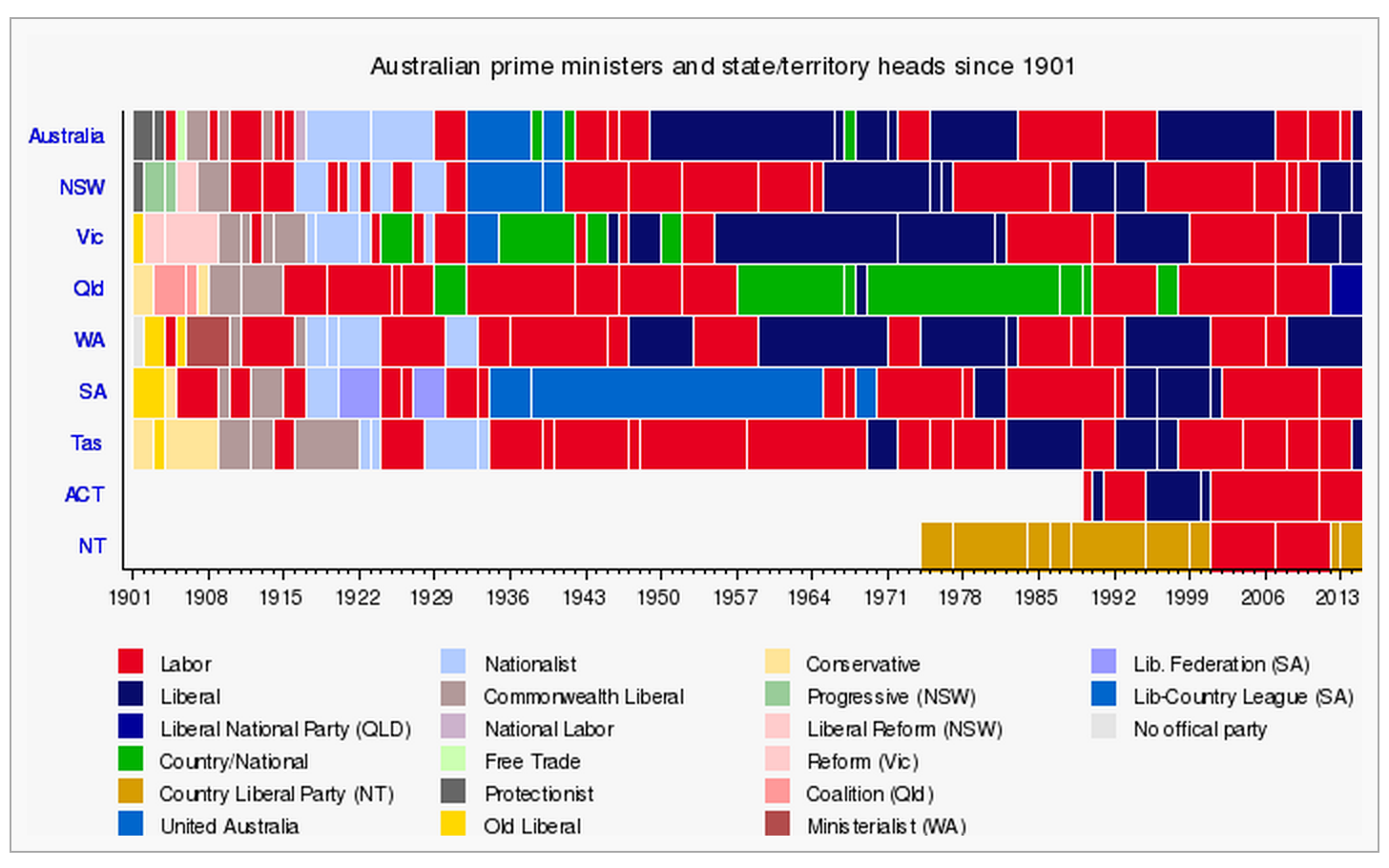
By his second term, Obama took a hard-line position to negotiating and the Republicans were the ones that copped the blame for the government shutdown of 2013.
For example, Ted Cruz, the barnstorming Republican Senator from Texas who led the Republicans into the debt default impasse (an issue that required negotiation to resolve).
Cruz is described as…, well, let me Google that for you.
Now, Cruz lost the wrangle over the debt default. He was cut out by his own side. But his ploy might have been the only way to win. If the other side thinks you are an idiot before you start negotiating, you’ve convinced them they need to offer something stupidly good to close the deal.
The lessons for Australia are many. The moderates in parliament hold less power than the wildcards. And this is especially so in the Senate, where neither party currently has a majority, and negotiation is far more important.
This may be why you hear so much from the Greens Senator Sarah Hanson-Young and so little from the ALP Senator Carol Brown. The less mainstream your position, the more you can expect to gain in concessions, and so the more favour you can expect at the ballot box.
Evidence the Australian public is savvy on this topic can be found in the most recent Senate election, which sent a full box of Froot Loops to our nation’ capital.
This line of thinking raises two important questions:
1. Does this way of voting represent an inherent conservative desire? If we want to gum up the works of politics, matching the other side’s wildcards with wildcards of our own should just about do the trick. A government system stocked with outliers on the spectrum will create a lot more noise and fireworks than one stocked with moderates, but perhaps just as much in the way of real reform.
2. Where we see moderates elected to rule a system, can we assume this means we don’t expect any negotiation to happen? That if someone seemingly sensible like Bill Shorten is elected to head the ALP, that we expect him to rule it with an iron fist?
I value your thoughts on all this – please leave a comment below!
Thursday night: Special occasion dinner for two at a restaurant. (which boasts a chef’s hat in the Good Food Guide – the Melbourne equivalent of a Michelin star.)
Friday: Peking Duck at a Peking Duck restaurant in the suburbs.
Late Friday night: My partner engages in copious vomiting.
Saturday: She spends the day in bed, speculating about the possible effects of so much Peking Duck.
Saturday night: I discover that I too have a ticket on the vomit comet. I suppose that I also ate an excess of Peking Duck.
Sunday: I spend the day in bed.
Mid-week: Our housemate also falls violently ill. Speculation about the role of the Peking Duck falters and wanes. No decent alternative theories emerge.
Time passes. All recover.
A week later: A missed call from the Victorian Government Department of Health Communicable Diseases Unit. (A frightening voice message if ever there was one).
The lady on the end of the phone is duty-bound to provide no information and engage in no speculation. She’s a bug detective, not a news service. But the questions she asks tell the story.
“I got your telephone number from the booking sheet at Easy Tiger. Did you eat there on the night of April 17?”
“I did,” I said, having an aha! moment.
She then goes on to ask a range of questions about symptoms. She also reads out the whole menu, in a seeming attempt to isolate the cause. She tells me not to go to work if I work in the food industry.
Now. It’s very nice to know that the Victorian Department of Health is out there fighting the good fight. But the fact they are involved suggests a certain level of seriousness. I wouldn’t, for example, report a quick spew to the government. But hospital emergency departments are obliged to.
The fact that we passed the bug on suggests it was not your standard food poisoning, but either norovirus or Salmonella, and the fact the government cares enough to investigate may, perhaps, imply it is Salmonella, which is potentially fatal.
The end point of this, and the part where economics comes in, is what we did next.
Kudos to you if you noticed they don’t match. It seems to be policy to remove accusations of food poisoning from review websites, due to legal issues.
We considered the possible ramifications for the restaurant of writing a review linking them to food poisoning. On the one hand, there remains a chance they are not guilty.
On the other hand, making such a review could do a lot of good. If it prevents somebody with a compromised immune system from eating infected food, it could save their life.
But the long-run effect is also important. If restaurants know they can’t poison their diners without facing the consequences, their food safety standards will improve. (It could be the fault of their supplier, but shaming the restaurant will have an effect back up the supply chain.)
So we left a story on Urbanspoon (a restaurant review website) that delivered the facts, as I did above. A chronology of eating, spewing and taking calls from the Communicable Diseases Unit. Nothing definitive, nothing defamatory.
That has since been removed from the restaurant’s Urbanspoon page (while remaining visible via the users page, which nobody would visit).
“My friend ordered the coconut braised wagyu beef in a soupy broth, which the waitress said, came with a “complimentary” serve of rice. And she never got to taste the broth/gravy, because the waitress took her plate away before she could touch it! My friend had finished removing the beef and putting it onto her plate with some rice. She was going to take a spoonful of broth/gravy, but suddenly a waitress appeared, and without asking if she was finished, the waitress whisked the broth-full plate away!”
If you can’t communicate assertively with your waiter, you get to rant and rave. But if something genuinely serious happens, you can’t write about it.
The quality of food is what marketers call an unobservable product characteristic. You can’t know everything about it before you buy. Firms use signals to try to tell you about these unobservable characteristics. For example, they may set prices high (check), or make very public the awards they have won (check).
But with food, quality has an important dimension. Will it make you sick? This dimension is one which the restaurant won’t signal, and consumers are currently blocked from signalling in the most obvious place.
This blog post is therefore designed to stand in place of all those deleted reviews. I do not know for sure what made us sick, but I do know for sure that I’d like to hear about people’s reasonable suspicions before I make my next booking.
1. Letting states raise income tax to pay for services.
States have responsibility for things people really care about, like schools.
The Commission proposes dividing up the ability to levy income taxes between states and the federal government. (States lost this power in WW2). States would start off with a 10 per cent rate, which they could then move up or down. If implemented in Australia, there’s plenty of reasons to believe this would result in higher taxes and higher quality of services. People move house to access better schools all the time. State governments live and die on stories about ambulance waiting times.
Competitive federalism is a classically liberal idea. But these days one could argue the left, broadly defined, has as much claim as anyone to be the custodian of that tradition. Providing the right amount of government services efficiently is as much a left-wing idea now as right.
You give your money to the federal government they will only spend it on fighter jets and diplomats. You give money to state governments, they spend it on schools and hospitals, roads and transport.
The states have been, in the last 50 years, more red than blue. Anyone who doubted states leaned left before the last SA election got a big surprise when they gave Labor another chance. Putting more tax and spending power in the hands of a demonstrably more left-wing level of government will likely lead to more spending on – and better outcomes in – health and education.
If we had a lot of border towns, there would be big risks of distortion where states had different tax policies. Luckily most Australian population centres are far from the borders. The Gold Coast (QLD) is the closest big town to a border, being 23km from Tweed Heads (NSW).
This idea is the only really big game changer in the whole report. Every thing else is about levels of spending or ownership of entities. This one is about the fundamentals of our Commonwealth, and it is not a bad idea. Locating responsibility for expenditure and responsibility for taxation in the same level of government makes perfect sense. Of course commentators are opposed, and it will be, ahem, looming understatement, tricky to get off the ground.
2. Paid Parental Leave to clock out at incomes of $58,000, but keep the surcharge on the profits of big business.
This week, Tony Abbott cut maximum wage matching for the PPL from $150,000 to $100,000. (I estimated this would impact the payments of around 5400 women.) The audit commission argues it should be far lower, at Average Weekly Earnings, or $57,460. But the tax introduced to pay for the scheme should be retained, it argues, and spent on child care.
No upper middle class welfare, and higher taxes on big business? It’s like Bob Brown himself wrote this part of the Commission’s report.
3. Cutting a promised boost to Defence spending.
The Government, in its madness, has promised to boost defence spending to 2 per cent of GDP. Why 2 per cent? Not because that’s proven to be the level we need to keep the barbarians from the gate, but just because.
The Commission rightly argues we should choose our spending level based on strategic and fiscal need, not on easily memorable even prime numbers. (It then waters down the strategy-first argument by saying the government should prioritise: “reducing the staffing size of Defence headquarters in Canberra, including senior staff, to 1998 levels;”).Nevertheless, the government’s 2 per cent of GDP pledge is a shocker of an idea, and the Audit rightly sends it out on to the firing range where it belongs
4. Benchmarking the ABC.
Now, this one is a bit of a stretch. The government is clearly looking for opportunities to cut. But if you benchmark honestly, and compare the ABC to its peers, you’re going to find it hard to do anything but conclude they are very very frugal and represent a good return on investment.
This excellent analysis finds the ABC spends 14c per Australian per day. The BBC gets 39c per Briton per day. Canada’s public broadcaster also gets 14c a day, but it has advertisements. The ABC, is the runaway winner. The article adds that it is 4 per cent of the price of subscribing Foxtel.
While the ABC pays its top stars up to $356,000, I have it on impeccable authority that ABC Melbourne journalists have to BYO teabags to work.
I cannot imagine how a benchmarking exercise would find anything other than great opportunities to invest in the ABC.
–
The Commission of Audit report contains some other ideas I regard as excellent, like cuts to industry assistance, better e-government and slashing the hell out of DFAT. It also contains ideas I oppose wholly, like restricting access to Medicare, and cutting the minimum wage.
Tony Abbott is floating a special deficit tax. If you earn over $80,000 you’ll be up for an extra $800 in tax next year.
Here’s four reasons it’s a bad idea, (and one reason it’s not so bad).
1. We do not have a Budget Emergency. Yet. Our deficits are small and our debt is manageable. What we do have is a looming structural trainwreck as health spending rises while labour force participation falls. A short-term Budget deficit tax fixes the non-problem, while ignoring the real problem.
2. Raising taxes while the economy is in poor shape won’t help the recovery. Australia’s growth has been meagre and our unemployment rate rising for most of the past few years (with a blip down in April’s numbers). Smart economics says to spend more and tax less when you’re trying to induce a recovery. This is Keynesianism.
4. If we are so allergic to a deficit of a few billion, we may never borrow again. With Australia’s long-term government bond rate at 3.93 per cent, borrowing is cheap right now. If we are ever to build any infrastructure round here, we need to borrow money. (Infrastructure costs a lot now and pays off in the long run, so if buy it using cash current generations subsidise later ones). Insufficient borrowing will mean the country comes crumbling down round our ears.
BUT
5. It’s hard to imagine Treasury proposing this idea to the government, except perhaps as a second-best alternative to slashing a lot of programs, and only if the government was hell-bent on returning to surplus immediately. Where you do discern the fingerprints of the department is in the progressive design of the tax, that would mainly slug high-income earners:
Hitting the high income earners may work for Mr Abbott politically too. He hurts only people who are likely to vote for him anyway, keeping western Sydney sweet. That means the people with the highest tendency to consumer their income won’t be hurt, so the economic effect of the tax will be more muted than if it were shared equally.
I’ve written before on the National Broadband Network, under the following headings: National Broadband needlessness. National Broadband Nuff-Nuffs.
I believed the cost of the NBN was too high, the case for it had not been made, and the idea of rolling out fibre to every premises failed to recognise the differences in need between certain types of premises.
Also, I wrote this:
“I think there is a cap on how much data we can consume. No doubt data demand is increasing. From 286 MB/month in 2000 to 14,909 MB / month in 2009. But this is a result of moving real-world activities like photos and video onto the internet. YouTube’s audience is double that of the three big channels broadcasting US prime-time TV.
Data demand is limited by human constraints. Pixel demand is limited by the size of screens we can fit in our homes, audio quality demand is limited by our hearing and demand for video is limited by the number of waking hours in the day.
Camera megapixels are a good example of this. For about five years after the advent of digital cameras, the number of megapixels available grew exponentially. But then it plateaued at about 10-12. For the majority of people the marginal benefit of more and more data wasn’t worth it.
Similarly, telephone call sound quality is abysmal and noone cares. Most of the value is in the existence of the link not the quality.”
Well, the data is in, and while I hold fast to my fundamental point about eventual data satiation, that point looks far away. Data demand is nine times what it was five years ago.
There’s another point to make too. Both this data set and my analysis above are obsessed about downloads. But that’s not the only thing that happens on the internet these days. User-generated content is becoming more important.
It was not until I started making a bit of video that I understood how very very poor upload speeds are. The NBN as imagined originally would offer much better download speeds.
I still believe that the NBN should be subject to a proper cost-benefit analysis and weighed against other investments. It may be the NBN has an extremely positive return but still yields less than public transport investments. In which case we should probably reconsider our aversion to debt.
Also, this argument still stands:
“There’s a big difference between giving hospitals and the square kilometre array incredible internet speed (8 tbps!), and giving incredible internet speeds to every terrace house, flat and bungalow in postcode 3068. Where productivity demands better internet access, users should pay.”
But the idea that data demand won’t create need for the NBN, I concede, looks wrong.
Today, the consumer price index is released. Australian inflation appears to be in check, as the RBA keeps a steady hand on the tiller (If you are secretly unsure what the RBA does, click here.). Inflation gets really interesting over the long run.
Let’s look at what the damage will be in 2035, when we’re a lot older. It may shock you.
FOOD
A pie and a soft drink at the football?
I paid $14.40 for a Four’N Twenty pie and a bottle of Sprite on the weekend. The inflation rate for Food and non-alcoholic beverages over the last ten years has been 2.9 per cent a year. Applying that to the next 20 years means that by 2035, your half time snack will be a whopping $26.75.
BEER
If you want the exquisite contemporary Australian experience of drinking a bottle of Crown Lager at Federation Square, you now pay $9.The inflation rate for the Alcohol and Tobacco index over the last ten years has been 4.6 per cent a year. Applying that to the next 20 years means in 2035, the price of the beer will be $24.
TRANSPORT
A ticket permitting two hours of travel on Melbourne’s ‘world-class’ public transport system costs $3.58. The inflation rate for transport over the last ten years has been 2.3 per cent a year. The lowest rate we’ve seen so far. Applying that to the next 20 years means in 2035, a ride on a tram will cost $5.87.
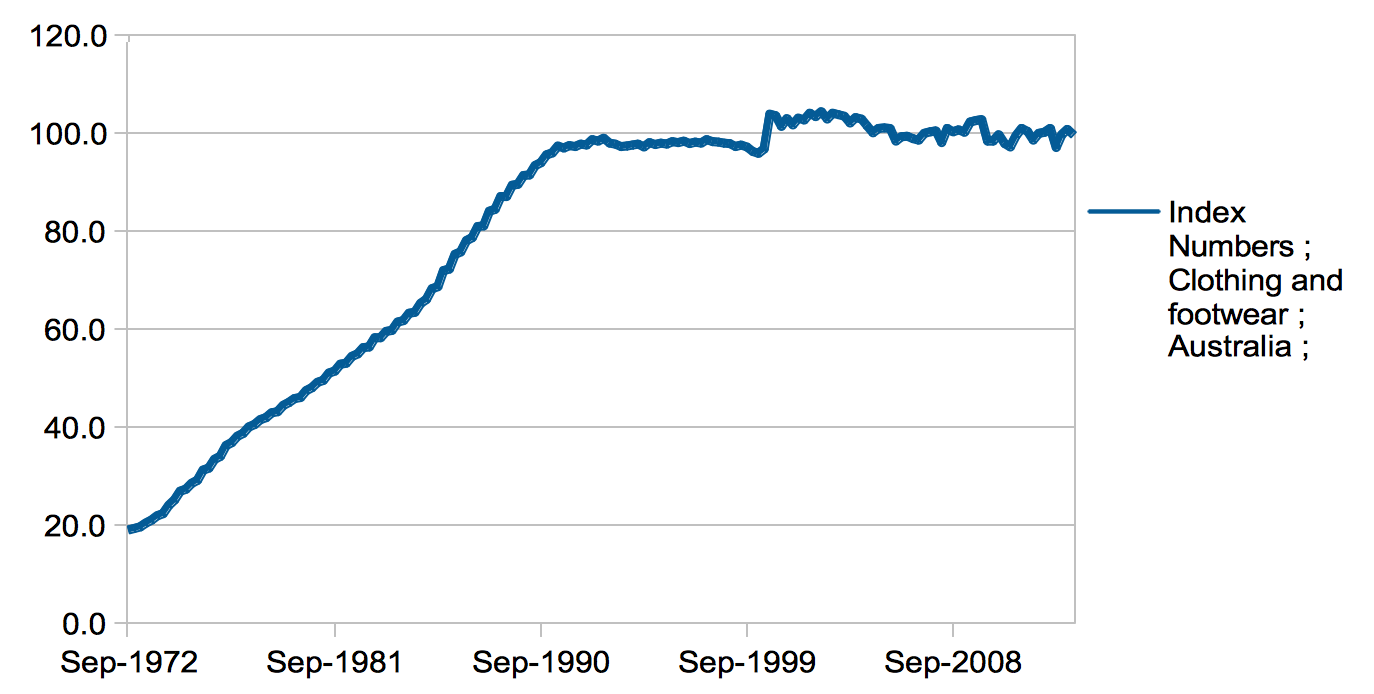
A pair of ASICS Gel Kayano running shoes costs $250. In 2035 that will be $235. Wait, what? Yes, it’s not all bad news on the inflation front. Some things have fallen in price in the last 10 years, especially clothing. The average annual price change in the last decade was -0.4. There’s more detail on this in a post I wrote a couple of weeks ago.
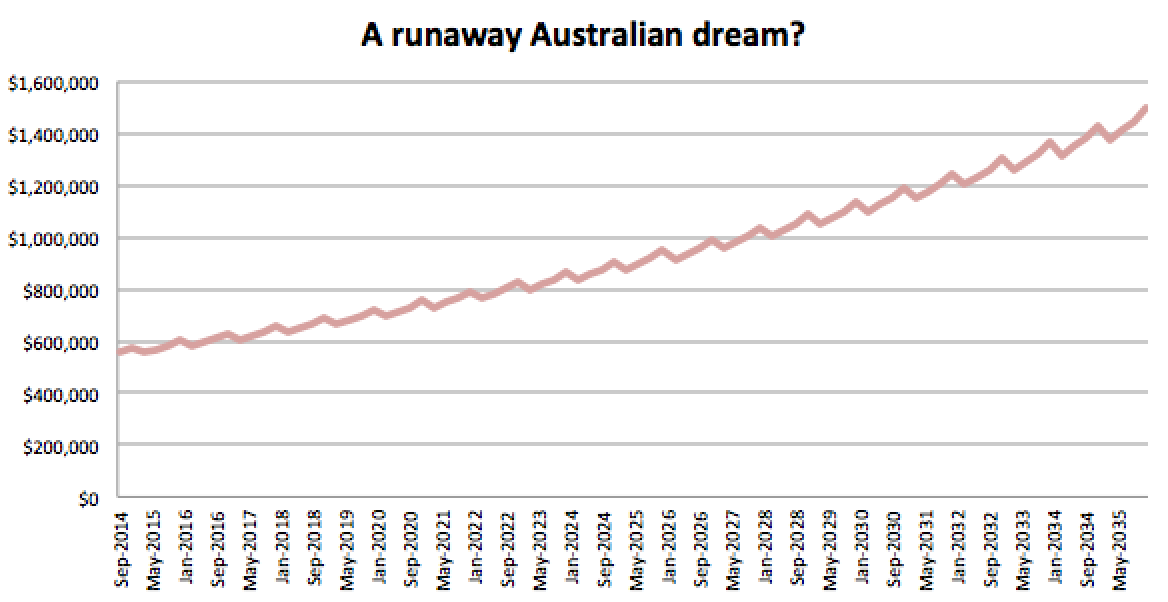
It has at an advertised price, now, of $550,000. Over the last decade, house prices have risen 4.6 per cent a year. If that continues, you’ll be looking at $1.49 million in 2035.
PAYCHEQUE
Here’s the good news.
If you have a full time job, and you pay 30 per cent tax on it on average, your fortnightly paycheque, based on ABS average weekly earnings, is $2012.
The rate of growth of wages in the past decade has been 4.5 per cent. By 2035, that fortnightly paycheque would have grown to $5294.
Will you be better off? Almost certainly yes. Wages have risen faster than consumer prices for most of Australia’s history, giving us improving real (i.e. inflation adjusted) income (see graph at right).
But if you can somehow arrange to want less housing and beer, and more clothing and shoes, you’re going to be even better off…
I just finished reading the Hunger Games (book one). I enjoyed it for a reason that might be unusual. It brought back vivid memories of my first-year economics textbooks. To me, the Hunger Games is clearly a secret primer in basic economics.
The free-market lessons kick in on page five, when Katniss – the heroine of the book – ducks under a fence to go hunting, in defiance of the rules that govern her district, which is both starved and ruled with an iron fist.
“Most of the peacekeepers turn a blind eye,” she explains, and we learn that a thriving black market – the Hob – is what keeps Katniss and family alive. Every time she hunts and then sells her kill Katniss defies a death penalty that prohibits trading.
LESSON 2: Central planning and colonisation are bad
The district itself is run as a sort of colony of the Capitol. The Capitol is the centre of a future North America torn apart by climate change.
The district where Katniss lives specialises in coal-mining. The citizens of this colony have no control over the coal production. They are forced to mine and send the coal to the Capitol. They are prohibited from engaging in commerce or choosing their fates. The result of their lack of freedom of choice is made clear in the first part of the book:
“Starvation’s not an uncommon fate in District 12,” says Katniss on page 28.
The parallels with the colonisation era of the 1800s are clear. The lust for cheap raw materials and labour makes the keeping of colonies highly advantageous. But the citizens have to be oppressed for colonisation to work. Katniss can’t bring her bow and arrows inside the District, because the powers that oversee it fear an uprising. The trade between the district and the capitol is anything but free. You know who else opposed colonialism? The famous economist Adam Smith.
Few services are provided from the capitol back to the colonies. Colonies get some supplies of oil and grain , a few hours of electricity a day, and TV broadcasts that are more like propaganda. When Katniss gets on a train to go to the Capitol to compete in the Hunger Games, it is the first time she has been on any motorised vehicle.
Same
Then, for a while the economics lessons of the Hunger Games become less about the virtues of free markets, and zeroes in on a particular micro-economic concept:
LESSON 3: Game Theory.
The dynamics of the Hunger Games are brutal. The Capitol forces 24 children from 12 districts into a gladiatorial battle to the death.
Lesson 3.1 Go to the cornucopia?
To start the game, the contestants enter the arena simultaneously, but at a distance from each other. Then they face the first complex and interdependent choice. The centre of the arena (the cornucopia) is filled with useful items. Weapons, food, shelter.
In the short-run, nobody is armed, so going into the centre is risky. It may be worth it if you can defend yourself, so the biggest, strongest players have the incentive to head in to the centre. But it may also be worth it if you think you have no chance without supplies.
Of course, if the weak players yield the advantages of the stash to the strongest players, it makes their job even harder. So some take the risk. Even Katniss. In the end the stash of items is the scene of several quick deaths.
Lesson 3.2 Form an alliance?
The stash of supplies is too big for one player to control, and so the biggest players form an alliance.
The existence of an alliance among the strongest players in the Hunger Games may seem surprising. Any alliance must eventually break down – it is after all a battle to the last man standing. Game theory suggests breaking an alliance earlier rather than later will always be advantageous. But the presence of a stash of food binds them together. They need to be able to have some people sleep while others defend the stash.
If the alliance between the strong breaks down before the stash of food is depleted, the one remaining owner of the stash will be unable to so much as sleep, or risk becoming a target of remaining outsiders. The stash itself is an x-factor that binds that alliance of the strong together, so long as it lasts.
Social factors can also influence the outcomes of prisoners dilemma-style interactions, which can explain a couple of alliances Katniss enters into, especially the one with Rue. Katniss simply likes Rue.
She likes Peeta too, but he is less useful as an ally. As if aware of the implausibility, the alliance of Katniss and Peeta is maintained by a steady stream of rewards that arrive. The payoffs to staying together are higher than the payoffs of moving apart.
Lesson 3.3 Run and hide?
The Hunger Games reward survival, not killing. The optimal strategy at the start of a game is obviously a defensive one. Let everyone else try to kill each other and just wait. It’s only optimal to choose to enter a battle later, when there are fewer than 24 opponents, so as to minimise the chance of stumbling upon someone whilst sneaking up on another.
For that reason it is no surprise the “Gamekeepers” unleash a massive fire on the unsuspecting players very early on. This makes sure hiding is very difficult. The action cannot be allowed to ebb, after all.
Lesson 4: Prices.
Contestants can obtain items from “sponsors”, which are delivered to them in the Game. Later in the game, the price of items goes up dramatically. If we assume sponsors want to help the eventual victor, this makes sense.
Gifts delivered late in the game when few survivors remain are likely to be more effective in securing a win than those delivered early on. So gifts delivered in the last phase of the game are most valuable .
Problems
The book is a sci-fi fantasy and I do not expect it maintain perfect adherence to economic incentives. Two examples stand out.
1. Tesserae. Children from Districts can increase their chance of being selected as a Hunger Games participant in return for a year’s supply of grain and oil.
From the kids’ perspective I understand it wholly. But where’s the upside of this to the Capitol? It doesn’t yield more participants, or more interesting Hunger Games. It probably just costs them more in oil and grain. We are told the point of the Hunger Games is to keep the residents of the capitol amused and the residents of the districts poor and weak. The Tesserae don’t really achieve either of those.
2. Careers. The book wants us to believe that the Hunger Games are dominated by “career” competitors that volunteer to enter and almost always win. But it doesn’t seem plausible.
In the Hunger Games of book one, there are around six “careers.” Each must have an eighteen per cent chance of winning, assuming the rest of the contenders have no chance. For each of them, the risk is too high and the rewards too low. Especially when you consider that the reward of winning is supposedly food and housing, and the “careers” are described as being from “wealthier districts … fed and housed throughout their lives for this moment.”
Given the chances of winning are so low and the upside is slight, the optimal solution for any one district would be to send their weakest, least valuable members.
Big questions about the merits of economic growth.
The Hunger Games also raises very interesting questions about the end-point of economic development.
When Katniss first arrives from the districts, and meets the surgically altered citizens of the Capitol, and eats the endless supply of bountiful food, she asks an important question
“What must it be like, I wonder, to live in a world where food appears at the press of a button? How would I spend the hours I now commit to combing the woods for sustenance if it were so easy to come by? What do they do all day, these people in the Capitol, besides decorating their bodies and waiting around for a new shipment of tributes to roll in and die for their entertainment?”
Katniss wonders what her identity would be without having to provide for her most basic needs. I think that question haunts a lot of people in the privileged parts of the world. We have all the food we need and much much more. Our lives are about comfort, not survival.
I suspect this sense of meaninglessness is why some affluent people seem to spend a lot of time on their vegetable gardens.
The question of giving life purpose is likely to become only more relevant as production of food, clothing and shelter become more efficient. When people’s economic contribution is less and less crucial to survival – making ads, doing graphic design for t-shirts, doing accounting, they may begin to wonder what the real point of wealth is.
…
I am eager to get into Economics 201 – by which I refer to Hunger Games book 2. Will we see a process of revolution and decolonisation that allow market forces to deliver the districts into a state of freedom? Will there be a surge of immigration to the capitol? Will the book explore the macro-economic implications, including on prices and wages? I can hardly wait to find out.
The internet economy is developing before our very eyes. Is it a gold mine? Looking only at the Silicon Valley Ferraris, you might conclude yes.
Or is it going to destroy value and jobs everywhere? Looking only at the newspaper industry you might conclude that every job that involves storing, processing and weighing information – from lawyers to bankers, doctors to teachers – is in deep trouble.
The internet reduces a lot of costs. As consumers we are comfortable with the concept of zero marginal costs. We breathe the air, look at the views, bask in the sunshine.
But as producers, as workers, we get worried. There are no jobs in the “Air Industry.”
The internet means a lot of work is about to be done at zero marginal cost. You build a system that teaches kids their time tables, you can roll it out across the English-speaking world. Teachers quake. Build a system that retrieves data from legal cases and roll it out across the jurisdiction. Lawyers will quake. Build a system that uses symptom data to develop diagnoses and hospitals will take it up while Doctors rend their garments.
But all this is a long way off.
For now, the internet is a lot simpler. The only industries that have been transformed so far are ones where data is simply displayed, not manipulated. Industries like advertising.
Google shows you ads all over the internet – in your email, when you surf the web, etc. And this transformation has reaped it a large and growing pile of money.
Until now.
Google revenues have fallen in all categories in the first quarter of 2014.
Of course Google is still profitable, and Q1 2014 beat Q1 2013, but the movement in the trend provides another data point to support the second hypothesis above, that the internet-isation of our economy will not involve a lot of money.
The internet is just a distribution mechanism. Making information for distribution still takes work, at least for now. But economic theory says the cost of a good will fall to its marginal cost. The predictive power of economics is pretty impressive when you look at how many newspapers are free, how many TV stations are free, and how many movies get pirated.
Whether companies will find ways to get people to pay for information products is an open question.
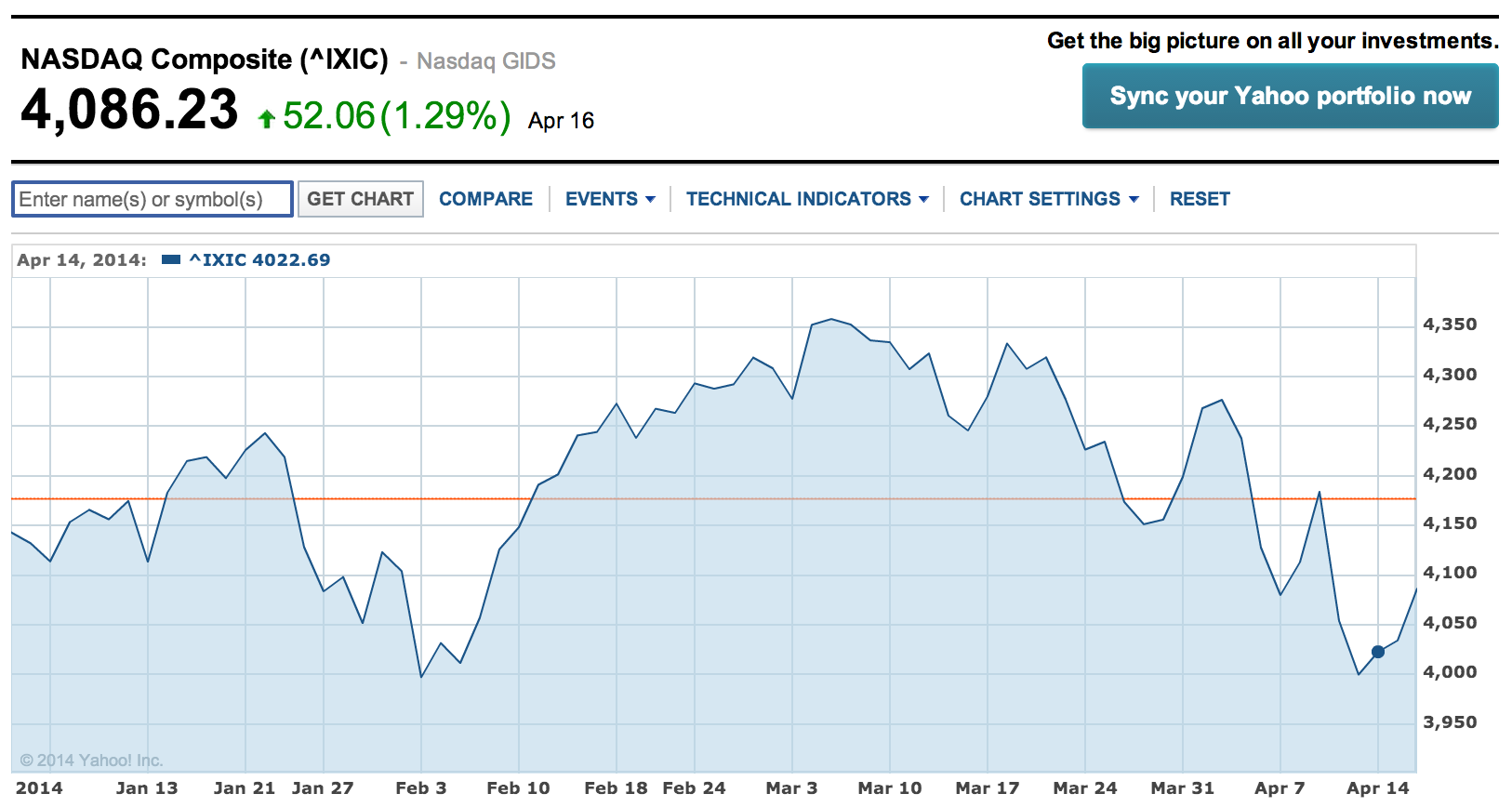
But if the “zero marginal cost” feature of the internet economy proves to be decisive, investors will lose a lot of money. Evolving views on this “big question” may explain why the Nasdaq – the technology stock index – surges and falls with more volatility than other bourses.
Some investors clearly already worry about the profitability of technology companies.
But money is not everything. The world in which zero marginal cost is decisive could be a good one.
Imagine if air was made in big O2 factories, and you had to buy a subscription. Would you be better off, or worse off?
So it could be with a lot of technology. We may be better off in an economy where there are slightly fewer jobs but much more that you can consume for free.
Even if the robots don’t get up to scratch and we need people to make information products for free, will we be able to expect them to do so? Let’s look past the evidence that they will (YouTube, blogs, most short films, most bands, Open Office, a lot of apps, Wikipedia, etc.) to the theory.
The concept rests on the idea that people have a “cognitive surplus.” You can meet your basic needs (food / housing) without using up all your week. Then you have time you can spend doing things that look like work.
This cognitive surplus may come in a certain phase of life. You may be a child or a student or retired. Or you may have a cognitive surplus because you work part-time, or because you are still full of beans in the evening when you get home from your “real” job.
The you use that cognitive surplus to do things that look, to the outside observer, like “work.”
The fact that a cognitive surplus needs to be defined and explained, really shows the incredible power of one of economics simplest models: breaking your day up into Leisure and Labour.
The model is pervasive. People use it to do all sorts of calculations about how much they should pay to save an hour of leisure, etc. But it’s also kind of stupid. Commuting is neither leisure nor labor. Neither is washing your work shirts. The category of unpaid labour is invented. For washing the floors, sure. But does it include baking a cake? Digging in the garden? Building a treehouse? You can enjoy unpaid labour.
Slate economics blogger Matthew Yglesias goes on and on about the enjoyment of your job, calling job amenity value the most neglected subject in economics. Of course you can enjoy paid labour too. This is just another way in which the binary “paid labor vs unpaid leisure” model of life is defunct.
The internet could end up making the leisure/labour model look even more stupid, if people accept they won’t get paid for things that were once deemed work, and do them anyway.
They’re spending their cognitive surplus. Is it leisure or labour? Wrong question.
But a zero marginal cost economy won’t wreck the whole economy. There will always be plentiful jobs in things that are not zero marginal cost. Humans need food and housing and transport and always will.
If you’re worried about the rise of the internet, invest in something concrete. Like iron ore mining, or potato farming, or logistics. These industries will continue to sell things, hire people, and make money.
I learned something surprising about Google this week.
Their spam-filtering software lives an amazing double life.
I’ve known for some time that if you fill in this form (to post a comment on a blog, or whatever), you need only type the number on the right – it will ignore the number in the photograph. That was perplexing.
Then I discovered Google is using us. When you type the number in the photo, that gets sent to Google Maps, where it answers a question being asked by Streetview – ‘what street number is this?’.
This is quite brilliant. They apparently also use this program, called ReCAPTCHA, to decipher words the software can’t untangle when scanning books. So every time you post on a blog, you’re contributing to the quality of streetview, or scanned books.
The idea is so clever that Google now has software that is entirely designed to trick us into doing work for them.
I am talking about the “game” called Ingress. I downloaded this last week, because it was free and the Google App store told me it was highly regarded.
I opened the app and when it told me I had to “walk” to achieve the missions, I started pinching the screen, tapping, even shaking my mobile device to figure out how to “walk.” Soon it dawned on me. “Walk” meant “walk”.
The app is designed to collect data on the walking distances, way-finding and walking time between landmarks, especially those which are in pedestrian areas not covered by the Google streetview system. (The game itself is pretty intriguing but also pretty confusing.)
The lesson of all this is the power of a big company – there are amazing things you can do inside a company that you couldn’t do outside.
Inside companies, exchanges are based on relationships, not market payments. Unless you get paid piece-work, you are rewarded for being there, not for every article you write, or every ministerial briefing, or every line of code. You do the work because they trust you to do it. You are getting paid, sure, but you trust that working hard now will lead to reward down the line. It’s not specified in the contract.
Every time a company expands, they are saying that they have more faith in using relationships to get the output of the people they just hired, than using the market. The reason is transaction costs.
While Google is tricking us into doing work for it via non-market transactions, Amazon is arranging to pay people to do similar work.
They have a “marketplace” called Mechanical Turk, where you can get stuck into the task of diong things computers can’t. Maybe selecting which photo of a landmark is clearest and best, transcribing some audio, or similar.
But there are many tasks, like completing surveys or any crowd-sourcing task, where low effort from lots of people delivers a better result than lots of effort from a few well-paid people. Google seems to have this figured out – the market is not always the best solution.
The Budget comes out on 13 May, and when it does, one thing is for sure. Everyone will get in a flap and a lather over the wrong things.
The Budget is a whopping lump of documentation, and many of the people sent to cover it are inexpert in matters fiscal.
So at the end of the day, an inordinate number of stories will be simply about “the deficit.”
It’s one of only a few simple numbers in the whole Budget. Earnings minus Spending, delivering a binary result: Surplus/Deficit. Good vs Bad. It’s quite graspable.
But it is very hard to find experts that care about each year’s budget deficit. (1, 2, 3, 4.)
Forecast deficits are more important, but the actions that need to be taken to get the ship in order long-term are often counter-productive if you want a surplus ASAP.
Stressing over one year’s budget deficit is akin to stressing about the score in a five minute period of a game of football. Sure, the end result is made up of periods just like this one. But experts understand that the game turns over a longer period than just five minutes.
Sometimes you are kicking into the wind, and a deficit score can be okay. Sometimes you run a deficit on purpose, to prop up the economy or grease the wheels of reform.
Headlines that scream Deficit! and Surplus! – complete with a cartoon of a treasurer either pulling out his pockets to show they are empty, or otherwise evilly grinning and hoarding cash – would be better spent focusing on what matters.
The way to train people’s focus onto certain matters is to measure and report them.
“If you can’t measure it, you can’t (media) manage it,” as they say.
Labor had the opportunity to remake the focus of the Budget, but lacked the foresight.
They could have put the budget balance in size eight font and tucked it away down the back. Obviously you can’t take away the food bowl and expect the media to sit there wagging their tail. You’d need to give them something else.
Politically speaking, this last one might have been quite useful.
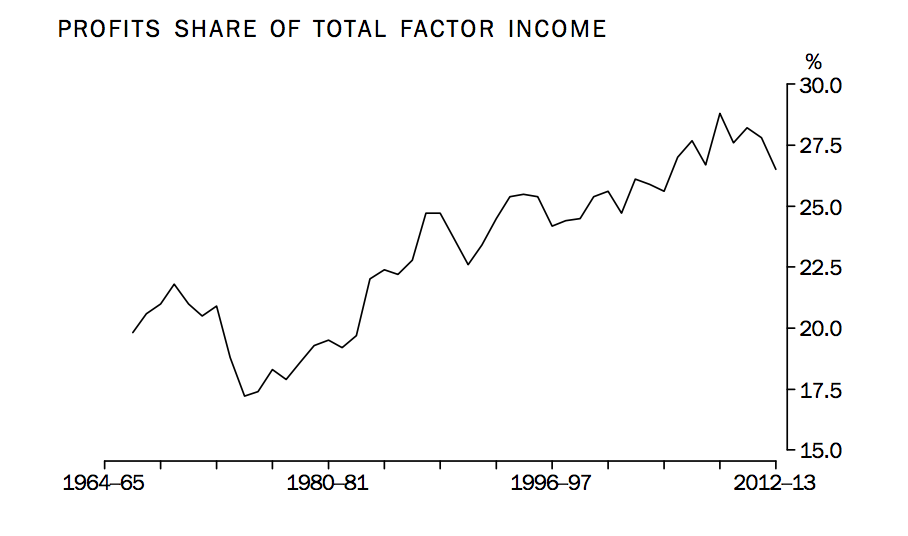
The Australian economy has been characterised by a fall in the compensation of employees (COE), relative to profits.
The National Accounts, from where these graphs come, note: “The profits shares recorded since the late 1980s are at a distinctly higher level than those reported at any time since 1959–60.”
I do not suggest that at the moment there is a crisis in equality in Australia, but I suspect many people think Australia could do better. And there is a choice to be made as Australia equips itself with policies for the next decade. Do we want to be Sweden or America?
People realise policies that promote freedom and small government can lead to inequality of outcomes. Mostly they accept that, until the inequality is bad enough to undermine the society expected to enjoy that freedom.
In the US, inequality is so bad that Walmart now is forced to declare as a material risk to its earnings, any changes to Government welfare cheques that would further impoverish its customers. (from the Wall Street Journal).
The Budget is the best time to try to introduce a new concept or issue into the economic debate, because that is when the greatest number of Australians are paying attention. Using the budget to shape the environment in which economic policy is played is going to yield better long-run outcomes than playing another round of The Deficit/Surplus Game.
Even if the other side gets back in and removes that statistic from the Budget, the public – by then attuned to expect this data – gets the sense the new team is hiding something.
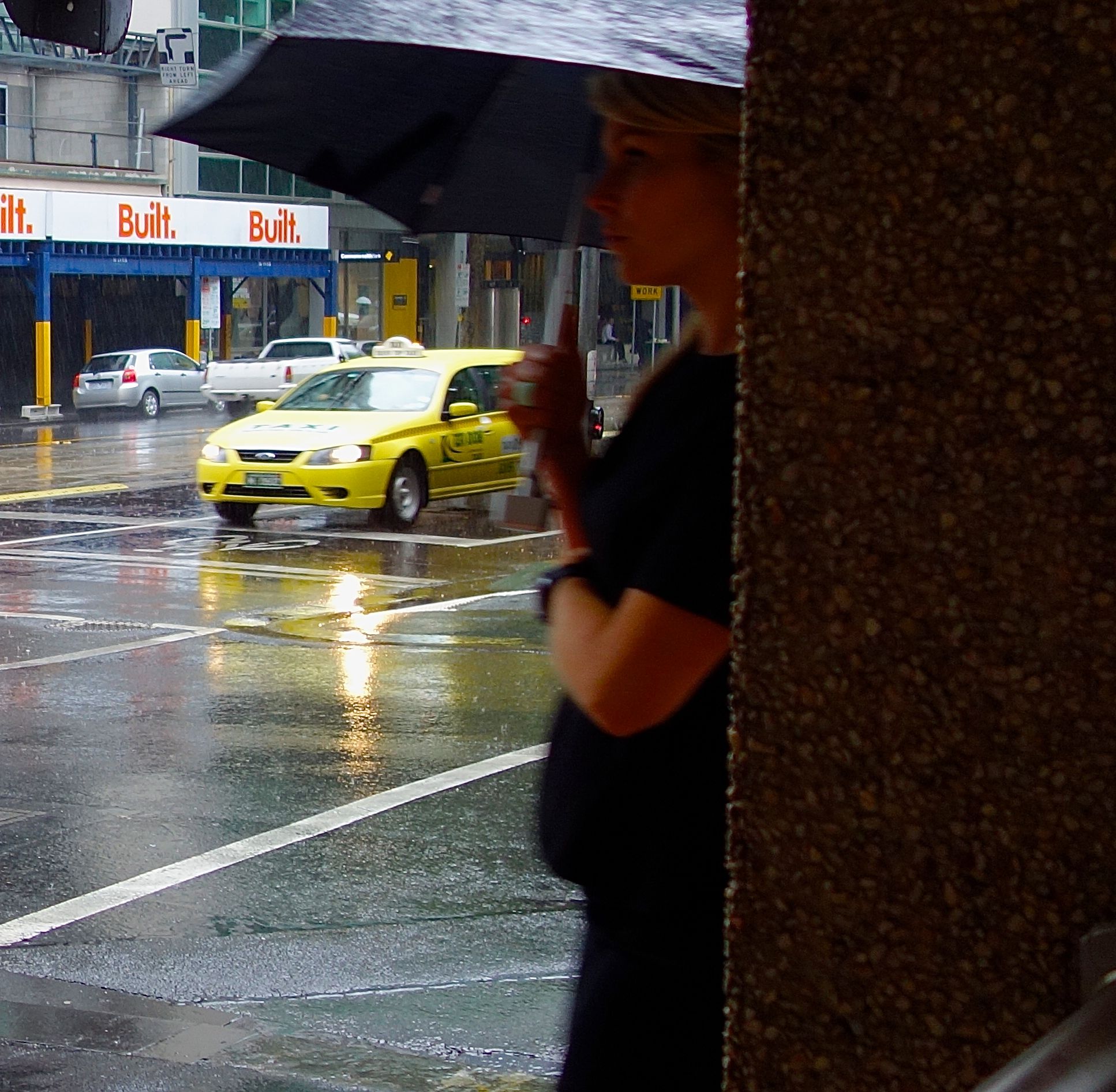
In the rain on Wednesday night, I got a cab home from the city – a $15 fare. Near my house the driver had to turn from a busy road into a side street, across oncoming traffic.
As the windscreen wipers flicked back and forth, the oncoming headlights of a bus distorted into a kaleidoscope of colour in the raindrops. At that exact moment, the driver took his foot off the brake and began to make his turn.
Every muscle in my body tensed and I opened my mouth to shout something, but then he stopped again. The bus had to swerve past the yellow bonnet of the car. Once it was gone the driver proceeded.
And I’d rate this guy as one of the better drivers I’ve had in recent times. At least he didn’t drive on the footpath.
The government is proposing to raise flagfall from $3.20 to $5.20 after 5pm and to $6.20 on Friday and Saturday nights.
A sheltered industry
The market for taxis has long been a mess. A big part of the problem is the lack of actual market forces. The industry has long been regulated to within an inch of its life. The biggest single rule has been a cap on the number of taxis in Melbourne, that drives up the value of a cab.
The licenses (aka plates, aka medallions) that permit you to have a taxi in Melbourne are worth hundreds of thousands of dollars. The owner gets half the money you pay. The value of the medallion exists only because the number of taxis is regulated.
One of the reforms proposed by the Victorian government’s taxi review was for the split of revenue to change from 50:50 to 55:45. A ten percent increase for the driver is hardly earth-shattering, but it has been opposed by the Victorian Taxi Association. That is the peak body for the industry. Unsurprisingly, it doesn’t effectively represent the users of taxis or the casual drivers. It is backed by the money.
It also opposed the big reform proposed by the taxi industry review, increasing the number of cabs in Melbourne. Despite its arduous work in representing the interests of the medallion holders, that reform has driven down the price of a taxi license. (In 2012, licenses were changing hands for as much as $500,000.)
The government has agreed to a clever approach – leasing 12 month taxi licenses at $22,000 a year. This price is indexed at below the rate of inflation. The eventual effect is that the price of a taxi license approaches zero, and the market is no longer held hostage by the medallion holders.
The other big change that is being stealthily introduced is deregulation of fares. Part of the problem is that a taxi is just a taxi. There’s no easy way to get a good one. No way to offer a better service and charge a higher price.
Another yellow ball bouncing round the barrel of the quality lottery
But in country areas, the government is introducing a rule that allows taxis to set their own fares. I see a link with today’s announcement. Might higher fares in the city build a consensus that really, deregulated fares are the desirable outcome?
Hopefully by that point, the taxi industry as we know it will cease to exist anyway. The hire car and limousine market has also been given freer rein under these reforms. Hire cars differ from taxis because they cannot pick up fares on the street – they have to be booked. Pre-smartphone, this was an impediment. Now booking your ride is only an app away.
The biggest player in this space is Uber. It started as a a way for towncar and limo drivers in the US to make money in their downtime, and is now available worldwide. The little car-hailing company that could is now worth an estimated $3.5 billion. According to their website, riding from my house to the city could cost as little as $10 and you might end up riding in a Prius or a Mercedes.
If they put our yellow cabs out of business, I won’t shed a tear.
We all know the feeling. You take your annual leave and go on a terrific holiday. Perhaps some cultural time in the capitals of Europe. Perhaps a noodle and beer-intensive tour of South East Asia.
Then you return to work. The swivel chair sits forlornly awaiting your return. Hundreds or thousands of emails demand your attention.
You dive into work with a mixture of novelty and regret – this used to be very familiar, you think, and now it is not. At least until around midday, when it will seem as though your holiday never happened at all.
Fatality risk increased for every day the surgeons took off between procedures.
In the study the mean mortality rate the first day after surgery was 0.62 per cent. Mortality rose by .05 percentage points for every extra day it had been since the surgeon held a scalpel. That is a 7.4 per cent rise in the risk of dying.
The study (Hockenberry and Helmchen) covered 56,000 patients and 188 surgeons and focused on a procedure called coronary artery bypass grafts.
Hospitals prefer doctors who do a lot of surgeries, because they are more effective. Surgeons who did more than 100 of the procedure per year had lower one-day mortality outcomes (0.52 per cent), but for them, time off was even worse. For every day of rest, the morbidity rate of their next surgery rose by .09 percentage points.
The doctors did not perform worse on absolutely every measure. When they were back from a break, they apparently sped through the surgery, using less resources. Each day off correlated with a fall in the cost of surgery of 0.6 per cent.
But the saving was well below the value of life lost. In other words, society would prefer the doctors to spend more time and money. The researchers theorise that the cost effect and the morbidity effect are related – relaxed surgeons with their brain still on the golf course are failing to notice important complications and therefore closing up when they should be doing more work.
“After temporal breaks, surgeons may fail to identify and treat life-threatening complications.”
The effect was stronger for surgeons if they had had a lot of time off from surgery in general, rather than if it had been a long time since they undertook the specific procedure being studied.
The effect requires more study before we can determine a policy response.
If the depreciation of skill happens exponentially the longer doctors are on break, we could encourage them to take several two-to-three day breaks a year, rather than one four-week holiday.
But if the depreciation of skill has a linear or decreasing relation to time away, doctors could be encouraged to take all their leave in a lump. General learning theory suggests most forgetting happens straight away, suggesting the latter solution would be preferred, but this study did not attempt to answer the question.
The research is part of a field of study that looks at human capital and how it erodes. It is well-established that the amount of time that elapses between repetitions of a task decreases the quality of outcomes.
This raises questions about a lot of training courses the modern office worker is encouraged to attend. Is the day off worth the meagre benefit if it also makes the worker less productive on their return?
The link between time off and productivity may also have negative implications for going part-time, buying extra leave, and taking career breaks. These issues are ever more relevant in the modern economy where parental leave is all the more common, where people change jobs often, and where jobs may encompass a wide range of tasks undertaken infrequently, rather than repetition of a few tasks.
There is room for a lot more research on this question, but for now, there is one clear lesson: Don’t choose a surgeon with a suntan.
Swedish clothing brand H&M is opening a new store in Melbourne today. It’s the latest big global clothing retailer to show up here, following Zara and TopShop.
Japanese brand Uniqlo is also set to launch here soon. But why are they coming? The headlines have been full of bad news for all retailers.
Clothing retail looks especially terrible.
Growth has been stagnant for years. Why come to Australia?
People everywhere are spending far more on food than on clothing these days. And yet I don’t see people shuffling around in clothes that need repairing.
I had begun to suspect prices may have something to do with it, but the ABS inflation data for clothing was still a shock to me:
Despite a 10 per cent hike at the time of the introduction of the GST, the price of clothing has risen only 1 per cent since 1993!
I remember 1993. I was 12 years old. For the first time it was possible to buy a pair of Nikes that cost over $100. The last time I went and looked at Nike sneakers, the price range was roughly the same (and I picked up a pair from the factory outlet for $30). If they’d followed the inflation path of food and beverages, sports shoes would all be over $200 now. But they haven’t and they aren’t.
Why not? The answer is not on the demand side. It’s not that in two decades something fundamental has changed in the way humans wear clothes. It’s about the supply side.
And that’s what’s interesting about H&M. It owns stores that sell its own brand. It makes only very limited attempts to stock fancy Italian or American brands. A bit like its Swedish retail older sibling, Ikea, it is vertically integrated and tightly focused on cost.
I bought a terrific shirt at H&M’s Sapporo outlet 10 days ago, for ¥500 (A$5.50). Even on the discount rack that is an absurd bargain. Only after I got it back home did I think to look for this tag, and it was as I suspected.
There are moral issues when it comes to making clothes in Bangladesh. I don’t want the fact that this post doesn’t cover them to stand, in anyone’s mind, for the idea that they are unimportant.
The fact of the matter is that if you can control costs well enough, you can make big margins even as prices fall. That’s the difference between Myer and H&M. Cost control. Myer can’t do it so easily because while it has 66 stores, H&M has 2600. H&M can make or break people while Myer deals with suppliers that have options and won’t let their margins be crunched.
A quick look in the H&M annual report shows just how good those margins are. More than half of the average price tag is mark-up.
The H in H&M stands for Hennes (“for her”), the name of the original company that sold women’s clothing. The M stands for Mauritz Widforss, which was the name of a hunting apparel shop next door to the original Hennes, which H&M took over to develop a men’s line and become what it is today.
If you’re interested in knowing more about the business models of big clothing retailers, check out these very good Forbes profiles that highlight the differences between Uniqlo, Zara and H&M.
Like most people who care about economics, read about it or talk about it, from time to time people say this to me:
“I couldn’t get interested in economics. I just don’t care enough about money.”
They say it dismissively. As though economics was about money.
Economics is about people.
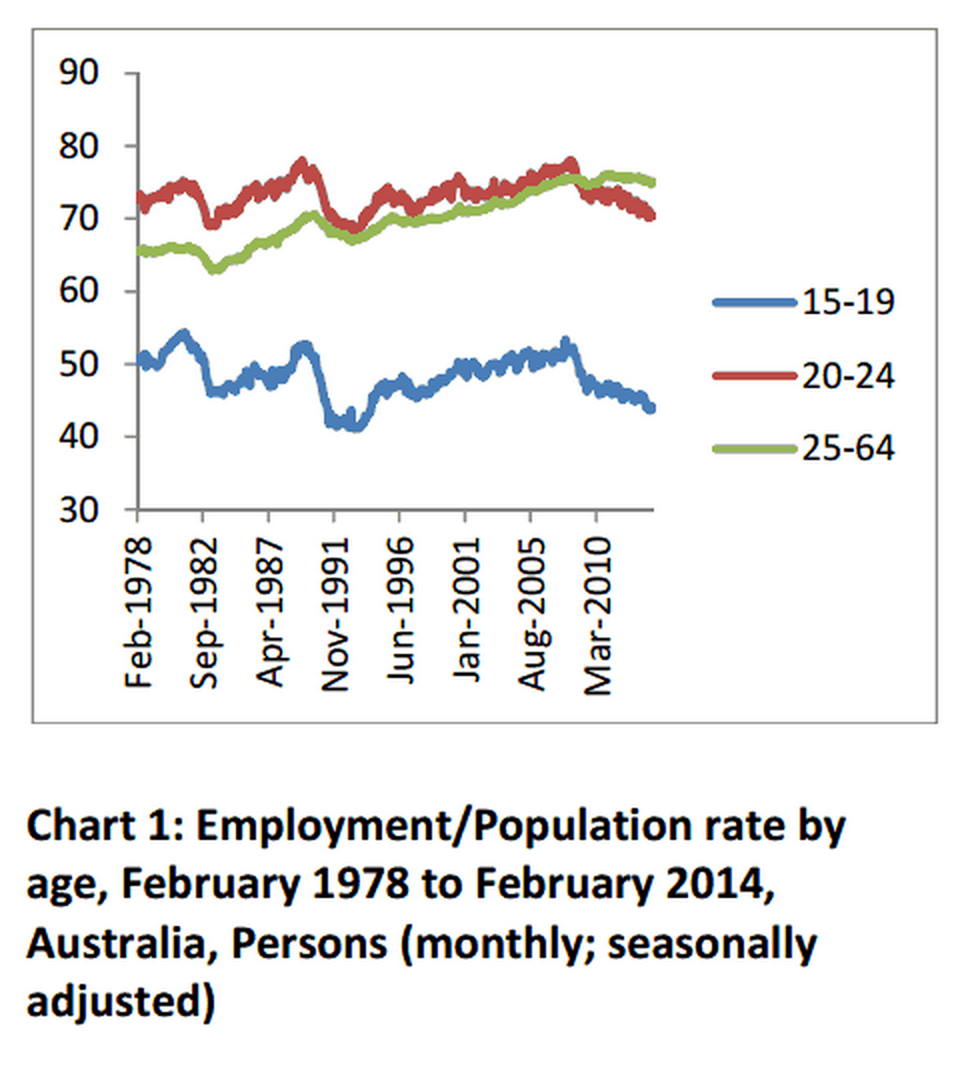
Take the latest work by one of my favourite economists, Professor Jeff Borland. He produces a “labour market snapshot” each month that he emails to interested parties. The April one was focused on the plight of the young.
“Employment prospect of the young in Australia have weakened considerably since the GFC,” he writes.
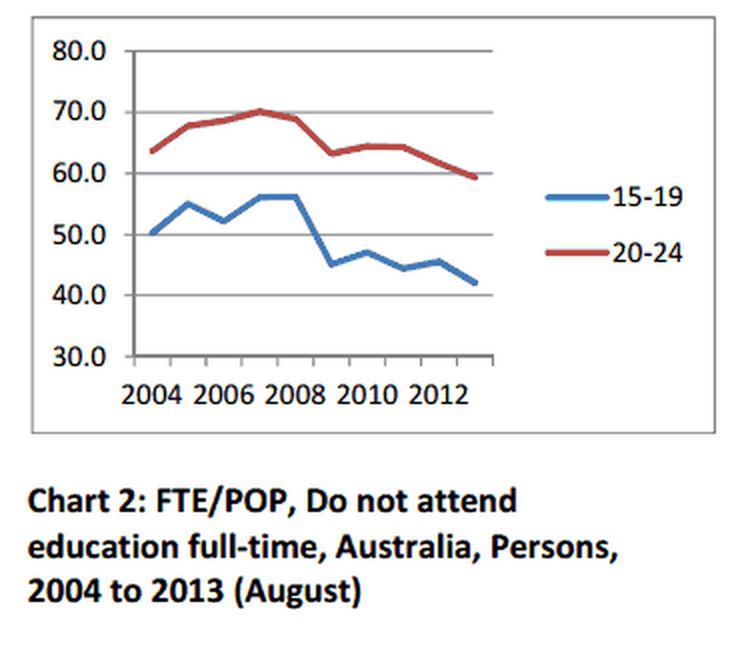
The biggest fall in employment is among those who are not in full-time study.
This is not an academic issue. It’s a goddamn human tragedy. Unemployment at this tender age correlates with worse outcomes on just about every measure.
“Unemployment while young can lead to long-term reductions in wages, increased chances of subsequent periods of unemployment and poorer health outcomes,” according to UK economists.
Brotherhood of Saint Laurence executive director Tony Nicholson: “And in our modern economy that means that they’re really being sentenced to a lifetime of poverty.”
“One in three (32 per cent) long-term unemployed youngsters have contemplated suicide and one in four (24 per cent) in this group admitted to self-harming,” according to a UK survey reported in early 2014.
This blog from the Peterson Institute for International Economics: “Considerable research suggests that less stable employment experiences of young people can lead to “scarring” that affects their future employment and earning prospects.”
The critics of economics implicitly accuse it of reification – that by creating ways of quantifying and measuring the material world they bring materialism to the centre.
There could be a germ of truth there. But to not study the material world in a systematic way would be to deny the real influence it has on humans’ experience of their lives.
Entrepreneurialism – it seems – is not about the wild frontier nor about libertarian values. The most entrepreneurial state in Australia is its most densely populated and most left-leaning (arguably).
The data comes from the ABS series Business Entries and Exits. They show not only that Victoria has (slightly) more businesses per capita than anywhere else, but also that it is extending that lead.
Is that surprising? Victoria is not only a wealthy state, which allows residents the opportunity to strike out on their own, it is also a beacon for immigrants, who often open small businesses. Also it has experienced a lot of structural change as manufacturing businesses close, forcing people to create new opportunities for themselves.
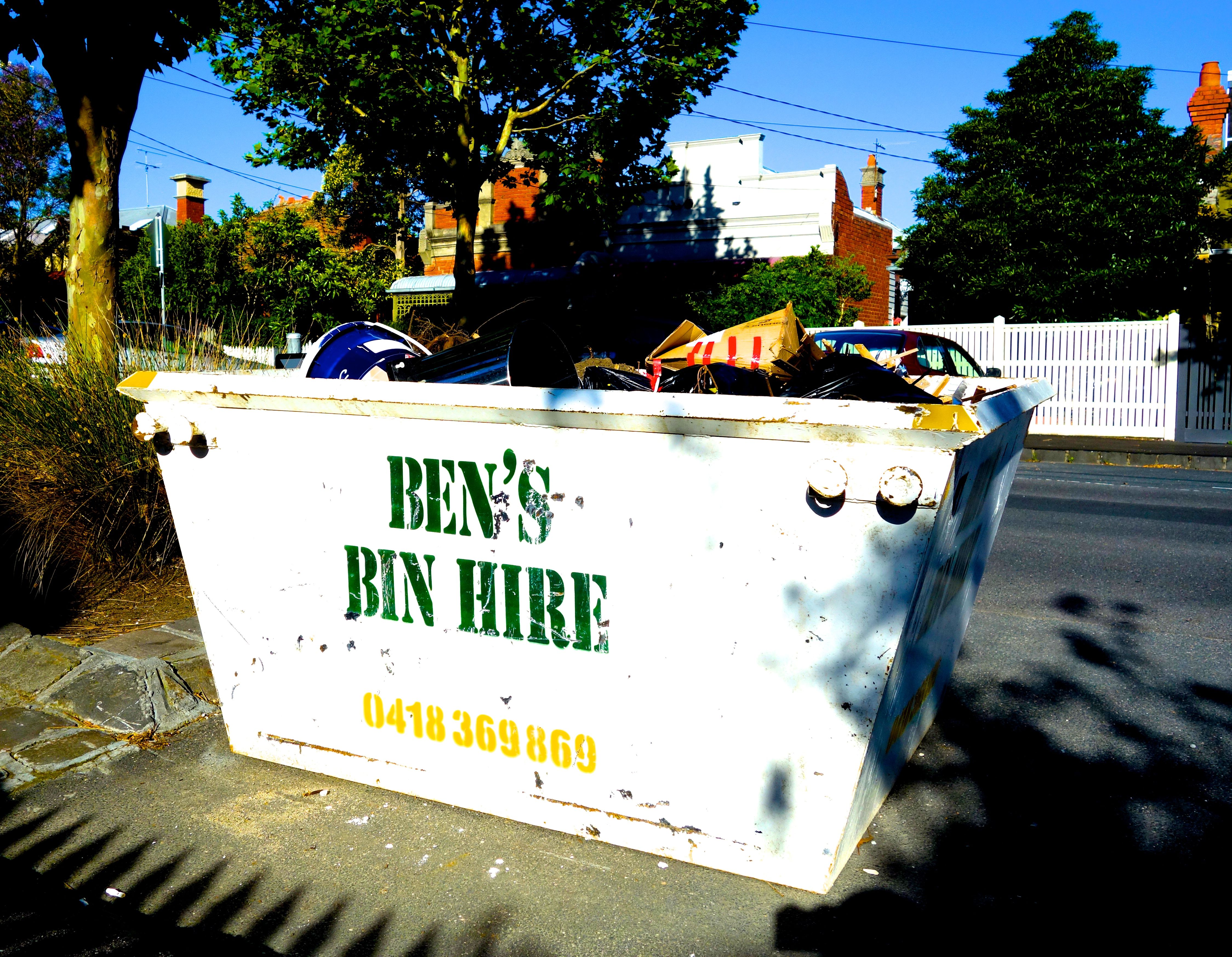
The beginning of a Bin Hire empire for Ben?
(Another point of note is how the ACT is a laggard for total number of businesses, but mid-pack when it comes to opening new businesses. I’m imagining a lot of senior public servants applying for an ABN as they prepare to lose their jobs and become consultants under the Abbott government.)
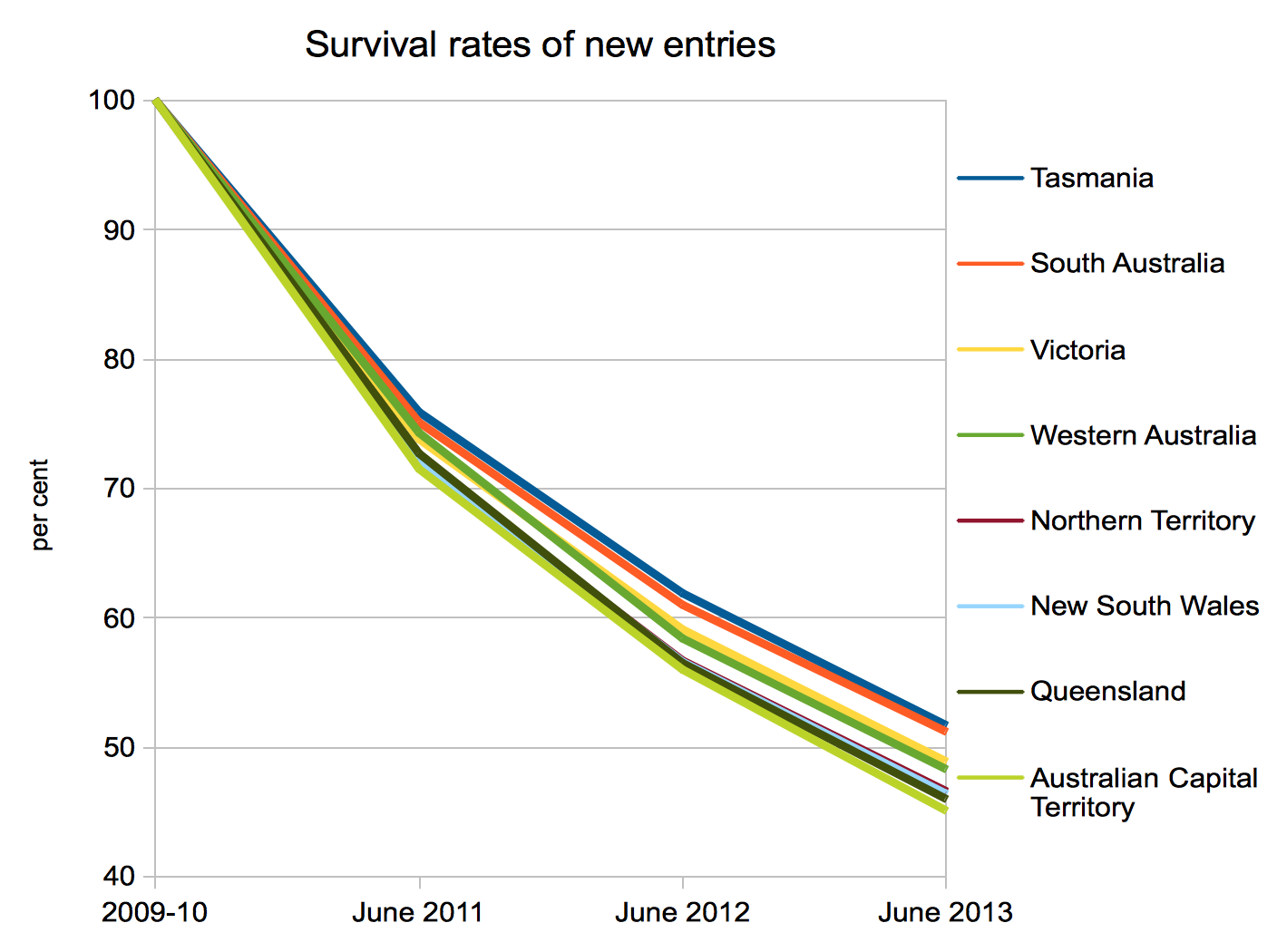
But historically, the ACT is the worst place to start a business. More than half of them disappear within a few years. In fact, Tasmania and SA, with their seeming reluctance to start businesses, are rewarded by having the highest four-year survival rates.
The failure rate of small business is not a mainstream topic of conversation. But I can’t help imagining all the life savings that get flushed away, and all the relationships that fail when small businesses disappear.
It’s the hidden underbelly of capitalism, in a way. We focus on the big businesses that put people out of work, but in those cases, workers have none of their own capital involved and governments guarantee their benefits. When your local milk bar goes down or a removals company runs out of money, nobody notices but the proprietors. They’re not just looking for a new job. They are dealing with the death of their dream. But nobody comes to interview them about their plight.
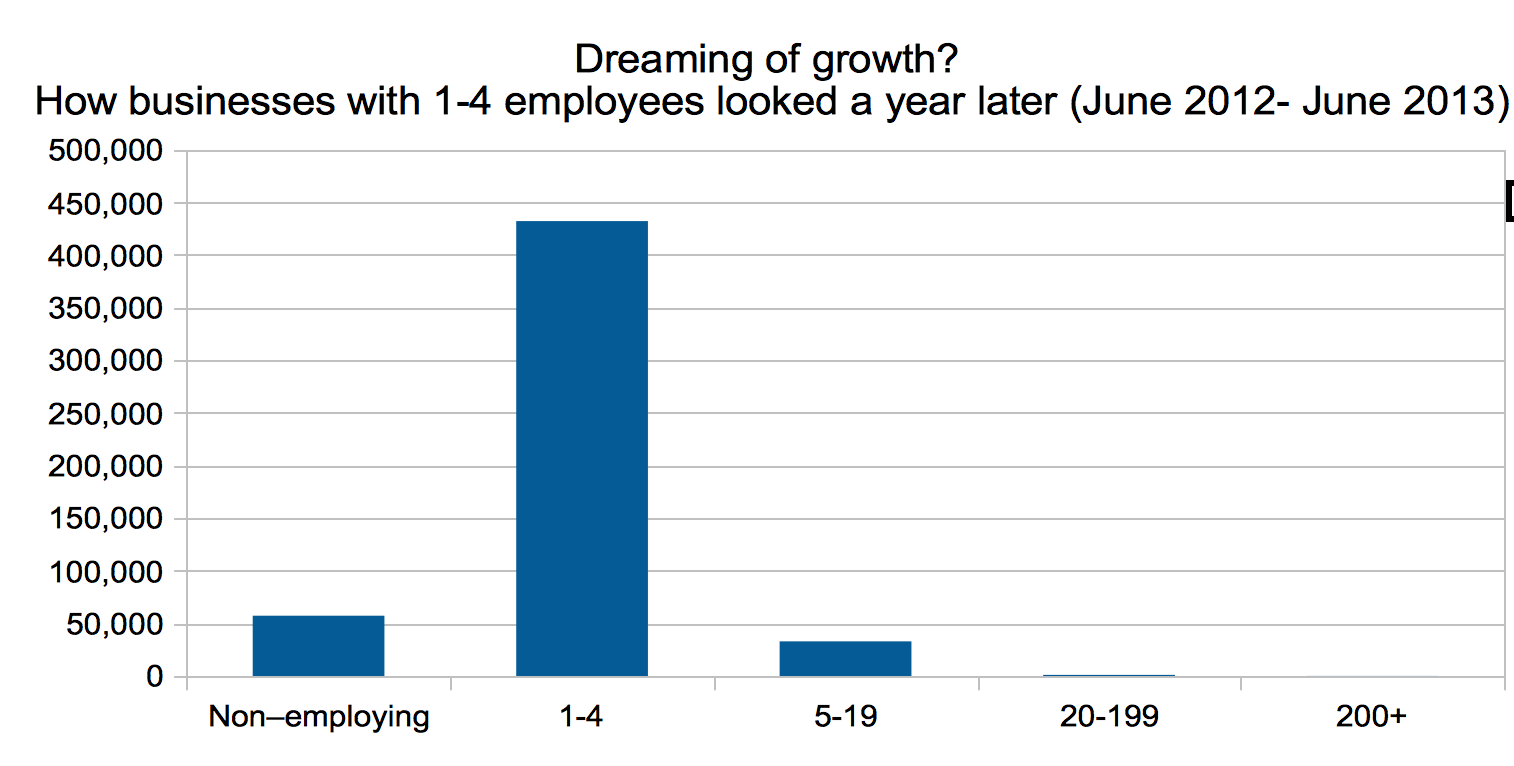
Governments go ga-ga over small business, calling it the backbone of the economy, etc, etc. But they are risky. The data show you are much safer working for or investing in a business with more than 20 employees.
But if you believe in yourself, the carrot is there. Last year, 27 businesses went from having no 1-4 employees to having over 200 in the space of one short year. It’s a bit like buying a Tattslotto ticket – it is unlikely, but just possible that you will have a very exciting result.







 The Budget’s unemployment forecasts are higher than the consensus economics forecast (see chart at right). Perhaps because they wouldn’t cut so hard at the moment the economic recovery is gaining momentum.






 By his second term, Obama took a hard-line position to negotiating and the Republicans were the ones that copped the blame for the government shutdown of 2013.




 The inflation rate for the Alcohol and Tobacco index over the last ten years has been 4.6 per cent a year. Applying that to the next 20 years means in 2035, the price of the beer will be $24.



 Will you be better off? Almost certainly yes. Wages have risen faster than consumer prices for most of Australia’s history, giving us i


 The idea is so clever that Google now has software that is entirely designed to trick us into doing work for them.







 Thomas the Think Engine