Why we should tax tampons, and everything else.

Tax on tampons is a hot topic, with Tony Abbott and Joe Hockey in major disagreement. The issue was brought into the spotlight via a petition on communityrun.org.

“And how can a bodily function be taxed? Because the government doesn’t consider the tampons and pads we’re forced to buy every few weeks ‘necessary’ enough to be GST-free.

On the other hand, condoms, lubricants, sunscreen and nicotine patches are all tax-free because they are classed as important health goods. But isn’t the reproductive health and hygiene of 10 million Australians important too?”

I didn’t sign the petition, and here’s why

Sanitary items are different from “condoms, lubricants, sunscreen and nicotine patches”, because people already want to use them, and there is no evidence of significant public health risk if usage falls. Also, “necessity” is not the binding criterion for determining what gets taxed – we tax electricity.

“Half the population menstruates and they shouldn’t be financially penalised for it.

If you still aren’t convinced, let’s consider some statistics: on average women, who make up the majority of people who use sanitary products, earn $262.50 per week less than their male counterparts, and they are also statistically at greater risk of living below the poverty line. Furthermore, this tax disproportionately targets those who may already be disadvantaged, that is the homeless and unemployed.

So why force this underpaid, at risk and disadvantaged portion of society to pay more for basic essentials?”

Healthy women menstruate for about half their life. So, less than 25 per cent of the population menstruates. How big is the financial burden of this tax on them?

A 16 pack of brand-name tampons costs $4 at Coles. Let’s estimate a woman spends $10 a month. GST on that adds up to $12 a year.

The number of people who can’t afford tampons because of GST is therefore negligible. The number of people pushed into poverty because of that $12 slug would be small. Most people campaigning against this tax have no trouble affording $12 a year.

So if you want to make a difference to the financial well-being of poor women, this is an indirect and very marginal approach. It comes with real trade-offs – it would cost the government revenue. That undermines the ability of society to support the poor.

Here’s a petition I’d support instead: raising income support payments to a more reasonable level.

WHAT’S REALLY HAPPENING

If this petition is not really about public health, necessity or fairness what’s it about?

People hate paying tax. They really hate taxes they can’t avoid. They then create ex-post reasons why they should not have to pay tax, generally involving the welfare of the wretched. (Their own benefit is merely incidental to the social good they’re pursuing!).

The mining industry showed the way, with its campaign against the mining tax, focused on the health of small towns and communities. The big polluters mimicked this in killing the carbon tax, worrying about the electricity bills of families on the bread-line.

It’s no surprise these tactics have spread – they’re extremely effective!

The crux here is whether there is a link between fairness and avoidability. Is a tax fair only if there’s a way to avoid it?

Unavoidable taxes are the backbone of our revenue raising system. We already raise lots of revenue effectively through big taxes on things everyone agrees are “good,” like earning income and buying clothes. I’ve previously written that we need more taxes nobody can avoid.

Tax theory says not to introduce loopholes. That was the mantra when I worked at Treasury – maintain the integrity of the system. Always use payments to solve problems, because exemptions are not targeted and get exploited.

But perhaps I am out of step with community sentiment.

Hate for (certain) unavoidable taxes goes back a long way – Poll taxes brought down Margaret Thatcher, for example. Also, exemptions to the GST were what bought it enough legitimacy to be introduced.

I sometimes wonder if sin taxes – tax on alcohol and cigarettes for example – are to blame for the way people see tax in general. A lot of people interpret the tax system as a moral agent judging their actions. If I saw all tax as punishment, I’d be furious about paying tax on sanitary items too.

Tax is not punishment, so maybe we should rename sin taxes to something other than taxes. What we should not do is carve up the system with more exemptions.

Exemptions undermine the efficiency of the tax system but also the sense that tax is our common duty.

I see plenty of normal people arguing that big companies that contort themselves to pay very little tax in Australia are “just doing what anyone would do”. The sense that everyone can and will avoid tax at every turn is pervasive.

I don’t mind paying tax because I can see the benefits it brings. (even though I’m quite aware it’s not all spent efficiently.)

“Tax is what we pay for civilized society.” US Supreme Court Justice Oliver Wendell Holmes, Jr.

Thanks for reading this far! If you’d like to agree, disagree or accuse me of obnoxious mansplaining please do so below, and I shall attempt to respond!

The real value of the government’s “phenomenal” $20k asset write off

The government’s small business budget has been a big success, it seems. They got positive headlines about the Budget being stimulatory, and now approval ratings of the PM are back up.

It’s a PR success. And a lot of that is due to attention lavished on the $20,000 tax write-off for small business.

It’s “Phenomenal” apparently.

Get ready for a lot more asset write-off announcements in future. Because they buy the government a lot more headlines than they deserve.

You wouldn’t know this from reading about it, but the “$20,000” asset write off is worth only about $1000.

Here’s why:

The $20,000 is not taken off the tax bill of a small business. Instead it’s a deduction from income – same as when an individual gives to charity.

After a small business takes $20k off their income, they save the 28.5 per cent tax they would have paid on it. 28.5% of 20k is $5700.

That’s the actual value of being able to instantly write off a car or machine from your tax this year.

But here’s the thing. Businesses could always write off asset purchases against their income. They just had to do it more slowly.

Using a depreciation schedule from the ATO website, I calculated how much a small business would have been able to save off their tax under the old rules.

It’s $5700.

The only advantage is that under the new policy, a business can claim all that $5700 in this tax year, instead of claiming it in dribs and drabs over the next decade.

Here’s a graph for how your depreciation works under instant write off versus slow depreciation.

Years since purchase on the horizontal axis.

We can measure how much benefit instant access to the write-off provides. All we need to do is make an assumption about how small business values money over time. We do that with a discount rate. Lets assume a discount rate of 8 per cent.

If that is the case, the net present value of the flow of money is $4660. Only $1040 less than the value of the money right now.

(If you assume small business is even more patient, the value of the instant write-off is even less. At a 2 per cent discount rate the NPV is $5350 and the net value of the new policy is a mere $350.)

In summary, the government is getting great value from this policy in media coverage terms.

Compare it to another tax break they gave small business in the Budget – a five per cent tax cut for unincorporated businesses. You probably haven’t seen mention of that anywhere.

But this five per cent tax cut (full disclosure, I run an unincorporated business!) is worth even more to the Budget bottom line. That’s it in the blue bubble on the right side – worth $1.8 billion. This graphic was in the glossy brochures journalists got in the Budget lock-up.

budget glossy

It’s one of the most expensive measures in the Budget. And it has barely got a headline. The government will not make that mistake again.

Expect asset write-off thresholds to be even higher in the next Budget as governments seek a headline that says something like $100,000 Asset Tax Bonus for Small Business.

Parental leave changes will hurt more than the Government believes

The government offers new parents 18 weeks parental leave paid at the minimum wage. It’s worth $11,500. Until now that policy was available to everyone. But the government will now retract the offer for people whose jobs offer them parental leave.

I can see the attraction of cutting it, to save $1 billion. And I don’t expect vast waves of public sympathy for the kind of people who have good employer parental leave schemes. These people are wealthier and well-attached to the labour force.

“At the moment people … are effectively double dipping — we are going to stop that,” – Treasurer Joe Hockey.

But the “double dipping” terminology is partly responsible for the positive initial reaction to this announcement. I was surprised to see even the redoubtable Peter Martin using that terminology in his report on the policy this morning.

Looking at it like that is insufficient. The question is complex. How to take away government services as the private sector provides them is one of the trickiest parts of any policy sphere.

In some policy areas, no matter your private endowments, the government provides. Public transport is available to people whether or not they own cars. Medicare is universal – even those with private health insurance can use it.People with Foxtel are still able to tune into the ABC. Public schools are not reserved for those who can’t afford private ones, etc.

In other areas, we means-test things tightly. Welfare payments are removed as quickly as possible as people earn more money, even though that creates high effective marginal tax rates.  (There is a strong movement arguing for a “basic income” which would effectively be a universal and non means-tested welfare payment).

In each of these cases, a range of questions comes to bear. Is the offering in question a universal right, or a safety net? Is it very expensive to provide widely without means-testing? Is it advantageous to have public and private provision alongside each other? And what will be the effect on private sector provision if the government means-tests?

This last point is crucial in this case.

If you work for a university like the Australian Catholic University that offers 52 weeks paid leave, your employer might not see the new policy arrangements as competitive. The government’s 18 weeks at minimum wage is no substitute. But the average duration of paid parental leave in Australia is under 10 weeks.

For most companies, I expect they will see that their expensive-to-provide policies are offering little or no net benefit to their employees, so they will have no reason not to cancel them.

This policy might actually provide savings to employers, but it will lead to a real fall in the amount of paid time new parents can spend with their children.

Instead of drawing on both, parents will then draw on only the government scheme and there will therefore be a drop in the amount of parental leave taken.

Faced with this shorter period of parental leave, parents will then choose whether to return to work. It could even cause some new parents to sever their connection to the workforce. The consequences could be further reaching than they seem.

The questions raised when the RBA leaks its next rate cut.

Last night, 5 days before the May RBA board meeting, a story appeared on the main Fairfax websites, indicating the RBA would cut interest rates.

Something about this story was unusual.

Written by respected economics journalist Peter Martin, it makes some very bold claims without any sourcing. For example:

“Concern about a deteriorating economic outlook and a resurgent Australian dollar will force the Reserve Bank to cut interest rates on Tuesday, taking the official cash rate to an all-time low of 2 per cent and discounted mortgage rates to just 4.55 per cent.”

How could he know? Normally, such a story obsesses on the implied chance of a rate cut, quotes experts and goes out of its way to show where all the ideas in it come from. Take this Peter Martin story from January for example.

“Inflation is simply not a concern, the Bank’s decision in February need pay no heed to the consequences for prices,” said BT Financial Group economist Chris Caton…

But futures traders marked wound back their bets on a February interest rate cut, cutting the implied probability from 84 per cent to 66 per cent. “The underlying inflation figure came in just above the market’s expectations,’’ explained NAB currency strategist Emma Lawson. “That allowed some pricing of the expected cut to be taken out of the market.””

This new story lacks a single quote, but it isn’t marked as an opinion piece either.

The second pertinent feature of the story was its timing. Five days before the next RBA meeting. Before the last rate cut, in January, there was another curiously insightful story published, by top NewsCorp business journalist Terry McCrann predicting a rate cut. That one also came out five days prior to the meeting.

It is hard to avoid the conclusion the RBA is briefing key journalists on what it will do next.

Two key questions occur to me.

1. This is a big new deviation in the RBA’s communications strategy, which until now had relied on officials making public speeches. Speeches have the advantage of being clearly attributable. If definitive information is being given out, why not give it out in a transparent way?

2. If the RBA can brief journalists on what it will do five days in advance of the board meeting, what exactly is the board meeting for?

The RBA board is stacked with high-flying people chosen for their ability to contribute to the making of monetary policy.

As well as the RBA Governor Glenn Stevens and his 2IC Philip Lowe, the board table has

  • John Akehurst, director of CSL
  • Roger Corbett, chairman of Fairfax
  • John Edwards, director of the Committee for the Economic Development of Australia
  • Kathryn Fagg, director of Boral
  • Heather Ridout, chair of the Australian Super Trustees Board
  • Catherine Tanna, managing director of Energy Australia.
  • John Fraser, Treasury Secretary

Are these great loci of business and economic acumen merely a rubber stamp for the calculations of the RBA?

I suppose it’s obvious that the RBA drives the meeting – it has the staff working on the question of rate cuts month in and month out. They provide the chair, set the agenda, and doubtless distribute packages of graphs to all present.

But now I wonder if the board meeting is really a discussion at all, or whether the gathered brains chew sandwiches while the RBA shows a power point presentation, concluding by presenting the next movement of the official cash rate as a fait accompli.

If that’s the case, ought we have a board and a board meeting at all?

Should businesses get compensation when policy changes?

Do businesses really think policy never changes?

The way they act when a change is proposed makes you think they never realised democracies worked like that.

House_of_Representatives,_Parliament_House,_Canberra

The mining industry would have us believe a mining tax on surging profits was impossible to anticipate.

The car lease industry feign they never dreamed the law might remove their favourable tax treatment.

The steel makers pretend charging for carbon was completely inconceivable.

The tunnel-makers insist they couldn’t foresee a world in which their tunnel wasn’t wanted.

Businesses who stand to lose from policy changes kick up a fuss about how they’ve been blind-sided.  All too often we are taken in by their sob stories. And we retreat from making policy changes we want.

Is this pretending part of the cut and thrust of political debate? It surely is. And yes, we can still make change over the sounds of protest when we really, really need to. For example, the government reintroducing fuel excise levy indexation.

Furthermore, change is costly. If we changed the rules every five minutes, that would make life hard for everyone. There has to be a balance.

But the pace of change in our society could be too slow if we take every business complaint at face value. Many business models depend on the status quo. This graph is a mock-up of why they might defend that status quo, and why that might be less than ideal for society at large.

costs of change
The horizontal axis shows rate of change. Think of that as bills passing the Senate. The vertical axis shows the payoff.

This graph shows a world in which policy change happens too slowly if we let businesses with an investment in the status quo drive policy.

So how do we bridge this gap? We want businesses to invest based on the current laws. But we also want the freedom to change those laws as soon as they are no longer useful.

I think there is a case for policy change insurance. That way if a law is changed that puts a business in the red, they can be compensated, but the taxpayer doesn’t have to be on the hook for it. If they don’t buy policy change insurance? Well they obviously weren’t too worried about that particular law!

Policy change insurance would be cheap to come by for laws that are rock solid. $0.01 a year would buy insurance against the government appropriating your land.

But if your business depends on something else, like funding for dodgy vocational education courses, then your insurance will be much more expensive.

tax reform constipation
An insurance company’s worst nightmare?

Prices in the insurance market would signal to firms what laws are more likely to change. Insuring against a one percent change in tax rates would be expensive. Insuring against a 20 per cent change would be cheaper.

That price signal should mean much less complaining when dubious programs are axed, and also signal to government which laws business honestly thought were steady. It makes both sides more honest.

The existence of this market should allow society to change its laws more often, if it wanted. In some ways I can’t believe it doesn’t already exist.  You can buy Sovereign Risk insurance if you operate in especially heinous jurisdictions, but there seems to be nothing for Australia.

(Perhaps it doesn’t exist because there’s no actual demand? That’d suggest we put even less stock in the bleating of ACCI et al.)

Further savings would come to businesses because they could sack their lobbyists. Of course, the ultimate lobbyists in this new model would be the insurers. They would become the most conservative institutions in history. Every law change would rip money straight from their pockets Strict laws against political donations from insurers would have to be enacted. Laws would also have to ban former MPs from ever working for insurers, etc.

Does this model make sense? Are there any reasons why policy change insurance wouldn’t work? Or reasons why it doesn’t exist already? Is it just simpler for government to pay compensation instead? Is my basic thesis that the pace of change is too low completely wrong? Please share your thoughts below!

Why is Aldi so cheap?

I like Aldi.

It can be very very cheap. Aldi is selling this yoghurt at $6.99 for 18 tubs.

vaalia

At Woolworths it is $9.25 for 12 tubs. That’s 98 percent more expensive per tub.

Similarly Woolworths is selling lamb rack right now for $44.99/kg.

lamb rack

Aldi is selling it for $19.99/kg.

How can they do it?

Woolies and Coles are famously focused on the cost of goods, pushing their suppliers to sell more and more cheaply. While Aldi has less buying power, it obviously negotiates hard too.

But Aldi is famous because it is extremely tightly focused on costs inside its own business.

aldi method
These numbers made-up to serve as an illustration.

The savings at Aldi come from a lot of things – visible and invisible – they do to keep costs down.

THE CHEAP WAY

One of the most visible examples is making you pay for a trolley. To get one you must insert a gold coin, which is refunded when you return the trolley. That way Aldi doesn’t have to pay young people to hang out in the carparks retrieving scattered trolleys.

That’s just one example of how Aldi makes life a bit more difficult for customers, in order to keep prices down.

You may have also noticed that they make you pay for plastic bags. Aldi has been doing that since before the Greens political movement took off (coincidentally, also in Germany), simply because it saves money.

They have only 900 core products on offer. Every item a supermarket stocks costs them money in managing supplier relationships, in accounting, etc. The small selection means small stores, which means less rent.

Similarly, you may have noticed that Aldi doesn’t have an “8 items or less lane” at the checkout, saving on staff. They also make sure products have multiple barcodes or enormous barcodes, so the check-out person needn’t fumble and fuss to scan the item.

aldi rice crackers
baaaaaaaaaar coooooooooooooode

Aldi often employs only two or three staff at the entire store. The guy with the mop could easily be the assistant manager. (They pay those few staff very well however, with assistants getting $23.40 an hour, and assistant managers $76,000 to $84,000.) The stores are open less than 12 hours a day (8.30am to 8pm), however, so Aldi spends less on labour and lights, etc.

Those are just the things you probably already noticed. There are also less visible things Aldi does differently.

They forced pallet-maker CHEP to invent a “multi purpose beverage tray” that can go from the factory to the truck to the supermarket floor without being unpacked. It can store 1.25L bottles or 2L bottles.

MPBT

You spend less on shelf stackers if you don’t need to stack shelves.

Aldi also operates on a Just-in-Time system. Storing inventory is a big cost for businesses. Having goods arrive right when the previous batch runs out means Aldi spends less on behind-the-scenes space, and has less money tied up in owning stock.

Aldi also makes sure cereal packets, etc, are full. The trend to sell half-empty packets to convince consumers they are getting a lot when they’re not is incompatible with Aldi’s hyper-efficient supply chain. [source]

One other invisible innovation is especially welcome…

https://www.youtube.com/watch?v=GdV4pr4frd4&ab_channel=Coles

Unlike the major companies’ incredibly annoying jingles, you probably don’t remember seeing an Aldi TV ad.

Only a handful have gone to air in Australia – even having TV ads is pretty radical for this company. In fact, the only public statement company owner Karl Albrecht ever made was this one, in 1953:

“Our advertisement is the cheap price.” [source]

BROTHERS GRIM?

Aldi has been around since Albrecht brothers Karl and Theo took over their father’s store in Essen, Germany, in 1946. The name stands for Albrecht Discount and the thirst for efficiency goes to the very heart of the business. The brothers were famously ruthless, according to this article in German newspaper Der Spiegel.

“High-ranking executives would dig old pencils out of their desk drawers whenever one of the brothers paid them a visit, just to avoid causing any suspicion that they were wasting office supplies.”

Aldi’s maniacal focus on prices has had spill-over effects in Australia. An investigation by the ACCC found that prices at Coles and Woolworths were lower when an Aldi store was nearby.

Sounds good! But Aldi’s effect has been more complex than that. The lower prices at Coles and Woolies have caused problems with suppliers. And the deluge of home-brands those big supermarkets now own can be traced back to Aldi’s entrance into the market.

This clip from the excellent Mad as Hell shows just how the home brand revolution is working out:

Aldi must bear some responsibility for that. But it never had real brands, so it can’t be found guilty directly.

Reports suggest Aldi treats suppliers better than the big two. Could it be that having stable, simple supplier relationships is more cost-effective? Unlike the big two supermarkets, Aldi refuses to charge suppliers for shelf space and boasts it has very simple terms with suppliers, unlike Coles and Woolies.

PROFIT MOTIVE

Aldi claims it wants “to suck the profitability out of the [supermarket] industry in favour of the consumer.”

That’s pretty radical for a business in the current era. Most businesses are ultimately about shareholder value, not consumer value. It is likely Aldi’s claim is marketing spin. Likely. But not certain. Aldi is not a publicly-owned business, and if it wants to pursue goals other than pure profit maximisation, it absolutely can. Giving up on profits would certainly help explain the low prices!

The brothers who founded Aldi were famous for being billionaires – the richest in Germany. Perhaps their views on the merits of such wealth changed after one was kidnapped and forced to pay a ransom in 1971? It seems unlikely given the drive with which Aldi has expanded across Europe, the USA and Australia. And with the passing of the last brother in 2014, Aldi is free from their direct influence.

If Aldi changes, or makes a mis-step, it need not be the end of German discount retailing in Australia.

Lidl is ready to open stores in this country. Lidl is even older than Aldi and has reportedly opened an office in Australia and registered its business name. In the UK it has proved even more popular than Aldi, with a business model very similar to the Aldi model.

Under the pressure of a bit of direct competition, Aldi might become even cheaper.

Shoppers like me will rejoice. But whether that is a good thing will continue to be debated. Can supermarkets be run with even fewer staff? Will rumours of widespread unpaid overtime intensify? Might Aldi be forced to tighten the screws on suppliers just as Coles and Woolies have? Is there a point where your yoghurt and lamb is too cheap? Or is that idea a middle-class affectation?

Land Tax is having its annual meek and ineffectual resurgence. Can we give it some oomph?

Land tax is a great tax.

Just today, Treasury released a report that shows how much more efficient Land Tax is than all the alternatives.

land tax

I’ve previously argued that to promote land tax, we should emphasise that it is unavoidable. But I’ve gone cold on that idea.

It is true, but not a great argument when the government is going soft on tax dodgers. It simply encourages people to say we should enforce our existing taxes. [They’re right, we should. But we should have land tax too.]

Today the SMH economics guru Jess Irvine wrote a long and very welcome piece about land tax. But it conflated the hard-to-grasp concept of a low distortion tax with the easier-to-grasp concept of a tax that’s hard to “dodge.”

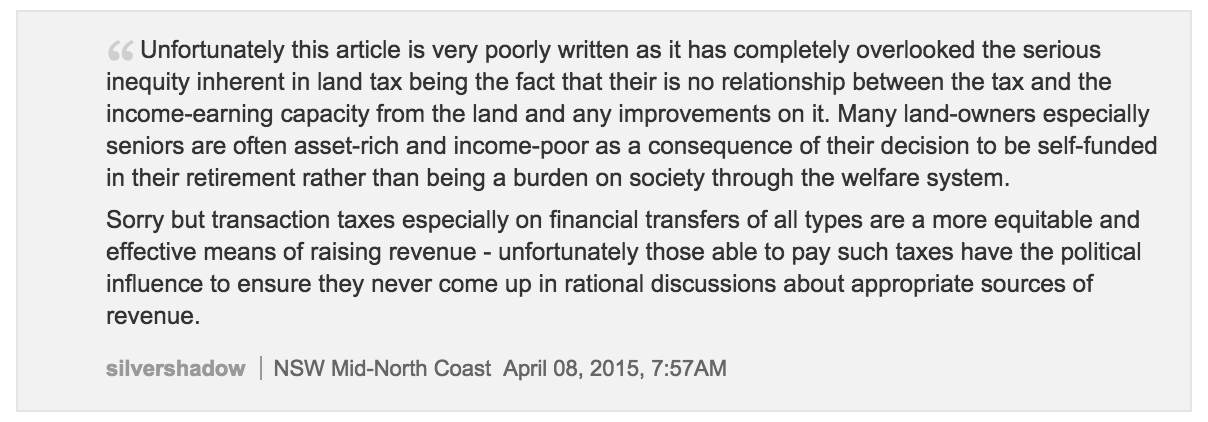
“Land tax is one of the most efficient taxes for precisely the reason it is unpopular: it is hard to dodge. They know where you live. You can hire as many accountants as you want, but it is difficult  to hide that mansion in Point Piper.”

I found myself wondering why land tax is not on the agenda. And I think I’ve figured out why. The conceptual framework you need to grasp its benefits is not commonly shared. And you can see that by flicking to the hundreds of comments that followed the article.

Screen Shot 2015-04-08 at 12.19.12 pm Screen Shot 2015-04-08 at 12.17.40 pm

The comments on the article were almost exclusively focused on fairness. Fairness is just one of the keys to good tax policy. Efficiency is the other. And there is a gulf of understanding between economists and the general public on tax efficiency, with economists to blame.

To get land tax out there you need to teach people why distortion is bad.

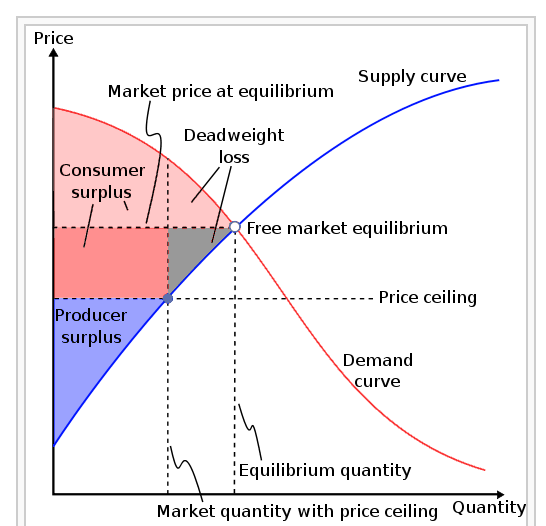
Economics students learn about a model of the economy like this: Trade is mutually beneficial. Taxes prevent trade. Therefore taxes prevent that mutual benefit. The amount of prevention (aka the distortion) is called deadweight loss.

deadweight loss
Deadweight loss from a price ceiling works much the same as a tax. From Wikipedia

The distorting effect of taxes is one of the great insights of microeconomics. It is counter-intuitive and hard to see, because deadweight loss is always a counter-factual. But can we transmit this flash of inspiration and insight from economics to the general public without messing around drawing supply and demand curves, or measuring utility?

A stumbling block is that the purpose of current taxation is so muddled.

We use taxes on “good things” to raise revenue. And we use taxes on “bad things” to change behaviour.

From observing the tax system, it may be unclear why smoking and working are both taxed. Does the government hate work?

The progressivity of the tax system – which I emphasise I support – doubtless contributes to this confusion. Being a low-wage worker, buying healthy fresh food and education attracts lower rates of tax. Being rich, buying luxury cars, eating at restaurants and making capital gains in shares attracts higher rates of tax.

It would be easy for some to see the tax system as a kind of moral agent, punishing bad behaviour and rewarding good. In this scenario, land tax makes no sense.

Explaining that taxes distort behaviour – but we want to minimise that! – is going to be a hard sell when the public sees we use taxes to distort behaviour all the time.

We tax all these things, and you want me to believe that’s because you want to stop some of these things, but you don’t want to stop others? 

Fixing this will be hard. The terminology is a good place to start.

It cannot be helpful to use one word – “tax” –  for both imposts on activities we actually want to encourage, like work, buying goods and services, making profits and owning land; and for things we actually want  to discourage.

I’ll accept suggestions for how we could rename these taxes – Maybe they could be divided into Detrimental but Oh Well, it’s Necessary Taxes and Useful Pricing Taxes (DOWN and UP)?

This distinction would help plant the seed that some – but not all – taxes should be designed in a way that minimises distortion.

The journey to give land tax a fighting chance will be a very long one. The first steps in that journey will be to help give people the capacity to grasp why land tax might be desirable.

Has the government stuffed up its tax review already?

What’s the hashtag for the new tax review? There are several: #taxreview, #rethink, #bettertax, which means there may as well be none.

To describe Australia as excited for this review would be, shall we say, intemperate.

Was there a time when a major review was major? When the big splash of a report launched a thousand editorials and inflamed as many angry talk back callers?

It’s easy to imagine the answer is yes.  But that is probably based on us remembering the big ones, the ones that cut through. Plenty of reform drives run out of fuel.

It is early days, but this review seems to be sputtering. Yesterday morning at 9am The Age had up two stories about the review by Economics editor Peter Martin. One reporting, one editorialising.

By 12.17pm they were both gone from the front page.

They were replaced by a strange little story about how Uber made Joe Hockey worry about GST. (I know mentioning Apple in headlines creates a huge number of clicks and suspect Uber is also on the keyword list editors love.)

Surprised, I went hunting around the net at that time to see what other coverage I could find. Both the Australian and the AFR had the tax review as their top story. But The Age had the Uber story in the 7th spot on its site, and the Herald Sun offered me over 100 links before I found a Breaking News section right at the bottom of the page where, in tiny font, there was mention of the tax review.

The tax paper itself worried about this on page iii.

To deliver lasting, workable reforms, the community needs to be on board and engaged in the conversation.

I kept finding evidence the community wasn’t.

On the ABC news, a story about a suburban church burning down – with no casualties – ran higher than the tax story. And on Reddit, a link about the review got 20 upvotes, while this cat with a map of Australia on its nose got over 1000.

STRAYA CAT

Is this one of those articles that says “social media is making us dumb!”? Then spends a few paragraphs yearning for a golden age that didn’t exist, before vaguely hoping everyone will “grow up”?

No.

I see people discuss policy all the time. Online and off. Social media can be a powerful force for good, when people care.

So why has this review not engaged us yet?

I see three big reasons, two of which represent mistakes by a government I believe is sincere in its desire to achieve something – anything! – before the next election.

1.  The discussion paper contains a headline idea that is undeliverable. Nobody need worry about the government raising the GST.

They lack political capital to do things that should be much, much easier. Like passing their first Budget. Seeing this idea revivified once more just gives people license to pay no further attention.

Props to Mr Hockey for ruling nothing out of this tax paper. It’s brave and principled. But is it wise? I’m unsure.

2. Treasury wrote the discussion paper. This .pdf lacks gravitas, has no imprimatur. If you want people to pay attention to something, it is helpful to have a name behind it. The Henry review had weight because at the time, Henry himself was extremely influential. The ideas in and implied by this discussion paper lack a visible patron.

3. Partly, I think people are disengaged about tax reform because they do not see tax as an input to economic activity. We see tax as something that happens after. We make money, then we pay income tax. We buy food, then we pay GST. We don’t observe all the dissuaded activity and so fail to grasp the systematic effect of taxes, i.e. the link between tax and growth.

Most public discussions I see on tax reform focus on the fairness aspect – who should pay from a justice point of view – not from a growth point of view. This is a shame, because it leads parts of the public to assume Treasury doesn’t care about fairness. I believe they do care, but they are also trying to optimise the effect of tax on growth.

The links from tax to growth are highly debatable – plenty of rich countries have higher aggregate tax takes than us, and plenty of rich countries have different ratios of consumption to income taxes.

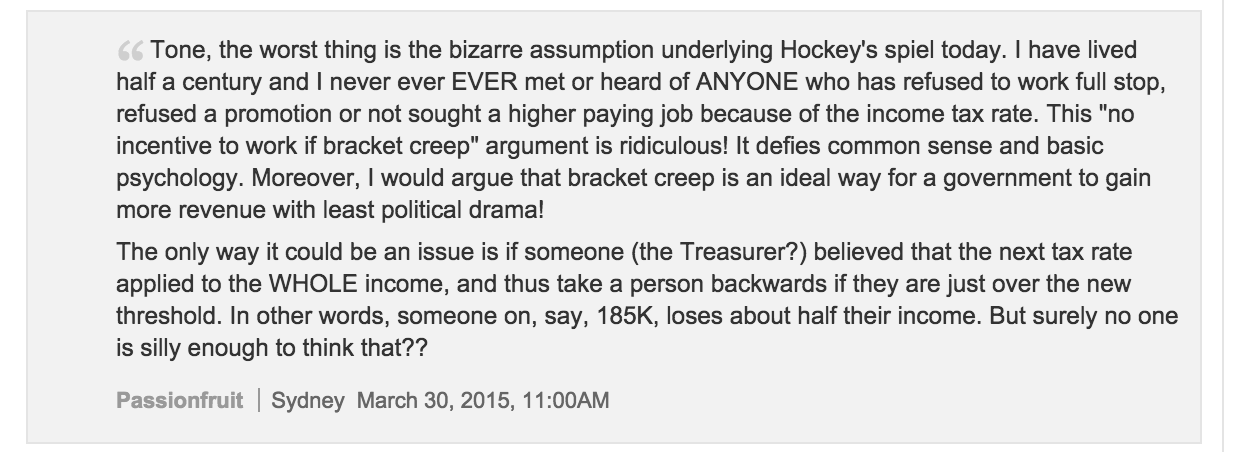
Commenter from the Age is at least engaging with the idea that tax affects growth.
Commenter from The Age actually engaging with the idea that tax affects economic decision-making. I’d describe them as skeptical.

Treasury makes this claim:

“each additional $1 collected by way of company income tax reduces the living standards of Australian households by around 50 cents in the long run because of reduced investment.”

I’d like for everyone to be talking about that idea, which rests on assumptions about the mobility of capital. But 99% of the public discussion is about revenue adequacy and fairness questions. If the frameworks people had for discussing tax were the same as the frameworks Treasury was deploying, a more fruitful discussion may take place and Chart 2.9 – marginal excess burden – would be a national obsession.

Chart 2.9

This discussion process is only just beginning, and I hope I’m wrong that people have already tuned out.

I note good articles in the Guardian and New Matilda have appeared today. But at the same time, a new review has been released – on competition policy! We are asking a lot of the polity to absorb both at once.

I guess it is the role of the public sphere – including humble blogs like this – to try to bring ideas in these reviews out of the tarpit and spray them with the hose, in order that they may be introduced to wider society. I shall try to write more about the tax review in coming days and weeks!

Musiconomics: Why the Macbook is the new Fender Stratocaster

My recent travels through the USA took me to Austin, Texas in the middle of March. At that time Austin is taken over by the festival known as South by Southwest (SXSW). This was no coincidence. We went especially for the music part of this festival and were ready to be blown away.

I wrote in 2013 about my first SXSW experience, and this time was definitely different. The festival had returned to its roots – eschewing big names in favour of exposing new bands. This meant the bills were filled with names we did not know, and gave us more freedom to choose venues at random, without expectations.

The music was often great, and despite never having heard the tracks before, we regularly left gigs with a hook on repeat in our heads.

But there was one surprise. Time and again we found “bands” on stage that were not traditional bands.  Many acts did their show on just a laptop and a microphone. We saw the Apple logo more often than the Fender logo.

That’s fun, but a traditionalist streak lurks within us. So on day four, the desire to actually see a big, proper band letting loose made us seek out an African/Carribean night at a smaller club. It featured acts from Cote d’Ivore, Nigeria, etc, and we expected something in the tradition of Fela Kuti.

But our search did not lead to a big band. Not a cymbal was struck in anger. Once more, we saw multiple acts featuring one microphone and one Macbook.

Serge Beynaud of Cote d'Ivoire
Serge Beynaud of Cote d’Ivoire. (It may look like there is a band on stage but those guys are roadies/photographers/loitering.)

It sounded great, the crowd was into it and we had a good time. But it got me thinking. In Cote d’Ivoire, how is a band starting out going to buy instruments? In Australia, people who are in bands work hard in traditional jobs to get the money to buy a bass, a guitar, and a drumkit, each of which can cost over $1000.

My friend the trumpet player, for example, is a vet.

It’s common knowledge that a band doesn’t make money in 2015. Not for the first few years, anyway. So they need a revenue stream. With the economic situation in Cote d’Ivoire, it’s probably not as simple as working in a bookshop to save for a new amp or some pedals. It makes sense most acts will be lean, streamlined, cheap to run. Expecting a full band is like expecting a grand piano. Not realistic.

That idea stewed in my mind for a while until I realised that it wasn’t just relevant to impoverished West Africa. It would apply in the rich world too.

Instrument choice could even explain success and longevity. Longevity and success are going to be linked in both directions. Because a good band will last, but a band needs to last to get good.

In the Western world, assume a share of bands start up with a traditional four or five-piece set up – more EADGBE than QWERTY, and a share of bands start up with a macbook they had anyway and a pirated copy of a music making program.

Who is more likely to get the 10,000 hours of practice they need before they crack?

iLoveMakonnen is a two piece - microphone and DJ.
iLoveMakonnen: A two piece featuring an MC and a DJ (who hasn’t touched an actual ‘disc’ in years).

While all bands suffer from entropy and slowly disappear, the effect will be more pronounced for larger bands with more expensive equipment. There are plenty of reasons for bands to split. But money-making is not the least of them.

If a big band does make a bit of revenue, the musicians will find it divided among many people, and soaked up by depreciation of the band’s material. They will start to see the band as an ongoing expense, not a money maker.

Perhaps in the 1980 and 1990s, bands endured this period with a little more hope of cashing in eventually. But in 2015 the idea of selling records is something of a joke. (Side note: at SXSW, the streets were littered with thousands and thousands of CDs that enterprising bands were trying to give away and punters couldn’t be bothered carrying home.)

In this scenario, bands with an upright bass and a trumpet are disappearing fast, while the number of bands using pirated software and a macbook shrinks at a lower rate. That means by year four or five, when all the skills are finally in place to write a song that’s genuinely awesome, the bigger, more traditional band’s songwriters are back at university, while the smaller acts are still plugging away.

It may be hard to justify a full band when you can make all those sounds through a computer. The main advantage of a proper band could be the richer stream of ideas that come with a meeting of minds.

Happily, there is still evidence of that happening.

Quality still wins out and the occasional seven-piece does make it through the cracks to become a viable band. Below is the Mowgli’s, who sounded great. Sure they’re white people from LA – one of the richest cities in the world – but at least that swirling moneypool is splashing some cash in the direction of old-fashioned music making.

Mowglis

Slammer Jammer! Ticket scalping in America.

I’ve been to Utah a few times. One thing I like to do there is attend an NBA game. The Utah Jazz play home games in central Salt Lake City.

In 2011 I wanted to go see the Jazz, so during the afternoon we made our way to the poetically named Energy Solutions Arena, to see about tickets.

Inside, a uniformed woman told us tickets would be $40. But outside, a significantly more casually attired man was able to sell us tickets and was willing to negotiate on price, down to $20.

That night, as we joined the purple-clad throngs filing towards the stadium, we saw many more people pushing tickets outside for low, low prices – including some shouting “free tickets!”. Prices don’t get much lower than that.

Screen Shot 2015-03-27 at 8.59.32 am
Mountains, as viewed from inside the arena.

Ticket scalping is a state issue, and it is not one the lawmakers of the mostly mormon state have sought to trouble themselves with. In the absence of any law, ticket scalping there is apparently totally legit.

Inside, it was clear why the man had been willing to negotiate our ticket prices. High in the stands where we sat, there were very few other punters. But we added our voices to the support for the Jazz (hilarity ensued as we convinced one Australian basketball ingenue that it was completely normal and in fact expected to yell Slammer Jammer! after every dunk).

Despite our enthusiasm, the Houston Rockets prevailed that night, 97-96, and my favourite part of it was seeing in the flesh the subject of my favourite piece of long-form journalism ever, Shane Battier. Michael ‘Moneyball’ Lewis wrote a big feature on him in the NYTimes that I had re-read several times, before I even knew who Michael Lewis was. 

So when I returned to Salt Lake City in 2015 I knew I would go back to Energy Solutions Arena to see the Jazz play, and I knew tickets should be damn cheap. I was googling to see if scalping was still happening, hoping I might get my hands on some of those free tickets I remembered so vividly.

But my googling soon led me to a whole different marketplace. Online ticket re-selling. Within moments I was on the website of SeatGeek.com, where tickets were going for an amazing range of prices. You could pay over $200 to sit behind the benches, or as little as $10 to sit high up in the stands.

seatgeek
The SeatGeek interface

This felt substantially better than transacting on the street. For one thing, I had more information about the range of prices for different games (Thursday’s game’s lowest seat price was $10, Tuesday’s game was $7) and for different parts of the arena. I also got the guarantee that the seller would refund me if there were any problems. Unlike the dodgy guy who’d sold me the tickets in 2011, I was confident I could find SeatGeek.com again if I needed.

And this, surely, was good for the game. Empty seats make for a bad experience for everyone, especially those who paid $200 to sit closer, but also the fans and the TV stations trying to give the impression that this sport is exciting.

Pre-game pyrotechnics
Smatterings in attendance for pre-game pyrotechnics

Where we sat, the crowd was full of families with plenty of children, and groups of unaccompanied teens. In Australia, these demographics would not be found at most professional sports events, because the price is such a barrier. What does that mean for attendance at live games in 20 years time? Will kids raised with sports on TV suddenly want to pay to attend once they become rich enough?

But back to Utah on a Thursday, where the arena ended up about three-quarters full and the mascot worked hard to keep the crowd engaged as the Rockets capitulated pitifully. The focus of scalping laws is normally on those popular events where ticket prices are high. Economists bravely defend tickets going to those who can afford the highest prices.

But might scalping not be just as useful – and even more morally defensible – in games where ticket prices are low?

In Australia, scalping is not allowed, and the AFL often sees tiny crowds limp in for games in giant arenas, all the while keeping ticket prices at astronomical levels. Members and those who’ve bought season passes often let their seats lie vacant.

I wish SeatGeek would arrive in our market and allow a bit of price discrimination – and I wouldn’t be surprised if the big sports leagues actually found it was to their advantage too.

How do you get a country excited about tourism?

1. Tourism is super important, accounting for 10 per cent of Australia’s export earnings.

Screen Shot 2015-02-20 at 10.21.26 am
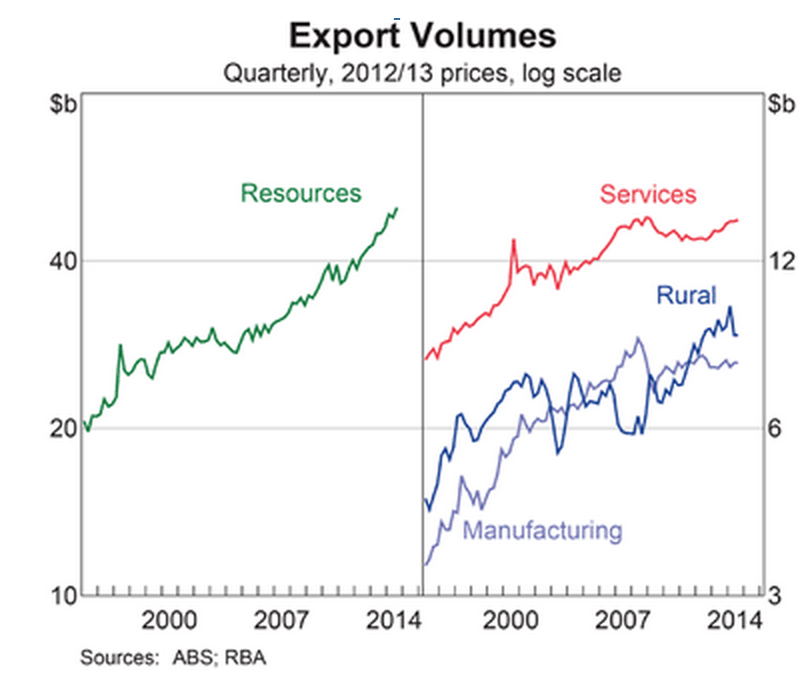
Services are our second biggest export sector and tourism is Australia’s largest services export.

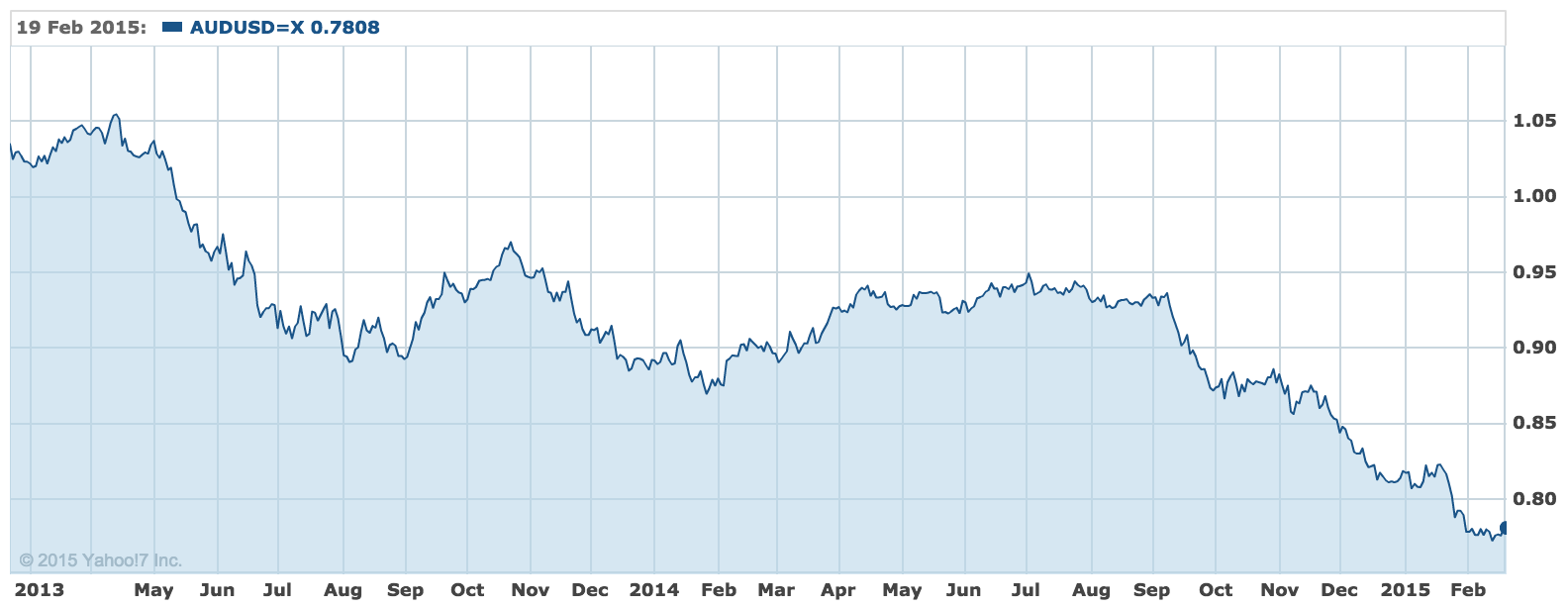
2. Tourism’s moment has come.

Source: Yahoo Finance
Australia: on special. Source: Yahoo Finance

3. International tourism is understood to have public good aspects (e.g. brand Australia) that warrant some public spending on attracting visitors. Tourism is also a public policy issue because regulations around immigration and customs, aviation and airports can determine the cost effectiveness of a trip to Australia.

But at this crucial moment for the industry, government funding for Tourism Australia has gone from $132 million in 2012 to $129 million in 2014.  That’s a fall from $21.29 per visitor to $19.64.

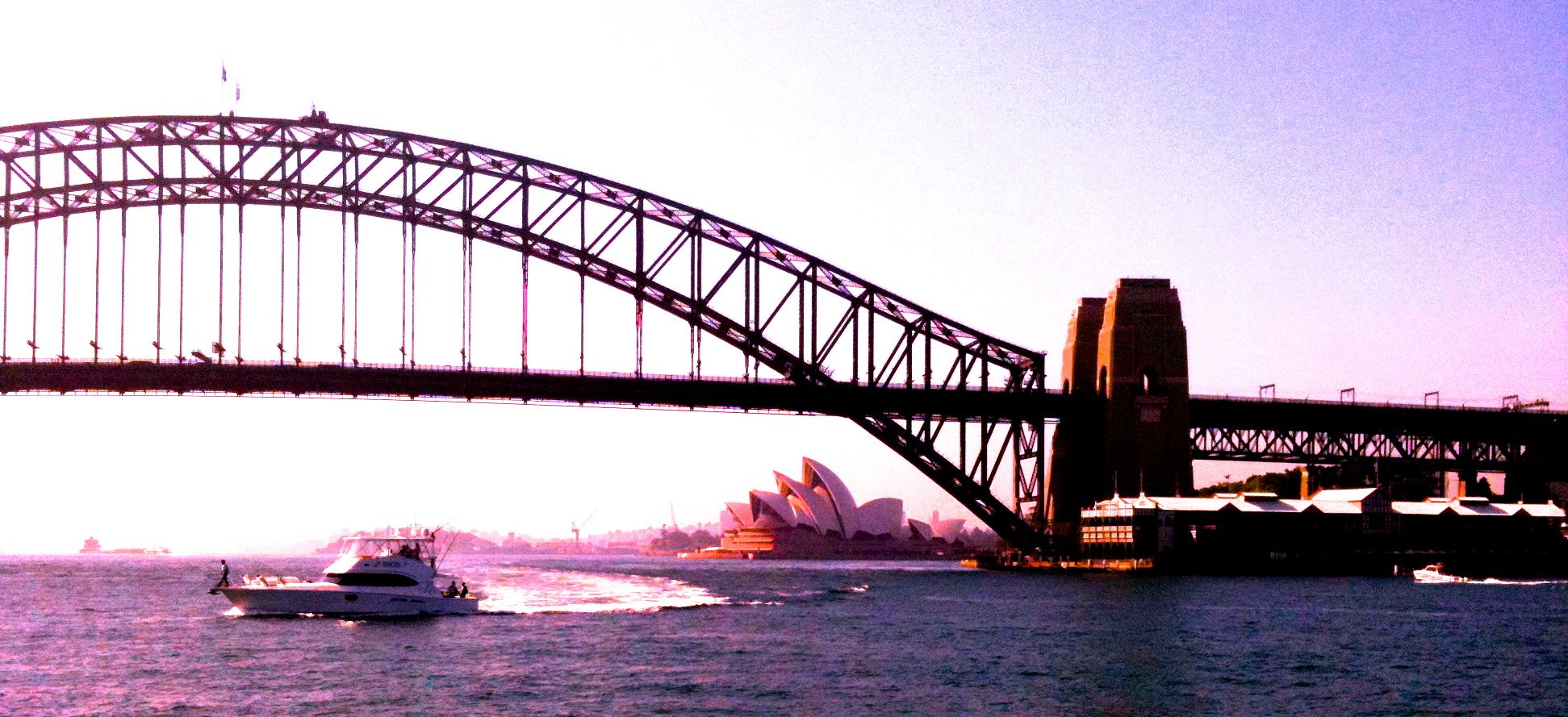
sydney

4. The Government does not have a minister holding the title of Minister for Tourism (they do have a Minister for Sport). The Trade minister has tourism in his portfolio. But he has been accused of “neglect” for the sector.

5. There have been no data released on overseas arrivals since September 2014. The Department of Border Protection changed the arrival cards and completely screwed up the system that had delivered excellent monthly data for the previous 14 years. The timing of this mistake, at a likely inflection point in inbound tourism, is truly remarkable.

6. To make matters worse, right now the Productivity Commission is trying to put together a major report on tourism, in the absence of that data.

I have written before about the best way to invest to take advantage of the coming tourism boom, with AirBnB seeming like the safest bet. But as well as dispersed individual actions, we need a big coordinated push, and that doesn’t look like happening yet. Services industries remain a side-show to the “real” economy of tangible things in too many people’s minds.

Can the PC report shock the government into doing more? Or will the government remain focused on issues like foreign purchase of agricultural land?

Economists are now predicting the rise of the robots will impoverish us. Can that be true?

I’ve just read a frightening new working paper by authors including Jeffrey Sachs, outlining scenarios under which the rise of robot competition could actually make people worse off. 

Sachs – who made history by becoming a Harvard Professor at age 28 – is a heavyweight in the field of economic development, so it’s worth listening when he writes “technological progress can be immiserating.”

The paper acknowledges that such predictions have been made before, and proved wrong. There were some details in the history of Ludditism that I didn’t know, particularly the role of the state in defending novel production methods.

“Concern about the downside to new technology dates at least to Ned Ludd’s destruction of two stocking frames in 1779 near Leichester, England. Ludd, a weaver, was whipped for indolence before taking revenge on the machines. Popular myth has Ludd escaping to Sherwood Forest to organize secret raids on industrial machinery, albeit with no Maid Marian. More than three decades later – in 1812, 150 armed workers – self-named Luddites – marched on a textile mill in Huddersfield, England to smash equipment. The British army promptly killed or executed 19 of their number. Later that year the British Parliament passed The Destruction of Stocking Frames, etc. Act, authorizing death for vandalizing machines. Nonetheless, Luddite rioting continued for several years, eventuating in 70 hangings.”

The model constructed by Sachs and his co-authors has no role for hangings. It simplifies the economy into a technology sector producing “goods” and a residual sector staffed by humans, producing “services.”

The model tries to answer the question:

“Will the reduction in the cost of goods produced by more advanced robots compensate workers for the lower wages?”

The team runs the models several times and gets a range of different answers depending on assumptions. But the news is certainly not all good.

“A second prediction of our model is a decline, over time, in labor’s share of national income.”

The model has ‘retention of code’ as a central feature. They argue that over time, useful code builds up so that new code is less and less necessary, leaving less and less work for people engaged in its production.

Code is defined as “not just software but, more generally, rules and instructions for generating output from capital.”

It assumes over time code becomes more durable, driving unwanted “high tech workers” to go and work in the services space, where they drive down wages.

“The price of services peaks and then declines thanks to the return of high-tech workers to the sector. This puts downward pressure on low-tech workers’ wages and, depending on the complementarity of the two inputs in producing services, low-tech workers may also see their wages fall”

The ‘retention of code’ is a key feature of the model. When the researchers ramp up the coefficient on that, the model has gloomier and gloomier predictions.

The mechanism by which this works is because each more poorly compensated generation can add less and less to the economy’s capital stock:

“The long run in such cases is no techno-utopia. Yes, code is abundant. But capital is dear. And yes, everyone is fully employed. But no one is earning very much. Consequently, there is too little capacity to buy one of the two things, in addition to current consumption, that today’s smart machines (our model’s non-human dependent good production process) produce, namely next period’s capital stock. In short, when smart machines replace people, they eventually bite the hands of those that finance them.”

But is code different to any stock of knowledge? Humans have invented designs for thousands of perfectly functional cars, yet there’s work being done on inventing new and better ones at a fantastic rate. Computer code may accumulate, but “rules and instructions for generating output from capital” sounds like management. I don’t see managers being replaced by computers soon.

The model also has no room in it for the rapid expansion of the service sector. I’ve written about this before, and I think it is a central to an economy operated by the fanciful and idiosyncratic species we call humans. If our needs are met cheaply, we will invent new things to want.

Nevertheless, the paper adds to the rich debate over what might happen in an economy where humans are not directly engaged in the tasks most important for their survival.

I’ll leave you with the working paper’s dystopian predictions:

“Will smart machines, which are rapidly replacing workers in a wide range of jobs, produce economic misery or prosperity? Our two-period, OLG model admits both outcomes. But it does firmly predict three things – a long-run decline in labor share of income (which appears underway in OECD members), techbooms followed by tech-busts, and a growing dependency of current output on past software investment.”

“Our simple model illustrates the range of things that smart machines can do for us and to us. Its central message is disturbing. Absent appropriate fiscal policy that redistributes from winners to losers, smart machines can mean long-term misery for all.”

How likely is the bond market to crash and ruins us all?

When countries go into debt, they don’ reach for the credit card. They reach for bonds. By selling bonds, a country gets a stack of cash it can spend, and all it has to do is pay back those bonds in the future.

A lot of countries have a lot of debt, the global bond market is active. People don’t just hang onto the bonds they bought from governments. They’re traded. The price of the bit of paper goes up and down even though the amount it entitles you to stays the same.

Wikipedia explains the idea neatly:

Treasury notes (or T-notes) mature in two to ten years, have a coupon payment every six months, and have denominations of $1,000. In the basic transaction, one buys a $1,000 T-Note for $950, collects interest of 3% per year over 10 years, which comes to $30 yearly, and at the end of the 10 years cashes it in for $1000. So, $950 over the course of 10 years becomes $1300.”

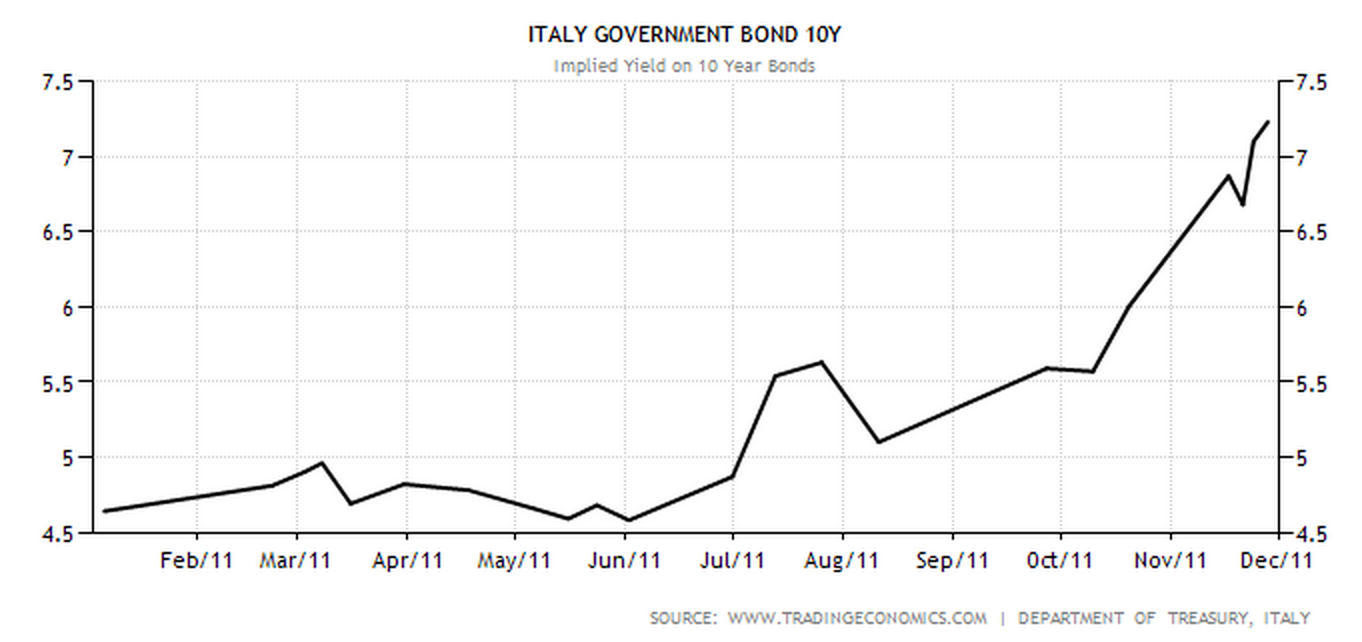
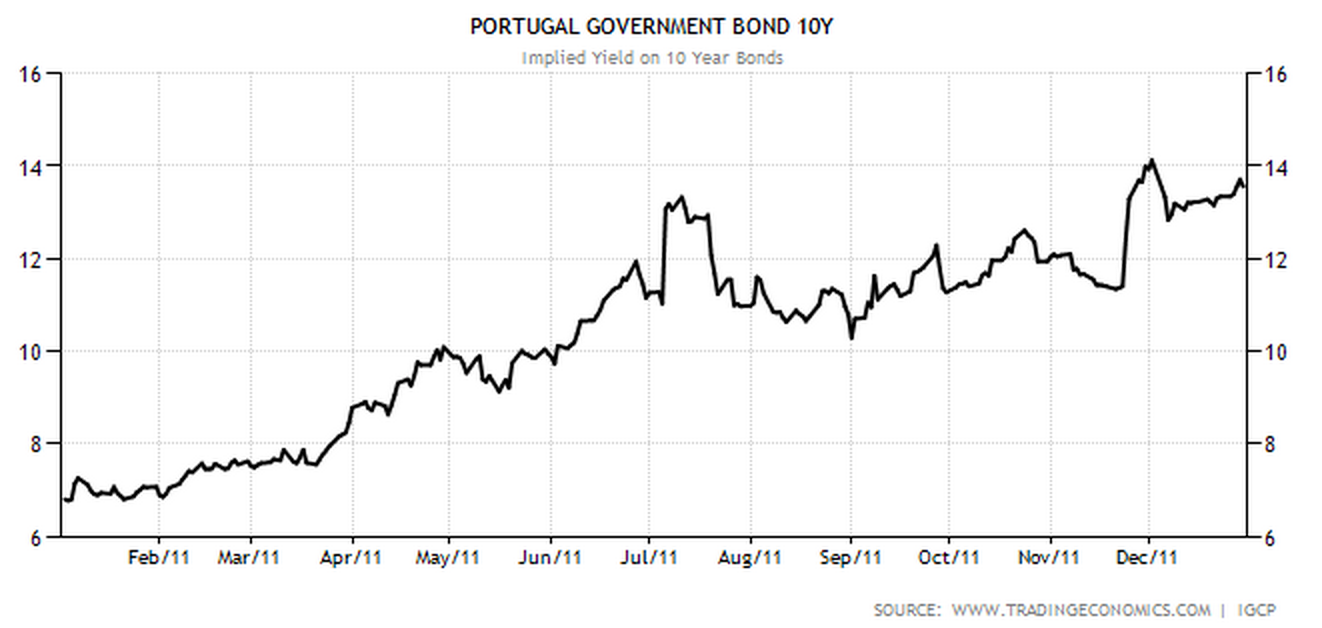
Some people find bonds to be a very good investment and they are also closely watched as markers of trouble. When it looked like Greece was going to be kicked out of the eurozone, its bond yields shot through the roof. (Bond yields are the inverse of the market price. If you pay $1000 for the bond described above, your yield is zero (assuming inflation of 3 per cent).) In 2011, everyone was selling Greek bonds and buyers were few.

Screen Shot 2015-02-13 at 10.53.54 am
In late 2011 if you bought a Greek government bond you were brave or crazy. Its yield was 40 per cent, implying people were worried the government would not honour it. Source: Trading Economics

Those high yields said nobody wanted to buy Greek bonds. Or Portuguese, or Italian. Screen Shot 2015-02-13 at 10.57.20 am Screen Shot 2015-02-13 at 10.56.49 am

Bonds work a bit like a stock. There’s always something to worry about.

When yields are up and price is down, it’s because people think that entity is going to go broke. When yields are down and prices are up, people start to worry that the price has overshot and might suffer a damaging correction.

Overall, riskier countries have lower bond prices and higher yields. For example, Japan’s bonds cost a lot, and yield just 0.4 per cent, because that nation is believed to be trustworthy and reputable.

But suddenly, the whole bond market is looking more Japanese, and that should rouse suspicion.

Bonds are a hot topic because of plunging yields in the last few years.

Screen Shot 2015-02-13 at 11.05.01 am Screen Shot 2015-02-13 at 11.03.59 am Screen Shot 2015-02-13 at 11.03.22 am

Does anybody really believe all the risk has gone out of these countries? Does it really make sense that Spain can borrow money at under 2 per cent? I think I’m less of a credit risk than Spain (unemployment 24 per cent) and my credit card company charges 10.99%.

What we may be looking at here is a bubble. All these bonds are in hot demand. But what happens if the bubble pops? The people that hold them lose money. That includes central banks, hedge funds, private investors, superannuation funds and banks. Any of whom could upset financial stability.

The reason this topic is hot is that a sharp object has come over the horizon that could burst the bubble. A rise in US official interest rates.

It seems likely that the US will start raising interest rates in the next few months, given their strong recent economic performance. (This is the view of the RBA Governor, at least). If outlooks for the US economy and global economy are better, a rate rise could coincide with investors deciding they’ve had enough of boring safe bonds, and getting back into stocks. That would see bonds being sold off.

The Governor of the Reserve Bank is expecting such an event, he has just revealed in testimony this morning to the House of Representative Economics Committee.

The size of the global bond market is big enough that a sharp crash would hurt the financial system. And we’ve all learned that crashes in the financial system hurt the real economy soon enough.

Further reading:

http://www.businessinsider.com.au/bond-market-panic-phase-of-financial-crisis-2015-1

http://www.telegraph.co.uk/finance/personalfinance/investing/bonds/11290961/The-experts-who-expect-bonds-funds-to-crash-in-2015.html

http://www.cnbc.com/id/102421990#.

What Mr Hockey will do next.

Last night on ABC’s 730 program, the Australian Treasurer demonstrated that he has a lot of changing still to do.

Mr Hockey insisted the government would press on with a stringent Budget full of cuts. He bemoaned the total government debt and the legacy current generations are leaving behind. His catchphrase of choice with respect to cuts was this:

“We have no choice!”

But the loudest message was that he had not fully understood the events of recent weeks. He appears to think that the Government’s problems are all about Tony Abbott, because he insisted that all he needed to do was better explain his policy choices to the electorate.

Of the two – Abbott and Hockey – it is Abbott who got closest to the fire and Abbott who has learned the most. Abbott has spoken about listening more, to both the public and the party room. Mr Hockey may think that is yet more spin. But I doubt it is. The 2015 Budget is going to be designed with a lot less guidance from Hayek and a lot more from Roy Morgan. The problem is that Joe Hockey doesn’t realise that yet.

So Mr Hockey is going to have to adapt. Adapt or perish. If and when he adapts, in some small part of his being he may wish he’d been rolled as Treasurer on Monday.

But in his 730 Report interview he said several times “the customer is always right.” Let’s generously assume that motto means he can and will adapt.

So what will he do in this new, constrained environment where ideology is out and the Budget is worse than it has been for a long time?

Worst case scenario as estimated by Deloitte Access Economics

If commodity export prices keep falling, Hockey could beat Wayne Swan’s record of highest Budget deficit ever ($54.5 billion in 2009-10.)

The new, chastened, post-realisation Mr Hockey will be faced with a set of unenviable choices. He can let the deficit blow out, he can cut spending, or he can raise more revenue.

The most unenviable part of his dilemma is that he will probably have to do all three. Suffer the ignominy of a great big budget deficit, trample all over his own principles by raising taxes, and risk the wrath of the electorate by making more cuts.

Mr Hockey’s task in the next few months is to make this something other than a political suicide note.

After surprising the hell out of the electorate with his first budget, he won’t be allowed make the same mistake again. You can be pretty sure that the key ideas in the document to be released on the second Tuesday in May will have been given a thorough airing.

Cuts will be thin on the ground. Reinforcing the message that the Coalition slashes and burns will not be welcome in the party room. That leaves a gaping hole of a deficit.

Unless he can somehow arrange to include tax increases. If he wants to stop the deficit increasing, Hockey’s best option is to look at tax expenditures.  You can cut tax expenditures and simultaneously claim you are not levying new taxes. (A tax expenditure is just a big exemption to tax, so cutting a tax expenditure raises more revenue.)

tax expend
Source: Treasury tax expenditure statement 2014

As you can see, the numbers involved are real. Many many billions. GST and the family home are probably no go areas. But some of these tax expenditures – on superannuation and capital gains – overwhelmingly help the Coalition’s older, richer, higher marginal tax rate base.

Politically, removing or changing them may be the best option, because the Government has lost the centre, and needs to regain it. Tax hikes that hurt working families will be off the agenda in 2015.

This will go against almost everything Joe Hockey believes in, except his belief that his government should win the next election. But as I wrote last year, Joe Hockey is likely to resolve his cognitive dissonance in favour of an election-winning strategy. There’s always another choice.

Australia’s cheapest house.

Today data came out showing Australia’s house prices rocketing up.

Screen Shot 2015-02-10 at 1.21.18 pm
Source: ABS

The average price for a home in this country is now $571,500. We hear a lot about the homes at the top end of the distribution, places that cost 100 times as much as the mean, like this Mosman Park pile for $57.5 million.

Screen Shot 2015-02-10 at 1.56.33 pm

We don’t hear so much about the other end. There must be houses in this country that cost a lot less than the mean. I went looking for them.

This place in outback NSW costs $40,000.

Screen Shot 2015-02-10 at 1.27.07 pm

You could imagine living there, stepping out onto the verandah with a cup of Bushell’s tea as the sun rises through the eucalypts, thinking: I made a good choice.

This place 200km away costs $39,000 and I thought you couldn’t go much lower.

Screen Shot 2015-02-10 at 1.28.47 pm
Not pretty, but (presumably) effective.

But I reckon I found the cheapest advertised house in the whole country when I tracked down this one:

Cunnamulla house
Three bedrooms, one bathroom. Large block.

The lack of interior shots in the listing should rouse suspicions, but if you’re game to renovate this place, it’s near to a supermarket, a hospital and a park.

Cunnamulla has a river, and a train station with services twice a week. It’s also host to the Cunaumulla Fella Festival, an annual celebration of rodeo riding, etc. The closest town you may have heard of is Bourke, about 250km away.

cunnumulla map
Surrounded by red dust.

Paying $13,000 for a whole house seems incredible. In Melbourne, that would buy you 2 per cent of the median home, five nights accommodation in certain fancy hotel suites, or a sedan with 156,000 km on the clock.

But here’s where this story goes from being a fun way to think about our crazy housing market to a rather more serious reflection on race and poverty.

Cunnamulla’s Wikipedia entry highlights domestic violence and flooding.  Seek has two jobs listed based in Cunnamulla – both social workers, one related to drought and one related to domestic violence. Cunnamulla was the subject of a controversial documentary produced in 2000 that depicted its bleak side, with quotes like this:

“In Cunnamulla, that’s the only thing you can do. Drink, smoke marijuana, fight, look for women and break in. That’s it.”

The most recent news article about Cunnamulla is about a teenage mum who got her scuba license by practising in the river and wants to leave to work on the Barrier Reef. The official unemployment rate is 5.9 per cent, but the region’s population of 1900 supports only 892 jobs, suggesting labour force participation is low.

In short, there’s a reason houses in Cunnamulla – even ones in decent condition – sell for so little. And those reasons are not nice.

This is a country of extremes – not just of drought and flooding rains, but of wealth and poverty. It’s easy sometimes to forget about the poverty. I’m somewhat ashamed to have started writing this post thinking only of the amusement value of a cheap house, and not at all about the conditions that explain it.

Why the “induced demand” argument against roads is no good.

I read a lot of forums and articles about transport policy where most of the people agree with each other. The splintering of discussion into groups that agree is a common and well-understood phenomenon that is amplified on the internet.

Listen up, Melbourne
Divided

As well as getting excited by optimal stop spacing, one thing people in these circles agree on is that roads are bad. The most common argument made against roads goes like this:

“Essentially, if you widen roads to reduce congestion, people who were avoiding the road because of congestion will find it more convenient and take more trips, thus increasing traffic again.

So what do you have then? A big expensive project to eliminate traffic, and more traffic.” Streetsblog

“New roads will create new drivers, resulting in the intensity of traffic staying the same.

Mann explains how this counterintuitive reality can possibly be true: “As it turns out, we humans love moving around. And if you expand people’s ability to travel, they will do it more, living farther away from where they work and therefore being forced to drive into town. Making driving easier also means that people take more trips in the car than they otherwise would.” Planetizen

“Research indicates that generated traffic often fills a significant portion of capacity added to congested urban road. Generated traffic has three implications for transport planning. First, it reduces the congestion reduction benefits of road capacity expansion. Second, it increases many external costs. Third, it provides relatively small user benefits because it consists of vehicle travel that consumers are most willing to forego when their costs increase.” Victoria Transport Policy Institute

While I support many of the ideas this argument is rolled out to support, I find the argument itself utterly unconvincing. If you want to argue against investing in roads, you’ll need a better argument. Here’s why.

1. Public Transport will behave exactly the same.

If you widen a road, it will encourage more people to drive on it, bringing congestion to an equilibrium level* on that road, and spilling congestion into other parts of the network.

Likewise, if you increase the frequency with which a public transport service runs, it will attract more people to ride on it, bringing congestion to an equilibrium level and spilling congestion into other parts of the network.

This means that induced demand operates as an argument not to invest in any popular/crowded transport where crowding levels may be deterring travel. I’m not sure that’s what proponents of the induced demand argument intend.

*The equilibrium level is not necessarily the same amount of congestion as before, it’s the level where congestion deters travel.

PT1

2. Induced demand is good.

Induced demand means previously people had latent demand for travel, but they were unable to satisfy it. Now they are able to access jobs, get to shops that sell items that match their needs better, visit friends and family more. Any argument about transport investment that objects to people doing more travel should be treated with suspicion, if not contempt.

sahdow

3. Focusing on congestion is the wrong way to look at transport policy.

If your approach to solving a city’s transport problem is to seek out choke points and jams and try to untangle them, you may end up fighting unwinnable battles against geometric problems. You will become frustrated, growing ever more sure that transport is a zero sum game with no easy answers.

But the answer is not necessarily eliminating every queue – there are planners who believe congestion is perfectly acceptable, a sign of popularity and even of success. (1, 2, 3,)

Forget congestion. If you make your yardstick access, you focus on what people want: What places can I get to?

A rational approach to transport planning in a city would be to measure access: From each address, a sum of all the jobs, services and other addresses that can be accessed, averaged across a time period encompassing peak and off-peak.

That number would be aggregated across the entire city to create a total score. Then, you would provide incentives for bureaucrats to improve that number. These bureaucrats must have more than just transport levers at their disposal.

They should also be able to make decisions on zoning and land-use, and road pricing. Improving access can as easily mean moving jobs to people as people to jobs. If a particular investment is expected to have spill over effects that worsen transport times in a far-flung part of the network, the access measure should pick this up and permit that effect to be compared to its positive local effect.

Build a new school, access improves. Add traffic light priority for buses, access improves for some at the expense of others. Price a road, access improves for high-value trips at the expense of lower value trips. Add a new lane on a freeway, access improves locally and probably diminishes elsewhere.

Focusing on access allows trade-offs and comparisons to be made. But often, improved access will involve turning latent demand for travel into real trips. We shouldn’t object too loudly to that.

DSC00841
The point of a city is that people want access to other people, and services. Let them at them.

More on this topic:

Trevors in Traffic: a PR strategy for congestion charging.

Selling the street: A land use hypothetical…

New competition report tries to go hard on road pricing, but is naive

How to dodge a big payout on cancelling a road contract AND avoid creating sovereign risk

The government of the state where this blog is produced is in a pickle.

Prior to an election last November the then Opposition promised to cancel or defeat in court a contract for a big controversial road tunnel. The tunnel, worth perhaps $6 to $10 billion dollars, has not been built yet. Nothing beyond planning has commenced

Now the former Opposition are in power, they are finding that the old government left them a poison pill. 

Screen Shot 2015-02-06 at 1.07.08 pm

If the road is not built for any reason, the government must pay the company that would have built it $1.1 billion. This clause was added by the previous government. The companies might have done only $50 million of preparatory work – being generous here – but they get paid $1.1 billion simply for missing out on finishing the job.

Ignoring for a moment the morality of inserting such a clause into a contract (it’s vile, wasteful, ridiculous, and would in a better world result in a range of senior bureaucrats and politicians going to jail), we turn our minds to how the present government can deal with it.

There are three main options.

1. Avoid the payment and make the road. This would involve reneging on a major election promise, but you don’t waste the money.

2. Avoid the road and make the payment. This would gift a billion dollars from an indebted state government to a consortium of companies including Lend Lease Group, worth $9 billion, Acciona, worth €3.6 billion and Bouygues SA, worth €10 billion.  It would probably be politically convenient too.

3. Avoid both the road and the payment. The government has one big advantage. It makes laws. It can write legislation that annuls the offending contract. But the big risk in such a course of action is that it establishes an extremely unwelcome precedent that promised payments can be cancelled at whim by the government, and valid questions being raised about sovereign risk.

I want to look more closely at option three. Is there a way a law could be drafted that gets a just result and avoids sovereign risk? I think there might be.

Any law to cancel the payment provisions in the east-west link should:

1. Make it clear that this is a once-off by raising the hurdle for ever cancelling this kind of contract again.

For example, the Government could include a clause requiring that in future passing legislation that annuls any contract above a multi-billion dollar value threshold requires a supermajority in parliament, e.g. two-thirds of votes. The requirement for a super-majority should not apply to contracts where the cancellation provisions are substantially greater than the cost of the work done.

Sovereign risk only applies if a company can genuinely fear its contract provisions may be changed by legislative fiat. If they fear risk, they will raise prices.

Reducing the risk of such legislative action should attenuate the real costs of sovereign risk (although it won’t prevent the political costs of big companies mouthing off about it.)

2. Legislate against any future government ever introducing “poison pill” contract clauses into infrastructure contracts. (Part of me wonders if this law could apply retrospectively?)

3. Legislate that any large contract signed during the “caretaker period” in the lead-up to an election should be agreed upon by the leader of the Opposition as well as the Government, in order to prevent sneaky surprises. Part of the problem with the east-west link project was that it was never an election pledge, was controversial for 3.5 years, and with weeks before the election it looked set to lose, the government signed a contract.

Transport
We’re in a tangled mess.

Now. Could the state government of Victoria pass such legislation? It has a lower house majority, so it could pass it there, no problem. In the Upper house it holds just 14 of 40 seats. But The Greens have five, and they are likely to support such a plan. Then the government needs just a couple more, drawn from The Democratic Labour Party, the Sex Party, Shooters and Fishers, and Vote 1 Local Jobs. It might require some side promises, but it may be possible.

I welcome your thoughts and comments on this idea. Please leave a comment below, or hit me up on Twitter.

What country flies most?

I was wandering up to the entrance at Melbourne airport late last year when three members of the Rebels motorcycle gang arrived at the terminal.

Approaching the sliding doors at the exact same time as these three large, black-clad, sunburned men, I realised I would either have to slow down or speed up to avoid bumping shoulders.

I went to speed up, then, remembering the news about bikies killing someone at an airport a couple of years ago, I suddenly reversed my decision. I might just keep my eye on this lot, I thought, and let them through first.

What happened next?

They passed through security and I later saw them sitting near the gate. Like any other Australian, a bikie sometimes needs to travel by air.

Flying is a regular part of life for most of us. I doubt there is anyone reading this blog who hasn’t held a boarding pass in their hand in the last year. It’s a convenience, but it’s also a pain. All that waiting, the tiny seats, the way food tray is so crowded with things and hard to manage. It’s easy to forget that most people in the world have still never flown in a plane.

That fact made me wondered if I could quantify Australia’s tendency to fly.

It turns out Australia is in the top 10 countries globally for passenger movement, according to World Bank data. (The World Bank uses domestic and international aircraft passengers of air carriers registered in the country, which is a fair proxy in the case of some nations, and not for some others).

When you look at the data, you could easily conclude that Australians fly more than the citizens of any other country.

This chart uses that World Bank data to show domestic and international flights for the most flying-oriented countries, plus a few others for comparison. Nine countries score higher than Australia on this metric

Screen Shot 2015-02-04 at 2.09.39 pmWhen you look at the chart, it makes sense. The countries with the most flights per capita are islands. They are also often small countries where there’s nowhere else to go except to fly out. Several of them are tourist destinations or aviation hubs. (nb. Ireland and Antigua probably top the list because of their tax status (and RyanAir), not their proclivity for flying. The Irish statistical office claims only 22 million international flights) .

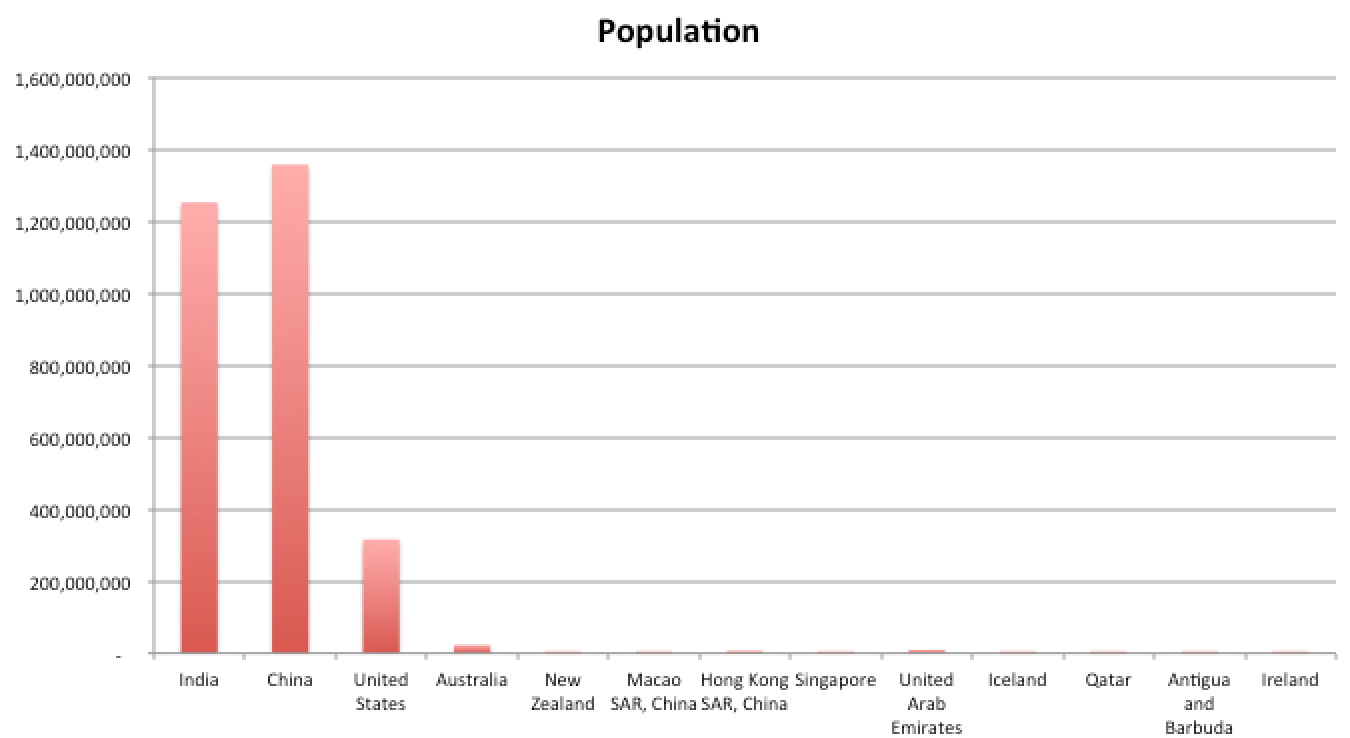
The countries above may also top the flights per capita listing because they are small. Australia is more than double the size of any country above it on the list (UAE, home to Emirates airlines, has 9 million inhabitants.)Screen Shot 2015-02-04 at 2.08.55 pm

Given all this, I am prepared to say Australians probably fly more than citizens of any other nation.

(The data from our own statistical agencies show the World Bank figures may underestimate the amount of flying. According to BITRE, Australia has 57 million domestic passengers a year and 23 million people, making 2.5 domestic flights per capita per year. Add in 33 million international passenger movements and the data suggest more than three flights per person per year – closer to 3.5. New Zealand may also be a contender for the flying-est nation, but its numbers are swollen by high inbound tourism, while Australia sees more departures than arrivals and a higher share of domestic travel.)

So Australians probably fly the most! We head to the airport as often as every three months. Woo-hoo?

I didn’t think so.

Meanwhile, at the other end of the scale, Indian nationals rack up on average one flight every 20 years. That’s less than Kenyans, but slightly more than the Cambodians.

What would happen if Indians started flying more? Such a densely populated country will probably never fly as much as Aussies do, but what if they flew at the same rate as the Americans, 2.35 trips a year?

That would mean another 3 billion people taking to the sky every year. That’s a doubling of current global passenger numbers, which, according to ICAO, topped 3 billion for the first time in 2012.

It’s safe to say this would be bad for carbon emissions. The contribution of aviation would jump from 2 per cent of the global total to more like 4 per cent. Sorry, penguins. Sorry polar bears.

Furthermore, I estimate the world would need an extra 8,000 planes. (Based on a generous 370,000 passengers per plane per year). For context, Airbus currently makes around 50 planes a month.

The conseuquences for the aviation fuel market could be significant. There are already problems with supply leading to rationing.

Those extra planes are going to need somewhere to land as well. What cities in the world have space for more runways?

China has already increased its appetite for flying tenfold. From 35 million flights a year in 1994, it has increased to 350 million by 2014. The lesson is this – economic growth sends people to the airports, for business and for leisure.

India’s economy grew at 5 per cent per year. At that rate it won’t be a “rich” nation for perhaps a century. But in 2010 it grew at 10 per cent, and if –  like China –  its growth rate can be held high, then it can become very rich very fast.

If everybody in India can afford to fly – even the bikies – its worth asking the question of whether the world is ready for the consequences.

An interest rate cut next week?

What will the RBA do next Tuesday?

Last year, the RBA left rates on hold. Despite increasing unemployment and modest inflation, the bank decided that “a period of stability” was the best course for interest rates.

Screen Shot 2015-01-30 at 10.03.03 am

At the December meeting of the RBA board, they seemed calm. The statement released said

“…most data are consistent with moderate growth in the economy……. monetary policy is appropriately configured. … the most prudent course is likely to be a period of stability in interest rates.”

But the meeting was followed the very next day by the release of the National Accounts which showed “dreadful” growth in the quarter, of 0.3 per cent. And shortly thereafter, unemployment figures came out looking like a horror show. Trend and seasonally adjusted measures converged on 6.3 per cent. A record high.

The bank suddenly seemed perturbed. In an interview published by the AFR on 12 December, the Governor said:

“…if at some point we can be more helpful for confidence by doing something different, then obviously that will be on the table, and we will take a fresh look at all these things in the new year”

In the minutes of the meeting, released two weeks after the meeting and four days after publication of that interview, the labour market was singled out:

“…members noted that subdued labour market conditions were likely to weigh on consumption growth and consumer confidence more generally.”

So perhaps Glenn Stevens spent the long summer fretting he’d left the interest rate unchanged for too long. Perhaps he sipped light beer by the pool and bored his bbq guests by extemporising on how a two-month break between the December and February meetings was inappropriate for a modern economy. Perhaps his long summer nights were filled of dreams of a rate cut.

But then the New Year began and with it came more positive news on the economy.

Unemployment, when the December figures were released in mid-January, was suddenly much better.

November figures released in December.
December figures released in January
December figures released in January. (note, for all the fans of the trend line, how it moves in several periods on the release of new data. The seeming predictive power of the trend line is achieved via retrofitting!)

This gelled with labour market survey findings that showed job advertisements had been rising for seven consecutive months (PDF in link).

At the same time, the Aussie dollar went into freefall. It has gone from US85c at the time of the December meeting to just under US78c today. (under seventy-eight?! oh my god this upcoming American trip is going to kill me.) The speed at which the economy can expand is affected not only by interest rates but also the exchange rate, which are lumped together under the terminology “monetary conditions.”

The lower exchange rate boosts the economy in several ways. Both by making imports less competitive, and by making it easier to export. It should also reverse the enormous disparity between the number of Aussies who go offshore and the number of tourists who arrive. (A lower exchange rate is not without costs, of course, as many goods, especially capital equipment, is imported).

In all these ways, a lower exchange rate does the same work as a rate cut, all without Mr Stevens lifting a finger. Best of all, the lower exchange rate should not lead to higher house prices, which is very welcome as bubbles remain a topic of great importance to the RBA.

Last but probably not least, the falling oil price is going to put stacks of cash in consumer pockets. I filled up the car with glee the other day. Unlike falling interest rates, which rob from savers to give to borrowers, lower oil prices are pure upside for consumer buying power, and therefore a more powerful spur to consumer confidence.

Source NASDAQ
Source: NASDAQ

Which is why it’s interesting to see that the actual measure of consumer confidence is down in the dumps, still.

Screen Shot 2015-01-30 at 10.30.21 am

It fell 5.7 per cent in December and recovered just 2.4 per cent in January (PDF in link).

That same PDF, authored by Westpac, predicts two rate cuts this year. But is that really going to happen? For that to come about, the bank would need to have changed.

Inflation was not a major concern and probably won’t be so long as the falling dollar is pushing average prices up, cancelling out the falling oil price.

The bank’s two big worries have been the housing market and the unemployment rate. With house prices still rising at the end of last year, it must surely be frightened of a 2015 full of headlines featuring a median house price nearing $1 million in Sydney. And unemployment looks like easing.

I bet the RBA will leave rates on hold again.

But the one thing that sticks in my mind is this article in the Herald Sun. Business Editor Terry McCrann has a long report on why the RBA will cut interest rates. It is specific enough and well-researched enough to appear to be a leak rather than (like this piece) the author’s own ideas.

McCrann writes:

“The RBA will be reducing both its growth and inflation forecasts in this statement [a report to be released after the board meeting]….

Critically, on (underlying) inflation, the RBA will also make its first point-forecast for June. It is likely to be 2.25 per cent, it could be as low as 2 per cent — either way, significantly, very significantly,below the 2.5 per cent midpoint of its 2-3 per cent target range.

Almost as significantly, it will cut its December forecast inflation range to 2-3 per cent and do the same for at least the first half of 2016.

In short it will be forecasting weakish growth and inflation below target. It quite simply could not release those figures on the Friday and have left its official rate unchanged on the preceding Tuesday. Or at least signalled a pending rate cut.”

If he is right and the forces pushing down on inflation are far greater than those lifting up, then you can’t help but expect a rate cut. It’s an inflation-targeting bank, after all. Tuesday will tell.

You won’t believe how much prize money is on offer at the Tennis.

At the Australian Open, first round losers take home enough money to buy three (3) of the automobiles on offer from major sponsors Kia. They can stand on an outside court, not even touch a ball with their racquet, and still take home $34,500.

Even those who fail to qualify for the tournament itself are richly rewarded. 64 men and boys and 48 women and girls have their dreams crushed in the first round of qualifying each year. To compensate them, they get $4000 in prizes. Losing in the second round of qualifying garners you $8000 and losing in the third round nets $16,000. Not bad.

Since I found out the total prize pool at the Australian Open, I’ve been asking people to guess it. Guesses have ranged from $4 million to $12 million. None have come near the true total: $40 million.

The organisers give out prizes left and right. Every player gets something. The Aussie Nick Kygrios takes home $340,000 for making it to the quarterfinals of the men’s singles draw. But he also gets $7400 as his share of a team that lost in the first round of the doubles. (Nick is ranked 1207th in the world for doubles, suggesting that entering the doubles draw might have been about the cash, not his passion for the game.)

The prizes in the singles are greatest.

Screen Shot 2015-01-29 at 2.52.11 pm
Winners’ loot.

The most expensive match of the tournament is the final, of course where the loser gets $1.55 million and the winner $3.1 million. But it is also the only round where the winner collects a cheque. In each other round the winner goes on to a chance of bigger and better things. Excluding the final, the most expensive round for organisers, at $2.1 million, is round one, where 64 losers get $34,000.Screen Shot 2015-01-29 at 2.39.37 pm

The prizes are rich enough to cover airfares and accommodation – even for the players who lose at qualifying. Research suggests 150 pros are making enough money to break even in each of the men’s and women’s game. At the same time, some up and comers are probably losing money now in the hope of gaining the experience to make it big later, and others are losing money in the twilights of their career, hanging on in hope of one more glory. (Hi Mr Hewitt!).

So, where is that money coming from?

Tennis Australia’s Annual Report shows it made $193 million last year from “events and operations.” While there’s not much detail, one can imagine that the vast bulk of that is broadcast rights to that highly rare prize, the Australian Open. Channel Seven in Australia pays $20 million a year.  The rights globally are doubtless severalfold higher.

Having a grand slam is quite a feat for a country of Australia’s tennis stature. Government supports it, but the support is less direct and therefore less controversial than that provided to the Grand Prix. They prop up the Melbourne and Olympic Park trusts which run the stadiums and have put in hundreds of millions of dollars for their development and re-building. Those stadiums are used for other purposes too, many of which attract tourists from around the world, contributing to the local economy.

Happily, Australia’s tax treaties mean athletes are liable for tax in the country where tournaments take place. So Djokovic, the Williams, et al, all face up to the ATO and hand over a chunk.