According to a new working paper by economists at Stockholm University and the University of Chicago, a key factor making unskilled workers worse off is broadband internet.
That means the NBN (which may be the most popular infrastructure investment ever announced in Australia) won’t be good for everyone.
The study had access to amazing data on 80 per cent of firms and 70 per cent of employees in Norway in the period 2000-2008, during which time Broadband Internet was rolled out slowly in Norway, allowing meaningful comparisons.
“For every employee, we know his or her length of education, and annual labor income.”

If you have a university degree, you are considered to be “skilled labor.” The premium for skilled labor increased very neatly alongside broadband availability as it rolled out in Norway.

The result for unskilled workers is not so good:
“[T]he estimates imply that a 10 percentage point increase in broadband availability in a municipality raises wages of skilled workers in that local labor market by about 0.2 percent. By comparison, we find evidence of a decline in wages of low skilled individuals.”
The researchers constructed counter-factuals to measure what might have happened in the absence of high-speed internet. They show the gap between skilled and unskilled would have been lower if the optical fibres had never crossed the fjords..

The reason more educated people do better with the internet is that they tend to not be doing complex tasks
“The estimates suggest an important channel behind the skill bias of broadband internet is that it complements non-routine abstract tasks but substitutes for routine tasks…. the expansion of broadband internet re-enforced the wage premiums to workers performing abstract tasks. By comparison, the wages paid to jobs requiring routine tasks declined because of the broadband expansion”
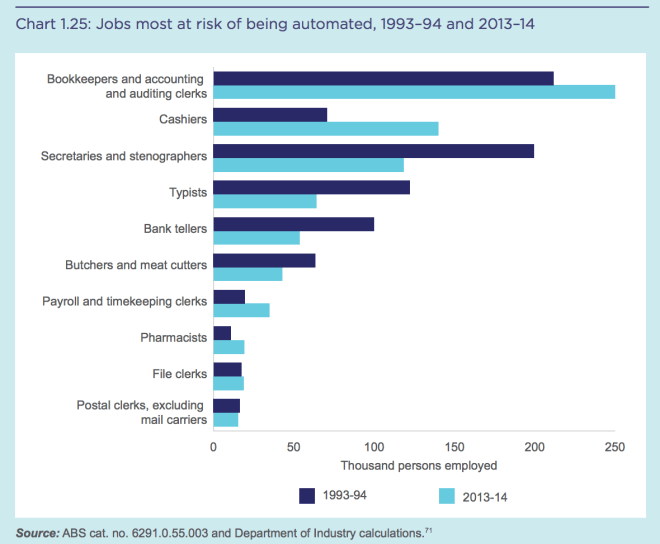
Broadband internet is obviously putting the postman out of work, but it is apparently having a less obvious effect on a range of other routine but non-manual jobs. This is very much worth bearing in mind as the internet enriches and enlivens our lives in so many ways.
This is not an argument against the NBN. We need high-speed internet and we’re going to get it one way or another.
It’s an argument for being aware that some people get left behind. The smartest policy we can institute to deal with that is high quality, universal education. This should start with high quality earl childhood education (this is extremely important to ameliorate skill-gaps that can develop in disadvantaged populations even prior to starting school), extend through good quality public schooling (needs-based funding as per the Gonski Report is a good start), and culminate in excellent universities that remain highly accessible (this would probably preclude the deregulation currently being proposed by the federal government).