People before what kind of profit?

Profit may be the most emotive and most disagreed-on word in the modern political lexicon.

Screen Shot 2014-01-25 at 3.09.41 pm

For some people, it conjures up a deep positive energy. It’s the lacquer of success that tells you your life has not been in vain, a thank you message from the universe.

For others, it’s a totem of greed. It’s the fuel barbarians pour onto the  bodies of the civilised before they burn them all, throw back their heads and howl as the smoke covers the moon.

Both can be right.

Whether you drive a Rolls Royce or a 1990 Subaru with a bumper sticker that says People Before Profit, you need to know this.

There’s two types of profit.

Economic profit (bad), and accounting profit (fine).

(for more: 1 2 3 )

Let me explain.

Accounting profit is what a business makes after it has paid all its staff, all its bills, but before it pays the people who put the money into the business. People who funded the business to start up need a little bit of sugar to keep their money in there instead of putting it in the bank.

Imagine a small business person who delivers things you buy on the internet. She buys a van, putting $30,000 into the business. If that money was put in the bank and got 5 per cent return it would make $1500. So the small business needs to make at least $1500 in accounting profit, on top of paying wages and bills, to compensate the person who funded the business.

That accounting profit is necessary for the business to run. If there’s no accounting profit, the delivery business will shut down, as the delivery woman realises she should sell the van, put the money in the bank, and work for someone else.

(In reality she should be looking for slightly more than $1500 in accounting profit, to help compensate her for the risk of running a business, which is much higher than plonking your cash in a government-guaranteed deposit.)

So, accounting profit is necessary for businesses to exist. The alternative is the business shutting down.

When you see Woolworths Limited reporting a before-tax profit of $3.4 billion on sales of $58.5 billion, some of that is the accounting profit necessary for the share to be worth anything at all.

But some of it might be economic profit. Let’s go back a step.

Us economists think accountants are simpletons. We like to think about opportunity cost.  We think that you should measure your ‘profits’ against the next best use of your money. So economic profit is not the little bit extra you need to pay back the person who funded the business. Economic profit is extra on top of that. If you make a lot of economic profit, something has gone wrong.

Some businesses make enough money that their owners don’t just get a nice 5 per cent return on their investment. They make enough that it rains cash. That’s often economic profit, and it’s a bad sign.

Unfortunately, it’s not always clear if a company’s profit is simple accounting profit or the extra economic profit.  When an company reports profit, it includes some that is necessary to cover the cost of capital, and the gravy.

PROFITLESS

Here’s the thing: under the assumption of perfectly competitive markets, there should be no economic profit in the long run. Businesses should make enough to cover their cost of capital and not any more.

It’s only during deviations from perfect competition, or when market failures creep in that economic profit can occur. Sometimes firms can create economic profit for themselves by behaving in an anti-competitive way. They have an incentive to do that, which is why we have to have competition law.

The most obvious market failure is market power. If a company is part of an oligopoly, or worse a duopoly (Hi Woolworths), or worst of all, a monopoly, then economic profit can be expected to ensue.

CBAThis is why we can be fairly sure the profits of Australia’s big four banks are not simple accounting profits. They operate in a protected space under the four pillars policy.

Australians think there is far more bank competition than there really is.

Of course banks should make enough to compensate the people that own the capital that allows the bank run. But should they make more?

Commonwealth Bank, Australia’s biggest, made $7.7 billion in profit last year.

The value of the Commonwealth Bank is $120 billion at time of writing. It was, at least until recently, in the top ten biggest banks in the world by value, even though it is not in the top ten by assets.

Any industry where all the competitors are making  extra profit on less assets should ring alarm bells. There is almsot certainly economic profit being made, and it is being made at the expense of the customers.

IS THERE NOTHING WE CAN DO?

I’m glad you asked.

A tax design idea is floating around – currently out of favour – called allowance for corporate equity. It is gentle to accounting profits, and starts to snarl and salivate when economic profits are made. As the name implies, it would allow profits to cover the cost of equity [that’s the money the owner put in, or the $30,000 van in the example above]. After that, taxes rise.

Another way of putting that same idea is to say ‘take the mining super-profit tax and apply it across all industries.’

Here’s an excerpt from the Fairfax press, quoting one of my old lecturers, John Freebairn.

“At the tax summit, Melbourne University’s John Freebairn, a former research director of the Business Council, said Australia’s super-profits tax rate might be ”more towards 40 or 50 per cent”. It would only be paid by companies earning ”monopolistic-type rent”. ”And let’s rub it into the banks,” he added. ”They seem to make much higher returns than anyone else.””

But that would not be popular. It’s one reason Wayne Swan ran from the Allowance for corporate equity idea when it had a brief resurgence a few years ago.

But recognising the difference between the types of profit is crucial for anyone who wants to make a difference to society. Tax policy makers know better than anyone else that companies making a super profit are probably managing it at the expense of the consumer. We should not stint from hitting them with extra tax.

How this blog is going

This blog is going gangbusters!

Here’s a chart of readership the first time I launched the blog, in 2009 vs this time around.

Screen Shot 2014-03-03 at 2.40.38 pm

You can see that with improved social media reach, improved writing skills and a more focused set of topics, I’m now doing a better job.

I’ve obliterated my record for most hits in one day twice (when the Guardian printed my story during January, sending waves of traffic in; then again when I wrote this wildly popular story about Bunnings ) . As 2014 picks up, I’m hopeful blog traffic will continue to surge.

Compared to the Fin Review, I’m pretty sure my least-read stories are getting more attention, although the best-read ones are still probably falling short of the impact I used to have in a national newspaper.

My only complaint so far is a notable decline in the number of comments per visitor compared to 2009/10. There’s thousands of you – please comment more! Plenty of the feedback comes via facebook, twitter, etc, but I’d really like this to be more of a forum.

$?

People sometimes ask me how much money I make from this blog. To which I answer: “The blog is an absolute delight. I love it.”

It is possible to host ads on websites. I am aware of that. Wordpress has an opt-in program called WordAds that I could share the upside of.

Is it worth it? Here’s a quote from their blog.

“We now have more than 10 thousand sites running WordAds with around 1 billion ad impressions per month, and we will be paying out around $1 million to WordAds publishers in 2013.

There’s enough information to make the upside clear:

When a billion ad impressions earn bloggers a million dollars, each ad impression is worth one-thousandth of a cent, on average. WordPress is not as generous as Blogspot.

When ten thousand sites get a million dollars between them, the average blog gets $100 a year. And the distribution will be a classic long tail scenario.

I read about a site that got 30,000 views in three weeks and made $2.39. Let’s just say I’m still building up to getting 30,000 views in three weeks.

So that’s why this blog has no ads – it’s not worth annoying you, dear reader! And you are important to me.

That’s all I wanted to say. Thanks a lot for reading. I intend to keep writing, every day. If you can do one thing for me, it’s to tell your friends about this blog!

Politicians – peddlers of pain. Why not make it plain?

Change that doesn’t involve pain is not political. It is administrative change.

Politics without pain is not politics at all. Change without pain requires no hard choices, no leadership, and no leaders.

Dress up administration as leadership, people will disrespect you. Pretend reform produces only winners and you’ll be unable to be true to your word. Say “this won’t hurt a bit” and people will soon learn to not trust you.

Politicians who aspire to be more than mere administrators must not flinch in the face of pain. They must be conversant in it. They must know that being a leader means being a dealer of pain.

Does the surgeon tremble when he picks up the scalpel? Does the coach worry that the players must be tired? Does the kindergarten teacher flinch at using the naughty corner?

Not if they know their job. So politicians too must be prepared to make scars, see sweat, deal with temper-tantrums.

Perceptions of injustice, angry placards, people weeping for a way of life lost and letters to the editor. These are the products of good leadership.

And I’m not talking about hurting foreigners. Asylum seekers and would-have-been aid recipients. That’s fish in a barrel stuff. Rookie stuff. Leadership means a willingness to rile your own.

Being willing to deal in political pain requires seeing over the horizon even when the voters can’t. Lead well enough for long enough, and the balance will show through.

Here are some examples of politicians being afraid to dish out hurt – beneficial hurt – to their constituents and stakeholders.

  • The absence of congestion charges and user-charges on the road system.
  • The lack of GST on education and health.
  • The failure to increase the tax on the abundant profits of the mining sector as ore prices rose.
  • The loopholes in the taxation system that allow trusts to operate and remove billions from within the ATO’s reach.
  • Urban planning rules that preserve certain suburbs in sepia tone.

Politicians need to step back and understand their job. Rather than trying to make changes that don’t hurt, or making changes that do hurt but pretending they don’t, they ought to make pain their friend. They are pain-makers.

When you lie about the way reform hurts, you undermine the case for reform. A simple headline that says “pensioners to be worse off” can end your reform.  But if you introduce a reform by emphasising that it hurts, that headline doesn’t have the same effect.

I’m not advocating pain for pain’s sake. I just want good policy to be able to be discussed openly. Pain and all.

If we know politicians are pain-makers, we will be more respectful and careful in selecting them. Fewer flighty weirdos. More hard-thinking, fair-minded squares.

Because a good politician, like a good coach, is one that makes us want pain. A communicator that fills each billowing twinge with the reason for it.

In other fields of endeavour we love and respect hard-liners who remind us nothing good comes cheaply. Why do we elect politicians that pledge to coddle?

Politics is ripe for cracking open, ripe for genuine innovation. The homogeny of ideas and approaches is stifling. The acceptance of the limits placed on politicians is stifling. But this stifling period in democracy will end.

When it does, it could be via a politician that does not shy from pain. I’d like the next Prime Minister to also adopt the title Minister for Pain. PM-MP. Put the issue front and centre. Make it clear that this is a government that won’t lie about the connection between hurt and improvement.

The canine financier’s terrible faux pas.

Let me tell you about the time I met a pet lender in a public van. It’s a story about a public transport ride, but it’s also a story about rich and poor, and the amazing eye-opening effect of travel.

The pet lender was white, well-dressed, fit-looking, perhaps in his mid-40s. He was happy and exceedingly confident, wherein lay his downfall. He owned a company that offered loans so people that can’t afford a pet can get a pet. 

It was in a van, but I mentioned that already. And it was in America. Of course.

I was in Vail, Colorado. I did it on the cheap. A crappy apartment far from the glitz and glamour of the centre of town, plus free lift tickets I swindled from the resort. Vail was charming and delightful and really I loved it. But some of the people you met there were as different from at home as the people in any far-flung corner of the world

The story I want to tell comes when we are leaving Vail. We needed to get from the town to the airport and we booked a van called Colorado Mountain Express.

We get in the huge American vehicle and there’s your typical mountain town shuttle van driver – addled and with a dream-catcher hanging rom the rear-view mirror. She natters with us as we drive to our next pick-up.

At some nice-looking condominiums far from where we had stayed, a single man gets on board and engages my companion and me in conversation. 

He immediately strikes me as prototypically USA. Perhaps a scion of a great dynasty, or perhaps born outside Belgrade. Either way, his warm greeting, perfect teeth, intense eye contact and open-ness with information tells us we are in the presence of the American Dream . 

“I make loans on lots of things.” he tells us. “For example pets,”

“Pardon?”

“If people want to buy a pure-bred dog, that can cost up to $3000, you know. We make finance available.”

We are incredulous. The mountain landscapes speed past, but for sheer American-ness, everything pales in comparison to hearing about this man’s company and its contribution to the American Economy.

The man reveals, when pressed, that the loans generally have an interest rate of 40 per cent, and maximum three-year terms. But many of them are not repaid.

“Obviously we don’t repossess the dogs in that case,” he says.

Having recently come into possession of a dog, I am quite aware that the main cost of canine acquisition and care comes on the care side. They are not free to run. The fact that people who couldn’t afford dogs would buy dogs strikes me as quite shocking. I put that to the man.

“I know,” he says. “It’s a really bad financial decision.” He seems to show a moment of genuine care for these people. But in retrospect, interest payments on pomeranians, pugs and poodles were funding his powder skiing, so any concern was a mere surface appearance.

The market for pet loans was only part of his business that also loaned for furniture and some complicated scheme with real-estate agents who would get an advance on settlement of homes they had sold.

Somewhere along the way our van-driver pulls over for another passenger to climb on board. She is blonde and immaculately coiffed, emerges from a lodging still more glamorous than the last one and takes the only available seat, next to the pet financier.

“I am tired,” she announces by way of introduction.

“You can lay your head in my lap,” says the pet financier with a smile.

In retrospect, that was it. You can’t say that to someone you’ve just met. It’s wildly inappropriate. So inappropriate that noone acknowledges it and she just moves on to another topic.

Anyway, over the next several hours of van travel, the garrulous pet financier gives up on chatting to the Aussies, and instead focuses his laser-like attention on the supposedly weary ice queen.

We listened intently as they chatted lifestyles of the rich and famous. Names were dropped.

“I’m flying out next week on my buddy’s private jet,” pet financier says. Twice. He is fairly subtle about it though, especially compared to his initial foray. He really does seem to have her rapt attention. They have plenty in common.

I begin to wonder if she perhaps hadn’t heard his initial lap comment. Perhaps I had misheard it? Or perhaps such a statement was de rigueur among the one percent?

Eventually, though, we near our destination. Pet man needs to close the deal.

“So I’m in town here for a few more days,” he says. “Are you?”

“Yes, I am,” she replies.

“it would be fun to catch up.” He pauses, but she’s apparently going to make him say it.

“Can you give me your phone number and we can organise a night to perhaps see each other?”

Literally 60cm away, in the back of this van, my companion and I are holding our breaths. It’s like a Bold and the Beautiful cliff-hanger come to life. What will happen next?

“No, I don’t think that would be appropriate,” she says.

We cheer silently. Hurrah!

“Okay, fine. I understand,” says the pet financier, head held high. He affects a mighty confident tone of voice in the face of crushing public rejection and my respect for him goes straight back up.

We had to get out of the van and carry on with our lives.

There’s no epilogue where we find out what happened to these two characters, whether perhaps she finds him hit by a bus on a street corner a few days later, nurses him back to health and they go on to devote their lives to ending world hunger. 

But it is a story that has stuck with me, not just because the rich are lending to the poor to buy dogs they can’t afford, but because of the way travel can open your eyes, and how it is always the people you meet, no matter how normal they seem, that will give you the memories that last.

Guest Post: Sabrina Lau Texier on making transportation policy in an environment of public distrust

Sabrina Lau Texier is a transportation planner who has worked in Toronto, New York City and Vancouver. She attended the University of Melbourne in 2003. The opinions expressed here are those of the author and do not necessarily represent the opinions of TransLink. 

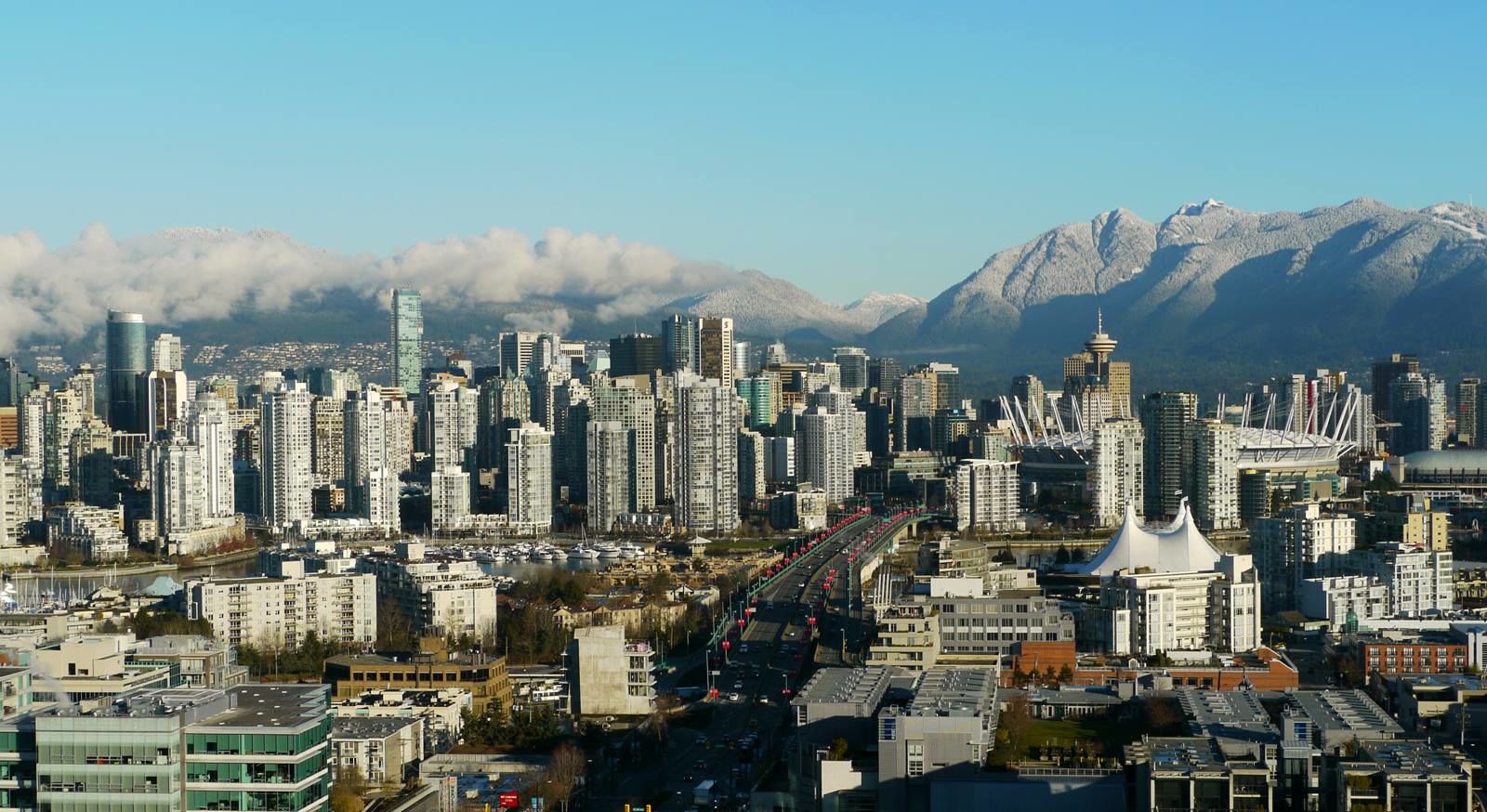
Vancouver City
Source: City of Vancouver, 31 Jan 2014

I moved from New York City to Vancouver a year and a half ago. I landed a job in a great organization that is admired from afar for its proactive approach to linking land use planning and provision of transportation, including public transit, major roads, bridges and cycling. But I’ve learned the hard way just to tell people my occupation and not name my employer. If I say the dreaded T-word (okay, it’s TransLink) I get an earful from the surprisingly strong anti-transit crowd in this town.(1) However, TransLink’s damaged brand is not just tough for me, it’s tough for making good policy.

Making policy is not quite the same as advocating for it. I’ve found it easier to advocate (or denigrate) from a distance, often with an air of righteous indignation; however, bearing the weight of public dissatisfaction has been a different beast.

We are, in the words of a former premier, the city “that mostly got it right”. In my metropolitan area, as in many others, we have reached a tipping point on traffic congestion. Millennials defer getting a driver’s license (2,3) transit access is a new requisite for commercial real estate (4) and the installation of complete streets for all modes of travel is becoming (already is?) the new normal (5,6) With growing demand for improved transportation options, agencies everywhere are struggling to come up with funds to maintain and expand services.

Vancouver rapid transit map
Source: http://www.evergreenline.gov.bc.ca/documents/Maps_Graphics/Transit_Map.jpg

Partly in response to a persistent public perception of gross mismanagement, my agency has been through two government audits in 2012 alone, and both have found that the system has the best funding formula in Canada, and that “the organization is well run and manages its costs”(7). However, implementation of all suggested efficiencies (including cutting low-performing routes) will not be enough to meet the future transit expansion needs of Metro Vancouver. The provincial government has called for a referendum on this issue by Spring 2015.

“The line between democracy by plebiscites and mob rule is very thin.” – Anne Golden(8), speaking about the upcoming transportation referendum, Jan 2014

The referendum question has yet to be set, but how do you create the message on an issue as complex, multi-faceted and far-reaching as future transportation funding? How do you reach a population that is so disillusioned with your organization, that they prefer to view the referendum as a vote on the agency itself, rather than the larger issues (9). Failure to pass this referendum has its own opportunity costs (10), but the importance of funding transportation expansion is lost as public attention is directed to how much money is spent on office coffee. The province has taken the politically-safe approach of asking taxpayers to decide if they would like further taxes to pay for transit. They have not asked taxpayers if they agree with funding recent road and bridge expansion, oil pipelines, or a coal terminal.

We are entering into this referendum woefully unequipped to succeed. At the best of times, making an argument for transit/cycling/walking is going against a 50-yr+ status quo attitude of “the car is king”. However, investments in transit infrastructure benefit more than the riders themselves. The regional economy, goods movement, personal mobility, job opportunities, and healthy communities require planning and funding of alternate transportation options. We can make many sound scholarly arguments, but it is often preaching to the converted.

“When trust is broken between the government and the governed, it’s almost impossible to generate support for public policy changes even when the proposals are right.” – Anne Golden, Jan 2014

The public has very little trust in my organization, and the media caters to this. Transit decisions, big and small, are routinely lambasted and misrepresented, with major omissions that compromise balanced reporting. There is scant awareness that the agency is also responsible for roads, bridges, goods movement, air care testing for vehicles, and pedestrian and cycling infrastructure. It is an easy news story to cater to the strong public appetite for taking potshots at the region’s punching bag. There is the sense that merely having a transit pass is the equivalent of an advanced degree in transit planning, and everyone feels they could have made a better decision.

It would be easy to put my head down, hide amongst the thousands of employees at my organization, and tell individuals in social settings that I wasn’t responsible for their particular grievance. Yet I am proud of the work that my city, my region, and my transportation authority have accomplished. I want it to succeed in the future. I worked in NYC for 5 of its most formative years in the transformation of its streets from auto-dominated through-routes to celebrations of public spaces, and I know how good news stories are borne of years of blood, sweat and tears. When one looks up from the battle, and takes a step back, it is possible to be reminded of what the fight is really for.

“I know the RBA sets interest rates but I’m embarrassed to ask why.” An explainer

“I know the RBA sets interest rates but I’m embarrassed to ask why.”

Someone said this to me at a party recently. In trying to explain interest rate policy by shouting over Daft Punk I achieved simultaneous pedagogical and social failure.

This setting, I hope, is a more appropriate place to provide the answer.

The Really Simple Version:

Interest rates are the brakes on inflation (price rises). When the RBA changes interest rates, they are trying to control inflation.

Higher interest rates slow inflation down.

If you notice the price of a sandwich keeps going up, the Reserve Bank is probably getting worried about high inflation. The RBA watches price rises by looking at the consumer price inflation data. If inflation is getting too high they will raise interest rates.

Lower interest rates speed inflation up.

On the other hand, if shops are having big sales that suggests prices are falling. The RBA is probably worried about low inflation. It might cut interest rates.

The RBA’s job is to keep consumer price inflation between 2 per cent and 3 per cent, annually. If price rises are above 3 per cent, they will raise interest rates. If price rises are below 2 per cent they will cut interest rates.

How does that work?

High interest rates slow down spending.

  • For people: If interest rates go up, it makes sense to put more money in the bank, not spend it.
  • For companies: If interest rates go up, you won’t borrow money to build a new factory. You’ll try to pay back your loans.

Low interest rates do the opposite.

  • For people: If interest rates go down, it makes sense to take your deposits out of the bank and spend them.
  • For companies: If interest rates go down, you can borrow to build a new factory.

Spending matters because the rate of spending affects the way companies set prices. If items are not selling, companies will put them on discount. If they are selling out, they may even put up prices.

This is the basic lesson. The RBA is controlling interest rates, to affect spending, to affect inflation.

The fairly simple reason we care about inflation:

Too much inflation can be bad – it means the money you have saved buys less and less.

But we don’t aim for no more price rises ever – because price rises can be good.  Inflation can be good because it CAUSES spending. I know we just said spending causes inflation. But it works both ways. Think about this:

If inflation is high, your money is losing value, so it makes sense to spend it. If $100,000 will buy you a Mercedes today, but it will cost $105,000 next year, it makes sense to spend the money now. That spending will pump up the economy.

If inflation is low, however, it makes more sense to save your money. Of course, if everyone saves, the economy suffers.

i.e. The way people react to inflation (spending/saving) is important to economic growth.

The RBA tries to balance the speed of the economy so we get the right amount of spending and saving to keep the economy growing. Inflation is kept between 2 and 3 per cent, because we’ve decided that is a good range to keep spending and saving in balance.

Why do we care about growth? Growth affects unemployment, and thereby people’s health and happiness. That’s why the newspapers pay so much attention to it.

Advanced class: How does the RBA control interest rates?

The RBA doesn’t set your bank account interest. And it doesn’t set your home loan rate. So what is it controlling?

The one market that rules them all.

The overnight cash market is the shortest-term loan in the market. Big banks borrow in there for just a few hours.

Because you can make a year-long loan out of 365 overnight loans, targeting the overnight loan market affects all other loan markets.

So the RBA gets in there and plays. It literally buys and sells money in that market so that the interest rate does not deviate from the publicly announced official cash rate (at present 2.5 per cent).

(Interest rates are the price of a loan, so increasing supply of money in that market lowers interest rates, decreasing supply raises interest rates).

The RBA is damn good at getting the overnight cash rate to match the target rate.

#winning
#winning

PhD level: Does the RBA have to balance unemployment against interest rates?

In the United States, their Reserve Bank (the Fed) has what they call a dual mandate:

“maximum employment, stable prices”

In Australia, the RBA technically has a triple mandate.

The Reserve Bank Act 1959 says it must act to ensure:

  1. the stability of the currency of Australia;
  2. the maintenance of full employment in Australia; and
  3. the economic prosperity and welfare of the people of Australia.

But that has basically been waived. A statement is agreed between the Treasurer and the Governor of the RBA after each election, agreeing that the bank should focus most on inflation when setting monetary policy:

“…allow the Reserve Bank Board to focus on price (currency) stability, which is a crucial precondition for long-term economic growth and employment, while taking account of the implications of monetary policy for activity and levels of employment in the short term.”

Why not focus on employment too?

Back in the day, economists thought  you could have low unemployment if you were willing to pump up the economy enough to have high inflation. Now we know this is not true.

You get a short term bump in employment under high inflation because the wages are not actually worth as much as the workers thought they would be. Workers aren’t dumb though, so once they re-calibrate their inflation expectations, they stop being willing to work for those crappy wages.

That means solely focusing on inflation is the surest way to promote low unemployment.

That’s the end of the lesson on interest rates! I hope it was helpful. Now you can nod wisely when Alan Kohler does the finance news.

Why won’t Americans suck it up and fly to Australia?

Americans, the hypocrites, will not stop complaining about the flight to Australia.

“I want to go to Australia, but I can’t stomach the thought of the year long flight….ugggh.” (source)


“I really want to go to australia but at the same time the flight is just soooo long, and everything there is poisonous” (source)


“Flying to Australia is a long arduous experience” (source)

And yet they consider driving across their vast, lumpy and obese country a simple jaunt! A petit amusement! A mere caper!

This graph shows that lots of people who can easily afford to fly will still happily ride the Interstate for hour after arduous hour. Among people earning over 100 grand, twenty per cent of trips of 2000 miles are done by car! 20 per cent!!

Screen Shot 2014-02-22 at 5.20.03 pm

Just for reference for our Australian readers, an example of a round trip of 2000 miles would be from Melbourne to Byron Bay, AND BACK.

Screen Shot 2014-02-22 at 5.33.58 pm

There should be millions of Americans trampling all over our fine brown land all the time.

The proportion of Americans with passports has risen from 3 per cent in 1989 to over 33 per cent now.

And yet growth in American tourism to Australia has been stunted, showing no growth at all in a decade, until a welcome recent blip. The cheap airfares that have had Aussies hitting up the States in record numbers apparently leave our American confreres ice cold.

Image

What Is Happening, America? Why You No Come Here?

Are they wholly xenophobic? Can we blame Lara “where the bloody hell are you” Bingle? Or is it our famous racism? Or are they more concerned about our drop bears, redbacks and large, fast-moving and highly venomous snakes?

Perceptions of safety can scarcely be the issue. It turns out the favourite destination of Americans in selecting their overseas travel is Mexico, with a 33 per cent share.

Oceania (presumably including those hobbit-botherers across the ditch, plus Tahiti, Fiji, etc) gets just 0.9 per cent. [source]

Canada gets 20 per cent and Europe is next with 19 per cent. Europe! What have they got that we don’t? Europe is at least 7 hours flight, NY-London, and as much as 14 hours if you try to go from LA to Helsinki.

Screen Shot 2014-02-22 at 5.48.27 pm

The American excuse that it is *just too far* is clearly made up. Which leaves us in an unhappy place. A place where we need to face a discomforting possibility.

Perhaps they just don’t like us.

Can we handle the rejection?

Why Bunnings prices are so damn clever.

Bunnings is more than a gigantic hardware store. Its canyon-esque aisles whisper to you of self-reliance and ruggedness, if not quite suggesting a log cabin of your own construction then at least the sort of Barbecue a man can be proud of.

Once you’re over about 26 it seems to slowly turn into a refuge, a bit like Thoreau and his woods.There’s always a sausage sizzle out the front on weekends and it has become an Australian institution.

Nevermind that it is based on an American big-box retailing model, or that it has only been a national chain since 1994, after it bought out McEwans hardware, closed most of the outlets, then sold itself to mega conglomerate Wesfarmers.

The reason there are now around 280 Bunnings nationwide is that the store is so good. We don’t begrudge the many hours spent lost in its chasms and nooks.  It’s like that because it is cheapest. Right?

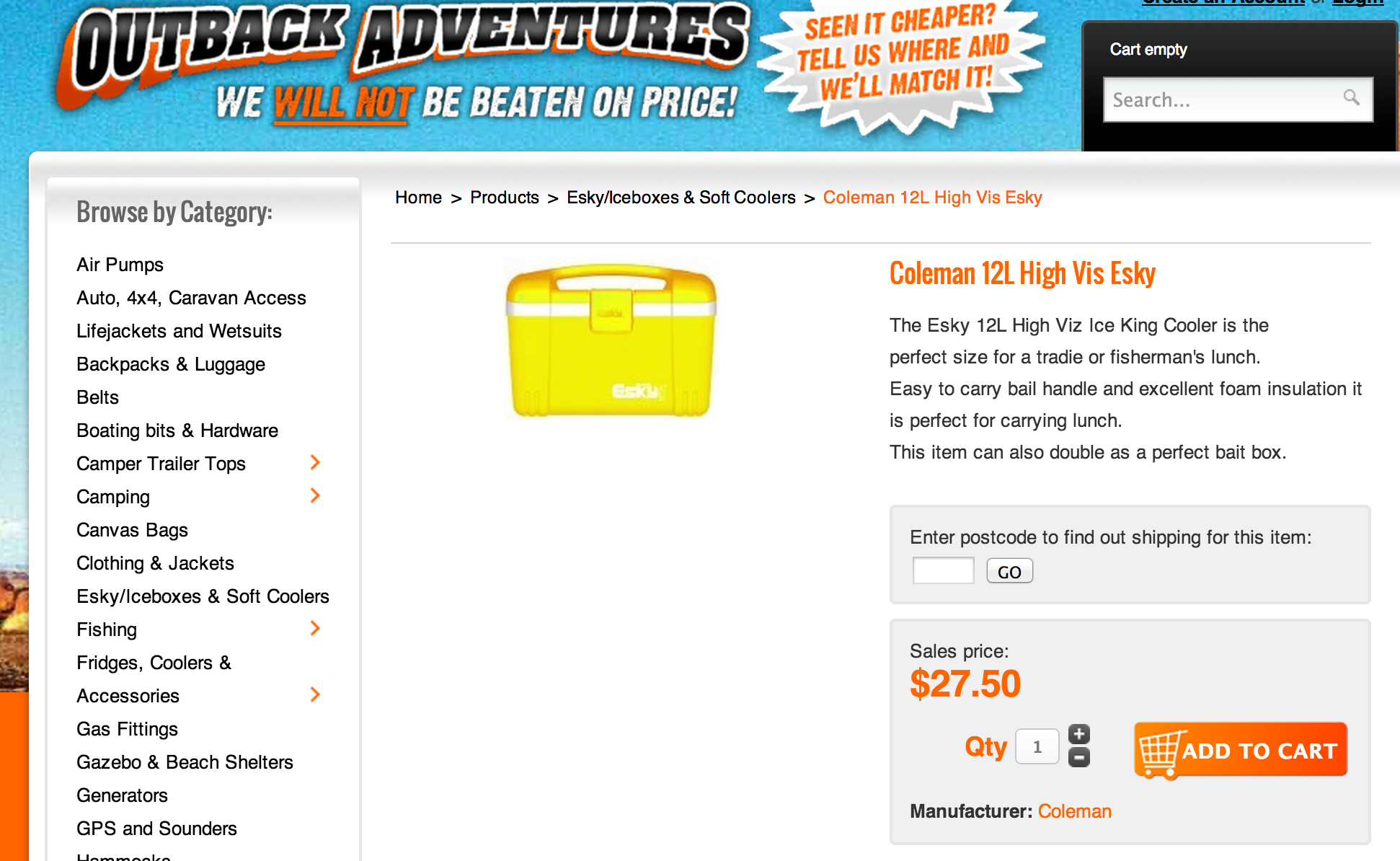
A tentative Google suggests, um, well, :

Image
At Bunnings, $34.99
Image
Online, $27.50!

There are three big tricks that Bunnings uses to reinforce the widely-held belief they are so cheap.

1. They often choose prices that to the first glance look odd. For example, they sell hammers for $8.45, $37.97, and $62. Apparently the theory is a range of irregular and specific numbers make customers think the price has been ratcheted down as low as it possibly can be.

Rather than having all the prices in the format $X9.99, the prices imply Bunnings takes the trouble to price everything at its minimum.

2. Using people from the stores in the ads. (I thought they might be actors but the internet says no. There are 33,000 staff so I guess some must be able to pass a screen test).

The point is, this is signalling. Bunnings has ads on during high-rating shows – they are not stinting on their marketing budget.

But if they deploy great cinematography and a highly polished vibe, like you might see in a car ad, it creates the impression they are wasting money on ads. Instead the ads look cheap and cheerful. The same motivation is behind The Good Guys using their staff in ads even though they too are a heavy-hitting national chain. (Baker’s Delight use their staff in ads to signal something else – that the bread is made by real people, not a factory.)

The signalling effect even flows through to the way stores are designed. Here’s Cotsco founder Jim Sinegal talking about his store’s budget vibe.

“We try to create an image of a warehouse type of an environment … I once joked it costs a lot of money to make these places look cheap. But we spend a lot of time and energy in trying to create that image.

3. “Lowest Prices guaranteed” / “Lowest Prices are just the beginning.”

This slogan seems to have moved away from using the word “guarantee” recently. But the claim is still a strong one. The only way Bunnings can get away with it is their price-beat guarantee: “Find a lower advertised price and we’ll beat it by 10 per cent.”

That is an extremely clever business plan. While anyone might think they could mock up an ad that offers something very cheaply and trick Bunnings into giving them a deal, the reality is the store would happily accept being tricked to get the benefits of such an offer. They would probably rather more people took them up on the price-beat guarantee.

Let me explain:

The effect of the price-beating offer is to permit price discrimination. They can sell things at a higher price to people that don’t bother shopping around, and at a lower price to those that care about price. That means they charge different prices to different types of people, just like a hotel or airline does, maximising yield.

But the real killer of a price guarantee is the way it discourages other chains from discounting and promoting. If I run Think Engine Hardware, why would I put an ad in the paper telling everyone Cordless Drills – Now 30 per cent Off!? I know customers can and will still go to Bunnings. Offering to beat advertised prices is very close to being anti-competitive behaviour, as it can cause all firms to raise prices.

From the great knowledge fount:

“While a store with price matching guarantees has no fear of losing customers to rivals’ price cuts, it has every incentive to raise its own price to charge a higher price to its loyal customers. It is an anti-competitive tactic that warns competitors not to attempt to steal market share by undercutting prices.”

So, Bunnings is like any other retail operation, playing clever psychological games to disguise healthy mark-ups.

It had earnings of $900 million on revenue of $7.7 billion last year, and contributed 26 per cent of Wesfarmers earnings before tax, etc. Wesfarmers is currently working on “conversion of the property pipeline into trading locations at a higher rate than historically achieved” in order to help Bunnings contribute even more to its annual profits, which were, last year $2.2 billion.

Time for a Mazdalanche!

In Nauru, half the cars on the roads are Hilux Surfs – a kind of old 4×4 sold in Japan. In New Zealand, half the cars are Nissan Sunny’s – a kind of car sold in Japan. I have driven both and they have been some of the happiest times of my life.

The prices for these cars are terrific. The  reason why starts far, far away..

Japan has very strong vehicle quality rules. Cars have to be inspected after the first three years, then every two years, and every year after they are ten years old. The inspections are not cheap, running up to $2500. This means Japanese consumers like to get rid of old cars even though they still run well, to buy new cars. The Japanese government wants to encourage that because Mitsubishi, Nissan, Toyota and Suzuki are all Japanese.

Japan ends up with a lot of used cars and exports them very cheaply.

Japan drives on the left, so there are not too many markets they can sell second-hand cars to. NZ and Nauru – both countries without car manufacturing – snap them up.

But, unlike a bunch of other smart countries, Australia doesn’t permit the import of normal second-hand Japanese cars!

Now we are losing Ford, Holden and Toyota, we no longer need this consumer-hurting import limitation. It is time to take advantage of Japan’s crazy policy. 

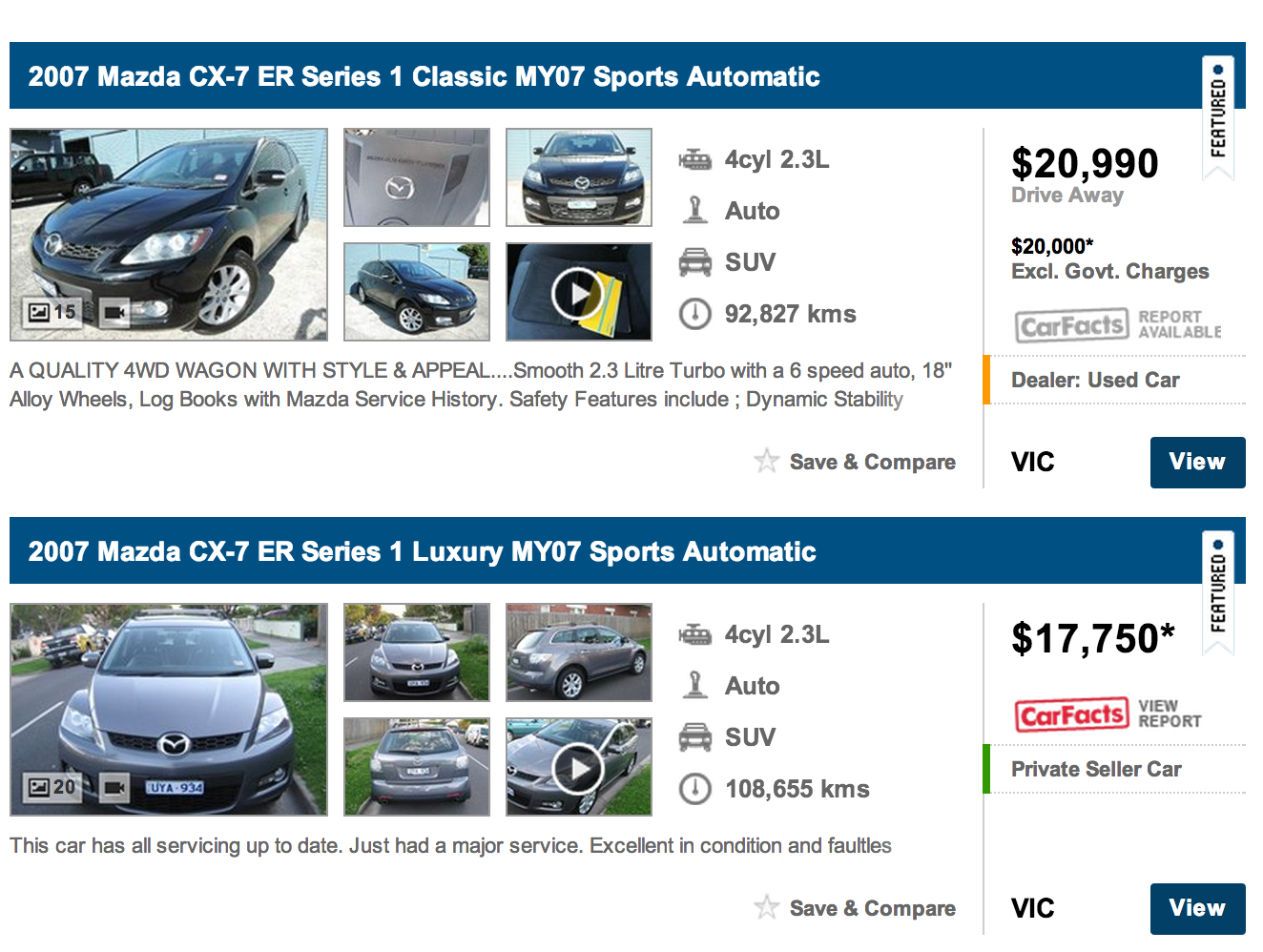
For comparison. Here’s some options from the Australian website carsales.com.au that are indicative of price range for a 2007 Maxda CX-7

Screen Shot 2014-02-22 at 9.28.37 pm

Here are the results from japan-partner.com.

Screen Shot 2014-02-22 at 9.27.58 pm

Big savings. Thousands per car.  Shipping costs can be very reasonable, in the region of $2000.

As our car industry fades into nothingness, this can be our compensation.

The Productivity Commission’s recent report on the car industry recommended getting rid of the limits on importing Japanese cars, so it’s a possibility it could happen soon.

The only reason to act cool on the issue is that I bet DFAT would like it too as a handy bargaining chip.

The Japanese government would probably be delighted if we started bidding up the prices of this category of export. All those Japanese consumers would find their second hand cars were worth a bit more. Perhaps we could even use it to encourage them to cut out their “scientific” whaling program?

I Love a Services Country; a Land of Sweeping, and Flying Planes

There’s an idea out there, that Australia is built on primary industries and manufacturing. That we are first and foremost a country that “makes things.” And that we should be proud of it.

This view of history must not stand.

This is a country that depends on services. Always has, always will.

People who go on and on about how we are about to turn into a nation of burger-flippers and/or door openers reveal themselves to have bugger-all understanding of the true history of Australia.

Services, mate. Since day dot. Each one building on the last, to make this great nation you see before you:


1. Pre- European Australia.

Story-telling services, decorating services, etc. [no photos available, sorry]

2. Cpt J.Cook

Captain Cook
Exploration and mapping consultant.

 3. Arthur Phillip

Arthur Phillip
Colony commencement consultant.

4. Burke and Wills.

Burke and Wills
Checking out what’s up there and failing to come back consultants

5. Governor Macquarie:  

Governor Lachlan Macquarie
Governance consultant with a sideline in financial services innovation.

6. Banjo Patterson

Banjo Paterson
Poetry and myth-making consultant.

 7. The Man From Snowy River

The man from Snowy River
Horse retrieval consultant. 

8. Ned Kelly

Ned Kelly
Funds liberation consultant / flamboyant headwear designer. 

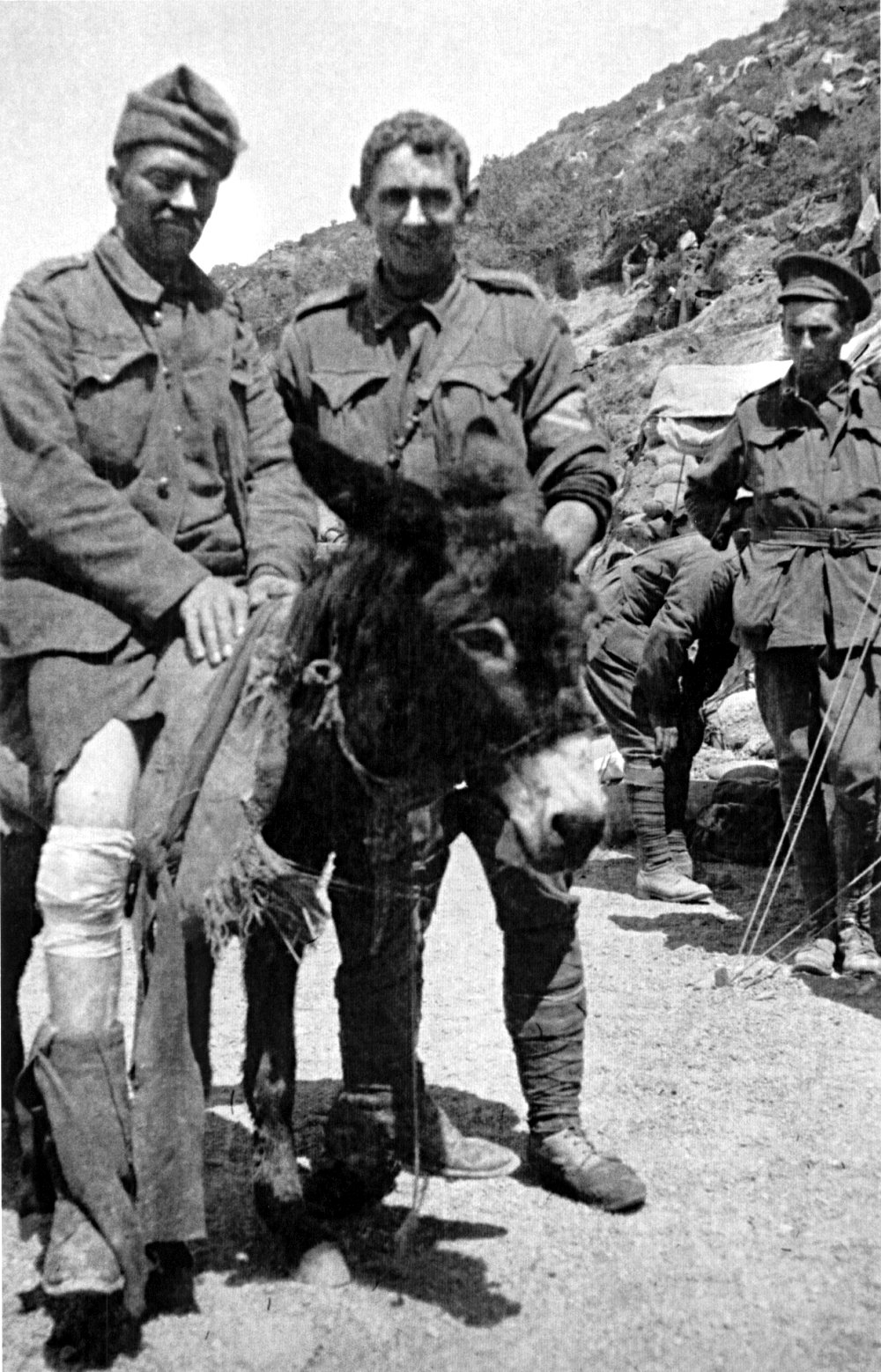
9. Simpson and his Donkey. 

Simpson and his Donkey
Casualty retrieval consultant.

10. Royal Flying Doctors Service. 

Royal Flying Doctor's Service
They don’t call it the Royal Flying Doctors Manufacturing Industry.

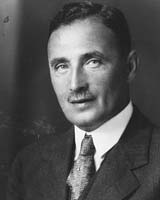
11. Don Bradman.

Sir Donald Bradman
English despair and dismay consultant.

 12.  John Bradfield. 

John Bradfield
Water crossing/tourism icon construction consultant. 

13. Sidney Myer

Sidney Myer
Retail services guru

14. Dennis Lillee. 

Dennis Lillee
Moustache consultant with a sideline in high-speed leather propulsion services

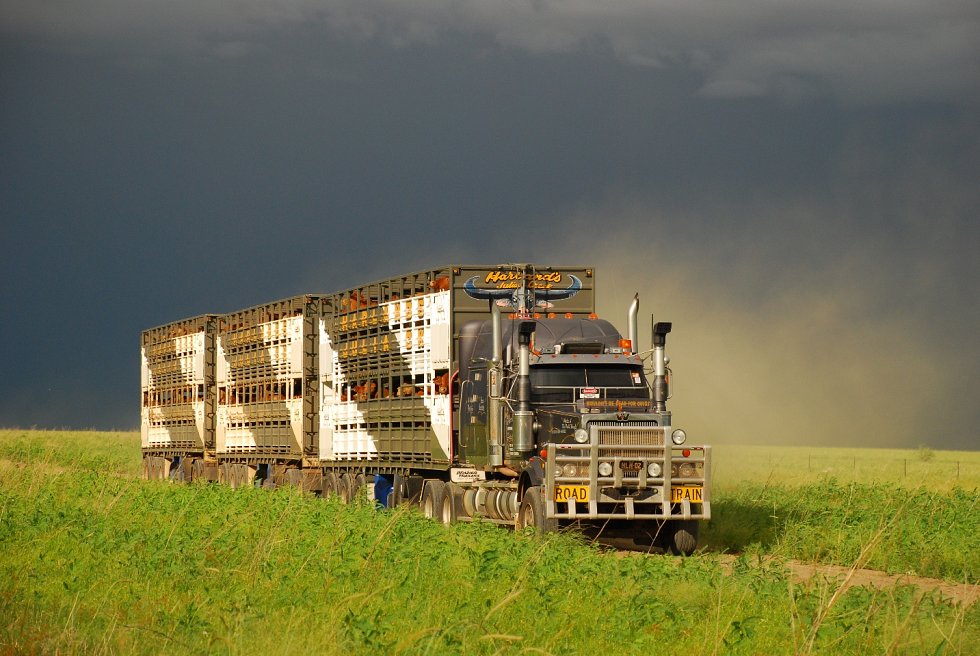
15. Road train drivers.

Truckies
Logistics consultants

 16. Bob Hawke.

Bob Hawke
Worker organisation/national leadership specialist

17. Professor Peter Doherty

Peter Doherty
Cure guru

18. Cate Blanchett

Cate Blanchett
Pretending to be someone else professional

This nation is not just about things.

It’s about people and the things they do for one another. If the Colt from Old Regret had got away and the owner went and bought another one, while the Man from Snowy River worked in a factory, it wouldn’t be much of a story, would it?

Next time you hear a politician say they don’t want to live in a country that doesn’t make things, remember that living in a country that didn’t do things would be even worse.

Get rid of the Winter Olympics

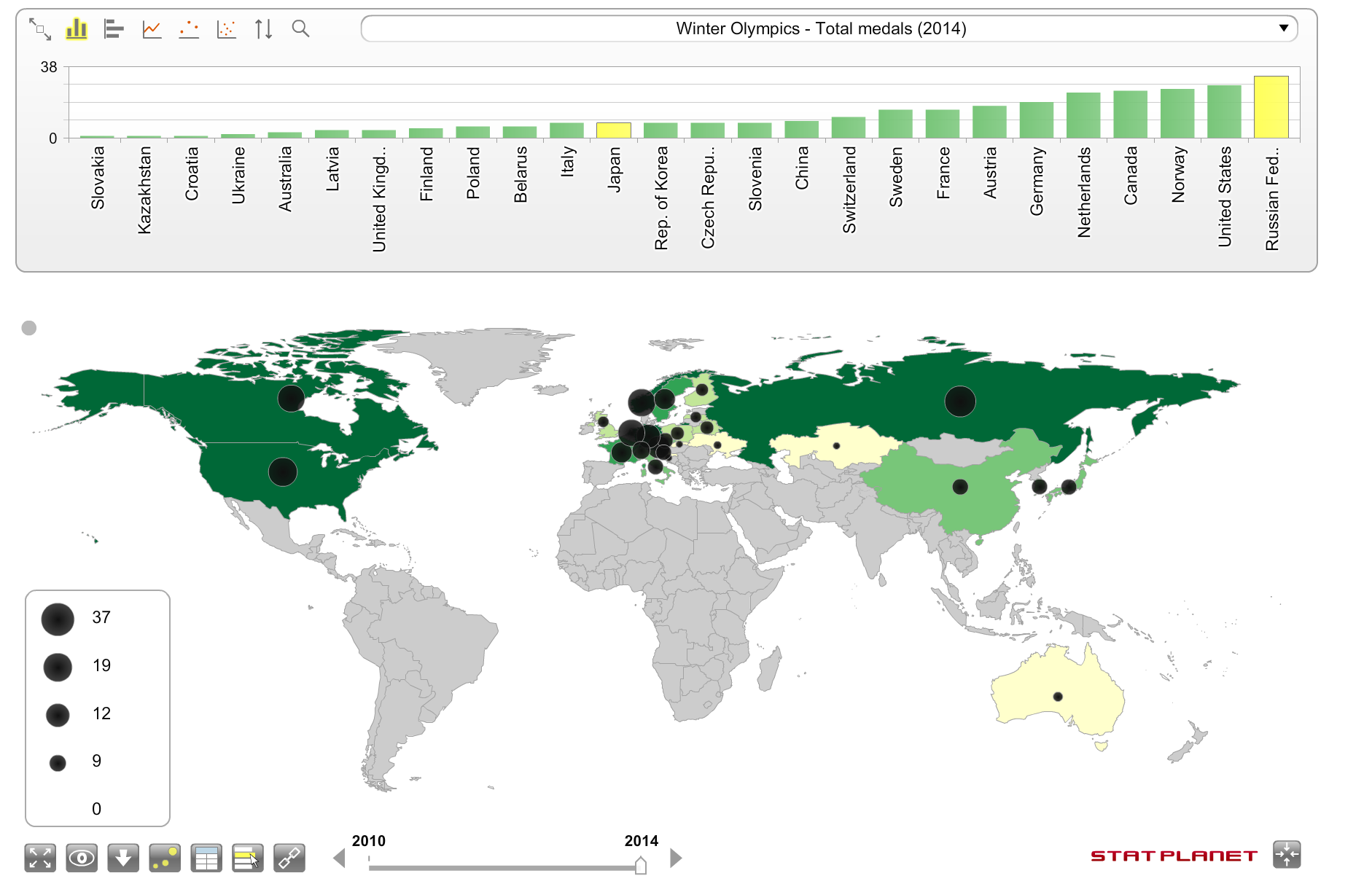
The Winter Olympics should be abandoned. Take away its rings and its eternal flame. It is polluting the concept of Olympics – Sport for All. Only 26 of the 200-something countries in the world got on the medal table.

Image

The games are so hopelessly skewed to the richer and/or more snowy bits of the world that most countries cannot compete.

Three African countries were able to send representatives to Sochi. That’s not so bad, you may think, til you dig a bit deeper and find they are “representatives” in name only.

Zimbabwe sent 20 year old Luke Steyn, who was coming 59th in the Slalom after his first run, and it only got worse from there, ending in a DNF. He has lived in Switzerland for the last 18 years.

Morocco sent two Alpine skiers, who performed perfectly credibly.

Kenzo Tazi: “When her family moved from London, England to the French Alps in 2007, she was able to begin skiing competitively.” and

Adam Lamhamedi: “I was born in Quebec and I grew up there, and I went through the Skibec alpine system. I’m just like any other kid from Charlesbourg. But I am lucky enough to have a Moroccan father.”

Togo sent a skier who had long competed for France, Mathilde Amivi PetitJean

“In May 2013 she was contacted by the Togolese Skiing Federation via her Facebook page with an offer to compete for the west African nation. “If I was told I would one day compete at the Olympic Games, I would never have believed it would be in the colours of Togo.” 

The second Togo athlete is 18 year old Italian Alessia Afi DiPol. “My father has a factory in Togo that specialises in sports clothes. He has a feeling for the nation, and I have an opportunity to run for Togo, and I am proud of this.”

Yep.

There is not much Africa in the Winter Olympics. A billion people without a medal. Here’s a graph that compares that result with Norway (population 5 million.)

Image

Norway won 26 medals, coming third on the medal tally, behind the hosts, Russia, with 33, and the US, with 28.

Its Scandinavian comrades were not too far behind. Sweden snagged 15. Finland got five. 

Here’s another way of looking at how narrowly held Winter Olympic glory is. You could go through those four adjacent countries – that won 27 per cent of the total medals – in one day, stopping for petrol maybe once (and getting caught in some Swedish roadworks apparently).

Image

Now, the Summer Olympics is not fair either. Rich countries win most of the medals. But poor countries at least have a chance. India wins a medal or two. So do Brazil, Iran and Indonesia. And Kenya. Especially Kenya.

Image

In 2012, There were 86 countries that medalled in the summer Olympics, or as I call them, the real Olympics. All continents were represented. That’s a result worthy of the five Olympic rings.

But, but, but… winter?

No.

Countries are on the equator don’t really get a winter. Winter, snow, ice and the Winter Olympics along with them, are geographically specialised concepts in a way the Summer Olympics isn’t. You can run 100 metres at minus 10 degrees or plus 40.

Not to mention the equipment. I bet you ten dong that people in Vietnam look at skis, snowboards and ice-skates with the sort of skepticism I reserve for bobsleds and skeletons. I just googled and there is nowhere in Nigeria, Africa’s most populous country, to buy a snowboard. The Winter Olympics are just a fantasy realm of preposterousness for billions of people. 

I feel qualified to say all this because I love winter sports. But I love AFL too, and I’m not campaigning for a special Olympics for sports played inside ovals. I think the Olympics should be about giving as many people as possible a chance.

Sports being excluded from the summer olympics for being insufficiently popular include baseball, with 35 million global participants. They almost cut wrestling out too. Meanwhile, the winter Olympics carries on with Biathlon and four versions of ski racing: Downhill, Super G, Giant Slalom and Slalom. 

Amazed? I’ll tell you why we get a winter Olympics despite most of the world’s population living near the equator.  Most of the world’s wealth is located far from the equator.

Is that right?

The Olympics is a special thing. An inclusive thing. The Olympic Charter says:

“The goal of Olympism is to place sport at the service of the harmonious development of man, with a view to promoting a peaceful society concerned with the preservation of human dignity.”

It’s a shame the populations of Africa and South America are excluded from that every four years.

We talked about bad brand extensions the other day. The winter Olympics is one. They drag down what the Olympics are supposed to be all about. 

I bet Norwegians and Canadians are getting all upset round about now. Don’t worry. I do believe you should still be able to put your tuques on for a big winter sports party every four years. But you should not be allowed to call it the Olympics.

Rapid growth of WhatsApp should actually make Facebook frightened.

Ever since Facebook swapped the GDP of a mid-sized nation for a simple messaging service, the chart below is getting a lot of attention.  But I fear its main point is being missed.

Screen Shot 2014-02-24 at 8.53.57 am

Facebook got so excited by this sort of user growth that it spent $US19 billion buying WhatsApp. But it should be cowering.

Facebook’s biggest single virtue now, is that it’s the social network your friends are on. Facebook’s entire $175 billion market value hinges on the idea that this “network effect” is enough to lock you in and make sure you never leave. Is it?

The first person to install WhatsApp had no way to use it. The second person to install it could only contact the first one. The thing had no real value until a decent-sized circle of your contacts was on it. Despite this, despite the presence of other perfectly good options, like email, SMS, Viber, and despite its terrible IT-developer’s-idea-of-a-pun name, the application has grown faster than anything the web has ever seen.

WhatsApp’s growth shows people are now damn comfortable in the app store. Nobody is worried about hitting install, checking something out, and deleting it later. That represents an important – but predictable – change in consumer behaviour. And a major threat to the apps we already have installed.

Facebook perhaps recognises it could be gazumped. It is trying to make our commitment to Facebook a virtue, with, for example, recent videos reflecting our history on Facebook, etc. But if its major selling point is that it stores your old memories, will that be enough? If we all keep our Facebook – like we all keep our old school photos – but use something else for day-to-day use, then Facebook loses.

Screen Shot 2014-02-24 at 10.34.09 am

There’s another even bigger point to make here about the lesson of WhatsApp’s incredible growth.

When I wrote about Facebook’s acquisition of WhatsApp a few days ago I mainly just goggled at the incredible price. $US19 billion in cash and stock, or about $A21 billion. Since then I have had a very constructive argument with someone I respect greatly in the tech space, about what the point of the acquisition is.

I argued you could have lots of customers but no good way to monetise them. Twitter was a really good example, I said. The old-school capital market guys that floated facebook and were currently propping up their shareprice would, I reasoned, have to learn the hard way to not rely on their old-world model that says a successful business is one with lots of customers.

But I got an eye-opener in response.

“Don’t get me wrong, I wouldn’t buy FB shares at the current frothy prices either. Nor would I pay $19 Billion dollars for WhatApp. But the long-term play is a little more interesting than “monetise internet service”. The aim as I read it is to eliminate the existing rent-seeking middlemen (in this case, telcos) by undercutting their service. Then, once you have sufficient user lock-in and network effects, you can *become* the rent-seeking middleman, but at an unprecedented global scale! Not exactly a glorious ambition, but it may just work out that way.”

That made me think about the way I look at the internet.

There is one company that has created “sufficient user lock-in and network effects” to be considered the backbone of the internet. Google. Revenue of $15 billion and profit of $3 billion in one three-month period in 2013. Google is to the internet what the state-owned telecommunications companies were to the early days of the communication by wire. A behemoth.

Screen Shot 2014-02-24 at 10.36.04 am

The question then becomes, is Google a model for the rest of the net? Can Facebook et al do that too? Or is Google an outlier?

The telcos became rent-seeking middlemen by owning a network that could not be replicated. They had physical wires that they controlled. Competitors needed to make huge investments to beat them. There’s an analogy to Google there.

Google’s search results are so good not just because of its smart Page Rank algorithm, but because of its expensive web-crawling. Its competitors, like DuckDuckGo, use third-party results in their search results, because web crawling is expensive to do right:

“While our indexes are getting bigger, we do not expect to be wholly independent from third-parties. Bing and Google each spend hundreds of millions of dollars a year crawling and indexing the deep Web. It costs so much that even big companies like Yahoo and Ask are giving up general crawling and indexing. Therefore, it seems silly to compete on crawling and, besides, we do not have the money to do so. Instead, we’ve focused on building a better search engine by concentrating on what we think are long-term value-adds.”

Google’s core products, search and ads, are protected by both being smarter than the competitors, and expensive to replicate. They look safe.

But its various add-ons, like Maps, Gmail, Youtube and the play store could in theory be beaten. It has happened before. See: 10 Google services that failed and why.

Facebook’s offering is not necessarily expensive to replicate.  Open source social networks are out there. Market leaders diaspora and Movim both make privacy a big feature. Who knows what the spark will be that sets them, or something like them, on the path to exponential growth.

Goldman Sachs and JP Morgan take note. The Google model may prove to be a once-off. The internet will continue provide a lot of terrific services, but will not necessarily continue to provide a lot of money. The economic rule that price equals marginal cost of production in the absence of market power has not broken. And marginal costs online are often very close to zero.

Just to emphasise this point, I’d like to finish this piece by introducing you to an app called Telegram. It does everything WhatsApp does, but cheaper. There are no ads. There are no fees. And it is run by a not-for-profit.

Add me when you join. :)


Why I’m not a union member

Is it because I’m disgusted at union corruption and waste?

No?

Is it perhaps because I harbour a distaste for collective action?

No?

Is it a lot simpler than that? Is it simply that being a union member seems awfully expensive?

I was a union member once, but not any more. My last job I made between $70,000 and $80,000. The union fees at the Media Arts and Entertainment Alliance are $12.65 a week, just under 1 per cent of wages, at $658 a year.

If I had to make a list of things I spend more than $658 a year on, it’s a) short and b) full of things that are extremely important to me.

1. rent.

2. food.

3. holidays.

4. charitable pursuits.

5. coffee.

A former colleague at the Fin Review once tried to convince me to join. (Yes, there are union members at the Fin …at least in the Melbourne bureau…). He compared union membership to a gym membership  He was trying to make it sound reasonable, but gym membership is exactly the sort of expense I try to avoid.

Value is subjective, and it could be I just don’t understand the merits of membership. But if so the union hasn’t done enough to communicate it to me. And I’m clearly not alone.

Screen Shot 2014-02-21 at 12.07.02 pm

Footy clubs have much the same incentives as unions to maximise their memberships, and they are creative about it. You can get all sorts of packages that meet your needs.

Geelong offers a membership for $50 and one for $407, with a swathe of options in between.

Collingwood is even more creative, with pet memberships.

Screen Shot 2014-02-21 at 12.21.58 pm

I’m not aware of unions doing the same, even as membership in Australia has collapsed.

I am not ideologically opposed to unions. I was a member of the National Union of Workers while I was a student doing telephone market research at DBM consultants. We had great pay and conditions and I know for sure that was not a coincidence.

I might even join a union in the future. But the value proposition has to be there for me. That means I need to feel good about the price, what I get for my money, and about the union in question.

At the moment news about the amazing places nurses unions fees ended up after they were paid to the Health Services Union makes me wonder if unions are being run as cleanly as they should be. That makes me even more reluctant to part with my hard-earned.

A fair start for unions might be to choose to submit themselves to the full responsibilities of companies. The recent ACTU study into union governance looks, to me, about as fierce as a wet lettuce.

Unions are going to face a lot more bad PR under the current government.

It might be smart for the movement to outflank the criticism, and commit to the highest standard of oversight and probity, before Tony Abbott runs them through with the rusty blade of his Royal Commission into union corruption. If they can prove they are protecting the union dues of existing members at the same time they think about offering value to potential members, they might even win a few new ones.

The value of Whatsapp, in perspective for Australia

WhatsApp will be bought by Facebook for $19 billion. That would make it the 14th most valuable company on the Australian Stock Exchange, more valuable than Fortescue Metals, more than Macquarie Group, two thirds as valuable as Rio Tinto.

Image

The deal puts the $1 billion Facebook paid to buy Instagram firmly in the category of forgotten history.

Whatsapp, for those of you not in the know, is just another way to send text messages.

Whatsapp

It has been downloaded over 100 million times, but it is free for the first year, doesn’t sell ads and costs $0.99 a year thereafter. So yes, it is a graveyard for investors capital.

The internet economy is great for consumers. But the expected monetisation of all this time spent is just never going to happen in the way companies seem to believe. Time spent online is not like time spent walking around a mall.

Do Crime and Meth addiction have to rise in Geelong?

Economically, the end of aluminium smelting and car-making in Geelong makes sense.
Both are low-wage, dead-end industries propped up by government subsidies. They subtract from our net welfare, as a nation. That’s the meta view. The view from space.

You don’t need to be a social scientist to know that when industries close down, disadvantage gets concentrated. I wrote about this recently in the context of another Australian city, in this post: Detroitelaide.

Economists cover this issue in the term “transition costs”, but that doesn’t really tease out how painful they are

Bruce Springsteen’s whole career is built on reflecting the suffering of the US rustbelt, where manufacturing’s long decline has hurt generation after generation.

From his 1983 song My Hometown:

“Now main street is whitewashed windows and vacant stores
Seems like there aint nobody wants to come down here no more
They’re closing down the textile mill across the railroad tracks
Foreman says these jobs are going boys and they aint coming back to
Your hometown, your hometown, your hometown, your hometown”

to his 2012 song “Death to My Hometown

“Now, no shells ripped the evening sky
No cities burning down
No army stormed the shores for which we’d die
No dictators were crowned.
I awoke on a quiet night, I never heard a sound
The marauders raided in the dark
And brought death to my hometown
They brought death to my hometown
They destroyed our families, factories
And they took our homes
They left our bodies on the plains
The vultures picked our bones”

Bruce’s songs resonate because these stories are real.

I have Springsteen on the brain but you don’t need to look as far as New Jersey to find pockets of suffering due to declining employment.

Victoria’s Latrobe Valley suffered a huge decline in employment in the 1990s when the State Electricity Commission was privatised. Towns out there are still setting records for socio-economic disadvantage:

So the citizens of Geelong must be worried. To lose Ford in 2017 was going to be hard enough. Will the 800 jobs at Alcoa prove critical? Luckily, Geelong is a much bigger city than any of the towns in the Latrobe Valley.

It has a university, a football team, an airport and a burgeoning market for tourism. The Government is likely to tip in money. There is a Geelong Investment and Innovation fund worth $25 million. Labor is agitating for that to increase to $100 million.

But even with that money Geelong will need to work very very hard or else its major export might end up being suffering. And singer-songwriters playing poignant minor-key rock anthems about it.

Hate the Porsche Cayenne? You’ll feel sick when you hear about the Lamborghini SUV.

Should Moet start selling lemon squash?

It seems like the answer may be yes. Brands that once zealously guarded their integrity are now stretching for brand extensions every which way.

Porsche – which some grey-beards in the audience may know as a sports car company – now sells more big four-wheel drives than speedy two-seaters. The Cayenne SUV shifted 42,000 units last year, compared to 13,000 of the “cheap” Boxster sportscar and 16,000 of the “classic” 911 range.

But how long until the excitement of driving a Porsche wears off? At $220,000, the Porsche Cayenne does not top any category. You can get a real Porsche for less, and you can pay a lot less for a perfectly good Range Rover that has real four-wheel-drive capability.

Porsche can obviously tell it is in a goldmine, and they have a plan. A new obnoxious Porsche SUV, the Macan, will be released in 2014.

Porsche Macan
If you’re thinking: “Wow! what a radical redesign!” You probably have never seen a Porsche Cayenne.

It is smaller and even less expensive than the Cayenne, with a base model coming in at $87,000. The motoring press is pretty enthused about it, but when Porsche is competing with the Nissan patrol ($82,000) that sends a message about Porsche to the market.

When you make a brand extension like this, you sacrifice some buyers for others. The hardcore sports car enthusiast views your product more dimly. The middle-of-the-road consumer’s eyes light up. Whether that is a good idea in the short run is a matter of simple mathematics. Do you lose more customers than you gain?

But long-term, there’s a bigger risk. Pierre Cardin was once a luxury clothing brand in the vein of Hermes. Then it went wild.

From the Harvard Business Review.

“Initially, the brand extensions into the perfumes and cosmetics categories were successful because the premium degree of the Pierre Cardin brand transferred undiminished into the new, adjacent categories. The owners of Pierre Cardin, unfortunately, attributed this to the strength of the brand rather than to the brand’s fit with the new product categories.”

I have a Pierre Cardin dressing gown that I believe came from Target. While it is terrific in its way, the brand impression I now have means I would not buy a Pierre Cardin suit.

Image

iSnack2.0 was an example of a bad brand extension. Not because Vegemite is too fancy to go into other products but because iSnack2.0 filled a niche that no customers lived in.

Jack Daniels and cola in a can is a good example of a brand extension. Laphroaig whisky and cola in a can would be a bad brand extension. What matters is not just the quality of the ensuing product, but how important exclusivity and purity was to the brand in the first place.

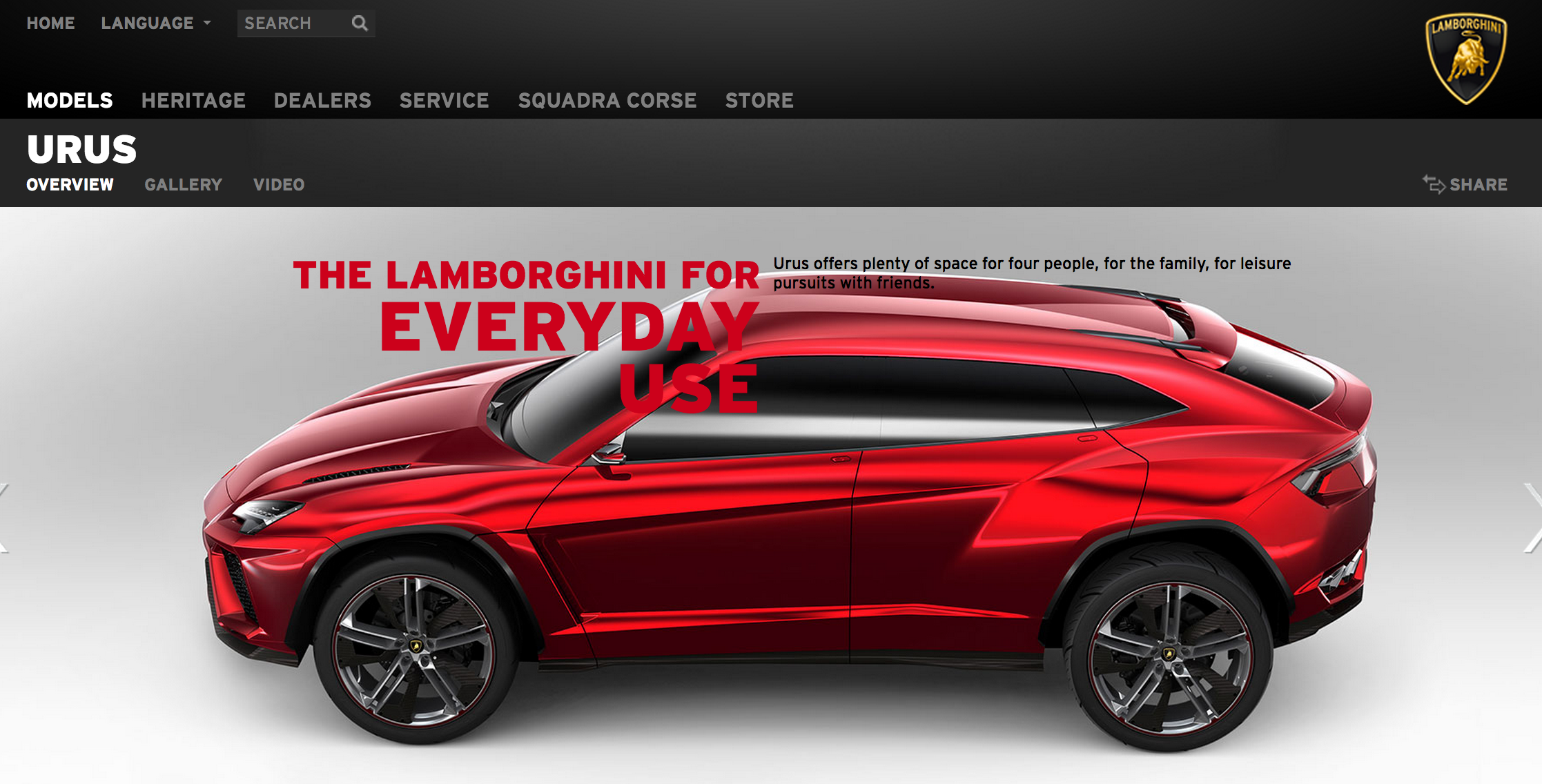
That’s why the fact that Lamborghini is preparing an SUV for launch is such a shock. Lamborghini is the quintessence of hand-made cars that cost an absolute fortune. Existing Lambo owners who paid around $600,000 to get their hands on the badge may not be too happy about the emergence of a Lamborghini lump costing “just” $200,000.

(In fact, this is not their first brand extension in the field. They made and sold 320 “Rambo-Lambos” between 1986 and 1993, after attempting to build a military vehicle but not finding any buyers. The market for SUVs is admittedly now much much larger.)

But will Kanye want to name-check the Urus like he did with “mercy me, that Murcielago?”

Lamborghini Urus

Not unless he is making a kiddies album.

The chief of Lamborghini has hinted the new SUV might not even be the end of the brand extensions. And the people most excited about  that can probably be found working at Ferrari. It means one less competitor for the position of top pure sports car maker.

“We will never build an SUV”, said Ferrari in 2013, before going on to claim that “an SUV cannot deliver genuine driving emotion”.

Springsteen-o-nomics.

Last night I saw Bruce Springsteen and the E-Street band play at an arena just a few kilometres from my house. He was supported by another great 80’s band, Hunters and Collectors, and the whole thing was worth many times the ticket price.

Bruce played for 3 hours 48 minutes, just short of his 4 hour 6 minute record. It was quality, not just quantity, but of course my mind still sometimes strayed into thinking about the economics of what I was experiencing.

boss
Springsteen at AAMI Park, Melbourne, 16 February 2014.

1. Externalities.

Watching the Boss in a crowd of one would be lonely and weird. You need all those other people to sing along, chant, create energy..

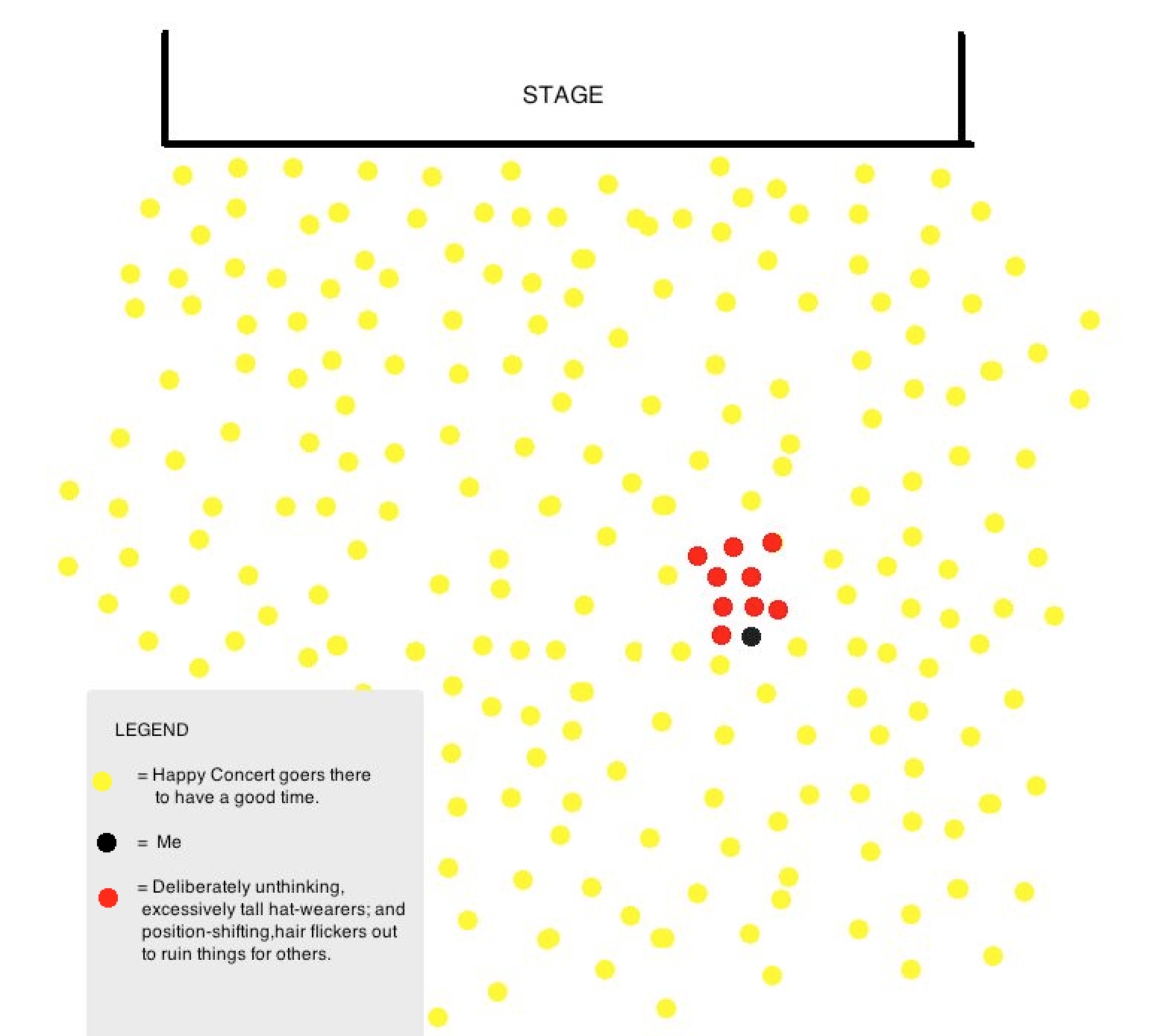
While most people in the crowd provide atmosphere, there’s a certain subset of the crowd that is pure negative externality:

Screen Shot 2014-02-17 at 11.05.33 am

Yeah, you guessed right. I’m not very tall. Still, I think tall people disproportionately enjoy live music and show up in disproportionate numbers. Could you create a simple market for live music that lets the short buy themselves a decent view?

2. Enforcement in the absence of clearly defined property rights.

Before the start, we were about six metres back from the fence in the general admission area. People guarded their space jealously. There were tiny pockets of space into which people from the back would push. The only way they could get away with it was by affecting the face of someone looking for someone, and loudly saying, “he said he was right here,” then looking at their phone. That created enough uncertainty to buy them time.

But if people – especially tall people – just muscled through and stood, it was another matter. There were two guys who looked like US professional wrestlers who stood right in my view, and this guy who looked like a retired orthopaedic surgeon tapped them on the shoulder and gestured violently that they better not stand there. It was beautiful.

3. Complements.

For some people, beer and music go so well together that they are willing to forfeit watching great chunks of an act they have paid $128 to go and see. They’d rather push through a darkened and tightly packed crowd, stand in a beer line and then carry beer back through – a mission of 20 minutes a time. Amazing. Perhaps this is actually a lesson in how some people don’t understand opportunity cost.

4. Diminishing marginal returns.

Bruce and the E-Street band played for over an hour before announcing they would play their 1975 hit album Born to Run from cover to cover. They played it. Then they played for another hour or so. That was when I first saw someone leave. Then the band left the stage, came back to start an encore, played a few songs, announced there was now just twenty minutes left, played a few more songs to use up that 20 minutes, played a super-long version of crowd-pleaser Dancing in the Dark, played traditional ending song Twist and Shout, did a huge finale, bowed and accepted the applause of the crowd. More of the crowd left to beat the rush. The entire E-Street band left the stage and just as Bruce was walking back past the drum kit, a roadie’s hand reached out with an acoustic guitar, he strapped it on and gave us one more song. Parts of the crowd audibly groaned. (Not me.)

The full setlist can be seen here.

5. For some people, a retirement age is a terrible idea.

Bruce is 65. He doesn’t look ready to start drawing down his super.

How to make athletes pay for their training and still bring home Gold! Gold! Gold!

As Aussie athletes make a name for themselves in Sochi, we can look forward to another four years of seeing their smiley faces shilling for products on our TVs. No athlete steps up onto that podium without making their agent’s phone ring off the hook.

That’s why the idea of a HECS system for athletes is very tempting.

(For the international readers, a quick primer: HECS is a TOTALLY AWESOME student loan system. Zero real interest rates and no need to pay any of it back until you earn above $51,309. Meanwhile Australia’s Institute of Sport spends millions training athletes without seeking any recompense.)

The Australian Sports Commission (which funds the Insitute of Sport) spent $310 million last year, and that’s before counting the various state institutes of sport. (The VIS is boasting today about an athlete that finished 61st in cross country skiing).

Screen Shot 2014-02-14 at 11.32.00 am

But there are a few very intriguing twists to this tale that will require policy makers to work hard to stick their landing.

Problem 1. Athletes are So Poor.

We have a sample bias. The athletes we see the most are the athletes that earn the most. Thorpey. Cadel. T-Brizzle (Australia’s favourite Mormon!) Clarkey.

BRW tells us our top athletes are earning over $10 million a year. But the best need the rest to make their performances stand out. Their glory is made out of trampling coulda-beens, duds, ones with questionable work ethic, journeymen and hacks. The ones who make no coin.

Solution 1. The way an athletes HECS scheme works needs to be different to the student system. Most people are not going to pay off. But some will pay off in spades.

It’s not a low-risk low return game like training people in nursing or accountancy. It’s a high risk, high return set-up. That means you need to more than fully recover the cost of training from the few big winners. If Clarkey got $30,000 of support from the Cricket Academy, you need to get $300,000 back from him to cover all the guys who also got $30,000 but made a string of ducks and no cash. The debts should be 10 times the investment, and recovered progressively.

Problem 2. Sports skills are just not useful.

If the AIS trains you to be the best white-water canoeist you can be, in the hope of bringing home Olympic gold, and you don’t, but then years later you go on to found an IT consultancy and you invent a really quite terrific database that makes you a lot money, should the AIS be able to ping you for cash?

It hardly seems fair.

Solution 2. If athletic earnings could be kept separate from non-athletic earnings, that would be ideal, but I fear such a system is ripe for being gamed.

ATO: “Pay up, Clarkey.”

Clarkey: “Sorry ATO, no dice. Swisse Vitamins paid me this money because I’m a good-looking Aussie dude, they didn’t even know I played a spot of cricket!”

ATO: *curses*

A simpler idea might just be a time limit on AIS debt so it expires at about the time any sporting career ends. Ten years for gymnasts. 25 years for long-distance runners, or five years after any career-ending injury.

Problem 3. Some sports are cash cows, some are not.

The AIS supported 1233 athletes in the most recent year. This includes weightlifters. Pole vaulters. Badmintoners. These guys could be reigning nine-times world champion and spokesperson for the globe’s top shuttlecock brand and still need to pull shifts driving a forklift at a logistics company to pay their way.

Solution 3. This one is easy. Set the bar for repayment at $50,000 and the earners in these lesser sports will never trouble the threshold.

The Clifton Hill under 12s have as much profile as the Australian badminton team.

The reality is that sport is luxury. These are frivolous games to play and our national pursuit of Olympic “glory” is also a simple distraction.

When taxpayers lay the groundwork for a handful of golfers, cricketers, basketballers and boxers to own homes in Miami and St Tropez, there is a moral issue at stake. Sports training can fund itself using the above principles, and by god it should!

If there are any other clever features such a program should have, or if you think I’m totally wrong, leave a comment below!

Small Business: Saintly and Ascetic?

In the wake of the Commonwealth government’s decision to not provide $25 million to Coca-Cola Amatil to revamp the SPC canning facility in rural Victoria, a particular sort of argument about small business seems to have gained currency.

“If a small business person runs their business badly, they personally suffer… Coca-Cola wants the taxes of small business people to subsidise their business failure.” Ken Phillips argued in the Australian this week.

On ABC TV’s Q&A, Yolanda Vega said this:

“We seem to keep making the same mistakes. There’s these massive businesses that keep getting bailed out, and yet the small business of Australia which make up 96 per cent – are completely ignored.”

Among the people apparently so busy ignoring small business are Commonwealth Minister for Small Business Bruce BillsonVictorian Minister for Small Business Louise Asher, NSW Minister for Small Business Katrina HodgkinsonWA Minister for Small Business Joe FrancisSA Minister for Small Business Tom Kenyon, and Queensland Minister for Small Business Jann Stuckey, not to mention an array of shadow ministers and small business commissioners.

Image
The tax on interrogative punctuation hits yet another local enterprise

Governments want to help small businesses so much it hurts, even if they don’t always know how…

Victoria has a small business commissioner, promising help in creating a fair and competitive environment; and another entity called Small Business Victoria. The state puts on a small business festival; small business workshops and seminars; not to mention providing help for small businesses through Regional Development Victoria.

When Yolanda Vega said small businesses were “completely ignored,” she obviously hadn’t seen this recent press release from Victorian Small Business Minister Peter Crisp, where the government committed to buying in consultants for 500 Victorian businesses. 

As the source who brought this to my attention says, “What a joke.” This “scattering bread to the pigeons” approach to business welfare is uniquely formulated in terms of its capacity to not be helpful in any strategic sense.

The State government also spent $70,000 recently on a study tour of Europe, designed to figure out the smart ways to support small businesses. (Manchester, London, Amsterdam, Berlin – at least it wasn’t Cannes, Monaco, Sorrento, Santorini).

Image
Small business policy is wigging out

The federal government doesn’t want to be left behind either. Competition laws are being shaped to give small business a better run, and the government is funding a superannuation clearing house to reduce compliance costs for businesses with less than 20 staff. The ATO has recently launched an app for small businesses too.

I crossed paths with Small Business Minister Bruce Billson at a Real Estate agent in suburban Carnegie late last year. He was eager to cast everything the Abbott Government was doing, including removing the carbon tax, as a response to the needs of small business.

Small business account for ten percent of the tax take, but more than that in terms of votes. The idea they play under the same rules and fight on the exact same terms as big business is untrue.

No business is easy, but no business should be easy. Competitive markets should have business owners – whether they are shareholders in a major miner or baristas at a minor cafe – worried about the medium term future and working hard to secure it.

The help big business gets might be news-worthy and include big dollar figures, but the narrative that only small business represents some sort of Ayn Randian ideal of free enterprise should be quashed.

How Fairfax helped kill car-making.

Toyota is going. And yet the government is barely sweating. They stand at the dockside, waving their hanky, thinking of something else. Not even a crocodile tear in their eye.

This, in an environment of rising unemployment, is politically shocking. How has it happened the populace apparently no longer wants this key industry saved? The answer is not that the Australian people have suddenly swallowed an Economics 101 textbook. It is just in the “national mood.”

And that mood is still shaped by the media…

One could trace the beginning of the end of support for Australian car manufacturing to 2011. The economics editor of the Australian newspaper was a man called Michael Stutchbury. A man with ambition. Fiery and with salt and pepper sideburns, “Stutch” put his hand up for a new job that was going across town.

He wanted to be handed the editorship of the Australian Financial Review – Australia’s only business daily. A paper loved and feared in decision-making circles. 

The top echelons of Fairfax considered the CV of the man. He was a man of strong views, sure, but the Fin Review had floundered under middle-of-the-road helmsmanship, so perhaps that was not just desirable, but necessary.


Image
Source: The Australian

Stutch arrived at the Fin amid a surge of excitement, armed with a two-word slogan: Agenda-Setting.

“I think we can turn it into a growth story by reinvigorating the journalism, concentrating on news breaking, going back to setting the agenda,” he told ABC business reporter Ticky Fullerton at the time of his appointment. The move to agenda-setting came with an advertising campaign too, that made the odd choice of appropriating some classic communist propaganda tropes.

The newspaper proceeded to take a far sterner line in deciding what was and wasn’t news. But it went a step further than that. The paper made some things into big news. 

Stutch’s sharp news-sense, formed at the Fin Review but forged in the right-wing foundries of The Australian, combined with his purist views of the government’s role in the economy, meant the car industry was a prime topic. I personally spent hours camped out front of Toyota’s Altona factory getting soundbites from workers, hours trawling through the car statistics to find an Australian manufacturing angle, hours looking into the history of government assistance to the industry.

I even interviewed motor-racing legend Dick Johnson about the possible end of the Falcon, a story idea I was told came from the very top. (Johnson said: “Australians have an affinity with a front-engine, rear-drive car [and] a medium to large body size . . . But it may only be my generation that sees that.” The paper printed the story and a picture.)

Anything with a car industry assistance angle was easy to get past the mid-level editors and into the paper, because they knew Stutch would love it. So he didn’t have to personally demand every single story that the Fin published. The car industry was hot, and everyone knew it.

Image
The Melbourne Bureau, 2013.

Not long after Stutch got the job, Tony Abbott announced cuts to car subsidies. 

Would the government keep this risky promise? The issue remained firmly on the agenda. I wrote at least ten stories on the topic, (1 2 3 4 5 6 7 8 9 10) and I was perhaps only the fourth reporter in line to write car stories, behind Mark SkulleyPeter Roberts, and Lucille Keen

(Three of the four reporters listed above no longer work at the Fin.)

But once set, the agenda doesn’t stay inside just one newspaper. If the Fin is in a lather about the car industry, then the Age gets a bit of froth on it too, as do the Sydney Morning Herald, the Herald Sun and the Advertiser. The tone of coverage nationwide took a subtle turn.

Now, newspapers can push barrows without getting anywhere. What gave the AFR barrowload so much momentum was the political gradient. Labor was clearly sliding out by 2013, and the Coalition was ascendent.

Stutch’s steadfast campaign was given legs because it coincided with a Productivity Commission report and a bright new political day (not to mention political capital in the shape of dozens of one-term backbenchers).

Newspaper editors are powerful people. The Abbott Government is emboldened to make the decisions it is making – decisions its predecessors were unwilling or unable to make – because the prevailing climate is one in which they can expect some media support for the decision. Neither national paper is going to crush the government for cutting the funding which kept car manufacturing here.

I can’t help wondering how Stutch feels today, with the end of Australian automotive manufacturing a reality.

Perhaps I am naive but I can’t quite imagine champagne corks popping. I prefer to imagine him slightly frightened. As in, “Jeez, I can’t believe I just did that!” Like the start of a superhero movie. In that context, here’s a quote I think worth remembering for newspapers editors everywhere: “With great power, comes great responsibility.”