Location, Location, Location

You can buy a French château for less than the price of an apartment in Melbourne.

This flat near Spencer Street is priced at $2.49 million.

Screen Shot 2015-01-14 at 3.42.59 pm

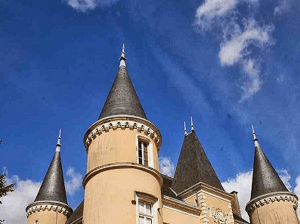
This château in France is worth $2.45 million (1.68 million euros.)

Screen Shot 2015-01-14 at 3.45.12 pmScreen Shot 2015-01-14 at 3.44.52 pm

The flat has two car parks. The chateau is on 24 acres.

Its not even an unusually cheap château. Here’s a 24 bedroom one for 3.6 million euros. And there’s page after page of more modest ones listed for less than a million euros

I find this amazing and just more evidence for my belief that Melbourne property prices are crazy. But in another way, perhaps it makes perfect sense.

France has a château every few villages, and many of them are far from good services. The one above is 3 hours south-west of Paris. If you lived there, you’d probably have to work in Angers. It’s a town of 150,000 people, so the job opportunities aren’t going to be really diverse. The local unemployment rate is 9 per cent.

But obviously, the kind of people who can afford a château tend to live in the city. So this would most likely be a holiday home. Here’s your problem. If you’re after a holiday home in France, you’d choose the French Riviera (Châteaux down there cost more – a lot more) or perhaps the mountains.

Chateau ownership enthusiasm is probably further tempered once you realise the maintenance costs on a building put together prior to the industrial revolution. In browsing the listings I did notice that many of them were “partly renovated.”

Still, with Melbourne property prices where they are, you might be tempted to buy a pile of 18th century French stone and take your chances in the local job market.

But the smart move would be to sample the market first… Through AirBnB I turned up dozens of châteaux for rent on a nightly basis at prices that seem extremely reasonable.

This one accommodates 12 people, costs $1200 a night, and has a moat!

Screen Shot 2015-01-14 at 4.57.13 pm

Not long until the SUV is Australia’s most popular vehicle

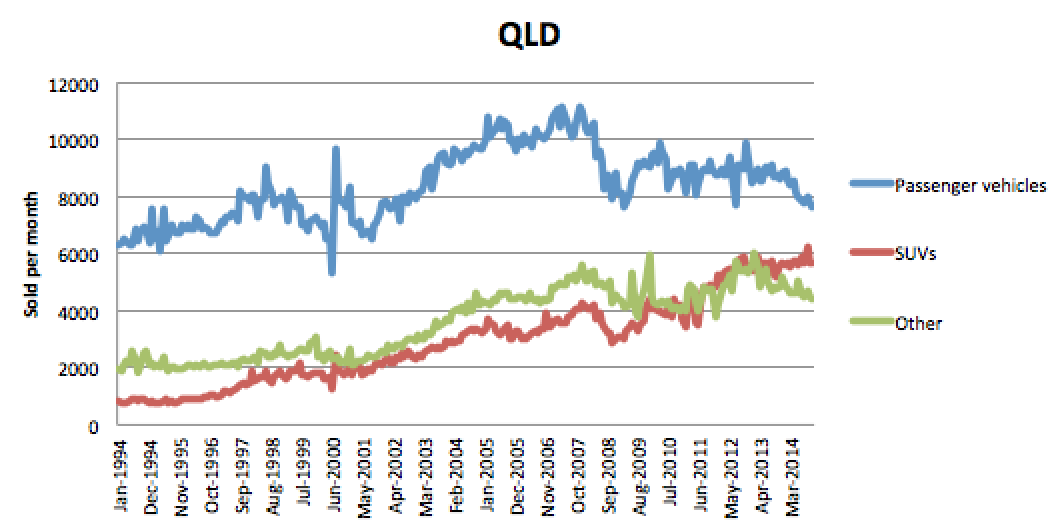
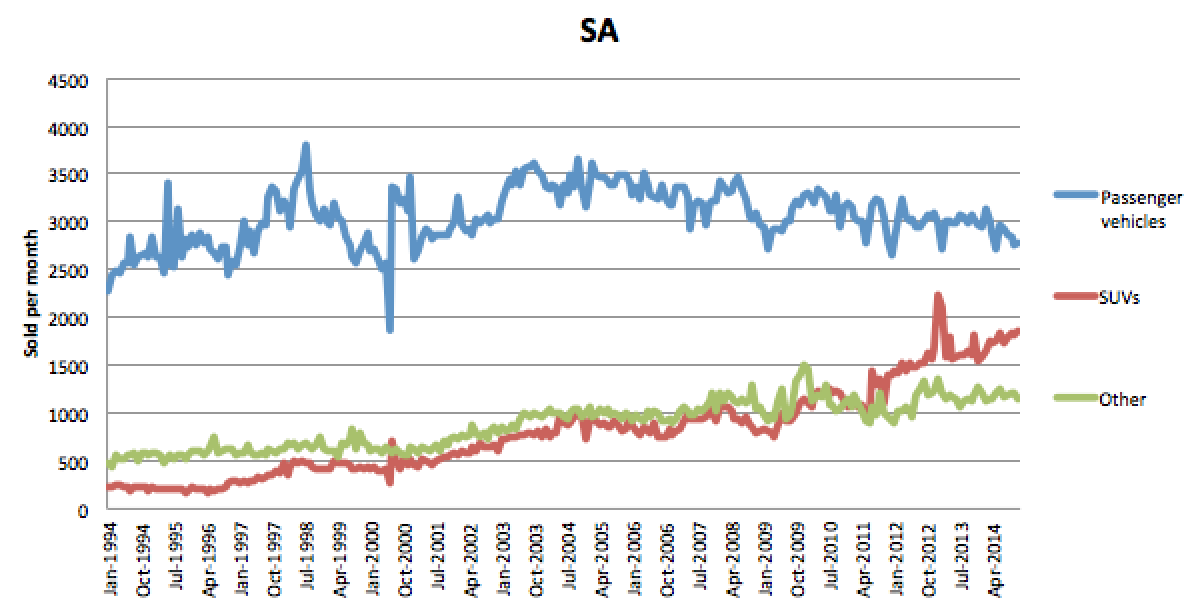
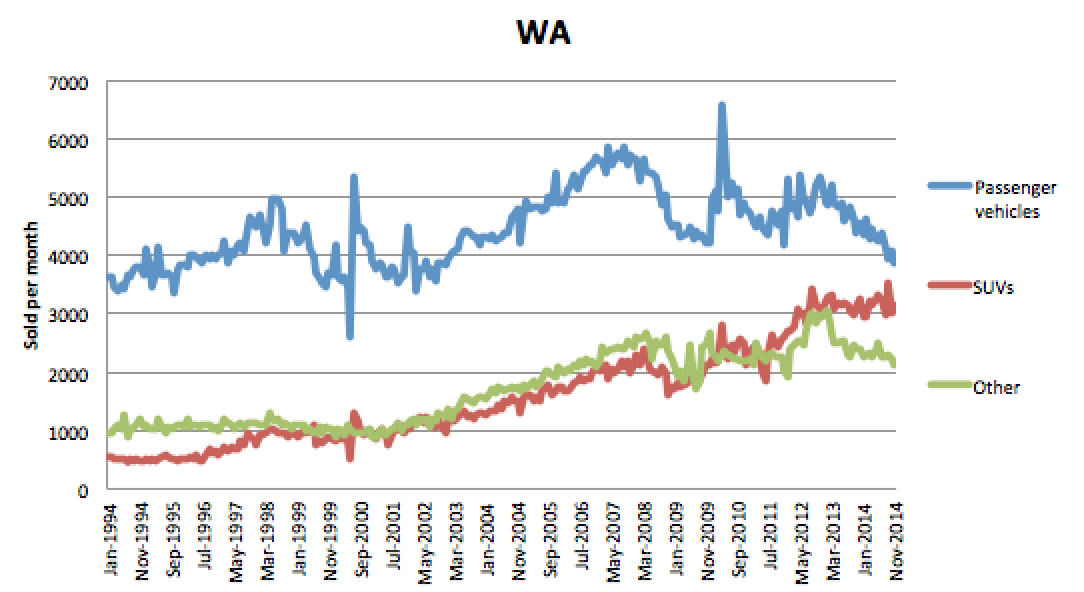
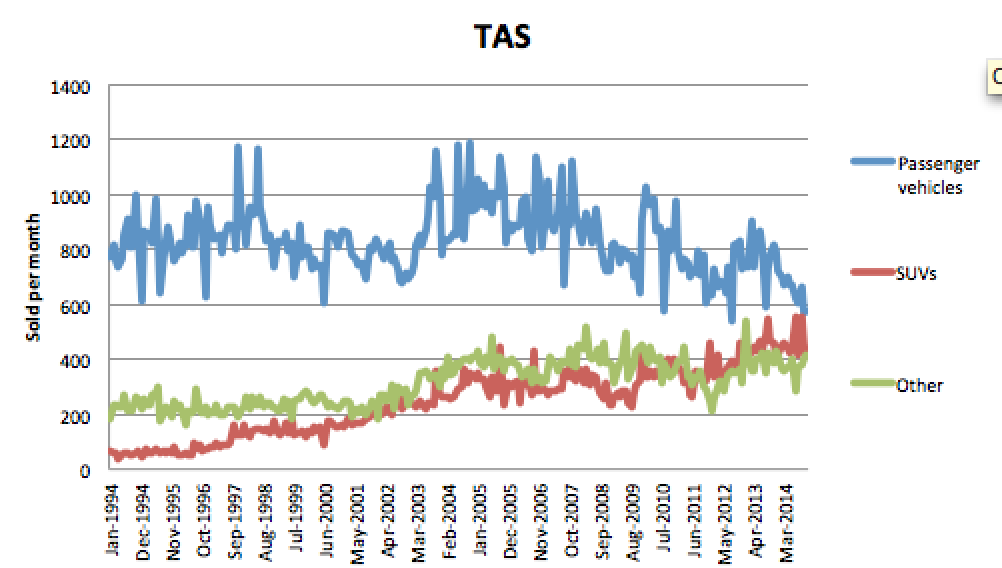
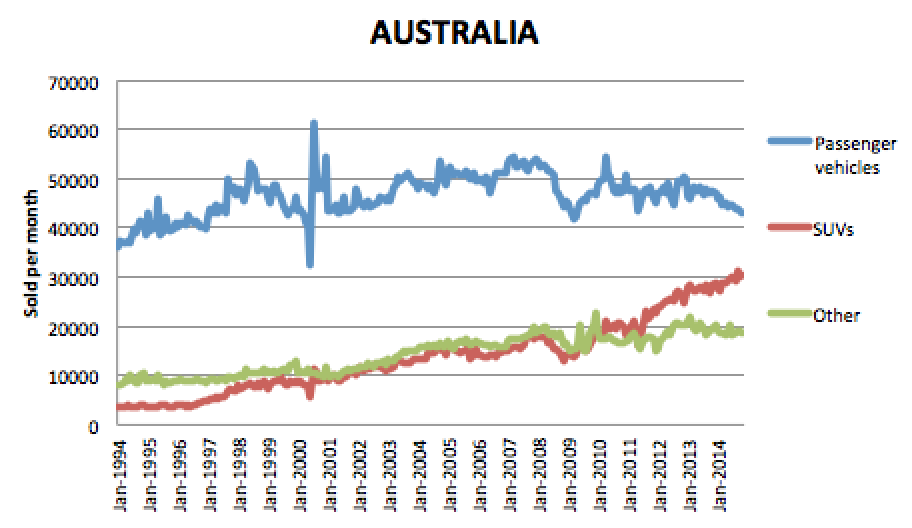
The SUV is rapidly becoming Australia’s favourite kind of car. In every state, SUV sales look set to outstrip sales of passenger vehicles soon, if they have not done so already.

Screen Shot 2014-12-16 at 9.44.11 am Screen Shot 2014-12-16 at 9.43.38 am Screen Shot 2014-12-16 at 9.43.13 am Screen Shot 2014-12-16 at 9.42.53 am Screen Shot 2014-12-16 at 9.42.25 am Screen Shot 2014-12-16 at 9.41.50 am

Screen Shot 2014-12-16 at 9.41.22 am

Congratulations NT, the only state where more SUVS are now sold than passenger vehicles.Screen Shot 2014-12-16 at 9.40.46 am Screen Shot 2014-12-16 at 9.40.18 am

The Toyota Hilux, Mistubishi Triton, Ford Ranger and Hyundai i35 are among the top selling SUVs.

SUVs are great. They’re safer for drivers, they give you a better view, they can mount any terrain, and they have lots of boot space. But they come with costs. More vulnerable road users get hurt. And we can see those costs across the whole country.

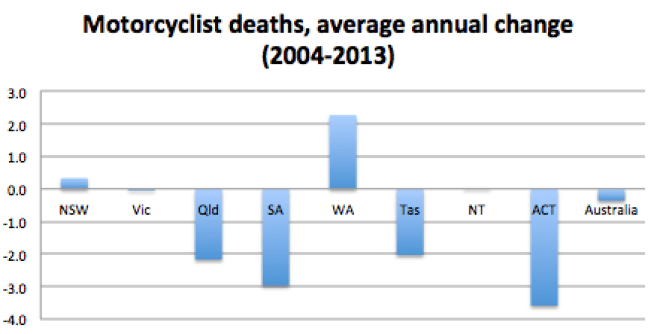
The results for non-drivers are substantially more mixed than the results for drivers, which show clear falls. Some of the states with the biggest proportional increase in SUVs (especially Tasmania) show the worst results for pedestrians and motorcylists..

Screen Shot 2014-12-16 at 10.11.51 am

Screen Shot 2014-12-16 at 10.12.03 am

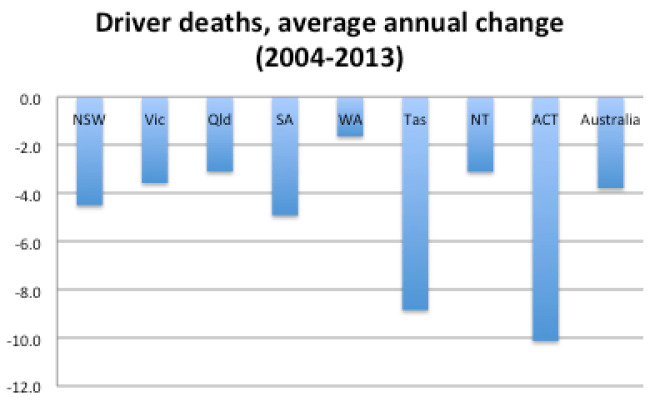
For comparison, here’s the rate of change in driver deaths. It’s worth noting that Tasmania’s population has been pretty stable in this time while WA has grown.

Screen Shot 2014-12-16 at 10.12.24 am

These “hatchbacks on stilts” are a game theory problem. If everyone else has one, we want one too, to be able to feel safe and to see what’s happening on the road. They come with clear externalities. There is a case for the government to intervene. 

Everyone’s panicking about the falling oil price. Should we panic too?

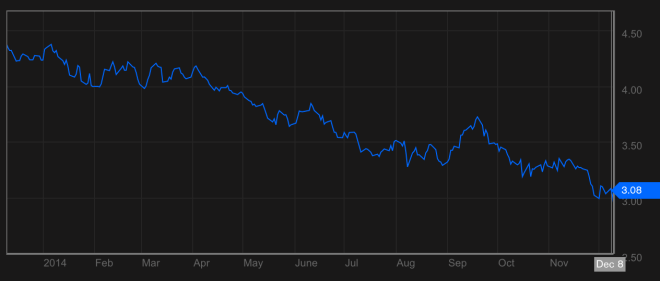
The price of oil has fallen an amazing amount in a short time.

Brent
Source: Nasdaq

Which is sending global markets into a bit of a panic.

oil hurts shares
Source: AFR

But is this really the moment where the Australian economy comes crashing down?

Lower petrol prices are already a reality, which has the same effect for many households as a reduction in interest rates – more money in their pocket.

Source: Australian Institute of Petroleum

Since this graph was made a week ago, retail prices have fallen even further, to 2005-era levels of $1.20/L. The median household spends $40 a week on petrol, so a 25 per cent fall gives them $10 extra to spend on other things.

This is a real boost to the Australian economy at a time when it really needs it.

And our major trading partner, China, is in the same boat. It is an oil importer and it is apparently stockpiling fast during this period of low prices. Like Australia, China is trying to get growth to continue without causing a surge in inflation. The oil price drop just made this a lot easier.

If lower oil prices perk up the Australian consumer just as a lower dollar makes life easier for Australian business, and China is able to continue to grow strongly, that represents just about a best-case scenario for the Australian economy.

But it’s worth remembering: What goes down can go back up.

crude history
Source: Bloomberg

If consumers in China and Australia re-set their oil price expectations, and then the price of oil goes back up, it will feel like an interest rate hike – at the worst possible time. In that scenario, with Australian consumer confidence falling as China suffers a blow to growth, anything could happen.

Why this could be the summer Joe Hockey turns Keynesian.

Next year’s budget offers the Government a horrible array of choices.

The government was badly burned by this year’s budget. Ideas like the GP co-payment saw their popularity plunge in May, and they’ve been in an election-losing position since.

polls
Source: the inestimable Edmund Tadros, AFR.

They burned their fingers badly, and what’s worse, didn’t even grab substantial fiscal gain from it. The Treasurer’s office is staring down the barrel of a budget with another big deficit next year.

If they try to push the budget back to surplus, the public will have their worst fears confirmed – these guys really are mean!

So the Treasurer can’t cut too hard.

The alternative – running a deficit and being proud of it – looks unpalatable. But there are ways to change one’s tastes …

Australia’s growth in the last quarter was poor, falling to 0.3 per cent.

gdp grwoth
Source: ABS National Accounts

There is a big school of thought in economics that says when growth is poor, governments should spend to prop it up. This is broadly known as Keynesianism, named for John Maynard Keynes, who was a major theorist of the great depression. The more contemporary theorists are known as New Keynesians

Spending to support growth is common. That’s what Kevin Rudd and Wayne Swan did in the GFC, giving us school halls, insulation and $900 cheques. The Rudd stimulus left Australia with a medium-sized amount of debt, and arguably prevented Australia from falling into recession alongside the rest of the western world.

The opponents of this policy included one of the national daily papers, The Australian. They hated it in 2009, and they hated it even more by 2013 and 2014.

But by 2015, might their rigidities soften? The political needs of the current government may demand it. The only way to not commit political hara-kiri while setting a framework for the 2015-16 Budget will be to adopt a far more generous way of thinking.

Torn between two forms of cognitive dissonance, “I am setting the national Budget in a wholly political way” and “I am a late convert to the need to support aggregate demand,” I suspect Mr Hockey may be tempted by the latter.

This summer, as he lies on his towel, listening to the Pacific Ocean waves crash on the beach, Joe Hockey may well be turning the pages on a biography of Keynes. Perhaps the same one Mr Rudd read in 2009. It might be the thing that saves him.

Bill Shorten should probably zip it about next year’s budget deficit.

Next May, Tony Abbott and Joe Hockey are going to feel very uncomfortable indeed. They’ll be bringing down a Budget that is completely the opposite of what they hoped for.

The 2014-15 Budget was full of spending cut plans and forecasts of rising tax revenues. The spending cuts are mainly in shreds on the floor of the Senate, and the rising tax revenue projections got vapourised by weak growth and falling iron ore prices. The few measures they did pass, like a temporary tax hike on high income earners, aren’t likely to be enough.

The Abbbott/Hockey game plan was to get their horror budget out of the way early. But the ghost train didn’t stop at the station, and it looks like they’re stuck on the ride as it enters the tunnel once again.

The Budget, when it comes out, is going to include some large negative numbers. They were expecting deficits of $30 billion this year and $17 billion next year.

deficit

But revenue fell hard in the most recent quarter as growth fell to 0.3 per cent.

Budget update

I expect the government will be forced to admit the deficit this year is very much like the last Labor year (around $50 billion), and that the 2015-16 one will be at least twice the size they expected.

What’s worse for them is this – the more they try to correct this scenario, the worse their reputations become.

I wouldn’t want to face the dilemma Hockey faces – try to put the budget on track and cement once and for all the impression of having a heart of stone, or try to salvage a bit of popularity while letting the nation’s finances spiral away. Perhaps he will happily give up his job to Mr Turnbull.

So, from a fiscal perspective, Opposition leader Bill Shorten has been given a free kick in the goal square. This is political gold!

But should he go hard on this topic? Should he try to drive a fiscal stake through this government’s heart?

I see three reasons he should not.

1. Don’t perpetuate Deficit-phobia.

The fear of deficits is extremely corrosive to our national debate. Governments are absolutely petrified of borrowing, for fear of being accused of running a deficit.

Interest rate the government faces on a 10-year loan. Source: Bloomberg

The cost of borrowing, right now, is exceedingly low, and the benefits of borrowing could be very high. Almost everyone thinks Australia could use a big whack of infrastructure to set it up for the next century. Obsessing about spending only what you earn is for people who can’t get credit, or for people whose expenses are smooth and predictable. A mid-size first world nation can get credit cheaply, and might want to occasionally build a huge project. In those cases a deficit should be celebrated.

If Shorten accusing Abbott of incompetence because of the existence of a deficit, then he further limits the policy options of all governments of all stripes.

2. Focus on something important.

Budget day I argued in April that Labor should have made equality a big budget figure. You could hoard all the relevant data on equality until Budget day, brief the right people that an important measure was coming out that day, and then boom, get some cut through on a topic that wasn’t so meaningless.

If Mr Shorten goes after Mr Abbott on the defict, he adds his imprimatur to the idea that managing a deficit is the most important job a government can have. Assuredly, it’s part of the government’s role. But to place it at the centre of responsibilities is to show a distinct lack of imagination. Find something important and make Budget day about that instead.

3. Tying your own noose.

If Mr Shorten wins government in late 2016 and the deficit is all he’s talked about for the preceding three years, he’ll be forced to fix it, fast. That could prove uncomfortable for him.

Mr Shorten’s approach will depend to some extent on what Mr Hockey has planned. We will know a but more about that once the mid-year economic update (MYEFO) comes out.

It was exactly 51 weeks ago that I wrote about the first MYEFO that Mr Hockey brought down, which was clearly setting the stage for big cuts. I wrote this

“What is the last “cut” that is heralded as a major political reform? Howard strangled the dole payment down below some estimates of the poverty line, but that’s oddly omitted in his hagiography. Even right-wing economist Judith Sloan has argued the dole should now be raised.

When we list the economic reforms that have made Australia great we include microeconomic reform, floating the dollar, an inflation-targeting central bank and the GST.  Not cuts.

If the Abbott government’s first term economic reforms can mainly be labelled “cuts”, what will be its legacy?”

It will be very interesting to see what themes we can read into this year’s MYEFO (perhaps coming out next week, and required by law before the end of January).

Time to start getting ready for when the robots take our jobs.

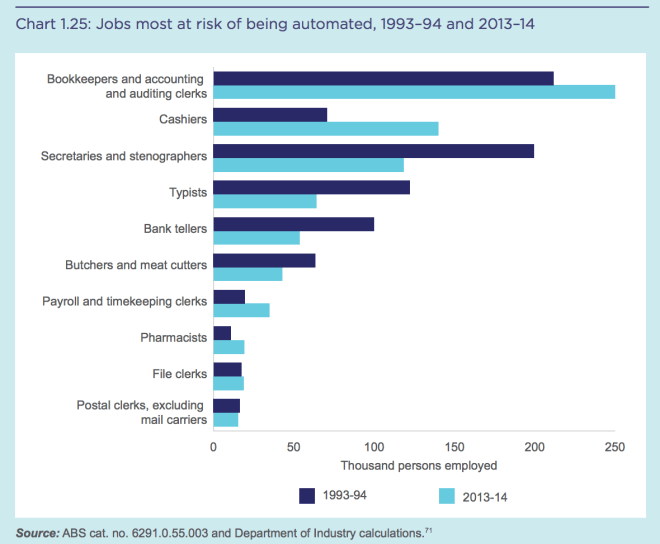
When the federal Department of Industry starts investigating when robots will be taking our jobs, you know the possibility has gone from remote to real.

A lot of jobs are at risk – half a million, according to the article – and they’re not “bad” jobs.

“The challenges presented by more automation are not limited to low-skilled positions, as robots are increasingly replicating the tasks of medium and high-skilled workers.”

job automation
Source: Department of Industry

I’ve written before about what will eventually happen to employment after the Robot Revolution. I think new skill-sets will rise to the top: people-skills and creative skills. The inspiration angle and the emotion angle will be our edge when robots are doing the physical and routine thinking work.

In the mean time, automation will make things cheaper. More and more goods will be like water.

water

Water is cheap. So cheap we don’t even think about it. Water is plentiful. You can easily get more than you could ever use.

Its abundance makes it easy to forget that it is incredibly important. And many other goods and services are much like water. Energy, definitely. You no longer need to pay a fortune for firewood and paraffin. Electricity comes into the house at far less than our willingness to pay.

You could argue clothing and food have already gone that way too. At certain very popular stores, you could buy a complete outfit, including shoes, for under $40. You can meet your daily energy needs for a couple of dollars.

We don’t talk much about how awesome this is. But it is incredible. It’s why absolute poverty doesn’t exist in the same way any more. Being poor is still a huge disadvantage, but has more to do with access to other needs like healthcare and housing and opportunity and with the challenges that poses to decision making, than simple starvation.

When people complain, saying things becoming cheap strips them of their value, they don’t realise the alternative.

Indulge me for a moment longer, let’s imagine prices going the other way – from free to expensive – and instead of using water as our example, let’s use air.

Air is abundant and cheap, and we barely think about it. Should we charge for it? Would that make people value it? Charging for air would be great for GDP. The whole population would be customers of the various air providers. Maybe they’d pre-pay, maybe they’d be on a plan (don’t go over your cap!). The government would set up a means-tested scheme to provide free air for certain groups. Still, it would be a big bump to the economy, and there’d be a lot of jobs in it. Jobs! Given how politicians love to promise jobs, I’m surprised charging for air isn’t on their radar.

So I hope I’ve convinced you, via these examples, that cheaper goods and fewer jobs is not necessarily bad. It can be good, in part.

But it will not be uniformly good for social outcomes. Here’s how the Department of Industry sees it.

“The comparative advantages of being human — the ability to solve problems intuitively, improvise spontaneously and act creatively — as well as the unlimited needs and wants of humans suggest that the displacement of jobs due to automation is unlikely to be long term.”

Note their use of the words “long term.”

The advance of the robots will not be uniform, and there will be times when lots of people get put out of work all at once. At these times, the returns to capital will be higher, and the returns to labour will be lower. In these times, panic will rise. Even though a future where humans are all out of work is laughably implausible, it might not seem that way if you and everyone you know just got the sack.

We will need policy settings that will help at these times.

The policies could try to prevent the robots from taking the jobs, but that means forfeiting the benefits in terms of cheaper goods. It would also be incredibly hard to implement.

So what is the best way to make sure we’re ready for a bump in unemployment? What’s the best way to make sure people are ready to get back into the workforce?

I’d argue there are two big things we should do:

1. Invest in education now. Education protects against long-term unemployment according to the data,  probably by making people ready to re-learn. This is not the time to be making university educations more expensive. Quite the reverse. It’s also the time to be investing in making sure nobody falls through the cracks. Proper implementation of needs-based school funding, in the manner suggested by David Gonksi, would be a good way to make sure that people are adaptable when the time comes.

2. Stop starving the beast. The federal deficit is growing, and since the government has failed to implement a range of spending cuts, and is opposed to tax hikes, it will probably keep growing. In the future, we may need to exploit the federal government’s ability to provide Keynesian stimulus via the  “automatic stabilisers” that are welfare payments. Bulking up the budget is necessary, and we probably need to push up the tax-to-gdp ratio. It may seem like an economically sensitive time to be lifting taxes, but that’s not the case if you put land tax on the agenda. Unlike taxes on income and companies, land taxes are not a tax on productive activity, plus they tend to be progressive (rich pay more, poor pay less).

With these policies in place, we should be much better placed to welcome the robots as our servants, not our rivals.

How the internet can prepare you for university

The best part of university was always the tutes. You could skip the lectures if necessary, but you missed the tutorials at your own peril.

I remember vividly stepping up the wide staircases of the John Medley building at 2.10pm on a Tuesday, burdened with a big folder of academic articles. You’d sit in a quiet room stuffed with too many chairs, talking about that week’s readings.  These were golden hours. To speak during the tute meant you had to have done the reading. You’d hear if other people got something totally different from the assigned articles, say your piece, have people disagree with you.

The shouts from South Lawn would filter through the leaves of the plane trees, but the debate at hand was always more enticing. This is where you saw what points held together, what ideas got torn apart, and worked out what topics you would write your big essay on.

If the point of doing a liberal arts degree is to develop critical thinking skills, the tute was the nexus of the whole affair. The selection of smart people put in a room with an interest in understanding the topic was unparalleled. The tute was to a political science student as the weights room is to a body builder. Where you break down to get built back up.

But now, I think you can build up the skills you need for university – at least somewhat – online.

The best online debates remind me a lot of those tutorials. I do not mean Twitter. Twitter is more like flicking the channels on TV while yelling things nobody will hear. Not Facebook either. Facebook is synonymous with shallow debate.

I’m mainly impressed by Reddit.

It’s a place where you write something, and it gets marked. You can get a big fat zero (or a negative score) if you write something stupid, wrong, unhelpful, or irrelevant. You’ll get called out on your spelling and grammar, too. But if you write beautifully, logically and use references, you’ll get upvoted. The culture there (in some places at least) is quite academic. If you’re clearly spouting off your mouth without having done the reading, someone will normally slap you down.

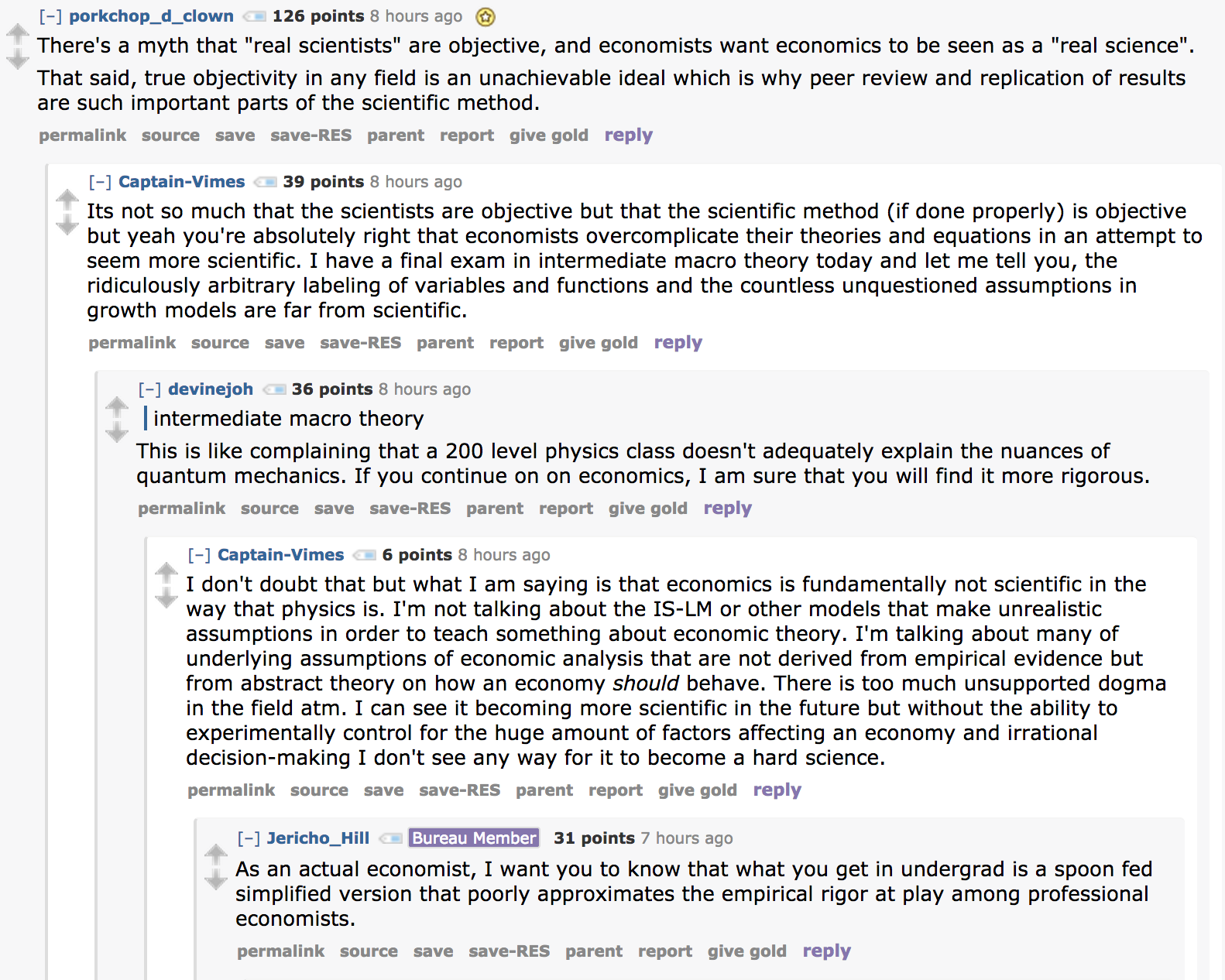
For example, here’s a debate going on in the economics subreddit today about this article at Vox, on whether and in what ways economists are partisan.

reddit economics debate

What we see here are people kicking around important ideas, learning things, being respectful to each other. It may not seem like much, but it’s damn nice to see that happening on the internet.

There’s also a lot of bona fide experts on Reddit that are only too happy to answer people’s questions clearly:

Bows and arrows
Source: Ask Historians

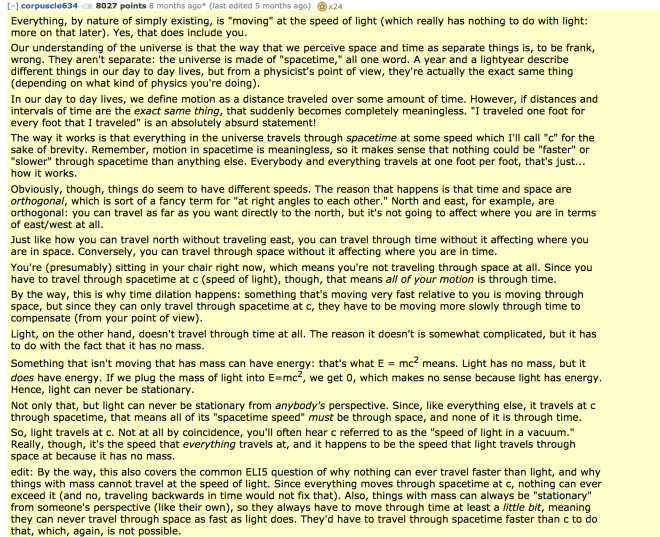
Not just in history but in physics too.

phsyics
Source: Explain Like I’m Five

Sometimes, you can see people being presented with evidence and changing their minds, in real time. At it’s best, it is quite amazing.

Caveat: I do not in any way imply Reddit substitutes for university. University is comprehensive, while Reddit is merely a subset of things that are fun to talk about. And furthermore, university is not just about engaging with ideas. It’s about engaging with people. It is is also about showing up and doing the work, even when you don’t want to, while Reddit offers no points for diligent attendance.

Reddit also fails where the sorting process for confirmation bias is complete, and people end up in subreddits that reflect their own points of view back at them. For example, the subreddit about the holocaust has ended up as a place for deniers.

Still, using Reddit to develop your reading, writing, persuasive argument, critical analysis and grammar, plus skills in giving and receiving feedback will put you in damn good stead to make the most of a proper liberal arts education.

The reason Reddit is like this seems to be its culture. It started out as a nerdy place, and it retains some sort of internal pressure to be fair and accurate. But it is growing fast. I’ve written before about what happens when the internet grows – it gets way more mundane. So there may be a time – and maybe it has already arrived – when the best place to learn and debate online is somewhere else.

Online debates are probably one reason we can hope this internet *is* making us smarter. If there are other websites you love that you think also support good debate, mention them in the comments below.

The man to sell tax hikes to the Australian people … is John Howard.

Australia’s budget is in a spot of trouble. The ABS released its latest Government finance statistics this week and they show a slump in revenue. 

Budget update


This, to me, is not a crisis. It’s not good news, but just as you don’t judge a game of football on a 2 minute period, you don’t judge a fiscal situation on a quarter (or even a year, or even a group of years). You ned to judge the fiscal position in the long run.

I’m interested in this high-level measure, the tax-to-gdp ratio. And that’s an interesting thing, with a few moving parts.

Tax to GDP ratio

Treasury has relatively recently begun spruiking it. (This began in the Rudd era, I believe, when he wanted to seem fiscally prudent while spending a lot.) It can be affected by deliberate actions of government, or by shifts in GDP and prices of key exports.

That spike in the red line at the end is now at risk, due to factors beyond the government’s control. In the 2014 Budget, the government announced it would increase revenue as a percentage of GDP, from 23 per cent to 24.9 per cent.

Given the way everything economic and budgetary has come up turds since, the MYEFO is likely to replace this optimistic assumption when it comes out (soon).

A 1 per cent fall in the terms of trade is estimated to have a $2.6 billion impact on the budget, according to published sensitivty analysis. And this week’s national accounts show an 8.9 per cent fall in terms of trade over the last 12 months.

So we’re likely to get a budget deficit that is expanding and a tax to GDP ratio that is falling.

So what should the government do? In the short-run, it should keep spending to prop up growth. But in the medium to long run it needs to do more.

The most senior figure in Australian economics, Max Corden, strips the issues back to their essentials in the Conversation today.

“Given the deficit prospect, the government faces three choices: (1) Run a bigger deficit, (2) raise taxes, or (3) cut government spending… What the government should consider is raising taxes.”

Cutting spending is important where programs are ineffective, or where you’re trimming fat. That is crucial. But it won’t be enough. The Australian people want the government to do more, not less – we want important things like the NDIS and funding childcare and kindergarten.

I’d support raising taxes, slowly and in a clever way, to try to right the structural budget deficit.

This might seem like an impossible PR job for the government. But with the help of one man, it may not be.

John Howard, Prime Minister 1996-2007

The name John Howard is like a magic charm in contemporary politics.  A man who wins four elections  (96, 99, 2001, 2004) gets a lot of kudos in retrospect, even if he had a seriously easy incumbency, bountiful in threats to national security and bumps to government revenue.

Mr Howard presided over an era that saw the tax-to-GDP ratio rise over 24 per cent, even as he gave away income tax cuts as fast as he could. People remember that time fondly. The song that pleaded for us to not take a rose coloured glasses view of his legacy? That record broke.

The man is viewed (wrongly) as a fiscal genius.If I were Joe Hockey, and I was facing up to the fact I needed to to try to sell tax hikes, I’d stick his name on it.

“Reverting to a John Howard era tax-to-GDP ratio” sounds a lot more palatable than simply “hiking taxes.”

Could this be a better way to pay politicians?

Australia’s 824 politicians are paid well.

The lowest paid MPs are certain members of the ACT legislative assembly, who get $132,800.On the other side of Canberra, federal parliament is even more lucrative. The lowliest federal backbencher* makes $195,130. The highest paid is the Prime Minister, who makes $507,000.

State MPs seem to get about 70 per cent of the federal pay. The Premier of NSW gets $358,853 .

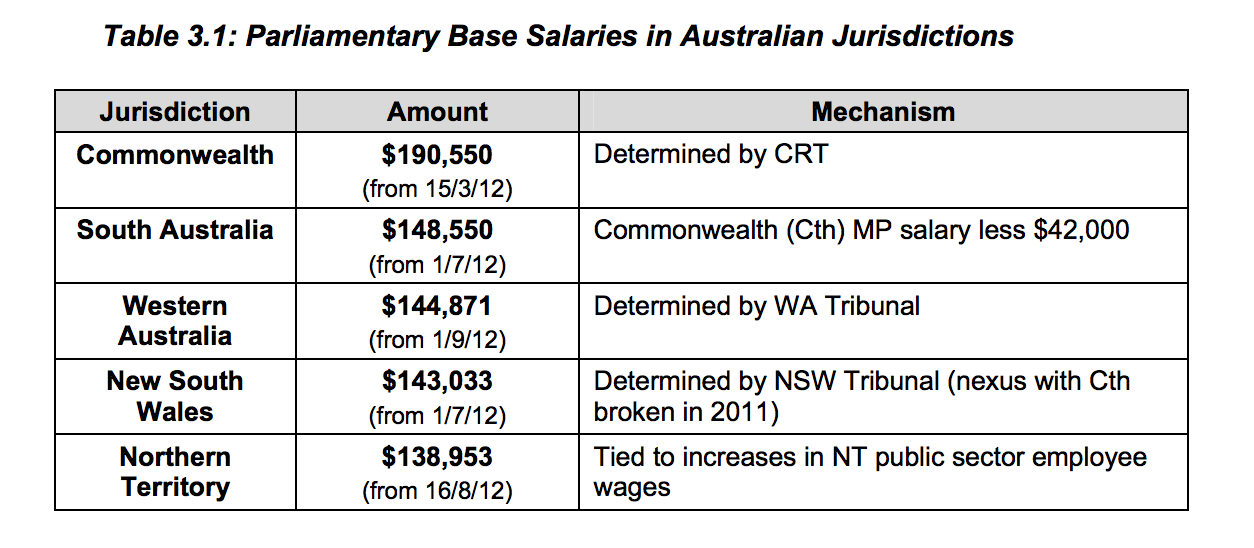
The following table is taken from a recent report in parliamentary salaries in Victoria. Since then, pay rates have been hiked for inflation once or twice.

MP pay

Politician pay is a fraught issue. The annual pay rises create a furore in the media, especially during times of budget stringency. It got me wondering if there might be a better way.

What if politician pay were anchored to something that we can all believe in? What if politician pay was somehow linked to how well the rest of us are going?

This could be an effective way to not only manage the PR aspect of politician pay rises, but to properly align their incentives with our own.

Here are some anchors we could use, for starters.

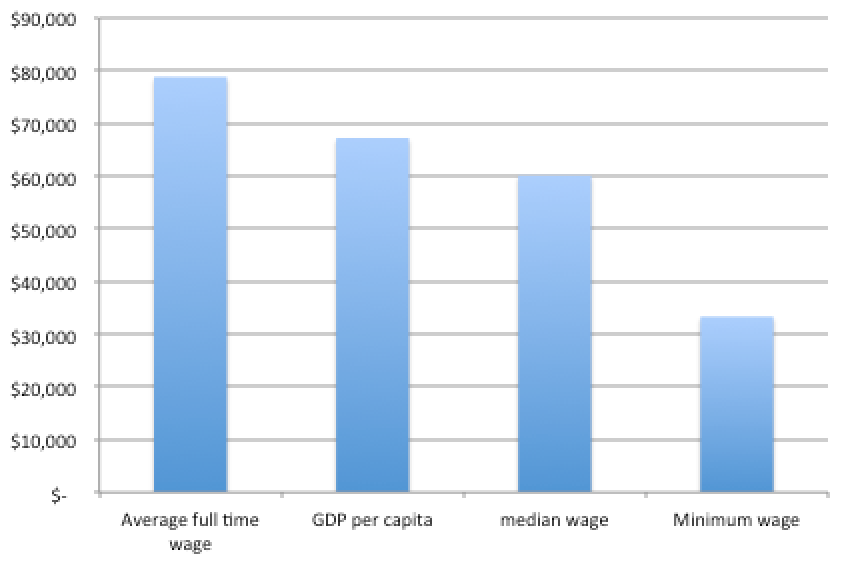
Average annual full time earnings (for the employed) is $78,821, GDP per capita is $67,218. The median wage is $60,112, and the minimum wage is $33,327.

Pay packets
Pay packets

There is a case to be made for paying politicians well, in order that they are not swayed in their duties by fat brown envelopes, or promises of lucrative employment after their retirement from public life. Generosity also prevents the other problem you get when you pay peanuts – you get the homo but not the sapiens.

So while it is tempting to say that politicians should be on the median wage, it may not be practicable.

Instead, a bundle of all of the above might make a sensible balance. If you add the four categories together, and multiply by 0.8, you get  $191,580 – a number that roughly approximates current politician pay.

You could easily argue, at this point, that this pay structure is entirely mis-focused and materialistic, and if we’re going to have performance pay for MPs it should be linked to a far broader basket of KPIs, including a rating of the health of the great barrier reef, carbon emissions per capita, spotted numbat populations, ambulance waiting times, NAPLAN testing results in western Sydney, etc, etc. I’d totally support all of that.

At this point, it’s worth mentioning that I really do not think any sort of MP pay reform is worthwhile without sorting out entitlements, which are absolutely arcane and create a culture where MPs are disproportionately focused on getting the public to pay for bookshelves and travel allowances.

Is this a good idea? What would you suggest putting in the mix to align politicians’ incentives with our own? Leave a comment below!

* Please feel free to use the comments section to nominate precisely who you believe is Australia’s lowliest federal backbencher.

Supply and demand for city views? The economics of skylines.

A skyline is one of the most iconic things a city can offer.

best skylines

Great skylines are rare – New York and Paris have terrific, unique skylines. But most cities are just a cluster of square towers.

Melbourne’s skyline, from many angles, is a classic example. Nice in the right light, but far from distinctive.

skyline 1

Melbourne’s more iconic features (Arts Centre Spire, Wheel, Bolte Bridge) are hard to get in frame with the CBD.

skyline melb


The Eureka Tower – Melbourne’s tallest building – isn’t a great building to my eye, but it is so prominent that it is now a feature in tourist mementoes.

tea towel

Skylines are a classic economic problem. The benefit of the skyline accrues not the to building’s owner, but to the people who gaze upon it. These are externalities, and so the market for a city skyline is clearly subject to market failure.

skylines


Worth mentioning – these external benefits are more than just warm fuzzy feelings. There is a reason houses on top of hills sell for a lot more. “City views” is a magic word in real estate.

When a building owner decides to make another 25-storey square grey tower, they’re not thinking about the city at large. What is most profitable for them is not necessarily what’s best for the skyline.

London’s Gherkin, Shanghai’s Pearl TV tower, Beijing’s CCTV building are great examples of where a bit of financial largesse has made for amazing, distinctive buildings. But the two Chinese buildings were not the result of market forces. And the Gherkin was put into receivership earlier this year.


Can the market deliver a great skyline?

The Eiffel Tower was not a result of market forces. Neither was the Statue of Liberty.  The Empire State Building was privately built, but that was in the 1920s, when market failures were left free to thrive and vast fortunes were sloshing around New York. Then, a handful of wealthy new Yorkers could afford to put up a signature building that would lose money for its first 20 years.

Will the sharpness of modern market forces deliver us only the drabbest lumps to adorn our horizons? If so, that’s truly a shame.

There has never been a better time to kill negative gearing.

Talk about killing negative gearing is like elevator music in our national debate. It is ever-present and we’ve tuned it out.

But there will never be a better time than now to rip negative gearing from the tax code. That’s because right now investor activity in the housing market is a major macroeconomic problem.

The RBA would love to cut official interest rates – if it weren’t for the strength in housing. It is worried trimming the interest rate even more could create further mad results, like this terrace house around the corner from me that sold for $1.96 million.

This is what Glenn Stevens said last month.

“A situation where:

  • prices have already risen considerably in the two largest cities (where about a third of our population live)
  • prices are rising, at present, faster than income by a noticeable margin, and
  • an important area of credit growth has picked up to double-digit rates,

should prompt a reasonable observer to ask the question whether some people might be starting to get just a little overexcited.”

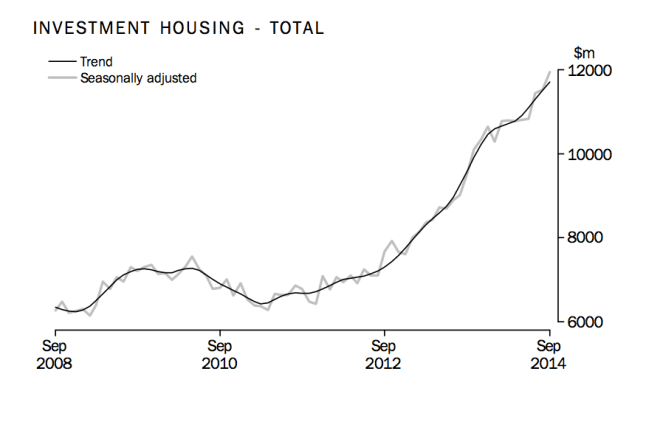
The strength in housing is very much on the investor side, not the owner-occupier side.

investment housing
Source: ABS catalogue 5609.0 Housing Finance Australia September 2014


The share of lending going to investors is at historic highs.

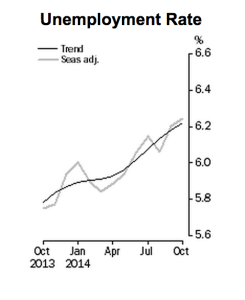
And the rest of the economy is in a morass with unemployment moving sluggishly higher.

unemployment
Source: ABS Catalogue 6202.0 Labour Force, October 2014


If the strength of the housing market was more in line with the rest of the economy, rates would fall like a tonne of bricks. Reducing investor demand for housing could give the RBA the freedom it needs to cut rates to the point where the economy picks up.

rates, unemp
Traditionally, if the red line is rising while inflation is controlled, the RBA will make the blue line fall. But house prices are impeding them. (Data: RBA. ABS Labour Force)


In summary, this is what the experts call a policy window.

If there was ever a time where scrapping negative gearing (on existing homes at least) was going to fly, it would be when the topic is macro-economically important.

Negative gearing has haunted the Australian policy landscape since 1985, doing much to enrich property investors while having an altogether ambiguous effect on the social outcome it was designed to address – housing affordability

A brave treasurer would reach back to the Henry Review and say, ‘ in order to reduce the policy bind the rba finds itself in, it’s high time we looked at this recommendation.’

The Treasurer would find plenty of backing in the Henry Review. It did not argue that cutting negative gearing would cause an immediate reversal in house prices. But it did point out that the policy represented a big fat subsidy, and recommended something a lot more modest.

“When negatively geared, asymmetries in the treatment of expenses and  receipts give rise to a more favourable treatment (see Chart A1–20). This asymmetry ranks  amongst the greatest tax induced biases to the savings choices of households. “

henry graph negative g
Source, Henry Review, page 419

The beat of the drums against negative gearing will never be louder than now. Let’s see if policy makers can hear them.

Victoria is cold on the Liberal Party – what can they can do about that?

The state government of Victoria lost power this weekend. The election saw their narrow majority reversed, and by losing government after just one term in office, they set a record. No other government has done that since 1955.

Since Jeff Kennett’s reign as premier from 1992 to 1999, the Coalition’s appeal to the electorate has been slight. They’ve lost elections in 1999, 2002, 2006 and 2014, some by big margins. They won in 2010 by just two seats.

The state is lurching away from the Coalition. (The Coalition is an alliance between the large city-based Liberal Party and the smaller, country-based National Party).

coalition blue

The Liberals can console themselves with a decent-looking result in first-preference terms (766,000 votes to Labor’s 820,000 on the count so far). But there are plenty of voters that do not put Labor first whose vote ends up with them thanks to the magic of preferential voting.

greens first preferences

The Liberal party do not have an equivalent. The Nationals operate mainly in different areas to the Liberals and are in any case a smaller, less popular party. The Greens took 11.2 per cent of the vote in 2014, to the National Party’s 5.6 per cent.

The whole state is lurching away from the Coalition. It’s not just the Greens. The National party are losing seats to Independents all over the bush.

Faced with this remarkable recent record of underperformance, The Liberal party can either follow the population or fade into irrelevance. They need to tack to the centre to become believable on key issues for voters at state elections, like schools, transport and hospitals.

The choice of a new leader will be essential in remaking the party. In some ways, the selections on offer look good: An man in his 30s of Ukrainian descent or a prize-winning lawyer known for his pro bono work . But Matthew Guy is a former staffer to Jeff Kennett and an unpopular planning minister while Michael O’Brien is a former adviser to Peter Costello.

These two are the front-runners for Liberal leadership. If you keep building a new house out of the same bricks, there’s a limit to how much better you can make it. And when you can narrow down your field to two senior cabinet ministers so soon after a crushing defeat, it indicates a “steady as she goes” attitude. Perhaps the Liberal party is unable to reform itself, and the voters will have to do it for them.

The most important question in our economy: Why will we invest in housing but not business?

The Australian economy is not growing fast enough. Everyone knows it, but we’re in a sort of paralysis, watching the unemployment rate rise.

Consumer price inflation is under control. Normally the RBA would simply cut interest rates, because they’e not impressed with the economy – not one bit. Here’s what the RBA Governor said last week:

“There are sufficient spare labour resources such that we could probably enjoy a couple of years of non-mining sector growth somewhat above its trend rate before we needed to worry too much about serious inflation pressure.”

Basically he’s saying he sees a lot of slack out there, and capital investment is not quite high enough to tighten it up.

ABS capex

So why don’t they act to cut rates? The answer is that house prices are going gangbusters, especially in Sydney,

“Prices have risen in all capitals, with a fair degree of variation: the smallest increase has been in Canberra, at about 6 per cent, and the largest in Sydney, at 28 per cent… a bit more of the ‘animal spirits’ evident in the housing market would be welcome in some other sectors of the economy.”

If they cut interest rates to boost the economy at large, they run the risk of pumping yet more air into the housing market. Because the RBA sets the interest rate but can’t control where investment is made, they are stuck sitting on their hands, hoping something changes. What they really want to see happen is investment (capital spending) in the business sector.

“for accommodative monetary policy to support the economy most effectively overall, it’s helpful if pockets of potential over-exuberance don’t get too carried away.

Turning from housing investment to investment more generally, a more robust picture for capital spending outside mining would be part of a further strengthening of growth over time. Some of the key ingredients for this are in place. To date, there are some promising signs of stronger intentions, but not so much in the way of convincing evidence of actual commitment yet

So while the RBA is in wait and hope mode, we might as well ask why?

Why do Aussies believe buying a flat and holding it for five years will bring us a return, while having grave doubts about the wisdom of opening a panel-beaters, or a cafe, or a farm?

The obvious answer is that we have higher expectations of return from housing than from investing in businesses.

But that is a sort of truism. It doesn’t really give us anything to latch onto and think about. Let’s try to break it down. Here are seven theories of various plausibility on why Aussies might think housing has a better return than investing in business.

1. Pessimism

This topic got quite a bit of air time from a speech just last night by the man seen as the next Governor of the Reserve Bank, Philip Lowe. He talked about the way the community felt uncertain while coming out of the GFC.

“It is important that we guard against the possibility that this uncertainty mutates into chronic pessimism – that is, for it to become normal for us to think that our prospects are limited. If this were to become our normal mindset, then we would be well on the way to finding ourselves in the very world that we feared.”

I’m not too impressed by talking about pessimism, because even if it is 99 per cent of the explanation, it’s not under the control of policy. Better to focus on the 1 per cent you can control.

2. Risk perceptions:

It’s easy to turn a million dollars into zero in business. The survival rate is not that great. Of the businesses extant in 2009, 37 per cent were gone by 2013.

Not so in housing. Houses survive very consistently and you’re far more likely to turn $1 million into $1.1 million.

RBA house prices

The quick remedy to this is a catastrophic housing collapse. But the good remedy is much harder and more difficult to engineer – better returns to business.

3. Structural change

The flux in the economy recently has many sources, not least the internet, but also globalisation. That makes investing tricky. How to choose the right sector to invest in? Media, finance, manufacturing and retail all look suspect.

If leading businesspeople have experience in sectors that are dying, you can not expect them to invest. It’s hard to expect all that slack to be taken up by the people with experience in organic foodstuffs, professional service or biomedical industries, because they are starting off a much smaller base.

4. Tax structures

Hello negative gearing. Your moment to be led to the chopping block may be nigh.

Given everything that’s happening, do we need more incentives for investment housing, especially for existing properties?

And what about the other side? Do we need lower taxes on business? Could the next CSL, the next BHP or the next Woolworths currently be a medium sized business with a growth plan in the top drawer? What is preventing the owner from making that growth a reality?

6. Pale pink in tooth and claw?

Australia is a country where it is great to be middle class and where Clive Palmer is a dickhead. Why would you even want to be loaded? Alan Bond, Chris Skase, Gina Rinehart, Nathan Tinkler. I’m struggling to come up with a memorable business person that people might see as a hero. Could that be crimping my generation’s desire to risk it all to top the rich list?

6. FDI

Even if Aussies are pessimistic, why isn’t foreign investment picking up the slack? Do they know something about us?

7. The dollar

The Aussie dollar has been ridiculously high. With the mining boom over, it has gone to tumble-town, and hit a four-year low overnight, around US85c. That could be the spark needed to get the economy going again. The RBA must certainly hope so.

Class and privilege on the 10.15 Hurstbridge train

I was on the train last night at about 10.15pm, heading home from the city.

Ticket inspectors got on. So I reached into my pockets to grab my Myki.

I held it in my hand as the ticket inspectors went up and down the carriage, checking left and right, until they came across the two women sitting opposite. The two women, aged perhaps 25 and 45, had just rushed onto the train at the last minute before it rolled out of Flinders St Station. Other than that little flurry of activity I hadn’t noticed them.

But the ticket inspectors zeroed in. At least one of the ladies did not have a ticket. They remained in remarkably good spirits throughout the encounter, insisting that they normally touched on. “Is he reading me my rights?” the older one joked. “Feels like being at the cop station,” the younger one laughed. And a little bit later she told the ticket inspectors, “I just got out of jail!”

I worried about these two ladies being able to pay the fine. Probably, I imagined, they wouldn’t and would end up in court. Probably, I imagined, the presiding judge would sigh when they saw the long list of priors.

As the inspector wrote out the last few details on the ticket, the older woman got a bit snarky. “Do you get off on this?” she asked, pointedly. “I’m just doing my job,” the inspector said, in a voice that was controlled and milky-mild.

Whether inspectors really enjoyed checking tickets, or were simply doing their job, you’d think they might have checked mine.

Ticket inspectors were milling around everywhere. Three were talking to the women opposite while the rest checked the other passengers. But not me. I sat there with my Myki in my hand, even making eye contact with one ticket inspectors who was leaning against the wall, but it seemed none of them wanted to see if I’d touched on. (I had.)

I was wearing a suit. My partner and I had just been to the art gallery to see an exhibition. We’d been guests of a company that sponsors the gallery. They had served food and drink before letting us loose into an after-hours visit. We were grateful for the night out and we enjoyed the exhibition.

“Aren’t we lucky to get to see this?” we said. But it may be even luckier to have people look at you and assume you’re not guilty.

So what’s the lesson? Life’s easier in both obvious and subtle ways when you’re from a privileged background. It’s worth remembering.

Why are there puppies in toilet paper commercials?

Toilet paper is a consumer brand that has been around for over 100 years. The basic product proposition has evolved very little, and the marketing is a tricky issue. You can’t really depict the product in use, or even go into detail on its performance!

Luckily, marketing often works best when it ignores those issues and uses metaphors to talk to people. By the 1920s, the Scott company had a mascot called Mr Thirsty Fibre. As you can see, he’s a fighter, (tough) but made of loops of paper (soft!).

Screen Shot 2014-11-24 at 9.45.55 am

Fast forward about 90 years and the basics of TP marketing are basically the same. You’re selling the idea of softness and strength. But the metaphor chosen is different. It’s a puppy.

Screen Shot 2014-11-24 at 9.22.48 am


In the 20th century, the whole science of meaning-making blew up, with experts like Chomsky and Lakoff exploring how humans make meaning out of language and symbols.

Keen students of this evolving science  were the “Mad Men” – advertising executives. And so it was that advertising gave up on lengthy texts:

Screen Shot 2014-11-24 at 10.14.21 amIn favour of signs and symbols that any semiotician can tell you are just as easy to interpret. Especially if you’ve been subject to a barrage of advertising your whole life.

Puppies are softer than a full-grown dog but still strong. They are not scratchy like a kitten might be – in fact puppies may be the perfect TP metaphor.

Screen Shot 2014-11-24 at 9.24.50 am

While Kleenex chooses a cute yellow puppy, Purex goes for a brown, wrinkly one. Are they trying to convey what I think they’re trying to convey? Best to not think about that too much.

But the toilet paper market stands on the brink of a revolution. Kleenex are trying their best to break the habits of a century and sell us a new product, called Flushable Cleaning Cloths

Screen Shot 2014-11-24 at 10.18.35 am

This is basically moist towelettes for the bathroom. But they’ve given up on metaphor. The marketing message is wordy and long.

If they are keen to convey the need for water to really clean, they needs to use something that is wet and clean as a metaphor. If they don’t want to leave the animal kingdom, I might suggest a dolphin.

Screen Shot 2014-11-24 at 10.30.18 am


Aren’t dolphins more or less the puppy of the sea?

Another thing that seems synonymous with being clean and wet might be a car.

Screen Shot 2014-11-24 at 10.29.18 am

In fact, sn advertising campaign where a smirking guy drives around in a just-washed car while everyone else drives around in a car they’ve tried to wipe with paper might be exactly the marketing message that Kleenex needs.

The ABC should be slashed. But not like that.

The Industry Minister stands up to make his announcement:

The federal government is going to set up a car making company, and give cars away for free!

This would be a highly controversial policy. Consumers would be pretty excited, car-makers would be furious, and economists would probably mutter darkly. It doesn’t seem like a good idea.

But there is another struggling industry where the government supports a competitor that gives away product for free.

Media.

As Fairfax and Crikey and all the rest struggle mightily against falling revenues, the ABC and SBS continue to send reporters to news conferences, run documentaries, and blast pop music across the radio spectrum.

This is also controversial, but mainly among News Limited journalists. They’ve cried wolf on government policy so many times they have lost all credibility. But that obscures the few times they ‘re right, including now.

There are important economic differences between cars and news. Unlike cars, News has positive externalities and economies of scale. Both of these mean that news may be under-delivered by the market.

But notice I say news. I do not argue media in general has positive externalities.

There are heaps of things the ABC does that should stop, immediately. If it continues, it wastes its own money, (i.e. our money) and also hurts the profitability to other media outlets.

When the ABC broadcasts the Socceroos match versus Japan, as it did on Tuesday night, that’s not so different to Channel 7 broadcasting the AFL. There is no market failure here to correct. The ABC ought not touch it.

If we look at this evening’s prime time, we can see that the ABC is pumping out a range of programs, including some for which there is no justification and others for which there is a burning burning need.

ABC schedule


If I had to rank the top five programs on the list, that the ABC should be investing more and more in, I’d nominate

  1. 7.30. Because democracy demands our society be examined and our politicians be held to account, and the market is more interested in entertainment.
  2. ABC news. Because we need to know what’s going on in the world in order to understand it, and the free-market stations are more about pleasing us than informing us.
  3. Fireman Sam. Developmentally appropriate kids programming without huge commercial tie-ins is always going to be a market shortfall.
  4. Catalyst. Science programming on the free-to-airs consists primarily of cheetahs running down niboks and tearing at their flesh. Nice to have, but not all the time.
  5. Lateline. You need all the opportunities you can get to grill politicians in front of an audience.

If I had to rank the bottom five:

  1. The Tonight Show starring Jimmy Fallon. This show is so excellent. Just yesterday I watched Fallon impersonate Bono. It was incredible. Dude has TALENT.  Not a market failure.
  2. Peep show. How funny is David Mitchell? I laugh til my head falls off when I watch this. Not a market failure.
  3. The Drum. Is there  a shortage of opinion on TV and radio and the internet? Holy Mother of God, No! Not a market failure.
  4. QI. Is Stephen Fry the most popular man in the world? Probably. Not a market failure.
  5. Upper Middle Bogan. The commercial stations have very little comedy except Hamish and Andy, but the ABC tries to more than make up for it, with The Moodys, Chris Lilley, The Chaser, Micallef, Please Like Me, It’s a Date, and Soulmates. Whew. Probably, they are more than meeting demand.

Is some of this just cheaply bought-filler? Maybe. But ABC 3 shows us there is something cheaper than filler. And that’s closing down for the night. The ABC should consider doing this.

Now, if it is done strategically, buying a popular program to run into something worthy could boost the ratings of the worthy show. For example, Spicks and Specks is hilarious and fun and very popular. But what follows it is not four corners, it’s the Tonight Show with Jimmy Fallon.

The ABC should probably trim down the wildly expansive website and chuck out a bunch of radio stations too. Do we need Double J? It is my favourite station, incidentally, but I don’t ask the government to provide me with the hit songs of my youth. I could get a Pandora or a Spotify account instead. Ditto for Classic FM.

What the ABC should do is slice away all it sports coverage, a lot of its light entertainment, a bunch of music stations and do as much more hard news as it can. It is not important to fill three TV stations, dozens of radio stations and a really enormous website, if you’re filling it with fluff. I

It’s important to turn over the stones that the free market will leave untouched. The NSW ICAC shows there are huge numbers of extremely illegal and controversial things happening every single day. Good reporters could hunt these issues down before it’s too late.

The money that the ABC would save should be spent like this

  • Give Leigh Sales an hour to fill every night.
  • Give Lateline another four reporters.
  • Put Four Corners on two nights a week.
  • Resource Media Watch properly.

So I’m all for slashing the ABC where it treads on commercial toes unnecessarily, but only in order to build it up where those commercial toes fear to tread.

The best way to fix Australia’s road and rail might be out of left-field.

Australia has a problem with Infrastructure. We keep building the wrong things.

We spend a huge amount of time developing proposals that have benefit cost ratios less than one. Then, for want of alternative proposals, we turn those proposals into reality.

There are many reasons for this – politicians serving certain electorates, powerful lobby groups, bias to action, and inability to fix infrastructure through pricing .

But part of the problem is a lack of options. We build the East-West tunnel in Melbourne because it is the only idea that’s been properly developed and discussed. We put Sydney’s new airport at Badgery’s Creek because it’s the one location that has been kicked around for years. We plan a light rail line up the middle of Canberra, because that concept has been publicly flogged since Burley Griffin.

To find one great infrastructure plan, you need to discard 99 good infrastructure plans. But Australia doesn’t have 99 to throw away.

There’s a lot of talk about developing a “pipeline” of infrastructure ideas. But politicians are very risk averse, and big infrastructure companies don’t want to waste money on business plans. So our pipeline is the diameter of a carpet python, with a couple of big lumps where it has been fed an approved mega-project.

Computers could do this part.

Infrastructure Australia was set up by the Rudd government to try to help develop a pipeline of ideas, and independently test them. But it only has a few staff, and its leader was recently fired by the Abbott Government. Just as that was happening, he took a stand, publicly saying ”Entrenched truculent bureaucracies have impeded progress… It has been heard that some good ideas cannot go ahead because they would set ‘precedents’. Among other things, this implies knowledge of, but unwillingness to address, widespread deficiencies. Such wilful attitudes test the patience of our elected masters, industry, and the public.”

Even with this courageous bureaucrat in charge, the old Infrastructure Australia was unable to renew the infrastructure planning system. With his blood all over the carpet, the new Infrastructure Australia is cowed.

Even if it makes our political leaders uncomfortable, Australia desperately needs a truly independent infrastructure development and analysis capacity. But how?

I think the answer is not a bureaucracy. I think the answer is by using technology. The same technology that has helped humanity create the biggest encyclopaedia in history and a hugely detailed map of the entire world.

A Wiki.

Imagine a website where you can start a page for any infrastructure project you might dream of.

  • You want to extend a train line by a few kilometres? Start a page with a description and a map.
  • You want a helicopter pad installed at the local sports ground? Start a page with a project description and a map.
  • You want to build a very fast train between Melbourne and Brisbane? Start a page with a project description and a map.

Each page would be able to be edited by absolutely anybody. There would be a section for environmental impacts, a section for cost estimates, a section for estimating time for planning and building, a section for land-use changes and implications, a section for creating a cost-benefit analysis.

flinders st w bikeMost pages would be the hare-brained schemes of the lone wolves of suburbia. The pages would be underdone and silly. But by asking the community to rate each page, the better ideas would attract contributions from a range of talented people and rise out of the muck.

This could bring unforeseen solutions out of obscurity.

For example, when I was writing about the ridiculousness of the state government’s plan to put a new railway station in South Melbourne, right on top of an existing tram stop and miles from the new development it ostensibly serves, I found in the depths of the internet forums the suggestion that the problem could be solved better with a train line that runs from north-east to south-west.

Fisherman’s Bend should be on a new line from Merri (Northcote) to Newport (Wydham Vale – Mernda line).”

This idea may have a cost-benefit analysis ten times better than all the existing plans. But how would we know? There is a choke-point for shining light on new ideas, and its name is the Department of Transport. Risk-averse and slow-moving, DoT can only be expected to properly consider a few ideas that it thinks the government is interested in.

Choosing between a big group of well-developed projects that each have a range of intriguing benefits and positive cost-benefit analyses is going to be difficult, politically. But it’s a better problem than the one we have now, which is a small group of infrastructure plans that mainly look like wastes of money. (I refer here to Melbourne’s East-West tunnel and airport rail, but an honourable mention should go to the plan for a very fast train up the east coast)

If you want to find one project with a cost benefit analysis good enough to build, you need to look at 100 or 1000 projects across the country. The current pipeline is starved of proposals, so it is no wonder the infrastructure policy space is so sickly and anaemic.

train pic b and w

PROBLEMS:

1. The majority of analyses on the wiki would be defective. But the community should privilege the ideas that have the most potential and these should attract rational people to contribute. I expect projects will be submitted with wild underestimates of their cost, and there will be a push by more rational people to actually use cost estimates that reflect realistic Australian pricing. On the ‘discussion’ pages  I imagine there would be fierce argument about why it is we can’t have projects delivered at the prices that apply in China, America, etc. Projects with decent estimated benefits should be most willing to use realistic pricing.

2. Monorails and personal rapid transit. It’s going to be hard to keep really wild ideas out of there, but perhaps that’s the point.

3. Splintering into too many pieces. Every little change in a proposed plan (should this freeway have an exit here or here?) would potentially lead to a new page being created, with a new set of costs, environmental impacts, etc, etc. Conventions and rules may need to be developed to guide when a change is big enough to warrant a whole new entry. But wikis are good at developing cultures and rules that make them effective.

4. The whole thing would be at risk of being ignored if there was no suggestion governments would at least look at it. The project would be a really great thing to seed with some official resources, for example, freely available mapping software for wiki users to use, some models for doing traffic and demand forecasting, recommended ranges for cost per kilometre of roads, bike lanes, tram lines etc. I’d like to see it hosted at infra.wiki.gov.au to give it a sense of official imprimatur and encourage involvement. Perhaps the government could loose a few bureaucrats or pay a few infrastructure experts to play with the wiki to get it started, anonymously having them make edits and bring in a bit of rigour.

So, is this a good idea or a mad one? Is there some aspect of wikis I have overlooked or some problem I’ve not foreseen? Leave a comment below or hit me up on Twitter!

 

Should we tax and subsidise foods?

I’ve been thinking a lot about diet. A doctor changed my regimen just recently and I won’t go into details, except to say that I may have had my last pasta carbonara. Ever.

pork belly sandwich
farewell to you too, pork belly sandwich.

Along with all the time I’ve spent reading labels in the health-food aisle, I’ve been spending time reading about how food affects the human body.

I’ve always considered myself a pretty well-read and savvy guy. I think about food. But there have really only been two things I thought about.

  1. Eating the right number of calories.
  2. Eating fruit and vegetables.

You can see a little example of what I was eating in 2010 at this link:  Lots of fruit, some vegetables, but also lots of chocolate and chips and booze.

tomakin parma
I look at this photo, I see salad.

My diet today is pretty different. One of the things I’ve been reading a lot about is gut bacteria. There is a big link from the bacteria that live in your gut to your overall health. The bacteria do a heap of really important work (like protecting against allergies), and can cause major health problems, not limited to gut problems. They may be involved in a lot of mental illnesses and multiple sclerosis. 

The gut bacteria also respond strongly to diet, so you can change the populations in there by eating differently. But that’s not all. They also help change your dietary choices! So you could potentially create a cycle where you start feeding bugs in your gut, instead of feeding your own body.

The big point I’m going to make in this post is that science keeps moving on. It’s amazing how little we understand about nutrition. Some vitamins were discovered within the last century. And the science remains sketchy on whether vitamin supplements help or hurt people.

If I were designing a tax and subsidy scheme for food, and it was 1990, I’d probably have subsidised low-calorie cola, following the principle that fewer calories are better.

But in 2014 science has found evidence that diet coke changes your gut bacteria in a way that induces glucose intolerance. And advice has changed on wine, chocolate, cholesterol, coffee, bread, etc. The history of nutrition advice is a turbulent one.

I increasingly believe that eating better is a good idea. But I’m also aware that trying to fine-tune people’s diets leads to a risk of making a scientific mistake.

And that’s even before you look at the chance of making a policy mistake. Even for foods that are clearly and unambiguously unhealthy, you need to understand why people eat them before you can succesfully make policy that helps people not to choose them.

This great story from the Atlantic The Inconvenience of Salad covers off on a few of the traps that policy makers fall into.

For example, the idea that the problem is availability of healthy foods – the ‘food desert’ concept. That idea did not get support from a study in Philadelphia, where scientists eagerly tracked fruit and vegetable consumption after the opening of a local store. They found it had no impact.

The Inconvenience of Salad is a really nice feature that follows around a young guy who has opened a business putting salads in mason jars, putting the mason jars in vending machines, and putting the vending machines out in public.

salad vending

The vending machines have to be stocked every single day and I fear the nice young dude who has ploughed his life savings into this venture will be broke soon. In the article he appears to be mortally shocked when someone describes salad like this

“It’s just nasty to me; it doesn’t agree with my taste buds.”

While I was reading the article I kept thinking that the US should subsidise this guy. But then I tried to take a step back. How sure am I the science won’t change? How sure am I the subsidy will make a difference to behaviour?

The answer in both cases is I’m fairly sure. But not certain.

There is a big natural experiment in Australia. We actually do tax (most) processed food but fresh foods are not subject to the GST.

Despite this, I am yet to see a single study showing that the 10 per cent tax difference between the two has led to any change in diet, or in health. Has the study not been done for lack of data? Or because obesity has been rising so fast researchers fear what they might discover? If anyone is aware of such a study, please bring it to my attention!

Does money buy happiness? I say yes and so does the data.

The top article on the Wall Street Journal at the moment is about whether money can buy happiness.

The conclusion is it can, but only if you use it right.

Money makes you happier so long as you resist the urge to buy things with it. The article quotes Psychology professor Ryan Howell:

“”What we find is that there’s this huge misforecast,” he says. “People think that experiences are only going to provide temporary happiness, but they actually provide both more happiness and more lasting value.” And yet we still keep on buying material things, he says, because they’re tangible and we think we can keep on using them.”

Experiences are also more fun to anticipate, according to research, which might explain why my facebook feed is full of people counting down the days to their holiday, not counting down the days until they buy a new TV.

“[W]e also get more pleasure out of anticipating experiences than anticipating the acquisition of material things. People waiting for an event were generally excited, whereas waiting for material things “seemed to have an impatient quality.””

The research also suggests happiness comes from having more time to spare. The article cites work by Associate Professor of psychology Elizabeth Dunn.

She’s currently doing research on how people actually spend the time they save by outsourcing tasks and whether it makes them happier. The preliminary findings, she says, are that most people do become happier by buying time for themselves, but only if they use the time in the right way.

“Our hypothesis is that people will be much more likely to derive an emotional benefit if they think of it as ‘windfall time’ and use it to do something good, rather than just taking it for granted,” she says.

But while buying time is a good idea, putting a dollar value on your time may not be. In another piece of research in progress, Prof. Dunn is finding that when people think of their time as money, it makes them less likely to spend even small amounts of time on things that are not financially compensated. “Seeing time as money may have a number of destructive consequences,” she says.

I find these findings really resonate, because I think I have used the small amount of money I have to maximise my happiness.

I don’t have many material possessions to speak of. I share a 20 year old car with my partner and I have two second-hand bikes. My most valuable possession is probably the laptop I type this blog on.

The point about time is crucial.

People who know me know I work full time only part of the time. Twice I’ve quit very nice jobs and invested my time into this blog instead. Probably, some people wonder how I do that, so I’m going to explain. It’s somewhat gauche to talk about money, I guess, but here goes.

Mostly its good luck (of many different kinds), but partly, it’s because I’m a good saver. I keep an eye on recurrent expenses. For example, between 2005 and 2011, the highest weekly rent I paid was $120. I avoid gym memberships and insurance. I don’t drink much. That means when I have a paycheque, I save a lot of it.

For example, I saved about $15,000 a year while working at Treasury from 2005 to 2008. I started on day one with a $6000 debt on my credit card and finished on the last day with $40,000 in savings. (During that time, I also worked a second job as a ski instructor which mainly prevented me from spending money, rather than actually making me much.)

I don’t take credit for most of my good fortune. My run of luck goes a long way back, to being born in the right country and having the right parents, getting sent to a good school and stumbling into a good university. But also getting the in-kind support that comes with being middle-class (such as living at home during university and for a couple of patches during my 20s; or my sister giving me her car to borrow for a number of years.) I also made a lucky series of investments in the midst of the GFC, blithely following the motto of being greedy when others are fearful. The fact that turned out well was dumb luck, really.

That has meant I have a small buffer that means I can choose to spend my time on things other than full time work (for a little while at least). I really enjoy being the master of my own time.

I do, however, spend money on experiences. I travel overseas a lot. I go to see live music. I eat at restaurants most weeks. These things are amazing and they definitely make me happy. But they sure aren’t free.

There is a trade-off between being master of your time and a big consumer of experiences. This fact will inevitably send me back into the full time workforce at some stage!

You’ll never guess what happens when you give public servants less work to do.

They do a better job on the remaining work.

A giant study from the US has compared the output of state supreme court judges. It finds that when they have a lower workload, judges write longer judgments and the quality of those judgments is higher, as evidenced by them being cited more often in subsequent judgments.

The study looked at what happened  after the introduction of an intermediate court which reduced the workflow of the state supreme court judges to find out what would happen. The conclusion is that the judges have intrinsic motivation.

Consistent with other theories of motivation, the research found pay rises increased work performance, but only in those states where the judges choose which cases to hear.

“This suggests the importance of control over the work environment in the operation of intrinsic incentives.”

But the judges were not always at peak performance, with regular dips in output every few years. Those dips were associated with judicial elections.

In the US, judges have to be re-elected, which forces them into distracting process of campaigning. But how often that process comes around is relevant to their performance.

“We find evidence that in the year a judge is up for re-election their performance falls, consistent with the hypothesis that campaigning takes time.”

Less frequent elections turn out to be better for judicial output.

“In our sample, we find that a judge responds to a term length increase with higher-quality judgments and no decline in output as measured by the number of cases or total number of words written.”

The biggest application of this work in Australia may not be to the workaday public servants that we all know and love, but the high-profile public servants we call politicians.

“Explicit performance pay can crowd out intrinsic motivation.”

The fact that judges are intrinsically motivated suggests pay for performance is unnecessary. Perhaps the same thing could work for politcians. If ministerial and leadership positions attracted no more pay than back-bench roles, might they attract primarily people who are intrinsically motivated? And might that not diminish – even if only at the margin – the amount of backstabbing and scheming that goes in to attempting to be leader? That could only be a good thing.

If intrinsic motivation is sapped by the need to be re-elected longer terms in office could increase the total of quality work done by politicians. That may be why our senators seem on average to be better respected than our lower house MPs – their six-year terms make them a bit more inclined to do steady policy work.

The study also suggests that loading up a minister with a bunch of portfolios that they don’t care about is the wrong approach. For example, having George Brandis be Attorney-General and Minister for arts. Instead, farming out individual portfolios to MPs who want them most is likely to get better results.