Google ad revenue falls – what does it mean for the internet economy?

The internet economy is developing before our very eyes. Is it a gold mine? Looking only at the Silicon Valley Ferraris, you might conclude yes.

Or is it going to destroy value and jobs everywhere? Looking only at the newspaper industry you might conclude that every job that involves storing, processing and weighing information – from lawyers to bankers, doctors to teachers – is in deep trouble.

The internet reduces a lot of costs. As consumers we are comfortable with the concept of zero marginal costs. We breathe the air, look at the views, bask in the sunshine.

But as producers, as workers, we get worried. There are no jobs in the “Air Industry.”

The internet means a lot of work is about to be done at zero marginal cost. You build a system that teaches kids their time tables, you can roll it out across the English-speaking world. Teachers quake. Build a system that retrieves data from legal cases and roll it out across the jurisdiction. Lawyers will quake. Build a system that uses symptom data to develop diagnoses and hospitals will take it up while Doctors rend their garments.

But all this is a long way off.

For now, the internet is a lot simpler. The only industries that have been transformed so far are ones where data is simply displayed, not manipulated. Industries like advertising. 

Google shows you ads all over the internet – in your email, when you surf the web, etc. And this transformation has reaped it a large and growing pile of money. 

Until now.

Google revenues have fallen in all categories in the first quarter of 2014.

Image

Meanwhile, costs rose and operating margins fell to 27 per cent. This was quite a surprise and the stock fell sharply in after hours trading.

Of course Google is still profitable, and Q1 2014 beat Q1 2013, but the movement in the trend provides another data point to support the second hypothesis above, that the internet-isation of our economy will not involve a lot of money.

The internet is just a distribution mechanism. Making information for distribution still takes work, at least for now. But economic theory says the cost of a good will fall to its marginal cost. The predictive power of economics is pretty impressive when you look at how many newspapers are free, how many TV stations are free, and how many movies get pirated.

Whether companies will find ways to get people to pay for information products is an open question.


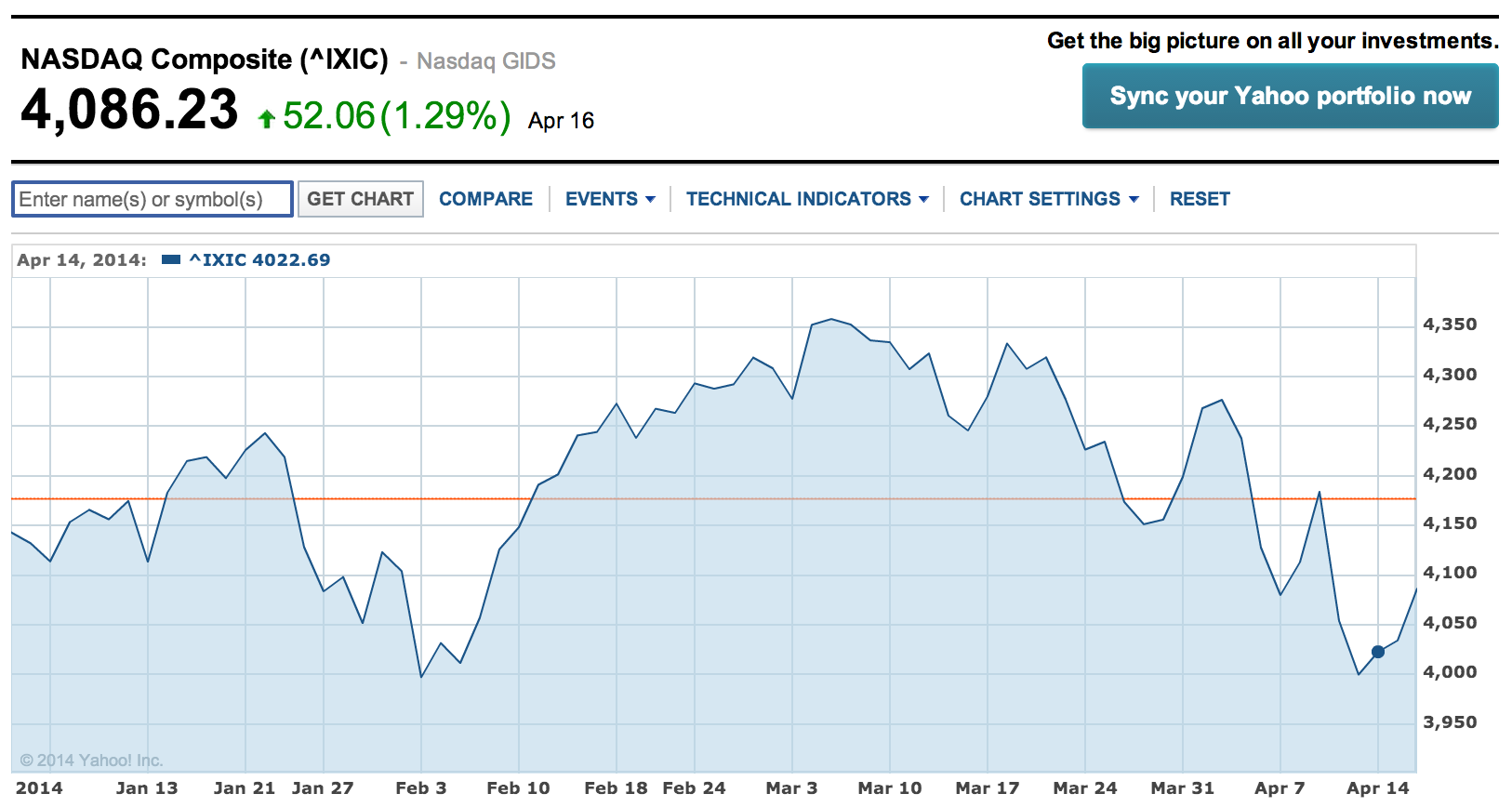
But if the “zero marginal cost” feature of the internet economy proves to be decisive, investors will lose a lot of money. Evolving views on this “big question” may explain why the Nasdaq – the technology stock index – surges and falls with more volatility than other bourses.
Image

Some investors clearly already worry about the profitability of technology companies.

But money is not everything. The world in which zero marginal cost is decisive could be a good one.

Imagine if air was made in big O2 factories, and you had to buy a subscription. Would you be better off, or worse off?

So it could be with a lot of technology. We may be better off in an economy where there are slightly fewer jobs but much more that you can consume for free.

Even if the robots don’t get up to scratch and we need people to make information products for free, will we be able to expect them to do so? Let’s look past the evidence that they will (YouTube, blogs, most short films, most bands, Open Office, a lot of apps, Wikipedia, etc.) to the theory.

The concept rests on the idea that people have a “cognitive surplus.” You can meet your basic needs (food / housing) without using up all your week. Then you have time you can spend doing things that look like work. 

This cognitive surplus may come in a certain phase of life. You may be a child or a student or retired. Or you may have a cognitive surplus because you work part-time, or because you are still full of beans in the evening when you get home from your “real” job.

The you use that cognitive surplus to do things that look, to the outside observer, like “work.”

The fact that a cognitive surplus needs to be defined and explained, really shows the incredible power of one of economics simplest models: breaking your day up into Leisure and Labour. 

The model is pervasive. People use it to do all sorts of calculations about how much they should pay to save an hour of leisure, etc. But it’s also kind of stupid. Commuting is neither leisure nor labor. Neither is washing your work shirts. The category of unpaid labour is invented. For washing the floors, sure. But does it include baking a cake? Digging in the garden? Building a treehouse? You can enjoy unpaid labour.

Slate economics blogger Matthew Yglesias goes on and on about the enjoyment of your job, calling job amenity value the most neglected subject in economics. Of course you can enjoy paid labour too. This is just another way in which the binary “paid labor vs unpaid leisure” model of life is defunct. 


The internet could end up making the leisure/labour model look even more stupid, if people accept they won’t get paid for things that were once deemed work, and do them anyway.

They’re spending their cognitive surplus. Is it leisure or labour? Wrong question.

If the zero marginal cost economy takes hold, quality of life may even go up, because people can consume more. It’s the same sort of change that came upon society when the printing press was invented – a huge decrease in the cost of distributing information, and a lot fewer book-binding jobs for monks, which caused a fuss at the time.(And of course the printing press itself wrecked a few legacy institutions.)

But a zero marginal cost economy won’t wreck the whole economy. There will always be plentiful jobs in things that are not zero marginal cost. Humans need food and housing and transport and always will.

If you’re worried about the rise of the internet, invest in something concrete. Like iron ore mining, or potato farming, or logistics. These industries will continue to sell things, hire people, and make money.  

A surprising thing about Google, and the economics lesson it teaches us.

I learned something surprising about Google this week.

Their spam-filtering software lives an amazing double life.

Image

I’ve known for some time that if you fill in this form (to post a comment on a blog, or whatever), you need only type the number on the right – it will ignore the number in the photograph. That was perplexing.

Then I discovered Google is using us. When you type the number in the photo, that gets sent to Google Maps, where it answers a question being asked by Streetview – ‘what street number is this?’.

This is quite brilliant. They apparently also use this program, called ReCAPTCHA, to decipher words the software can’t untangle when scanning books. So every time you post on a blog, you’re contributing to the quality of streetview, or scanned books.

Ingress by GoogleThe idea is so clever that Google now has software that is entirely designed to trick us into doing work for them.

I am talking about the “game” called Ingress. I downloaded this last week, because it was free and the Google App store told me it was highly regarded.

I opened the app and when it told me I had to “walk” to achieve the missions, I started pinching the screen, tapping, even shaking my mobile device to figure out how to “walk.” Soon it dawned on me. “Walk” meant “walk”. 

The app is designed to collect data on the walking distances, way-finding and walking time between landmarks, especially those which are in pedestrian areas not covered by the Google streetview system. (The game itself is pretty intriguing but also pretty confusing.)

The lesson of all this is the power of a big company – there are amazing things you can do inside a company that you couldn’t do outside.

One of the last century’s most famous economists – Herbert Simon (Nobel Prize in Economics 1978) argued the existence of companies actually showed markets’ weaknesses. (Here’s his great 1991 paper, Organisations and Markets.)

Inside companies, exchanges are based on relationships, not market payments. Unless you get paid piece-work, you are rewarded for being there, not for every article you write, or every ministerial briefing, or every line of code. You do the work because they trust you to do it. You are getting paid, sure, but you trust that working hard now will lead to reward down the line. It’s not specified in the contract.

Every time a company expands, they are saying that they have more faith in using relationships to get the output of the people they just hired, than using the market. The reason is transaction costs. 

Google is a monstrous, monstrous beast. It now has 47,756 employees, and if they are as happy as my friend who works there, they are very happy indeed.

While Google is tricking us into doing work for it via non-market transactions, Amazon is arranging to pay people to do similar work.

They have a “marketplace” called Mechanical Turk, where you can get stuck into the task of diong things computers can’t. Maybe selecting which photo of a landmark is clearest and best, transcribing some audio, or similar.

But it has been controversial. Bloggers complain the pay is too low and the jobs listed are themselves spam, the term digital sweatshop is being thrown about, and the Huffington Post has written about “Amazon’s new underclass.”

But there are many tasks, like completing surveys or any crowd-sourcing task, where low effort from lots of people delivers a better result than lots of effort from a few well-paid people.  Google seems to have this figured out – the market is not always the best solution.

Why Labor should have made equality a key budget figure.

The Budget comes out on 13 May, and when it does, one thing is for sure. Everyone will get in a flap and a lather over the wrong things.

The Budget is a whopping lump of documentation, and many of the people sent to cover it are inexpert in matters fiscal.

So at the end of the day, an inordinate number of stories will be simply about “the deficit.”

It’s one of only a few simple numbers in the whole Budget. Earnings minus Spending, delivering a binary result: Surplus/Deficit. Good vs Bad. It’s quite graspable.

But it is very hard to find experts that care about each year’s budget deficit. (1, 2, 3, 4.)

Forecast deficits are more important, but the actions that need to be taken to get the ship in order long-term are often counter-productive if you want a surplus ASAP.

Stressing over one year’s budget deficit is akin to stressing about the score in a five minute period of a game of football. Sure, the end result is made up of periods just like this one. But experts understand that the game turns over a longer period than just five minutes.

Sometimes you are kicking into the wind, and a deficit score can be okay. Sometimes you run a deficit on purpose, to prop up the economy or grease the wheels of reform.

Raising funds to cover a deficit is easy and cheap at the moment.

Headlines that scream Deficit! and Surplus! – complete with a cartoon of a treasurer either pulling out his pockets to show they are empty, or otherwise evilly grinning and hoarding cash – would be better spent focusing on what matters.

The way to train people’s focus onto certain matters is to measure and report them.

“If you can’t measure it, you can’t (media) manage it,” as they say.

Labor had the opportunity to remake the focus of the Budget, but lacked the foresight.

They could have put the budget balance in size eight font and tucked it away down the back. Obviously you can’t take away the food bowl and expect the media to sit there wagging their tail. You’d need to give them something else.

When in power, Labor could have chosen any number of other measures to make the focus. Productivity, the need for tax reform to fund the NDIS and Gonski, composition of revenue, efficiency of government service delivery broken down by department, or even equality.

Politically speaking, this last one might have been quite useful.

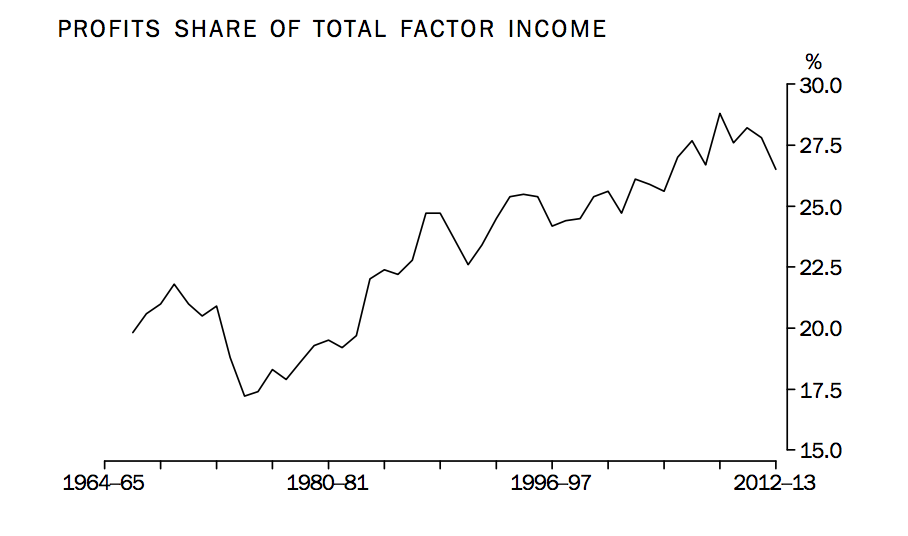
The Australian economy has been characterised by a fall in the compensation of employees (COE), relative to profits.

Screen Shot 2014-04-14 at 10.10.33 am


Screen Shot 2014-04-14 at 10.12.14 am

The National Accounts, from where these graphs come, note: “The profits shares recorded since the late 1980s are at a distinctly higher level than those reported at any time since 1959–60.”

I do not suggest that at the moment there is a crisis in equality in Australia, but I suspect many people think Australia could do better. And there is a choice to be made as Australia equips itself with policies for the next decade. Do we want to be Sweden or America?

People realise policies that promote freedom and small government can lead to inequality of outcomes. Mostly they accept that, until the inequality is bad enough to undermine the society expected to enjoy that freedom.

In the US, inequality is so bad that Walmart now is forced to declare as a material risk to its earnings, any changes to  Government welfare cheques that would further impoverish its customers. (from the Wall Street Journal).

It’s hard to have a mass market business if the mass market is so poor. And in America, the focus of inequality is no longer on the 1 per cent but the 0.01 per cent.

The evidence is not finalised but much of it is pointing in one direction – rules that promote equality inside a market economy are correlated with happier people. The Labor party has as its assistant Treasurer a man who authored a lot of the research on inequality in Australia, Andrew Leigh.

The Budget is the best time to try to introduce a new concept or issue into the economic debate, because that is when the greatest number of Australians are paying attention. Using the budget to shape the environment in which economic policy is played is going to yield better long-run outcomes than playing another round of The Deficit/Surplus Game.

Even if the other side gets back in and removes that statistic from the Budget, the public – by then attuned to expect this data – gets the sense the new team is hiding something.

If the Coalition wants to be smart, they can pick a concept (assuredly not inequality, but perhaps labour productivity, days lost to industrial action, rising health spending or a measure of how free Australian markets are) and use that as a central theme.

Market Forces: Should a taxi ride cost even more?

In the rain on Wednesday night, I got a cab home from the city – a $15 fare. Near my house the driver had to turn from a busy road into a side street, across oncoming traffic.

As the windscreen wipers flicked back and forth, the oncoming headlights of a bus distorted into a kaleidoscope of colour in the raindrops. At that exact moment, the driver took his foot off the brake and began to make his turn.

Every muscle in my body tensed and I opened my mouth to shout something, but then he stopped again. The bus had to swerve past the yellow bonnet of the car. Once it was gone the driver proceeded.

And I’d rate this guy as one of the better drivers I’ve had in recent times. At least he didn’t drive on the footpath.

So when the state government announces it is raising the fares on taxis, what do I think? I say thank god. Let’s make driving a taxi rewarding enough that people with a will to live and proper skills want to do it.

The government is proposing to raise flagfall from $3.20 to $5.20 after 5pm and to $6.20 on Friday and Saturday nights.

Image
A sheltered industry

The market for taxis has long been a mess. A big part of the problem is the lack of actual market forces. The industry has long been regulated to within an inch of its life. The biggest single rule has been a cap on the number of taxis in Melbourne, that drives up the value of a cab.

The licenses (aka plates, aka medallions) that permit you to have a taxi in Melbourne are worth hundreds of thousands of dollars. The owner gets half the money you pay. The value of the medallion exists only because the number of taxis is regulated.

As the medallion owner reaps return on the investment, the cab driver gets screwed. An Age journalist recently trained and worked as a cab driver and made $8 an hour for his troubles.

One of the reforms proposed by the Victorian government’s taxi review was for the split of revenue to change from 50:50 to 55:45. A ten percent increase for the driver is hardly earth-shattering, but it has been opposed by the Victorian Taxi Association. That is the peak body for the industry. Unsurprisingly, it doesn’t effectively represent the users of taxis or the casual drivers. It is backed by the money.

It also opposed the big reform proposed by the taxi industry review, increasing the number of cabs in Melbourne. Despite its arduous work in representing the interests of the medallion holders, that reform has driven down the price of a taxi license. (In 2012, licenses were changing hands for as much as $500,000.)

Image

The government has agreed to a clever approach – leasing 12 month taxi licenses at $22,000 a year. This price is indexed at below the rate of inflation. The eventual effect is that the price of a taxi license approaches zero, and the market is no longer held hostage by the medallion holders.

The other big change that is being stealthily introduced is deregulation of fares. Part of the problem is that a taxi is just a taxi. There’s no easy way to get a good one. No way to offer a better service and charge a higher price.

Quality lottery
Another yellow ball bouncing round the barrel of the quality lottery

But in country areas, the government is introducing a rule that allows taxis to set their own fares. I see a link with today’s announcement. Might higher fares in the city build a consensus that really, deregulated fares are the desirable outcome?

Hopefully by that point, the taxi industry as we know it will cease to exist anyway. The hire car and limousine market has also been given freer rein under these reforms. Hire cars differ from taxis because they cannot pick up fares on the street –  they have to be booked. Pre-smartphone, this was an impediment. Now booking your ride is only an app away.

The biggest player in this space is Uber.  It started as a a way for towncar and limo drivers in the US to make money in their downtime, and is now available worldwide. The little car-hailing company that could is now worth an estimated $3.5 billion. According to their website, riding from my house to the city could cost as little as $10 and you might end up riding in a Prius or a Mercedes.

If they put our yellow cabs out of business, I won’t shed a tear.

Unemployment is down! We Think!

Unemployment numbers are out and they look like good news. Unemployment fell 0.2 per cent to 5.8 per cent. This matters to everyday life in the following four ways.

1. Lower unemployment should mean bigger pay rises, and more options if you lose your job.

2. Lower unemployment increases the chance the Reserve Bank will hike interest rates, which will get you a better return on the money you have stashed in the bank.

3. Lower unemployment tends to force up the Australian dollar, creating cheaper holidays and cheaper imports. (It jumped over US94c this morning for the first time since last November.)

4. Lower unemployment increases the chance of the incumbent government doing well in the polls. “It’s the economy, stupid.”

But…

There’s not total absence of doubt.

If you look at the numbers more closely, there’s a few little things that might make you worried.Image

For starters, while the latest data, seasonally adjusted, shows the unemployment rate falling sharply, the trend data (calculated over a longer period) actually has unemployment rising.

There are things doubters can always say about the monthly data, that are not especially helpful.

“It’s just one month!”

“The standard error of the unemployment rate estimate for this survey is 0.2 per cent!”

“Seasonal adjustment is not perfect!”

The top two complaints are true and can only be resolved by waiting for more data (which will, itself, be subject to the same issues…).

But the ABS manages seasonal adjustment pretty well. They even account for the fact that Easter was in March last year and in April this year

March is a big month for falling unemployment.

Red line represent falls in March
Red lines represent March

On average, unemployment has fallen in 19 of the last 20 Marches, by an average of 44,000. Why? perhaps it’s only now that businesses are getting over the summer lull.

The ABS takes that effect out systematically. The red lines are the last 20 Marches, almost all of which show falling unemployment. But the average of the blue lines is just about zero:

Red dots are original data, blue lines are seasonally adjusted.
Red dots are original data, blue lines are seasonally adjusted. (data for last 20 Marches.)

We can trust this data for now. But it will be very interesting to see if April results in the effect being magnified or reversed.

Ethical economics: the externalities of eating meat.

Australians get through a lot of meat. The ABS released its meat and livestock series this week, and it caught my eye. Every month we kill and eat (or export) this many of the following animals:

Image

I’m an ex-vegetarian.

Image
A pork belly sandwich with which I crossed paths recently…

So this is not a diatribe or an attempt to persuade you to stop eating meat. It’s an attempt to persuade you that economics provides ways of thinking about issues beyond what you may expect.

Meat-eating can be considered as an economic issue. There are externalities to take into account.

CO2 emissions is one (agriculture is omitted from our carbon tax). But another is the ethical issue of killing. That might not seem like an externality – it’s central to the process – but it is external to the market. There is no price mechanism that accounts for the slaughter of the animal.

If we model that as an externality, there are important differences in the number of kills per mouthful of meat.

Here’s the monthly tonnage the industry produces.

Image

The result of that is that every meal represents a different amount of the externality in question.

Image

This is important information. If we aim for a buddhist ideal of minimising killing, perhaps we ought to eat only very large animals?

But deaths are not equal. Even fervent vegans would place more ethical and emotional weight on the death of an elephant than a fly (I think).

What happens if we weight these creatures by their brain size?

Cow 450g
Pig 180g
Sheep 140g
Chicken 4g
(Humans, for reference, have brains weight around 1.4kg.)

In this case, the chicken races up the league table to be a relatively ethical choice. The sheep, with a modest body size for its biggish brain, becomes the least ethical choice.

Image

Of course brain size is not the only measure of intelligence. (And intelligence remains a highly disputable way to measure the possible ethical externalities of killing animals.)

If you are interested in reading a bit more about animal intelligence, I found this article particularly amazing.

Do you really get a job by looking at job ads?

How exactly do people get jobs?

A few people I know are currently looking for work. I began to wonder if combing through advertised jobs is enough, and thought a little sample of my own experience might help answer that question.

1996. My first ever job was selling ice-creams at a festival in Melbourne called Moomba. I got the job through a friend’s dad. Pay and conditions were great.
Ad: 0%. Luck: 0%. Inside running: 100%.

Image
Back when I wore a watch

1998 After I finished school I got a job as a busboy at a cafe in a shopping centre. It wasn’t advertised but I handed my resume out to 20 businesses near my house and this one had an employee quit the next day. $8.50 an hour in cash seemed pretty good to me.
Ad: 0%. Luck: 100%. Inside running: 0%.

2000 I became a waiter at Pancake Parlour. Pay was a whopping $7.27 an hour. It was an advertised job for which I went through a quite involved interview process.
Ad: 100%. Luck: 0%. Inside running: 0%.

2001 Waiter at italian restaurant. Through a friend. I lasted about three weeks.
Ad: 0%. Luck: 0%. Inside running: 100%.

2002. Market research interviewer. A friend who worked there told me the place was hiring. Great pay and conditions so I joined the union. Ended up doing market research for big tobacco, but I didn’t mind because smokers loved to chat about smoking. It beat asking people about banks.
Ad: 80%. Luck: 0%. Inside running: 20%.

Teaching english2003 I applied to an ad for an English teacher in the small town of Qinhuangdao, China, where I found I could go months without seeing another foreigner.
Ad: 100%. Luck: 0%. Inside running: 0%.

2004. I parlayed my meagre teaching experience into a job as a tutor in the first-year economics subjects, which was among the best and most convenient jobs for a student ever.
Ad: 100%. Luck: 0%. Inside running: 0%

2005. My first full time job. I became a graduate Treasury policy analyst, living in Canberra.Treasury shot tidied up Ad: 100%. Luck: 0%. Inside running: 0%

2005. Ski instructing at Perisher Blue. A week-long “hiring clinic” for which you have to pay hundreds of dollars serves as both interview process and training.
Ad: 100%. Luck: 0%. Inside running: 0%

2008. Nauru budget adviser. I happened to have just finished my tutoring contract when I was asked by someone I knew in the federal government to come to an interview. I don’t think they interviewed anyone else.

nauru office Ad: 0%. Luck: 20%. Inside running: 80%

2009 Victorian government policy officer. Through a recruitment company.
Ad: 0%. Luck: 0%. Inside running: 0% (I’d say it was 100 per cent luck but luck should be good and this job wasn’t.)

2010. Journalist at the Financial Review – I applied at a timely moment when a bunch of people had quit. But there was no job advertised and I had someone on the inside put in a good word for me.
Ad: 0%. Luck: 30%. Inside running: 70%

2013 – Freelance writing. I sell things mostly to people I know from my other jobs, but also via some cold calling.
Ad: 0%. Luck: 20%. Inside running: 80%

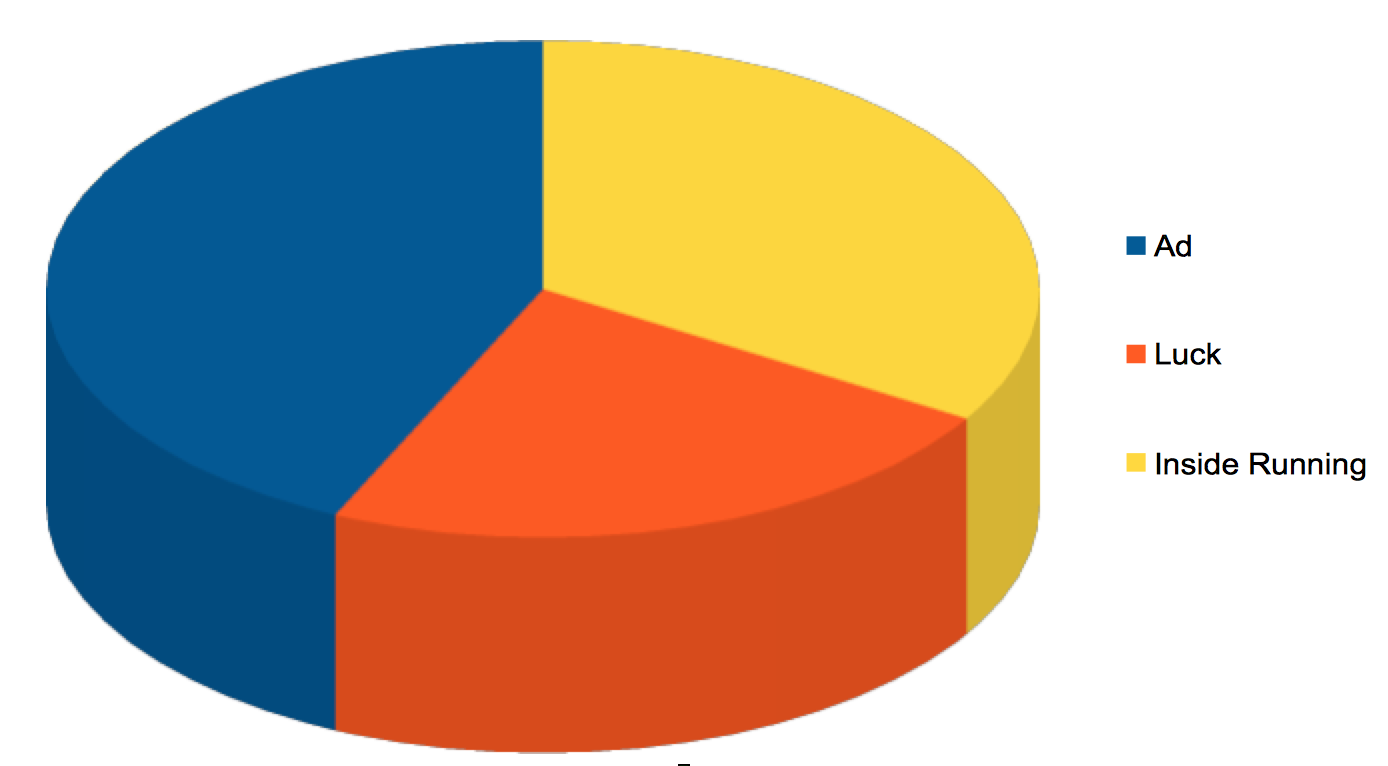
After having had 17 jobs, just six came from simply seeing an ad and applying. My crude averaging of the numbers (including some jobs I didn’t go into above) says ads explain 46 per cent of my jobs, inside running 32 per cent, and luck 22 per cent.

Screen Shot 2014-04-08 at 10.24.52 am

(I should note luck played a pretty big part in being born to a family that cared a lot about education and invested in my future. It also doesn’t hurt to be in a bunch of categories that are unfamiliar with the sting of discrimination. Is my experience strongly shaped by these privileges?)

The common trope is that 70 per cent of all jobs are not advertised.

Economic theory suggests a great benefit and a great cost. If firms are able to fill jobs quickly and minimise their search costs, that could be an advantage. But if it means they miss out on the best human resources, they suffer.

Despite the risks of hiring through word-of-mouth, the approach is not about to go away. This paper finds that firms that hire through referrals may be more profitable.

This expert recommends job hunters should spend: “20% of the time responding to job postings … another 20% ensuring your resume and LinkedIn profile are easy to find and worth reading, and the remaining 60% networking to find jobs in the hidden market.”

If my experience holds for everyone, its going to be advantageous to keep working in the same city, or at least the same country, where you have a bunch of connections. It also doesn’t hurt to be on LinkedIn.

But I want to know if the same is true for you. Have you got your jobs by responding to ads and going through rigorous processes? Have you been lucky? Made your own luck? Deliberately developed and used your networks? Please share your experience in the comments! (Look for the words “Leave A Reply” below)

When the first-day-back-from-holidays blues can be fatal

We all know the feeling. You take your annual leave and go on a terrific holiday. Perhaps some cultural time in the capitals of Europe. Perhaps a noodle and beer-intensive tour of South East Asia.

Then you return to work. The swivel chair sits forlornly awaiting your return. Hundreds or thousands of emails demand your attention.

You dive into work with a mixture of novelty and regret – this used to be very familiar, you think, and now it is not. At least until around midday, when it will seem as though your holiday never happened at all.

But it turns out there is clear evidence of the holiday. It can be measured in your performance. A recent working paper released by the US National Bureau of Economic Research finds that rather than refreshing your batteries, the holiday makes your performance worse.

And here’s the really bad news:

The study was done on surgeons.

Fatality risk increased for every day the surgeons took off between procedures.

In the study the mean mortality rate the first day after surgery was 0.62 per cent. Mortality rose by .05 percentage points for every extra day it had been since the surgeon held a scalpel. That is a 7.4 per cent rise in the risk of dying.

The study (Hockenberry and Helmchen) covered 56,000 patients and 188 surgeons and focused on a procedure called coronary artery bypass grafts. 

Hospitals prefer doctors who do a lot of surgeries, because they are more effective. Surgeons who did more than 100 of the procedure per year had lower one-day mortality outcomes (0.52 per cent), but for them, time off was even worse. For every day of rest, the morbidity rate of their next surgery rose by .09 percentage points.

The doctors did not perform worse on absolutely every measure. When they were back from a break, they apparently sped through the surgery, using less resources. Each day off correlated with a fall in the cost of surgery of 0.6 per cent.

But the saving was well below the value of life lost. In other words, society would prefer the doctors to spend more time and money. The researchers theorise that the cost effect and the morbidity effect are related – relaxed surgeons with their brain still on the golf course are failing to notice important complications and therefore closing up when they should be doing more work.

“After temporal breaks, surgeons may fail to identify and treat life-threatening complications.”

The effect was stronger for surgeons if they had had a lot of time off from surgery in general, rather than if it had been a long time since they undertook the specific procedure being studied.

The effect requires more study before we can determine a policy response.

If the depreciation of skill happens exponentially the longer doctors are on break, we could encourage them to take several two-to-three day breaks a year, rather than one four-week holiday. 

But if the depreciation of skill has a linear or decreasing relation to time away, doctors could be encouraged to take all their leave in a lump. General learning theory suggests most forgetting happens straight away, suggesting the latter solution would be preferred, but this study did not attempt to answer the question.

The research is part of a field of study that looks at human capital and how it erodes. It is well-established that the amount of time that elapses between repetitions of a task decreases the quality of outcomes.

This raises questions about a lot of training courses the modern office worker is encouraged to attend. Is the day off worth the meagre benefit if it also makes the worker less productive on their return?

The link between time off and productivity may also have negative implications for going part-time, buying extra leave, and taking career breaks. These issues are ever more relevant in the modern economy where parental leave is all the more common, where people change jobs often, and where jobs may encompass a wide range of tasks undertaken infrequently, rather than repetition of a few tasks.

There is room for a lot more research on this question, but for now, there is one clear lesson: Don’t choose a surgeon with a suntan.


How H&M can happily set up shop while Myer weeps.

Swedish clothing brand H&M is opening a new store in Melbourne today. It’s the latest big global clothing retailer to show up here, following Zara and TopShop.

Japanese brand Uniqlo is also set to launch here soon.  But why are they coming? The headlines have been full of bad news for all retailers.

Clothing retail looks especially terrible.  

Image

Growth has been stagnant for years. Why come to Australia?

The beginnings of our answer are overseas:

The value of clothing retailing fell in Canada last year by 0.6 per cent. The UK saw the same result.

People everywhere are spending far more on food than on clothing these days. And yet I don’t see people shuffling around in clothes that need repairing.

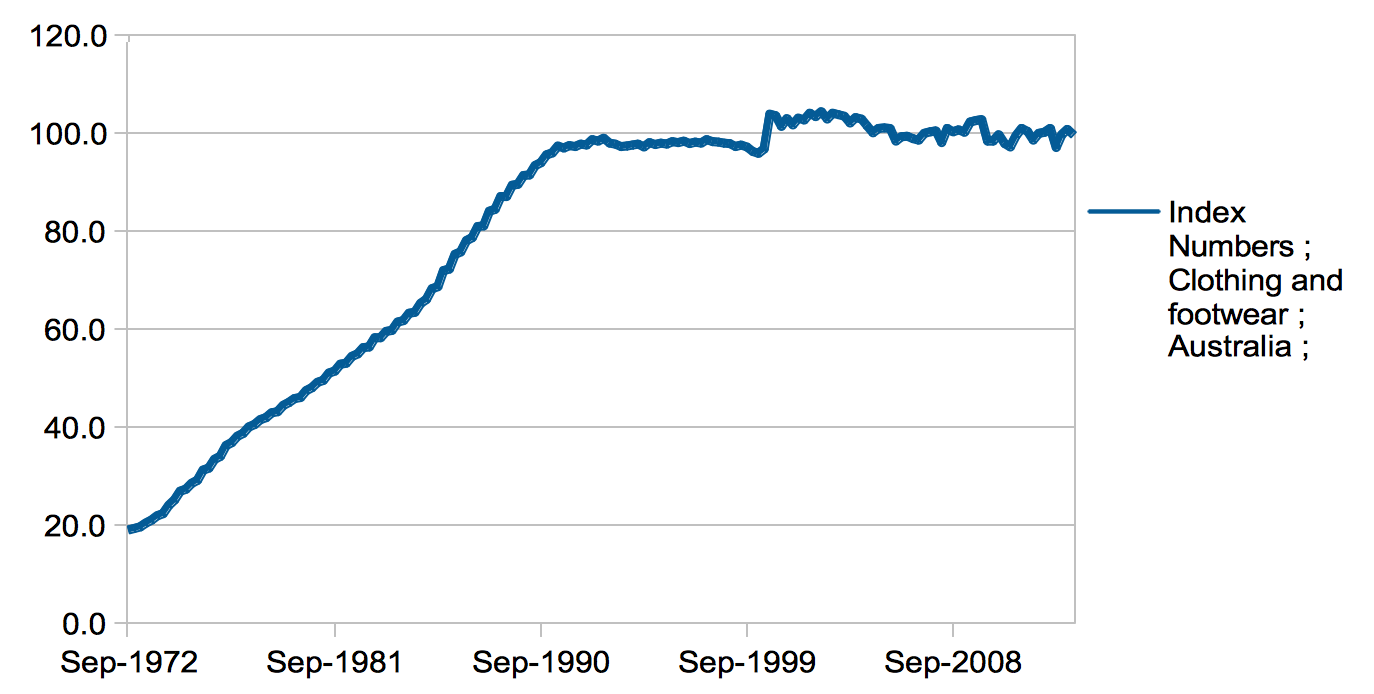
I had begun to suspect prices may have something to do with it, but the ABS inflation data for clothing was still a shock to me:

Image

Despite a 10 per cent hike at the time of the introduction of the GST, the price of clothing has risen only 1 per cent since 1993!

I remember 1993. I was 12 years old. For the first time it was possible to buy a pair of Nikes that cost over $100. The last time I went and looked at Nike sneakers, the price range was roughly the same (and I picked up a pair from the factory outlet for $30). If they’d followed the inflation path of food and beverages, sports shoes would all be over $200 now. But they haven’t and they aren’t.

Why not? The answer is not on the demand side. It’s not that in two decades something fundamental has changed in the way humans wear clothes. It’s about the supply side.

And that’s what’s interesting about H&M. It owns stores that sell its own brand. It makes only very limited attempts to stock fancy Italian or American brands. A bit like its Swedish retail older sibling, Ikea, it is vertically integrated and tightly focused on cost.

I bought a terrific shirt at H&M’s Sapporo outlet 10 days ago, for ¥500 (A$5.50). Even on the discount rack that is an absurd bargain. Only after I got it back home did I think to look for this tag, and it was as I suspected.

Image

There are moral issues when it comes to making clothes in Bangladesh. I don’t want the fact that this post doesn’t cover them to stand, in anyone’s mind, for the idea that they are unimportant.

The fact of the matter is that if you can control costs well enough, you can make big margins even as prices fall. That’s the difference between Myer and H&M. Cost control. Myer can’t do it so easily because while it has 66 stores, H&M has 2600. H&M can make or break people while Myer deals with suppliers that have options and won’t let their margins be crunched. 

A quick look in the H&M annual report shows just how good those margins are. More than half of the average price tag is mark-up. 

Image

And that’s why H&M‘s share price is up about 20 per cent over 3 years, while Myer’s is down around 30 per cent. 

MORE FACTS:

The H in H&M stands for Hennes (“for her”), the name of the original company that sold women’s clothing. The M stands for Mauritz Widforss, which was the name of a hunting apparel shop next door to the original Hennes, which H&M took over to develop a men’s line and become what it is today.

If you’re interested in knowing more about the business models of big clothing retailers, check out these very good Forbes profiles that highlight the differences between Uniqlo, Zara and H&M.

Economics is not about “money”

Like most people who care about economics, read about it or talk about it, from time to time people say this to me:
“I couldn’t get interested in economics. I just don’t care enough about money.”
They say it dismissively. As though economics was about money.
Economics is about people.
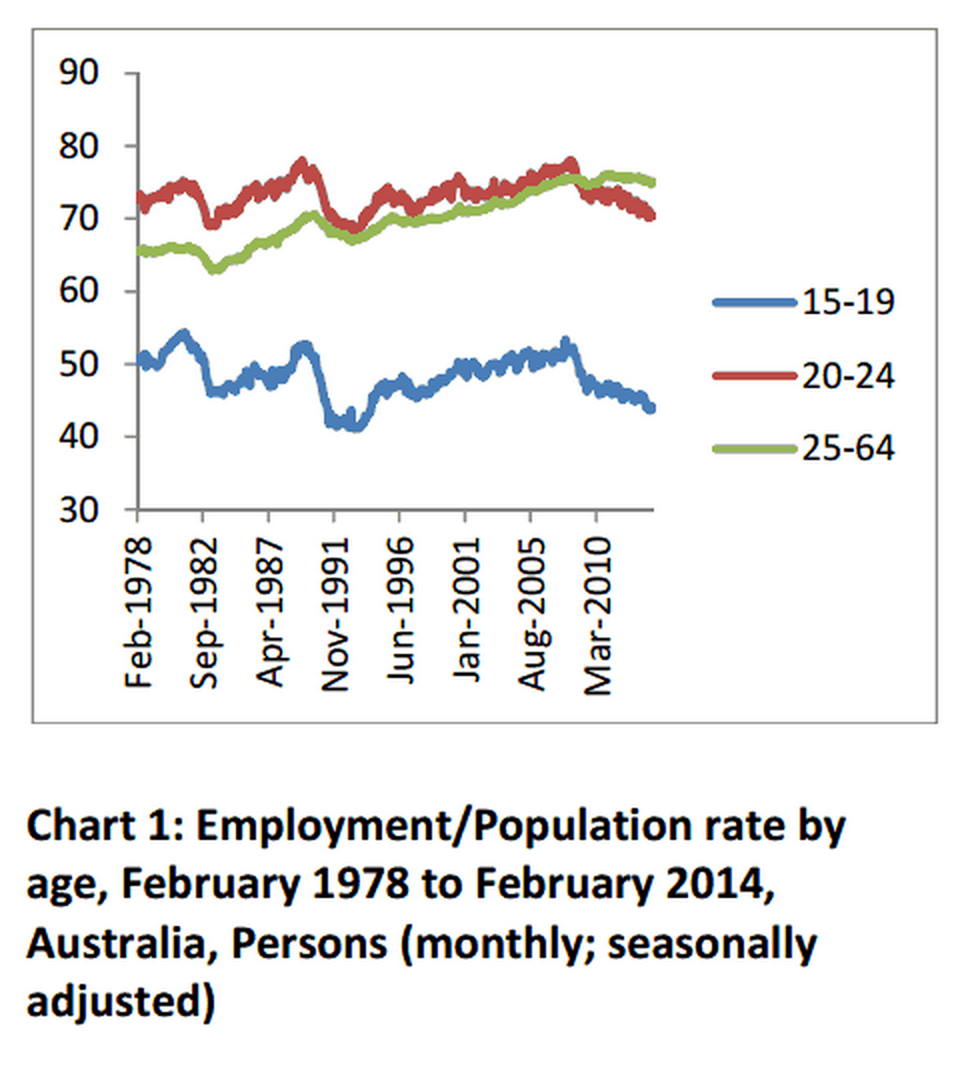
Take the latest work by one of my favourite economists, Professor Jeff Borland. He produces a “labour market snapshot” each month that he emails to interested parties. The April one was focused on the plight of the young.
“Employment prospect of the young in Australia have weakened considerably since the GFC,” he writes.
Image
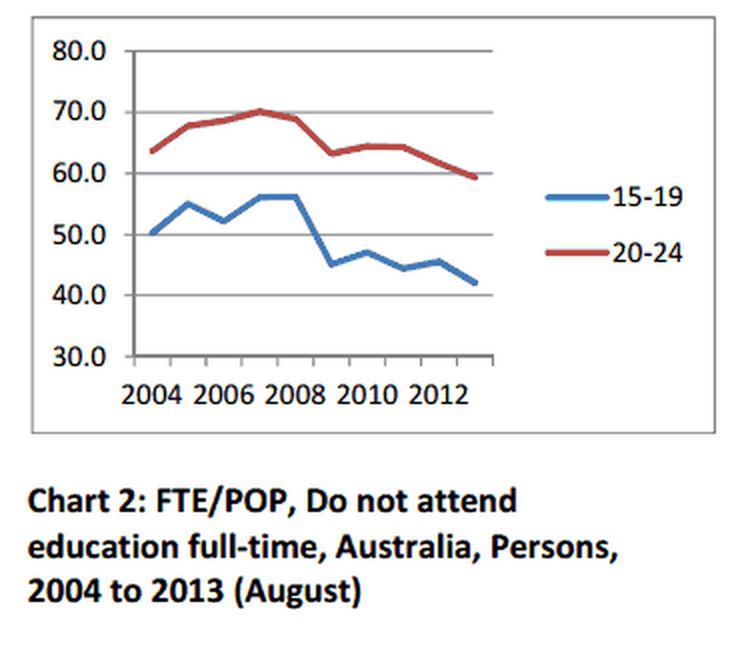
The biggest fall in employment is among those who are not in full-time study.
Image
This is not an academic issue. It’s a goddamn human tragedy. Unemployment at this tender age correlates with worse outcomes on just about every measure.
“Unemployment while young can lead to long-term reductions in wages, increased chances of subsequent periods of unemployment and poorer health outcomes,” according to UK economists.
Brotherhood of Saint Laurence executive director Tony Nicholson: “And in our modern economy that means that they’re really being sentenced to a lifetime of poverty.”
“One in three (32 per cent) long-term unemployed youngsters have contemplated suicide and one in four (24 per cent) in this group admitted to self-harming,” according to a UK survey reported in early 2014.
This blog from the Peterson Institute for International Economics: “Considerable research suggests that less stable employment experiences of young people can lead to “scarring” that affects their future employment and earning prospects.”
The critics of economics implicitly accuse it of reification – that by creating ways of quantifying and measuring the material world they bring materialism to the centre.
There could be a germ of truth there. But to not study the material world in a systematic way would be to deny the real influence it has on humans’ experience of their lives.

Which Australian state is most entrepreneurial? And is that a good thing?

Entrepreneurialism – it seems – is not about the wild frontier nor about libertarian values. The most entrepreneurial state in Australia is its most densely populated and most left-leaning (arguably).

Image

The data comes from the ABS series Business Entries and Exits. They show not only that Victoria has (slightly) more businesses per capita than anywhere else, but also that it is extending that lead.

Image

Is that surprising? Victoria is not only a wealthy state, which allows residents the opportunity to strike out on their own, it is also a beacon for immigrants, who often open small businesses. Also it has experienced a lot of structural change as manufacturing businesses close, forcing people to create new opportunities for themselves. 

Image
The beginning of a Bin Hire empire for Ben?

(Another point of note is how the ACT is a laggard for total number of businesses, but mid-pack when it comes to opening new businesses. I’m imagining a lot of senior public servants applying for an ABN as they prepare to lose their jobs and become consultants under the Abbott government.)

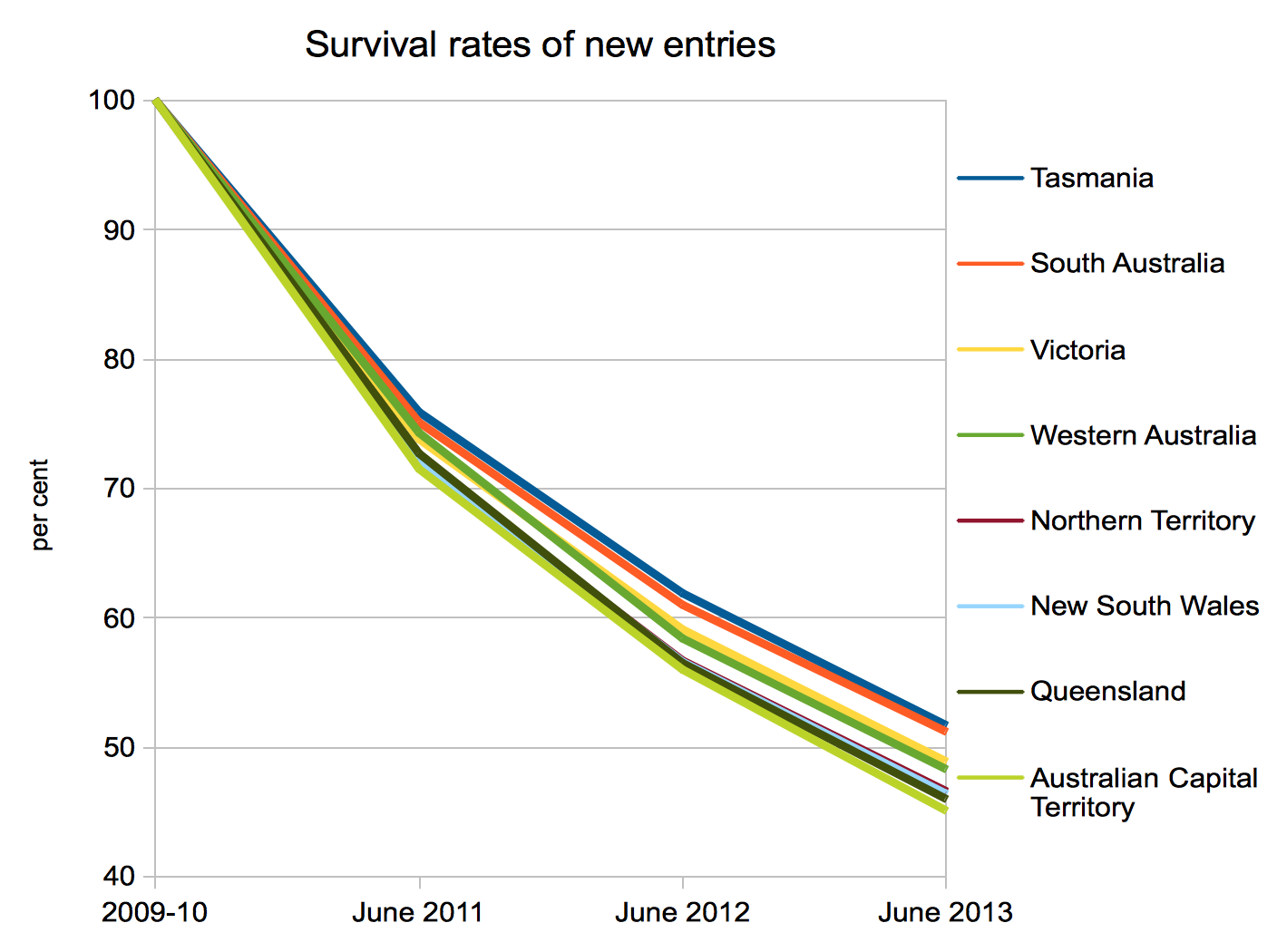
But historically, the ACT is the worst place to start a business. More than half of them disappear within a few years. In fact, Tasmania and SA, with their seeming reluctance to start businesses, are rewarded by having the highest four-year survival rates.

Image

The failure rate of small business is not a mainstream topic of conversation. But I can’t help imagining all the life savings that get flushed away, and all the relationships that fail when small businesses disappear.


It’s the hidden underbelly of capitalism, in a way. We focus on the big businesses that put people out of work, but in those cases, workers have none of their own capital involved and governments guarantee their benefits. When your local milk bar goes down or a removals company runs out of money, nobody notices but the proprietors. They’re not just looking for a new job. They are dealing with the death of their dream. But nobody comes to interview them about their plight.

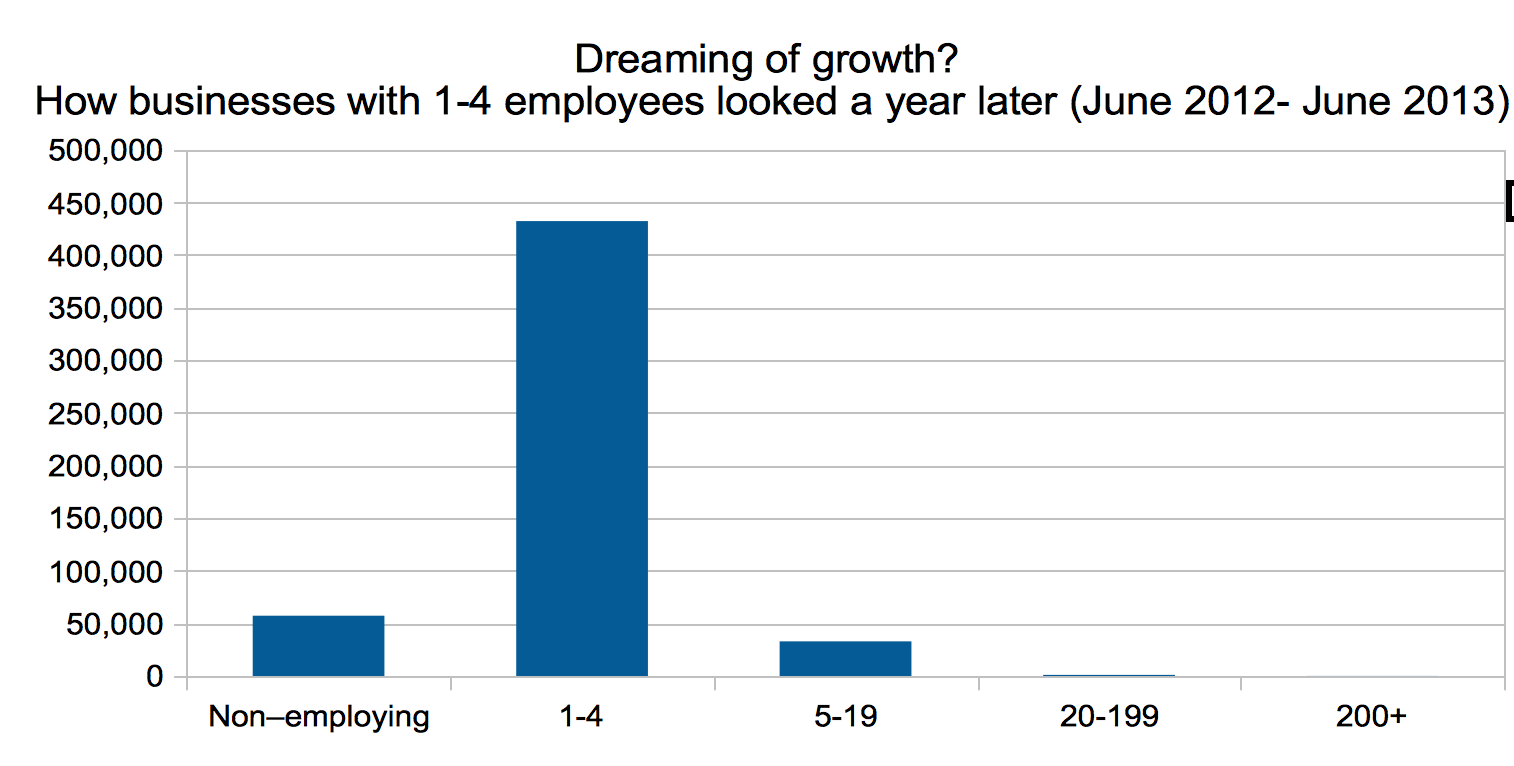
Governments go ga-ga over small business, calling it the backbone of the economy, etc, etc. But they are risky. The data show you are much safer working for or investing in a business with more than 20 employees.

Image

But if you believe in yourself, the carrot is there. Last year, 27 businesses went from having no 1-4 employees to having over 200 in the space of one short year. It’s a bit like buying a Tattslotto ticket – it is unlikely, but just possible that you will have a very exciting result.

Image


House prices – lessons from the huge differences between cities

Here’s what $1 million gets you in central Sydney. A functional two-bedroom apartment with around 100 square metres of floor space.

Image

Here’s what $1 million gets you in central Melbourne. A two-level, three-bedroom apartment with two carparks and a balcony that’s half as big again.

Image

Here’s what $1 million gets you in central Adelaide. A substantial house in the centre of town.

Image

The debate about house prices makes a lot of hay out of differences over time. Prices in Melbourne are 5.4 per cent higher than they were three months ago! That is generally seen as an argument that Melbourne prices must be set for a fall. 

But the difference in prices between Australian cities is even bigger.

Sydney’s median price for an attached house was at Melbourne’s current level in 2003 and has risen from there. Melbourne was at Adelaide’s current level in 2007 and has risen. Taking this perspective would seem to suggest there’s nothing to stop Melbourne house prices from going up further.

Obviously there are constraints. Wages differences between the cities are real. This chart shows $/week in the capital cities.

Image

But they are not as big as house price differences. (source: RPDATA)

Image

House price to income ratios in these cities show Melbourne and Sydney are similarly “unaffordable” and in Adelaide things are a bit easier. 

You could in theory argue that means Melbourne and Sydney prices are as likely to fall to Adelaide levels as Adelaide’s are to rise. I’ve argued before that expecting house prices to be a consistent multiple of income over time is a wrong expectation. 

The fact that house prices can be so different in Australian cities hints at the truth. There is no “correct” level for Australian house prices. We cannot rely on history to say where they should be, neither can we rely on price-to-income ratios. In fact, the concept of “Australian house prices” is suspect. Housing markets differ wildly by location. 

People like Christopher Joye and Steven Keen who publicly bet on house price falls regularly get egg on their face.

The only clear lesson of all this really, is that if you want a lot of house for your money, you should look outside the capitals. Here’s what $1 million buys on 10 acres near Ballarat.

Image

Betting on the Chinese Communist Party, and why that could make us poorer.

China’s economy is showing signs of failure, but people keep betting on it.

For example, last week an index of Chinese manufacturing output showed its fifth consecutive month of falls, and China-linked assets shot up.

The reason? 

Financial markets believe the Chinese government will come to the party with extra spending and extra stimulus.

Are they right? The question we are asking here is not merely academic. If we bet on China and lose, the following are likely to fall:

  • The Australian dollar.
  • Australian economic growth.
  • Australian share market.
  • Australian house prices.

The Chinese government obviously wants the economy to keep growing. The continued existence of the Communist Party is tied to the performance of the Chinese economy. They have to keep it ticking over. Their motivation is clear and pure and strong. But motivation is not always enough.

Shanghai skyline
Can we distinguish warnings signs from red flags?

Consider this. The only reason markets need to trust the Chinese government to add more stimulus is that previous rounds of stimulus haven’t done enough. Financial markets are betting the guys that got the market into this pickle can safely navigate out again.

“We expect Beijing to launch a series of policy measures to stabilize growth. Likely options include lowering entry barriers for private investment, targeted spending on subways, air-cleaning and public housing, and guiding lending rates lower,” said Hongbin Qu, chief China economist at HSBC.

A few iterations is enough for the human brain to learn a pattern. We’ve seen the Chinese government come to the party during the GFC and during the European debt crisis that followed, keeping China’s growth rate up over 7 per cent, rain hail or shine.

No wonder traders and hedge fund gurus trust their guts on whether the dragon will roar again. But a well established patten hurts the most when it breaks.

This time the problems in China seem to be inside China. They are not dips in demand caused by a failing USA or Europe. 

China recently experienced its first debt default and its first bank run. Corporate debt is being reined in.

The big pile of flammable material at the heart of China’s economy is house prices that are too high. China’s property market issues are unique. Everyone agrees prices are in bubble territory and will have to fall. Even the Asia editor of the Economist, who is otherwise totally excited by more China growth.

Image
You can bet these weird Grotto apartments in Shanghai sell at a premium.

The question is what will happen when Chinese house prices fall. It’s easy to imagine that it will happen in a controlled way, or simply not be too important. That’s what Ben Bernanke imagined pre-GFC too.

China is enormous and its government freer to act than most, due to the absence of democracy. I suspect any crash would be over sooner than some expect. But even a short dip would be a big problem.

The value of China’s growth has been that it is consistent. It can be counted on. Having to risk-weight China’s future growth will take a lot of shine off Australian asset prices.  House prices would be under attack from all quarters, with receding Chinese purchases, a falling share-market, and a weakening Australian economy. Bank shares, which account for a quarter of our stock market, tend to follow house prices. The Chinese government’s ability to manage its economy has become, it seems, one of the biggest risks to our wealth and well-being.

Image
It’s our head inside the lion’s mouth.

Story-telling, the exchange rate and Kurt Vonnegut

The Australian dollar has gone up! The only clear effect of that is that headline writers are in desperate need of a simple story to tell.

Image

I wrote currencies for two years and there is always someone telling you that if only the dollar would fall below Parity / US90c / US80c / US70c, Australian industry will suddenly be in a bed of roses. 

Of course the young reporter will include such a statement in a story, because – finally – they have something to say about the currency that could garner a few clicks.

But of course the reporter knows it is not true. There is no magic level for the dollar.

Every little fall in our dollar increases the benefit of exporting. A certain firm may have a break-even level, but an industry will find its exporting grows easier gradually, not step-like, as the dollar falls.

The effect on “industry” is in fact, even more complex than this. Firms don’t just sell. They have to pay employees and import material and equipment. That’s easier with a high dollar.

The simple story is high dollar = bad. But with a really high dollar in the last few years, the Australian economy grew fast, and Australians enjoyed a high quality of life. We bought overseas holidays, flat-screen TVs, overseas apparel, smartphones and Apple Mac computers at an incredible rate.

With a low dollar, such consumption is harder. But businesses should be better off. There will be less competition from imports, and it should be easier to export. But of course the equipment and materials they need to import as an input will rise in price.

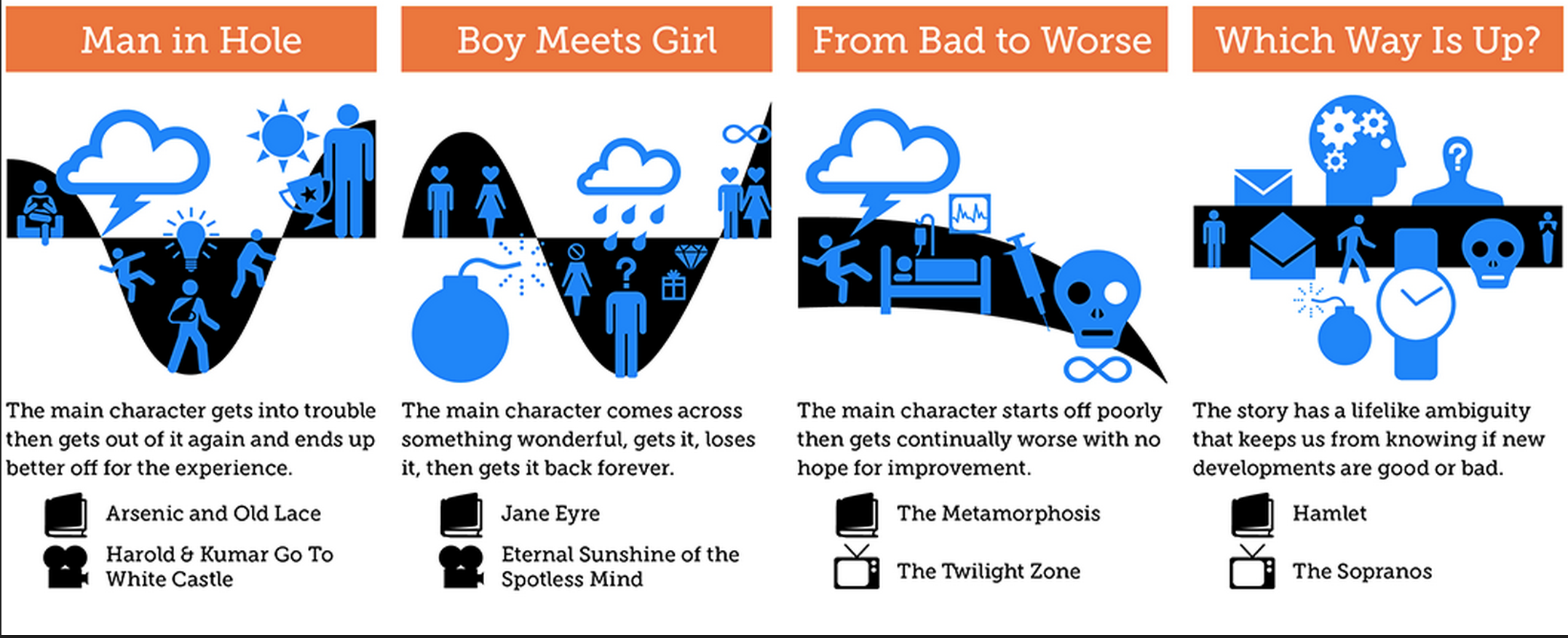
It’s almost as if every time the dollar moves, someone benefits and someone loses! The whole thing brings to mind, for me, Kurt Vonnegut’s famous graphing of stories. 

Image
Image credit: i09.com.

The industry wants you to believe that a rising dollar is a bad to worse story. The journalist writing the story is not going to fall for this – they want a better story arc than that.

They position it somewhere along the arc of the first two graphs: Industry had it good for ages, now it is bad. Or, for ages industry had it bad, now it is looking good. But such arcs are only ever true for a sub-section of the economy. Overall, we seem to be able to thrive whether the dollar is low or high. 

Here’s the truth: Any move in the dollar is an ambiguous and mysterious development. It takes with one hand and gives with the other. If you’re worse off at work, you may be better off at home. If you lose your job making exports, you may get a job delivering imports, etc.

The ineffable nebulousness of any story about the currency is of course a headache to headline writers. $A Crash Causes Yet More Ambiguity is a headline for a post-modern prose poem, not a news story. It will not fly. It will not get clicks. Do not even try to talk to the subeditor about the way really, uncertainty is the marrow of life

Vonnegut, of course, turns nebulousness into celebrated works of literature. But currency writers are no Vonnegut.

You can expect the inherent uncertainty that should be the backbone of currency stories to remained concealed. 

Why the public transport election promise is bad policy, but good news.

A super bold plan has come out of the Victorian Government. They pledge to make public transport free in the city centre, and to abolish Zone 2, the higher-fare zone in the outer suburbs.

The idea is clearly a vote winner – a small group of people benefits at the expense of taxpayers everywhere. The Labor party adapted the policy faster than you could say “Harold Hotelling.”

It is a flashy announcement, like putting Protective Services Officers on every station, that reveals its proponents don’t really use public transport and want to believe something – anything! – other than really expensive infrastructure improvements are key determinants of service quality.

Image

This blog has advocated for free public transport in the past [Myki vs Free PT] but in this case the best I can say is that I don’t hate these ideas.

Let’s have a look at what will really change under this plan:

Free public transport within the city.

Upside: No need to deploy those rude and aggressive ticket police. Accept that the amount of crowding means the service is scarcely worth charging for anyway. Simpler for tourists.

Downside: Amount of crowding is likely to increase as we enter a tragedy of the commons situation. Public transport policy is not tourism policy – using transport policy for other ends is partly why it is not up to scratch. Less revenue to improve the system.

The end of Zone 2.

Upside: Simplicity in the public transport system is good –  people expend physical and mental energy trying to beat the Zone 2 boundary. The people who live in Zone 2 are most likely to need the discount, so there is an equity effect.

Downside: We are not at a stage where we need to encourage patronage on the system – it’s busy enough as it is.  Public transport policy is not social welfare – using it for non-transport policy ends is partly why it is not up to scratch. Less revenue to improve the system. Likely rising fares in Zone 1 over time to recoup lost revenue. 

Essentially, this is a policy with some benefits, but they do not strike at the heart of what our system needs – more services more often to more places. In fact, by reducing the amount of revenue – the Budget will estimate of how big a reduction – it may undermine that true goal.

Image

What this whole surprise announcement says to me is that the Government recognises Public Transport is its big weakness. And that recognition could make for a big turning point.

This government sailed into power on the failure of Labor to do PT properly, and by promising better PT – to Doncaster, Rowville and the Airport. But it has made a giant road tunnel into its signature reform. Now it is scrabbling to catch up.

The reality is that the Liberal party will probably lose the November election. They have a one-seat majority thanks to the support of corrupt independent Geoff Shaw. They have a premier we never voted for after the previous one was kicked out. They are a shambles. A poll taken in early March has the government behind 47-53. But ex-post, the big narrative to explain the election result will likely be public transport. 

Image

After the 2010 election, the Frankston line was identified as a crucial issue that lost key seats for Labor. If public transport is once again seen as a swing factor in 2014, the narrative will be established in political operatives’ minds. In Victorian elections, good public transport policy could come to be seen like a pledge not to increase GST, or a stern approach to boat people – an absolute must have for any party to succeed. 

Imagine if the top minister in the government was dedicated to the public transport portfolio. Imagine if that minister actually rode the trams and trains at times when the cameras were not directed at them.

It’s just possible that a golden era of public transport policy is around the corner.

Latterday Knight Fever: the economics of prestige

The Abbott government has announced it bringing back Knightoods and Damehoods to Australia. Each year, four people will arise with the title of Dame or Sir.

Of course, the whole thing is a retrograde step taken by a man with, by George, a madness for kings. Knighthoods were first axed by Whitlam in 1975, reintroduced by Fraser in 1976 then axed again by Hawke in 1983.

In one way, I like it. The old honours system which topped out with ACs and AOs was both sterile and opaque. The Sir and Dame system is one that people can grasp. From Sir Lancelot to Dame Judi Dench, people see and understand. If a comprehensible public honour is not the point of an honour system, I don’t know what is.

(One also can’t deny it’s a political football that you kick up into the sky when you want to distract attention from something else, in this case the fact the Assistant Treasurer is featuring in a very unflattering way in a corruption inquiry.)

But the real question for an economist is why would people value a knighthood. It doesn’t come with a free horse and castle. It doesn’t get you a discount at the shops. In some ways it’s less useful than a seniors card.

While the income bump from winning an Oscar has been comprehensively studied, old-school conventional economics has little to say on the matter of awards for public service. Luckily our friends in the fields of behavioural economics have tuned their antennae more closely toward the workings of the human mind.

These Knighthoods and Damehoods are the ultimate in positional goods. A positional good is one whose value comes from the fact that others can’t consume it too. Being the richest person in the world, or gold medallist in swimming, having the best address in the best neighbourhood or a degree from the most elite university. The values of these goods “depend not only on the amount the individual consumes but also the amount others consume.” 

At my old employer, Fairfax, the publication of the BRW rich list was an event that carried huge importance. As if the money was not reward enough, certain business people would contact BRW to make sure their assets were sufficiently valued that they would feature prominently in the list. Being on the list did not increase the value of their money in a consumption sense, but it strongly increased its positionality.

Positional goods are theorised to create negative externalities for the many while benefiting the few (See paper from Brookings Institute.) And the giving of medals, etc. is not without negative externalities. Here is Churchill acknowledging that fact:

“A medal glitters, but it also casts a shadow. The task of drawing up regulations for such awards is one which does not  admit of a perfect solution. It is not possible to satisfy everybody without running the risk of satisfying nobody. All that is possible is to give the greatest satisfaction to the greatest number and to hurt the feelings of the fewest.”

In the case of Australia’s newest old-fashioned honour, just four will be handed out per year. Something so rare will indeed have cachet to spare.

The honours are apparently designed for public service, so the tabloids obsession with a Sir Shane Warne may never materialise: “My intention is that this new award will go to those who have accepted public office rather than sought it and who can never, by virtue of that office, ever entirely return to private life,” Mr Abbott said.

Such prizes may be efficient. In a world where tax dollars are not exactly overflowing from Treasury coffers, the government can use prizes as compensation for jobs that would otherwise command a lot of pay.

As Bruno Frey notes in his paper Knight Fever (which title I happily stole for this post) “The material costs of awards may be very low, or even nil, for the donor, but the value to the recipient may be very high.”

Where you can pay someone with a reward that costs you nothing, it would be economically unwise not to do so.

Phaleristics is the study of awards. There is a strong economic literature on the merits or using awards as motivation. From the merits of prizes in furthering science to prizes for poetry and independent film. 

Awards litter most fields. They are especially prominent in fields where the best make a lot more money than the rest, such as acting, and in fields where the government pays the players (the military). These may be fields where contracts are especially hard to specify ex-ante.

Awards like sportsperson of the year carry less weight than Best Actor awards, because it is far easier to identify success in sport, so an award adds little marginal value. (Roger Federer does not always show up to accept the Swiss Sportsperson of the Year award.) Similarly in fields where a free market determines the pay of participants, such as the private practice of law and business, awards are less visible and carry less prestige.

But the award benefits not only the recipient. Mr Abbott emphasises the reciprocal nature of these awards. They are intended in his mind not just as reward for service, but are in fact a payment for keeping mum:

“If you’ve been the Governor-General or a Governor, there are certain things that you can never really do again. You can never really be as free with your opinion as might otherwise be the case. There are certain jobs that you could never really do again because of the position that you’ve occupied. Ditto for a Chief Justice. There is lots of legal work, for instance, that a former Chief Justice could never really do. If you’re a former Chief of the Defence Force or a former Chief of Army, there are lots of issues upon which you can never really comment by virtue of the position that you’ve held. I think when someone does accept a position of such importance and gravity in our system, it is perfectly fitting to honour them in this way.”

When it comes to creating new awards, there may be motivation on the part of the giver, too:

“The institution (or person) bestowing an award can be taken to be a principal who maximises his utility by inducing the agents, as the recipients of the awards, to behave in his interests,” Professor Bruno Frey argues. He continues:

“The whole area of awards is very vague. The semantic is unclear and the various types of awards are not well defined. There is, for example, no clear distinction between orders,  decorations or medals, and they can go with or without titles and money. It will be argued in this paper that these unclear distinctions are no accident, but an important feature of awards. The suppliers of awards have an incentive to differentiate awards at many different levels and to continually create new awards.”

Managing to keep Australian knighthoods and damehoods to just four a year may prove very challenging. And if it can be done, might such an exemplary public adminstrator not be rewarded with the creation of a still higher honour? Time will tell.

Thoughts on the economics of honours and awards? Further reading you’d like to suggest? Put your thoughts in the comments section below!

Cash makes street crime. Does Bitcoin make e-crime?

From the United States National Bureau of Economic Research, an excellent new paper.

Richard Wright et al exploit a terrific natural experiment, wherein some counties of Missouri moved to paying benefits by debit card (Electronic Benefits Transfer or EBT) prior to others, leading to a decrease in circulating cash in those communities.

“Our results indicate that the EBT program had a negative and significant effect on the overall crime
rate as well as burglary, assault, and larceny. According to our point estimates, the overall crime rate
decreased by 9.8 percent in response to the EBT program.”

Wright et al show that the cycle of crime is thereby reduced, with fewer subsequent crimes in retaliation. They posit that part of the significant decline in crime in the United States over the last fifty years is due to the decline in the use of cash. Cash is now used in only 50 per cent of transactions in the US, down from 80 per cent 50 years ago.

It's all about the Platypi, baby.
It’s all about the Platypi, baby.

The data is sound, the methodology makes sense and the conclusions are appealing. So what are the lessons?

Like many of us, I am a fan of PayPass. I have a Mastercard I sling for every transaction I can these days, because PayPass means no need to bother my fingers with signing or PINs. It’s terrific. I use it for the piddliest little transactions, like a cup of coffee, and I go to the ATM perhaps once a month.

But that electronic transaction is anonymous. Anyone who has my Mastercard could use it. I strongly doubt any vendor would attempt to match my name to the identity of the person using the card. That card is only good for transactions up to $100, but a swift criminal could probably rush up to the card limit before I managed to cancel it, especially if they took the card surreptitiously rather than by force.

So I worry that the rise of PayPass and the Visa equivalent could reinstate some of the street crime that has been ebbing away.

But an even bigger lesson is there to be learned, online.

As recently as a year ago, there was no real cash on the internet. For online transactions you used credit cards or you provided proof of cash transfers made in the banking system. Both of these were intermediated by financial institutions who take the blame for fraud. Sure, you could steal a credit card number online, just as you could offline. But that was tightly policed and internet commerce was relatively safe.

Now there are 12 million Bitcoins in circulation, worth $573 each. That’s $6.9 billion of cash. The hermetic and pure world of the internet, which was once all about cat videos and enthusiastic editing of Wikipedia articles has been sullied by cash and the crime wave that has followed.

Is anyone surprised the news has been rife with stories about Bitcoin theft in the last few months?

Flexcoin had $620,000 worth stolen.

Poloniex lost 12.3 per cent of its coins.

And of course the big one. Mt Gox lost 650,000 Bitcoins, worth several hundred million dollars.

Crime does pay, and the way Bitcoins are designed to be anonymous means that it pays without great risk.

Hacking will continue so long as Bitcoins are kept on the internet. It remains inconvenient for Bitcoins to be kept offline, if they are to be used as an actual currency. Even if they are only kept as investments, they still need to be brought to market for trade, and that offers up opportunities for hacking.

The introduction of Bitcoins to the internet has transformed the internet into a place that traffics not just ideas and new shoes, but also drugs and murder. In other words, it is now just like the real world.Image

At the moment, the online cash economy has a frontier element, with big audacious thefts, akin to the bushrangers of early Australia. That will die down.

The way I perceive the hacking risk being diminished in future is if the big companies that have experience in protecting online transactions get involved.

I can imagine having a Bitcoin account attached to my Commonwealth Bank account, and/or attached to my Mastercard. It would undo a lot of the supposed advantages of the electronic currency, such as anonymity, but introduce convenience and trust.

“True” Bitcoiners will moan about the way the point of Bitcoin is lost, while everyone else just appreciates the fact that their currency is now secure and functional. I suspect people’s enthusiasm for perfect anonymity pales in comparison to their desire not to lose the money they put on the internet.

Of course, Bitcoin transactions outside, say, the “CitiBank Bitcoin Protection Protocol” would still be available, just like the way I can pay for a car with a big wad of cash.

But the people engaging in these transactions place themselves at greater risk. Who is most likely to trade anonymity for risk? The same kind of people who currently use cash.

Might it be that Wright et al can write another paper in 20 years about Bitcoin and security that shows less Bitcoin being traded online correlates with less online criminal activity?

The hidden TV lesson from True Detective

I watched True Detective Season 1. 

Rarely do acting, writing and production values come together in such a package. It was gripping. Two detectives, played by Woody Harrelson and Matthew McConaughey, hunt down a serial killer in rural Louisiana, while the scenery drips with evil portent and minor characters utter veiled references to the Robert W. Chambers story the King In Yellow.

When Woody and Matt encounter the bad guy in episode eight, the big revelation was not the identity of the creep in his catacomb. It was that this great run of TV was now done for good.

Harrelson and McConaughey agreed to something odd – a one season run. There will be a second season of True Detective, but characters, locations, etc will all be different.

The absence of more makes what we got so special.

Economics has an explanation for this. Scarcity drives value.

That’s why caviar costs $4000 a kilo even though it is not that nice to eat, but bread costs as little as $1 a loaf even though it is amazing.

TV has for 50 years ignored this fact.

TV networks have tried to wring every last drop out of anything good. There are many examples; 41 years of the Young and the Restless,  30 years of Neighbours, 17 years of South Park.

That has been the measure of success in TV. Being renewed.

To me, The Simpsons is the epitome of the idea. It’s a widely respected show. For 25 years, the family from Springfield have skateboarded, sucked, saxophoned, slacked and supported through an episode a week. The Simpsons has at times been a brilliant show. But once it turns into a permanent fixture, it becomes about as compelling as the wallpaper.

Ubiquity diminishes anything.

Films have been the pre-eminent form of cultural expression in the west for almost a century. The reason? The release of a film is an event that happens only once. (Except for those movies that spawn sequel after sequel until it is time for prequels. George Lucas, I am looking at you.)

The scarcity of film and audience’s awareness of its finite nature is no doubt part of what has given it cachet, driven the best actors into its arms, and allowed payouts that peak at almost $100 million per film.

Despite the cachet of film, it is not without problems. Film is limited to three hours at most. That’s not enough to tell the kind of epic story humans love. TV can be the better medium and recent shows have proven that, with an arc of quality stretching from the Sopranos to House of Cards.

Now actors that graced the silver screen are appearing on the small screen. From Rob Lowe and Martin Sheen in The West Wing, to Harrelson and McConaughey in True Detective.

True Detective got those actors by promising a short run, but attracting top talent is not the only practical reason for a nice short run.

When a network makes the decision to commission a second season, the writers must immediately start hoarding ideas, making the characters do new things, lifting the role of minor characters or introducing long-lost children/siblings/partners.They also write the second season with an eye to the third season. By then viewers are often attached enough to the characters to put up with it all, but it dilutes the quality of the show.

Short runs permit writers to do story arcs that hit satisfying conclusions rather than just situational drama or comedy, or story arcs that linger on ridiculously.

The success of season 1 of True Detective could go two ways.

It could mean lots of shows opt for short sharp seasons, or it could mean HBO commissions 22-episodes for season two, with an option to renew. It should be no surprise by now that I would rather the former.

Absence!

I am on holiday (in Japan) and will not be able to post daily for the rest of this week and or next week.

japan

I shall try to make a post or two when I can, but in the meantime, please feel free to browse the archives, starting with the “best of” section to the right hand side ->

Cheers!

Economics of Murder in Mississippi

I got the new non-fiction book by John Safran for Christmas. Murder in Mississippi. It was a quick read and a good one.

The premise: Safran knows a white supremacist in Mississippi – when the guy gets murdered he heads over to write a true crime book. The story only gets better from there.

Now.

Perhaps I’ve been overs-sensitised to costs by working for the Australian Financial Review (“BYO phone”, “travel by bus”, “we’ve run out of pens”). But throughout the book, Safran incurs big expenses that left me wondering if he, or Penguin, were going to actually make money on the book.

Let’s have a look:

Expense 1. Travel. Jackson is halfway between Dallas and Atlanta, or if you like, halfway between Miami and Denver. Today, the cheapest flights Melbourne – Mississippi are $1642.

Expense 2. Living. When he moves into the Sleep Inn and Suites in Jackson Mississippi, they are brand new and the carpet, which he says “feels like minigolf astroturf,” squeaks. Its advertised price is now $79/night.

Safran writes that he stayed in Jackson from winter to summer. Penguin claims “Over six months, Safran got deeper and deeper into the South.” During that time, Safran also went off to other parts of America to make some TV.

He also stayed at the Ashford Place apartments (circa $1000/month.)  If we assume he spent 6 weeks in the first motel and 10 weeks in the second one, that’s around $6000 on accommodation. I’m budgeting $50 a day for food and drink, for four months. That’s $6000 on food.

[Running total $1642 + 6000 + $6000 = $13642]

Expense 3. Car hire. Unavoidable. Jackson’s public transport situation is the sort of unholy tangle that would make Jarrett “Human Transit” Walker apoplectic. Four months of the cheapest Hertz car on monthly booking adds up to $4000. Plus, say another $1000 for gas? (Mississippi gas prices are almost the lowest in the US, equivalent to $A0.897/L)

[Running total $1642 + $6000 + $6000 + $4000 + $1000 = $18642]

Expense 4. Bribing the incarcerated.

This is the one that really caught my eye. The book includes a series of trips to Walmart where Safran buys phone cards for the murderer. He also delivers some other goods on his behalf. I won’t spoil the book by telling you what they are.

At one point the murderer asks for $2500 and Safran says “I can’t give you $2500. I don’t have much money left.”

Click here to see the murderer’s facebook profile (friends include one J.Safran!).

Assuming the items mentioned in the book are everything, that’s around $2650.

[Running total $1642 + $6000 + $6000 + $4000 + $1000 +$2650 = $21292] 

So. Twenty-Two Thousand Dollars. Quite the bill.

It is probably more than he budgeted. The book reveals he didn’t expect to spend so long in Jackson. He’s barely been in the place a few weeks when the expected trial is delayed.

murder in M

Safran is a big name as these things go, and I guess he was spending an advance he got from Penguin.

Instagram reveals that around the time the book was launched, Safran visited a whole heap of bookstores and posed for photographs with the proprietors. He did shows in Melbourne and Sydney to promote the thing.

Penguin is working hard to sell the book. There’s even been posters up around the place, as though his book was a rock act coming to town.

As author Ian Irvine explains here: “The promotional budget for your book is, generally, directly related to the size of the advance.”

Advances vary a great deal.

Melbourne internet publishing impresario Mel Campbell got $5000 for her book Out of Shape. Flinders University student Hannah Kent got over $1,000,000 for a two book deal, after writing one about an execution in Iceland. (!)

Safran is probably in the middle. I’d guess his advance is around $60,000. It is his first book and he’s got no form as a writer. On the other hand he is a publicity machine, especially among those who would buy non-fiction.

If I am right, that means he made $38,000. He could make more if and when the royalties cover the cost of the advance.

But he had to take time off from his radio show. Even if he got a $100,000 advance, and pocketed a large chunk of it, missed wages are a major cost of the book.

(Money would be scant compensation for hanging out in Jackson, which seems like the worst of what’s bad about America.When I dragged and dropped the orange Street View man onto a random corner of inner-city Jackson, I found myself on a huge roundabout with multi-lane roads in all directions, and no buildings in sight except a church.)

Quantification and snark aside, the book is pretty terrific, and I am insanely jealous. You have to invest to make something like that happen.

As his friend Lally Katz says to him in an email at the start of the book:  “What an exciting thing to do. You’d have such a great and sometimes dangerous adventure.”

Here’s the real economics of it all. A true adventure like that is scarce and therefore valuable. Of course it is worth it. Getting paid to adventure is every man’s dream. Speaking of which, The Economics of a Great and Sometimes Dangerous Adventure sounds like a book people would read. Any publishers reading who feel like commissioning that title?