Australians are living with their parents longer and longer, and prospective empty-nesters might be pulling their hair out if they saw the latest data.
Just 48.2 per cent of people aged 18-24 in 2001 moved out of their parents home by 2011. And what’s more, 8 per cent of those aged 25-29 in 2001 had moved back in with their parents by 2011.
The data come from HILDA, an absolutely amazing study by the good folks at the University of Melbourne. It follows thousands of people through their life, to deliver data that are richer than the regular snapshots from the ABS.
The trend is global and its causes are probably economic. The ratio of minimum wage to rent suggests moving out of home is hard.
I would have done the above graph for house prices too, but the line would go down so fast you’d have to scroll a long way to see it all, and I don’t want my readers getting RSI in their scrolling fingers.
Anecdotally, high house prices pin kids to the parental home in another way too. To buy a house you need a deposit. The best way to save for a deposit is to stay at home for a long time (or return home – this generation is called the boomerang generation for a reason).
That’s not all. While trying to save, kids are also worried about student debts. The cost of university has also doubled in the last ten years, far exceeding the rate of inflation.
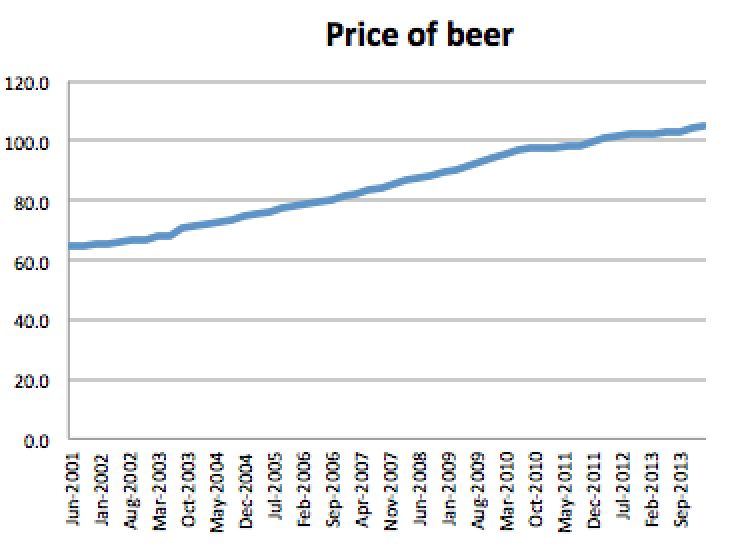
Incidentally, the price of beer has shot up too, and given how much of my student budget went on that, I’m glad I attended university over a decade ago.
For wealthy people from wealthy families, living at home is a simple matter of balancing material comfort against mild embarrassment. Kids who choose to live at home are a grand source of humour and pensive Guardian opinion pieces.
But really, the option is a blessing for those of us whose parents have stable housing situations. Not everybody is so fortunate.
Its share price has doubled in the last twelve months, taking its market value to $25 billion, as its cars are voted Car of the Year, Best Car Ever Tested, etc.
By pricing electric cars in the $100,000 – $200,000 range, Tesla have made them highly desirable. (Performance may also be helping. The Tesla Roadster reaches 100km/h in 3.9 seconds.)
Tesla has an eye for good PR. But this is more than that. It’s an attack on the whole patent system.
“When I started out with my first company, Zip2, I thought patents were a good thing and worked hard to obtain them. And maybe they were good long ago, but too often these days they serve merely to stifle progress, entrench the positions of giant corporations and enrich those in the legal profession, rather than the actual inventors. After Zip2, when I realized that receiving a patent really just meant that you bought a lottery ticket to a lawsuit, I avoided them whenever possible.” – Elon Musk, June 2014.
Musk has tapped into something vital. Patents (like copyright and trademarks) have long since broken their moorings to the island of usefulness and drifted off into an ocean of fantasy, where piratical lawyers rule the waves.
It’s not just inventions that can be patented, but “business processes.”
For example, Amazon patented “one-click shopping.” That means every other online store has to make sure you click twice to buy online, license the “process” or risk a patent lawsuit from the internet commerce giant.
Patents are private property though, so this should be fair enough, right? Wrong. From society’s perspective, possession of patents is very different to possession of something physical.
Owning an idea is a contrivance invented for the sole purpose of encouraging ideas. But ideas work best when they spread. A patent is therefore of most value when it balances encouraging new ideas and spreading existing ideas. Exclusive, indefinite use of a patent is arguably worse than never having a patent at all.
Some industries thrive without patents. Australia’s restaurant industry, for example, is electric with innovation. But you never see a chef hiring a patent attorney to show that a pumpkin and fennel soup on a menu across town is similar enough to warrant the paying of royalties.
A patent for a process for turning warm bean juice into a big deal by the application of hipsters? I may have just made a fortune with this idea.
The Australian government’s current review of competition policy has patent law under the microscope. The issues paper (released April 2014) appears to show willingness to move Australia even further from the clutches of the patent trolls.
“…[P]roviding too much protection for IP can deter competition and limit choice for consumers… Are there restrictions arising from IP laws that have an unduly adverse impact on competition? Can the objectives of these IP laws be achieved in a manner more conducive to competition?”
That could see patents renewable where a new use can be found for an existing product, and copyright protections lasting up to 70 years beyond the life of the author.
“Australians could pay more for drugs and medicines, movies, computer games and software, and be placed under surveillance as part of a US-led crackdown on internet piracy…” according to an article in the Sydney Morning Herald.
In Australia at present, copyright is a bigger issue than patents.
Consider the copyright over the tune “Kookaburra Sits in the Old Gum Tree.” That classic children’s tune was composed in 1932. But when, in 2008, a faint similarity was heard with the Men At Work song Land Down Under (itself released in 1981) the record label that owned copyright to Kookaburra pursued the songwriters. Some months later Men at Work’s Greg Ham – who played the riff deemed to be plagiarised – was dead by his own hand.
The courts required five per cent of royalties from the hit song to be paid to the owner of the copyright, and in 2011, the Federal Court refused to hear an appeal.
(The Song Happy Birthday is also copyrighted. It is owned by Warner/Chappell Music, which collects a reported $2 million a year in royalties.)
I’d be willing to sell off every childhood song we have, from Twinkle Twinkle to the Incy Wincy Spider, if it spurred more innovation in childhood songs. Similarly, I’d be happy for patents to establish a chokehold on the technology industry, if they clearly generated better products for consumers.
And that’s what inspired this surprising move by Tesla. Let’s hope many more follow them.
“Technology leadership is not defined by patents, which history has repeatedly shown to be small protection indeed against a determined competitor, but rather by the ability of a company to attract and motivate the world’s most talented engineers. We believe that applying the open source philosophy to our patents will strengthen rather than diminish Tesla’s position in this regard.” – Elon Musk
In order to answer this question, I’ve surveyed six people who started PhDs – friends of mine – from the following fields: physics, biology, computer science, chemistry, economics and history.
Five emerged from their programs with a Doctorate, one turned theirs into a Masters. (Given the PhD completion rate in Australia is 60-61 per cent, this sample is biased towards survivors.) One works in academia.
Their answers make a very interesting set. But before I let them speak for themselves, a confession: I was accused of asking leading questions. It may be true, but it’s the zeal of the convert.
As an undergrad, surrounded by lecturers with PhDs, I wanted one too. Then I got a job offer at the end of my degree. Starting that job I met plenty of public servants with doctorates. We were doing the same jobs, making the same pay. I came to see my desire for a PhD as the result of sample bias: Most powerful people in universities have PhDs, but most people with PhDs are not powerful people in universities.
With that noted, let’s hear from the experts!
BENEFITS OF A PHD?
Physics at Australian National University: I’m a researcher/lecturer, which I fundamentally couldn’t do without my PhD of course. I haven’t had any other profession since graduating. On a personal level, I really enjoyed it. I learn’t much more than just the topic of my thesis. I really learnt a lot about problem solving, logic, and life from being in close contact with world class researchers. During my PhD, I had the pleasure of interacting with four Nobel laureates at various times.
Biology at Melbourne University:I became a specialist in a very narrow field of study, possibly even an expert in said field. I also gained valuable generalist skills in experimental design, data analysis, working independently and as part of a team, critical thinking and the effective oral and written presentation of data and ideas. A PhD is also an exercise in persistence and perseverance, not necessarily intelligence, so I consider that most people who have completed aPhD are good at troubleshooting and are quite resourceful.
Computer Science, RMIT: I (arguably) got my foot in the door of my first job in industry from my PhD, and some of the domain knowledge I acquired there was useful in my job. My written and verbal presentation skills were also improved during my PhD, and I learned to have a healthy disrespect for authority. I also had a lot of fun! I found my PhD years to be quite relaxed (despite the odd moment of stress) and it was actually quite a nice transition between undergraduate spoonfeeding and the “real world” of the workplace.
Chemistry Masters, ANU: Benefit is a fancier CV. Without a masters I wouldn’t have gotten either my first or second job in consulting. In terms of education I am far more adept at seeing the ulterior motives and ugly manipulative side of people after working for my pitiable (but totally hatable) supervisor.
Economics, Oxford: Time to read and develop deeper / broader domain knowledge. For me, that was Chinese language, China’s economy and history, econometric techniques. Got supervision re: use of econometric analysis and thinking through data, and technical skills. I also played a lot of squash and improved my cooking. Those are the main benefits!
History, Melbourne University: For me, the three years doing it was probably the biggest benefit. I had a scholarship which is a privileged position to be in because it enables you to study something that fascinates you without having to work full time. I had a clear idea of what I needed to achieve each day, and if I got it done more quickly I gave myself the rest of the day off. More recently there have been career benefits I think, but like many people when I finished the thesis I wanted to do something totally different from research.
Graduation day.
DOWNSIDES?
Physics at ANU: More than once I felt like quitting. In hindsight, the pay is tiny compared to what you could be earning, but I didn’t really think about that at the time. You have no guarantee that you will finish. There are people who try as hard as they can for over 4 years and come away with nothing.
Biology at Melbourne University: The downside is that you are very cheap labour at the bottom of a pyramid scheme. You know that chapter in Freakonomics where drug dealing is compared to a pyramid scheme? Well, I’d change the “drug dealing” to “research” and “academia” and the chapter would still be quite accurate (minus the crack cocaine and guns). Everyone’s ego is complimented when they are asked to do a PhD. What hindsight has taught me is that there is very little money in Australian research and really not enough for most senior researchers (lecturers etc) to hire employees (such as postdocs or research assistants) so there is a huge reliance on the cheap PhD labour that the federal government (or uni) pays for.
Computer Science, RMIT: I didn’t earn that much money (although I found my stipend to be perfectly adequate) and, obviously, my entry to the workforce was delayed by a few years. In terms of climbing the career ladder it was probably not great bang for buck, but I don’t care too much about that sort of thing so don’t consider that a downside.
Chemistry Masters, ANU: Downside was three years of near-suicide misery and lost opportunity. I could have done a law or engineering degree in that time. I still feel that sense of loss – I am always years older than my peers.
Economics, Oxford: Long distance relationship. I’m not sure Oxford was the best place for me. 3-4 years out of workforce and foregone income and job experience.
History, Melbourne University: Honestly, the main downside was the public speaking obligations and pressure to publish along the way.
The academic job market is tight
WHO SHOULD START A DOCTORATE?
Physics at ANU: I believe that you shouldn’t do a PhD because you want a piece of paper that says “I have a PhD“. The people who I know who were trying to prove something, either to themselves or to others, always had a terrible time. If you have had a taste of research, and still feel like more, then you should consider a PhD. There’s also the question of talent. There are people who love science, yet just aren’t cut out for research. Fundamentally, if you’re not driven by curiosity, and have a hunger for discovery, specifically towards your project, you probably shouldn’t be there.
Biology at Melbourne University:I actively discourage most people from starting a PhD. For most professions, the experience you gain in the workplace will be better. For anyone wanting to do scientific research, then permanent positions in Unis or CSIRO are few and far between (see pyramid scheme comments above). With this in mind, I know plenty of people who I did my science PhD with who now work outside of academia, in the public service, as patent attorneys, as technical sales reps, and in private biotech/pharma firms and consulting. Someone contemplating a science PhD should realise that these non-academic jobs are actually where they are most likely to end up and then determine whether a PhD is really still necessary. And realise that their PhD supervisor is always going to encourage the singular academic trajectory (ie they are much happier to be a reference for further academic appointments than anything else).
Computer Science, RMIT: To consider doing a PhD you will need to be convinced you have the necessary skills and temperament to undertake a prolonged exercise in independent research, and at least one of the following should be true:
-You think you will enjoy doing a PhD for its own sake;
-Your chosen profession requires a PhD (e.g. academia);
-You will acquire **specific** skills that will help your career in your chosen profession.
These are bad reasons to do a PhD:
-You’re not sure what else to do after you finish your undergrad;
-You think it would be cool to get to call yourself “doctor”;
-You expect some ill-specified career advantage from having one;
-Your parents would be proud;
-It’s “prestigious”.
Chemistry Masters, ANU: The only people who should do PhDs are either saintly types who just love their subject and have no expectation of any type of employment related advantage or psychopathic sadists who will enjoy destroying promising young people.
Economics, Oxford: Almost definitely do one: if you want to become an academic; its paid for; have world leading supervisor who has top track record of placing their students into great academic jobs; at world class research institution, great city, great classmates etc.
Never ever do one: in the opposite scenario: Unsure if academia is the path; not at top ranking place and doing a major where job placements are super tough; where PhDs take 6-7 years; or living in a shit city.
History, Melbourne University: The peers I had that struggled the most were those who set themselves additional challenges such as designing research involving lengthy ethics processes and multiple methods, including undertaking lots of complex interviews and all the responsibilities that come with that. This type of research makes a huge contribution to the evidence base but goes well beyond the three years you sign up for and requires a significant time investment in project management.
There’s more than one way to prove you are a big shot.
WHAT PROPORTION OF SMART UNDERGRADUATES SHOULD SERIOUSLY CONSIDER IT?
Physics at ANU: Only those who tick the boxes in the above question. How many PhD grads do we need? Well, that’s a different story. In the Australian employment market, a PhD isn’t really valued. From an employment point of view, the only reason to do a phd is if you want to become a researcher. The number of permanent research positions that open up every year, divided by the number of phd graduates is bugger all squared.
Biology at Melbourne University: A large proportion of smart undergrads will contemplate it, and even be asked by lecturers to do a PhD. As above, I would suggest that only a very few should take it up. There are too many easily available PhD scholarships in this country and not enough investment in other parts of the research infrastructure, hence the pyramid scheme. If they are smart, they can get the benefits I mentioned above from plenty of other roles.
Chemistry Masters, ANU: Maybe 5 per cent of undergraduates? We need to rethink PhD candidature. There are things to be learnt, but should acknowledge that phd students teach each other and are self taught in what can be an educationally nutritious environment – it all depends on the calibre of your fellow students. With ten students to a professor this will always be the way. The idea of charging tuition for a PhD is outrageous. My only hope is this will decimate the ranks of the fools who sign up for one.
I see PhD years as a type of national service, where you accept below minimum wage for contributing to the R&D pie for the nation. We should acknowledge this and stop pretending it is training for an academic or other research career – those jobs don’t exist. Also we should acknowledge that growing the R&D pie is of national importance. Slave student labour will be cheapest.
Also I would like to see universities sued for misleading students regarding their employment prospects. Or scolded for false advertising. A PhD contract (because you sign a contract) should include a disclaimer with real graduate outcome figures. And then you should have a counselling session to determine if you’re likely to kill yourself.
Economics, Oxford: I’m not going to tell anyone they shouldn’t do it if they’re interested. I just think they should be fully aware of the academic labor market conditions and that it is in supervisor’s interests NOT to be fully candid / upfront about this. By this, I mean how tough the market is, especially in humanities, etc.
History, Melbourne University: Lots. It’s important to have a great topic and a good supervisor and that you like to work alone a lot. I worked part time doing something completely different which was a good balance for me.
—
I feel like we got a great range of answers there, with evangelism from both sides and plenty of middle ground. No matter your pre-existing biases, there is something to grasp onto!
The 2014 Budget is the most significant in a long time. I have an eager – some would say obsessive – interest in federal budgets, and I cannot remember a Budget that has got as much attention as this one.
Today marks four weeks since the second Tuesday in May, and Budget headlines are still around. For example:
I went through the internet archive. It shows the 2014 Budget produced not only a much bigger spike in interest in the Budget, but a much longer tail. It is not common for budgets to be sparking discussion three weeks after they are released – people normally move on fast and a government only dreams about getting three weeks of “traction”.
The graph above compiles mentions of the word Budget on the homepages of The Age and The Australian in the month around the Budget. I did an analysis for 2008 too, because the first Budget of the Rudd government would be a good comparison to the first Budget under Abbott. The data is a lot more spotty, but the pattern is the same. In 2008, Budget headlines died out after no more than a week.
Google trends data confirms that this Budget was a whopper as far as public interest goes. The graph below shows share of searches from within Australia. (Google omits the vertical axis – I guess that’s proprietary data).
Imagine putting your money in the bank, and getting a negative interest rate. You’d want to get it out again as soon as possible, right? That’s the point.
If the interest rate is negative, the central bank is goading you into using your money, not just sitting on it. That should mean more spending. More spending makes more jobs. And like this they hope to get Europe out of the quicksand of high unemployment.
So, if this works, how come it’s never been tried before?
The thing is, interest rates don’t just work on their own. You’ve got to consider inflation. If you get 2 per cent interest on your deposit but inflation is 3 per cent, then really you are losing the purchasing power of your money. (in the business this is called “negative real interest rates” where the word “real” means inflation is taken into account).
You can make “negative real interest rates” by setting the interest rate below inflation. That’s easy. The problem in Europe is there’s so little activity that inflation is very, very low. They have to make the advertised interest rate negative to get the “real” interest rate negative.
Now, it’s worth noting that the negative interest rates don’t apply to the average punter. They are for the deposits that banks have with the central bank. (Millions and billions of euros every night).
The reason for that is simple. If you or I see that the $11.50 we have in the bank is attracting a negative interest rate (here I am ignoring the “real” interest rate), there’s a simple trick we can use – take it out of the bank and turn it into cash. Cash gets an interest rate of zero, so that’s a lot better than leaving your money in the bank.
If you only have your money in electronic form, there’s no way to avoid keeping it in a bank account. You can’t put 1s and 0s in a shoebox under your bed.
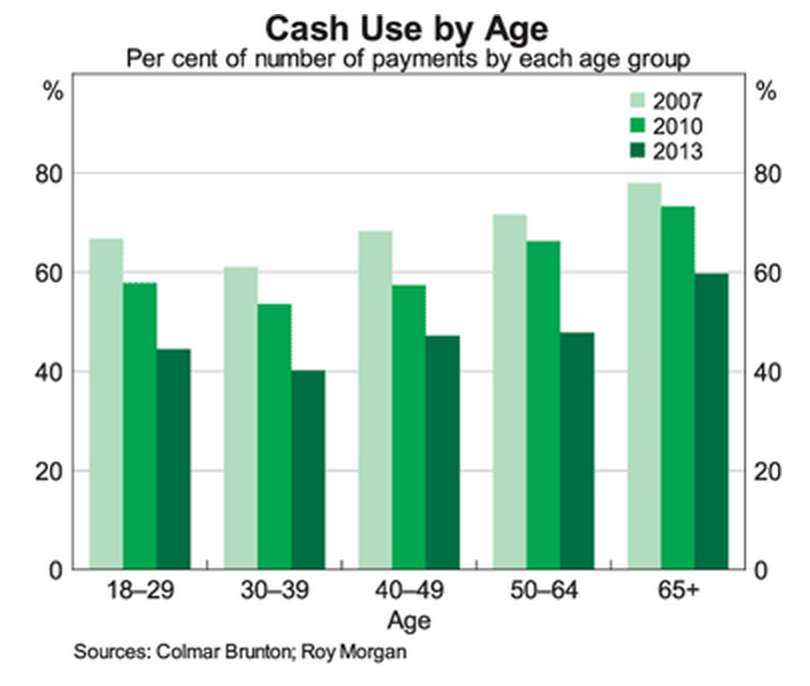
Negative interest rates would not necessarily cause a riot. Bank fees already work in such a way that we’re used to seeing our bank balances retreat when left alone. A cash free future is plausible. People are using cash less and less.
Cash use falls sharply in all age groups. (Source: RBA)
While the rise of Paypass could end up stranding us in a future where we actually pay banks to hang onto our money instead of the other way around, there are other innovations that make a cashless society with negative interest rates unlikely.
I am talking about Bitcoin. The rise of a kind of cash that is beyond the control of central banks means attempts to control rates on government-issued cash are more futile than in the past.
“Alabama-born, Dallas-raised Jeremy Sutphin, chef at Le Bon Ton, attributes it to adventure and awareness. ”I’ve been here eight years and the palates are searching for something different – and people are becoming more aware.” “
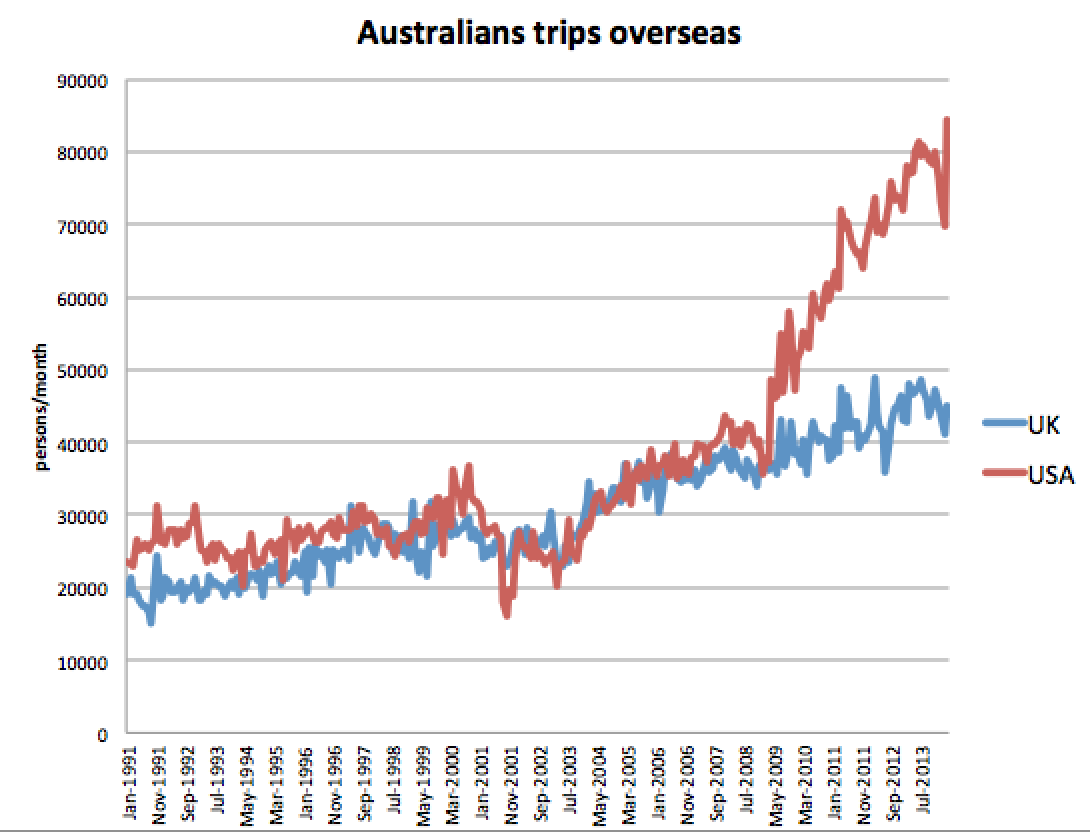
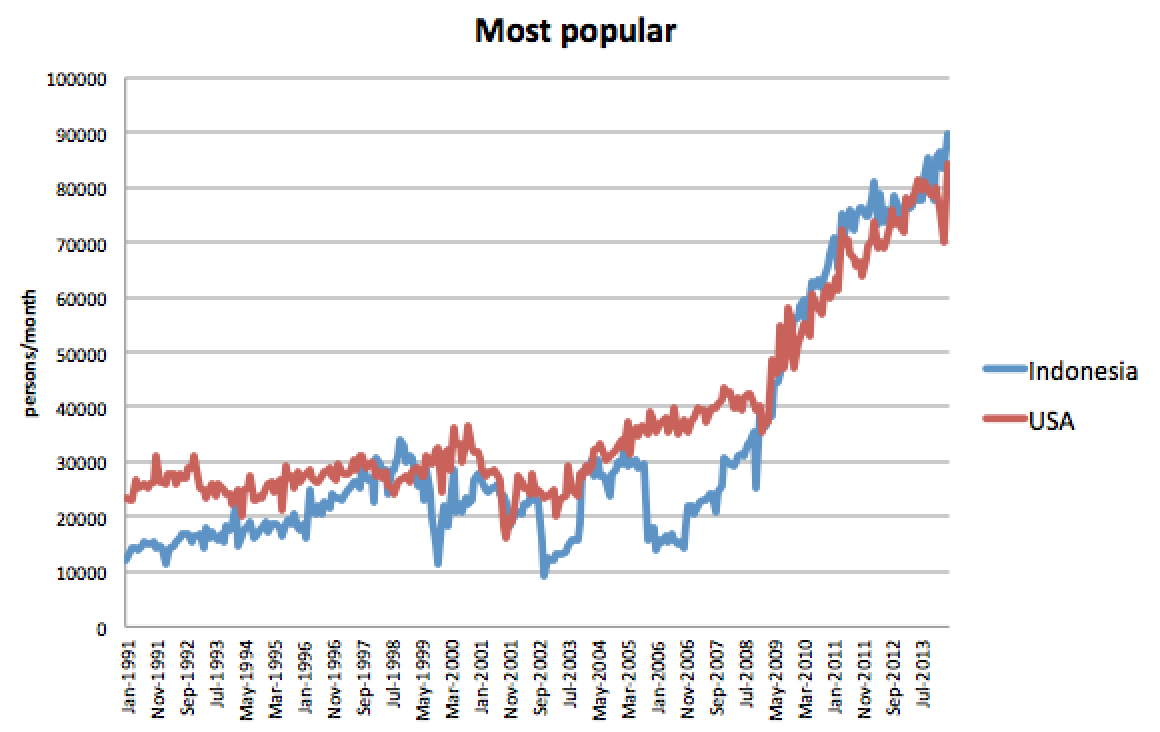
He’s right about that awareness. Australia’s knowledge of America is now a lot deeper and wider – we’ve now been to America enough that we’ve ventured beyond LA and New York.
“This agreement will be good for competition and it could … lower airfares.”
We’ll forgive him for not predicting the great barbecue explosion of 2012/13/14.
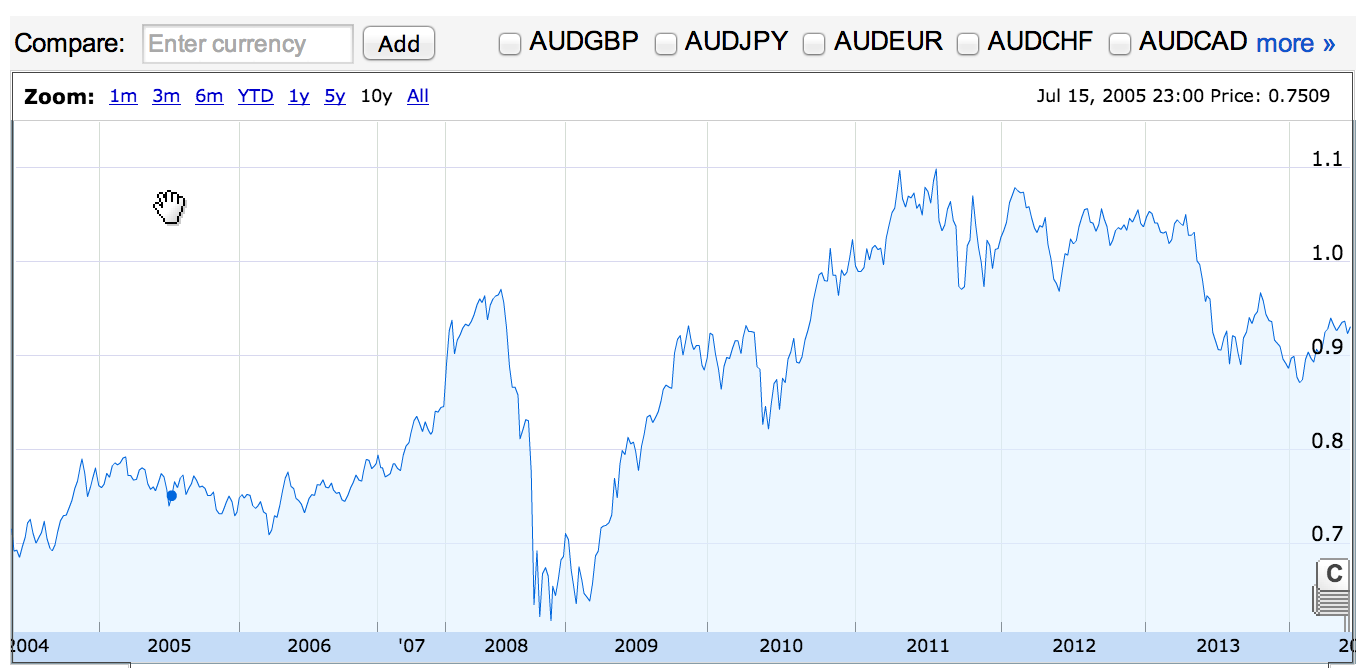
Of course, post-2009 also coincides with a much higher Aussie dollar. There were three good years there where you could buy a greenback for less than one Aussie dollar. Of course, those days are behind us.
So if travel predicts what we’ll be eating next, what’s the next big wave?
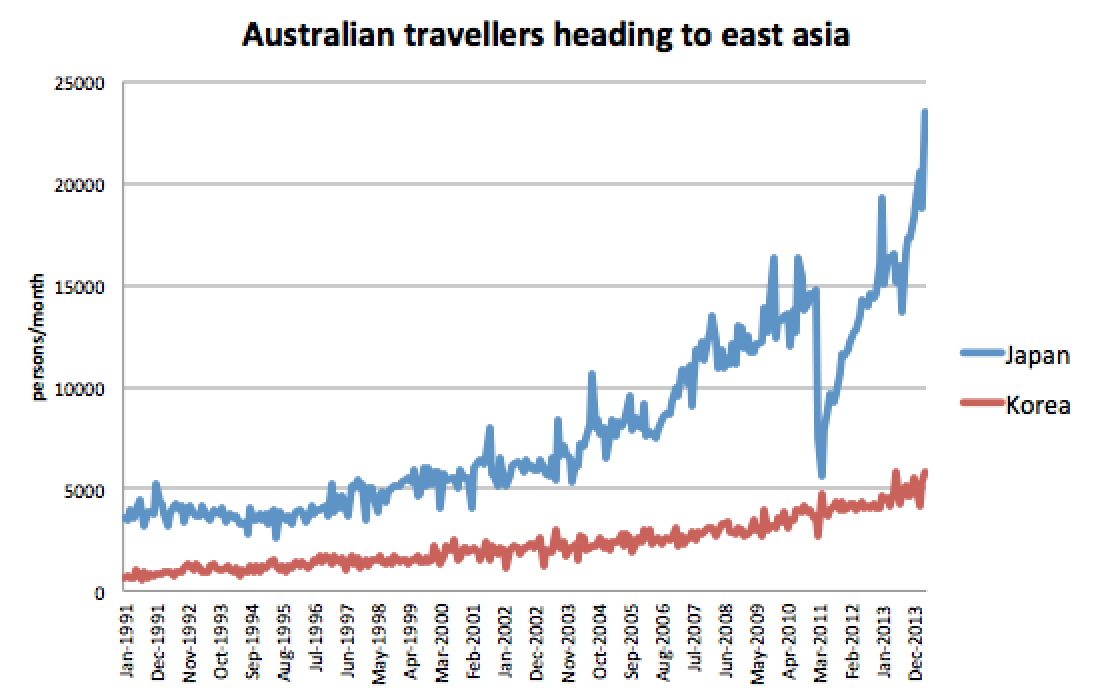
Might a renaissance of Japanese cuisine be on the cards? Perhaps. But Japan’s post-Fukushima bounce back still looks modest compared to other places Australians love to fly.
There is one extremely popular destination still terribly under-represented at the fancy end of the food business.
Indonesia’s surge is even bigger than America’s. Looks like queueing up to pay $40 for a plate of nasi goreng cannot be far away.
Talking about narrative goes deep into policy making circles:
“Narratives are stories, in whatever form they take – oral, written or visual. Conventional narratives in literature, the theatre or the cinema have a beginning, middle and end. Good ones provide drama, arising from a predicament that ensnares the principal character; they have plenty of action – the steps the character takes to escape the predicament – with unexpected plot twists and complications thrown in; and there is a resolution, culminating in the achievement of a visionary aspiration or objective. Economic narratives have some similarities.”
All this talk about narrative in politics has coincided with what many people agree is a golden age of story-telling in the ascendant medium of television (1, 2, 3, 4)
But I see no sign of politicians learning from it.
Our leaders scarcely ever admit to watching the box. They prefer to project an image of someone working tirelessly for their constituents. Why have they spurned the chance to learn from TV?
Politicians fetishise staying on message. That – they believe – is the only way to get voters to hear the one thing you want them to hear. It is true only if you assume that people won’t be listening, and it is a catch-22.
Would you tune into a show where the main character just repeated the same lines, week-in and week-out?
What about a show where they never admitted they were wrong? Never grew as a person? Never got into trouble and squeaked back out?
Our political characters all claim to be good people from ordinary backgrounds, and play down their weirdness. It’s immensely boring.
They end up with a script that’s all issues, no characters. But (most) humans don’t care about issues in the abstract. We are drawn to characters.
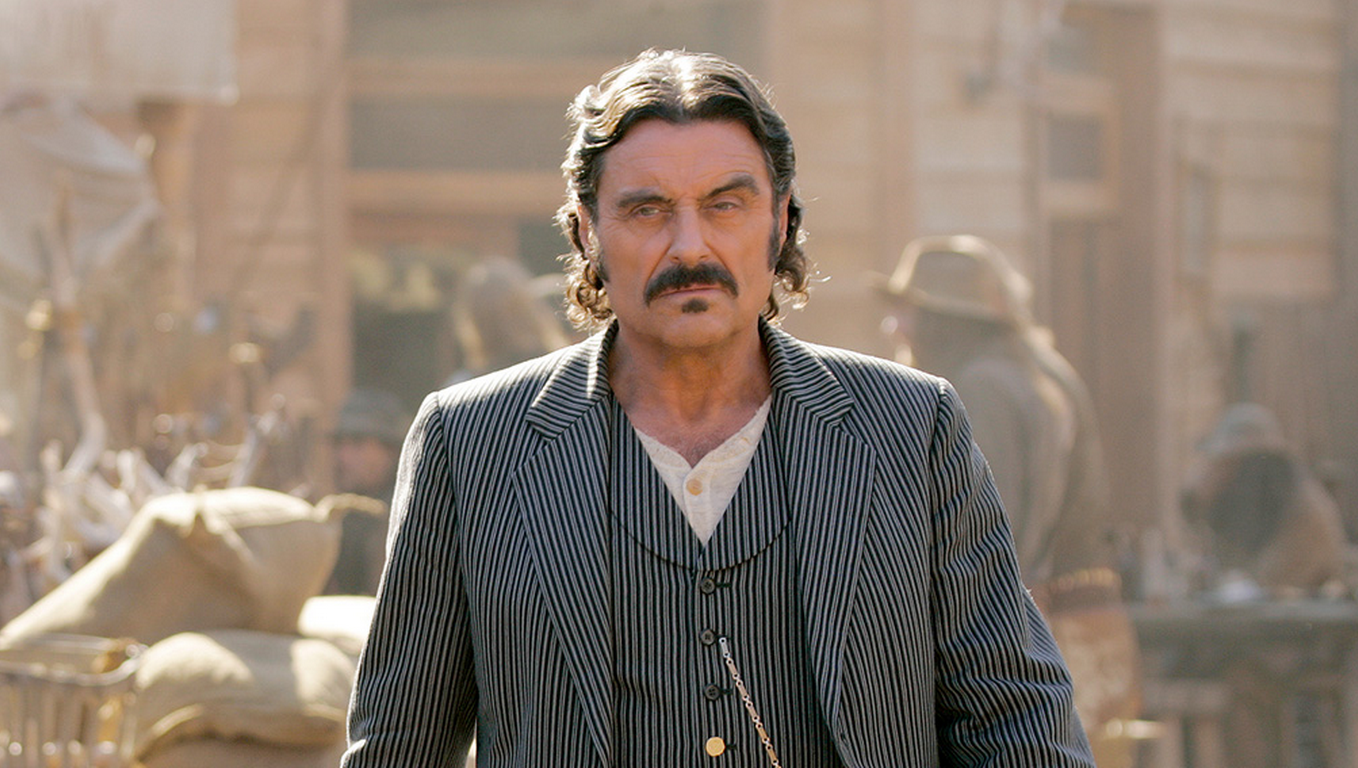
In the HBO western Deadwood, the opening credits are all about a tough but fair sherriff called Bullock. But after a few episodes Bullock’s role fades and the writers turn saloon-owner Swearengen into the main focus.
He’s a murderer, bully and brothel owner. But his motivations and relationships are complex. They make us love him in the end, and we forgive far more from him than we would from the rest.
Viewers don’t mind complexity. We can even feel for Sergeant Brody, the muslim terrorist at the centre of Homeland, because we get insight into his home life and terrible back-story.
We barrack for Walter White from Breaking Bad, who is a meth cook. We barrack for Omar in The Wire and the inmates in Orange is the New Black. All because we get to know them. We see not only their strengths but their weaknesses. We see them as humans, not message delivery machines.
Can politicians learn from this?
I’m not saying the front benches should start dealing drugs. Just that it doesn’t hurt to show a little of their real struggles. There should be plenty there. Difficult lives turn people to politics and politics is hard on humans.
A political career is a story written over the really long-term. It is not a movie. If it is to remain compelling, the main characters have to have depth. Depth means complexity and complexity requires ambiguity.
At the moment, political narratives strive to kill ambiguity. But this generates only the most superficial interaction with issues.
We might actually be a chance of engaging with university reform if we saw how Joe Hockey’s mother-in-law hates him for it, if we knew it kept him up at night, if we saw how his background and values explain why he balanced it off against other priorities.
As presented, there’s no meat to the political narratives. They are the kind of narrative you might get in a child’s story book. See Spot Run appears to have inspired See Joe Repair Budget.
There is little to grasp on to in the Coalition’s story. Nothing to stop us from painting them as simple villains. Nothing to stop us rolling our eyes and changing the channel. Nothing to make us focus in the short run, empathise in the medium run and barrack in the long run.
Bill Shorten could learn a lot from Batman. We know more about how Batman begins than Bill begins. Why is that?
But it doesn’t just have to be about the leaders. The Avengers or Oceans Eleven may be an even better metaphor for a political party. A raggedy team with distinct flaws and skills have to fit together to get a job done. There’s alliances and fractures that keep us focused on them, and those alliances and fractures are strengths, not weaknesses, in the narrative. Political parties try to keep talk of factions down. But they can be a fascinating sub-plot.
There are some politicians that modern messaging experts can’t explain. They include Bob Katter, Clive Palmer, and Lee Rhiannon. These people understand something of how eye-catching, complex characters can take an outsize role in a narrative. But does the political world learn from them?
Politics is much like it was 20 years ago and the time is right for a change in the way it is practised. It is a cozy old duopoly using old school communications techniques that are increasingly out of favour with the youth. In TV terms, the major parties are the Simpsons and the Bold and the Beautiful. Popular once, they are now the same old thing over and over.
Who is authoring The Sopranos of politics, writing a script that looses the foundations and doesn’t care who it shocks?
Is it Clive Palmer? Or is he just some sort of free-form experiment, like a drama student let loose with a digital camera.
When will we get a real narrative made up of characters real Australians actually care about? I cannot wait for such a show to hit the air.
Imagine you’re doing some internet shopping. You want some shoes to replace a favourite pair that is worn out. You type in the name of the place where you got the last pair, and click the first link that comes up. You choose the exact same pair, sling the credit card, and start waiting for the postman.
The shoe retailer sees this: someone searched for their name, clicked the link they paid Google to install, and then went on to make a purchase. They add that to their return on investment for buying ads associated with their own company name.
“search advertising only works if the consumer has no idea that the company has the desired product”
This also applies for ads with both the retailer name and a product in it. Like “Myer suits” or “Kogan TV”.
The effect of suspending paid search for branded terms like ebay shoes
The research is not some wishy-washy lab experiment. It was done by eBay Research, and involved a giant control experiment. eBay started by cancelling all the paid search advertisements for terms like “ebay shoes” in 30 per cent of America.
It then widened the experiment to non-branded searches, like “shoes”
What it found was startling: “on average, U.S. consumers do not shop more on eBay when they are exposed to paid search ads.“
The reason is this. Search engine marketing causes a big leap in traffic from people that have never used eBay before. But a vast majority of people that use eBay are experienced users. because the search engine can’t target the newbies, the return on investment ends up being very poor.
“consumers who have completed at least three eBay transactions in the year before our experiment are likely to be familiar with eBay’s offerings and value proposition, and are unaffected by the presence of paid search advertising”
effect of paid ads is very low among frequent users
So search engine marketing is still good for people who don’t regularly use your site. But here’s the rub. Among people who shop on eBay all the time (50+ purchases a year), they use paid links 4 per cent of the time. eBay pays for all those clicks and an unsophisticated measure of the effectiveness of paid advertising would therefore show that paid links are effective.
Turning off ads left eBay with 99.5 per cent of its normal sales. The differences between the period with ads and the period without are far from striking:
Obviously small companies can still get bang for their buck advertising online. But big companies perhaps less so, and that might hurt Google.
“Of the $31.7 billion that was spent in the U.S. in 2011 on internet advertising, estimates project that the top 10 spenders in this channel account for about $2.36 billion.”
The study can’t reveal eBay’s actual expenditure on Google paid search, but it uses an estimate of $51 million a year, based on google’s public statements. That delivers a return on investment of -63 per cent.
Forget the millions spent on building a brand that was recognised immediately across the state.
Forget the strategies that have made Victoria the clear leader among the states on cutting injuries and fatalities for years. (source)
Worksafe was a brilliant invention. By combining the regulator of workplace safety with the insurer, the economic incentives are all aligned. The company wants to reduce injuries, keep its customers happy and get the ill and injured back to work.
It’s a revolutionary piece of policy-making (mirrored in the design of the Transport Accident Commission, which has helped bring automobile accidents down to their lowest level in history, and among the best in the world.)
A huge part of the job of Worksafe is raising awareness of dangers in workplaces.
This is why Worksafe spent big bucks using proper advertising agencies and sponsors the Western Bulldogs. We are all familiar with its very successful advertising campaigns.
Awareness is enormously important in promoting safety and Worksafe has always used free publicity too. Whenever a prosecution or fatality happened, Worksafe would put out a press release, and papers would report on it.
Worksafe could not prosecute every little business with a safety breach. Amplifying successful prosecutions creates the impression firms face legal risks if they do not focus on safety. Worksafe would also issue a press release whenever a worker was killed or seriously injured at work. This served to keep workplace safety in the news.
But then.
In late 2013, the Hon Gordon Rich-Phillips, minister in charge of Worksafe, must have spotted one of these stories in the newspaper. Was Worksafe “anti-business”? Things changed.
The honourable member is an amateur aviation enthusiast.
Since then, Worksafe’s media strategy has transformed.
Worksafe issued 41 press releases in the first part of 2013. They did not stint on death and blood and gore, or big whopping fines.
But 2014 is extremely sanitised.
A change of tune
And it’s not as if there was nothing newsworthy. For example, at a factory owned by the company that makes Kettle chips and CCs, a man was dragged into a conveyor belt and lost his arm above the the elbow. That resulted in a $45,000 fine in February.
The organisation that was a world-leading innovator in public policy is no longer free to run in the best interests of workers and its own insurance scheme. It now dances to the tune of the government.
Now new ads have hit the papers with the name Worksafe nowhere to be seen.
“The important work that we do across Victoria is much broader than just safety, so using our legal name – VWA – better reflects all areas of our business” – the press release.
Changing your brand when you’ve spent so much on it will make your organisation less effective.
People are already confused about the difference between the Victorian Workcover Authority and Worksafe. (They are the same. The former is the legal name of the organisation. The latter was an effective brand designed to reinforce the idea the organisation should be more dynamic and less bureaucratic .)
Emasculating this powerful and effective brand will mean more injuries. Workers will suffer, and so will business owners who do the right thing and keep their workplaces safe. They will have to pay higher premiums to cover compensation for the injured and dead.
Worksafe’s creative communications: Spare parts vending machine. [source]That a good strategy and a powerful brand can be eliminated on a whim of a minister speaks of an anti-intellectual approach in the Coalition party-room. The state government ought to be ashamed.
I’ve spent the week scouring the FIFA website, making spreadsheets of the group stages, watching old videos on YouTube, and following Socceroos on Twitter. It’s a clear case of World Cup fever.
Ever since the 2002 edition, I’ve been hooked. I’m not a big follower of local or European soccer, but playing the game on a world stage changes it – not unlike how track and field suddenly becomes fascinating for two weeks every four years, during the Olympics.
I had a formative experience during the World Cup in 2002. I watched Brazil score 6 goals in a couple of early round matches, while other teams looked defensive and dour. That kind of attack was going to be hard to beat, I reckoned, so I popped $10 on them to win at 8-1.
A couple of weeks later I watched Brazil trump Germany in the final and took my winning ticket down to cash it in.
The next two World Cups were especially exciting because Australia was finally involved. I remember being awake and very excited in the early hours of 13 June 2006, when Australia scored three (three!) late goals to win their first world cup match in 20 years.
But expectations are a lot more modest for Australia in the 2014 Cup. Instead of having just one powerhouse of global football in our group, we have two. Spain and the Netherlands. The third group member, Chile, is actually ranked higher than the Netherlands on the FIFA tables. Australia is the lowest ranked team in the cup and Tim Cahill is no longer a sprightly unknown who is given space to score.
Still, World Cup 2014 sparkles with excitement, and that’s mainly because of the Calcutta.
I’d never heard of a Calcutta until last week, but now I am a believer.
It’s a bit like a sweep. You may have been involved in a sweep for a horse race – you put in $2 and get some beast that runs mid-pack the whole way, leaving you with a nagging sense of disappointment.
The Calcutta is designed to compensate for that. Teams are drawn from a hat and participants bid on them. If the team is a dud, there are few bids and it goes cheaply, allowing the possibility of turning a tiny bet into a large fortune.
Our Calcutta was run last night, in the salubrious confines of the Reverence Hotel, in Footscray. (I’d like to insert here, parenthetically, an enthusiastic endorsement of the menu at this establishment and the beef burrito in particular. If gentrification means a walnut and sweet potato salad with your burrito, then I am all for gentrification.)
Before the emerging writers festival crowd took over the back bar with a poetry slam, we auctioned off eight teams and six bundles of teams.
The eight teams were: Brazil, Argentina, Spain, Netherlands, Germany, Portugal, Italy and England.
The six bundles were:
Asia
Australia, Japan, Korea, Iran
Africa
Ivory Coast, Nigeria, Ghana, Cameroon
Americas
Mexico, Costa Rica, USA, Honduras
South America
colombia, chile, ecuador, uruguay
Europe
Greece, France, Switzerland, Bosnia
Europe 2
Russia, Algeria, Belgium, Croatia
Bidding began in a conservative fashion, when the Asian group was hammered down after only two bids, contributing $2 to the total prize pool.
The prize pool (and whole event) were designed by a local gaming impresario who I shall call Marty, since that’s his real name. 65 per cent to the winner, then 20, 10 and 5 percent for the next three spots.
The interest and excitement of the Calcutta auction process lies in the fact that the value of any team depends not only on its chances of winning, but the size of the prize pool. That’s an unknown. Basically the prize pool depends on how much people are willing to spend. I tried to wheedle this information out of some of my fellow bidders before the game began, but they held their cards close to their chests.
Bidding continued with the Africa and Americas bundles going to me for $3, the only sizeable outlay came when a gentlemen born near Birmingham put his heart into a bidding war and paid $9 for England.
I’d run some analysis in advance that told me bundles were the best way to get value, so I soon set a bidding record for the South America bundle, paying $15.
The feeling of winning an auction is not purely celebratory. What it tells you is nobody else shares your confidence. It can fill you with the fear that you may have just succumbed to the winner’s curse of paying too much.
The thrill of winning a bid was often followed, last night, with a small spell where the winner retreated into themself and stared in quiet contemplation at their ticket. After I bid my $15 (enough to buy 84 per cent of a really amazing burrito) I had my doubts.
But later, as bids rose, my $15 investment in Columbia (rank 5), Chile (rank 13), Ecuador (rank 28) and Uruguay (rank 6) came to seem pretty good. I smiled when Argentina (rank 7) sold for $36.
The auction was fun, involving at one point phone bidding that saw Portugal sold to an outside party. We joked about creating a derivatives market and on-selling our early buys at a profit to anyone who hadn’t been present.
But the big excitement of the evening was the auction of Brazil, host country and favourite. Nobody expected the way the bidding war would turn out for that.
Bidding rose swiftly above the highest price paid. Everyone could see Brazil still offered value, relative to previously auctioned teams and also to the total pot size. But with participants already having invested substantially, and budget constraints starting to loom (did anyone really want to go home and explain they spent $50 on a single bet?), syndicates quickly formed. Two syndicates – one of three persons and one of two – took the bidding up above $50, until finally the Calcutta auction was over with a total prize pool round $200. Markets work, people!
A most satisfactory way to spend a Thursday evening – plus I now have a dozen non-Australian teams to support in the World Cup!
(Back to that derivatives market. If you’d like in on this Calcutta, it’s not too late to buy a team! Make me an offer…)
The shot tells a story of changes in technology and economics. For starters, there are four horse-drawn carts in the photo.
While a busy Friday night in 2014 might still see a horse and carriage at this intersection, in 2014 they’d be pulling regretful tourists, not valuable cargo. The decline of the horse and rise of the car coincides with the industrialisation of the fuel-making process. In 1927, oil company Mobil was just 16 years old.
The tram stops also tell a story of change, not so much in technology as values. The tram stops of the jazz age – located in the middle of the street, amid a stream of traffic – amount to little more than a bit of paint on the ground. That has changed. Tram stops now are highly protected from traffic, probably because the value society places on human life has risen along with wealth and productivity.
One familiar thing in the shot is traffic. We see cars stacked three across and two deep, getting ready to hook turn from Flinders St onto Princes Bridge in the foreground of the shot. (For non-Melbourne readers, the hook turn is a unique form of torture inflicted by this city on unwitting drivers, for the purposes of mirth.)
The street at the top of the photograph – Swanston Street – is now closed to car traffic. The externalities associated with car traffic are very clear in this intersection, as early as 1927. (I am referring not to pollution, but the way the presence of one car on the road slows down all the others.) The proliferation of cars in the last 90 years means these externalities would have developed to city-threatening proportions had the use of cars not been limited.
The crowds suggest patterns of work is much the same. But it doesn’t show the city at night, which would reveal far more differences in society, in dress codes, and the purchasing power of young people especially. Zooming in would also reveal big differences in ethnic composition, thanks to the ease of global travel.
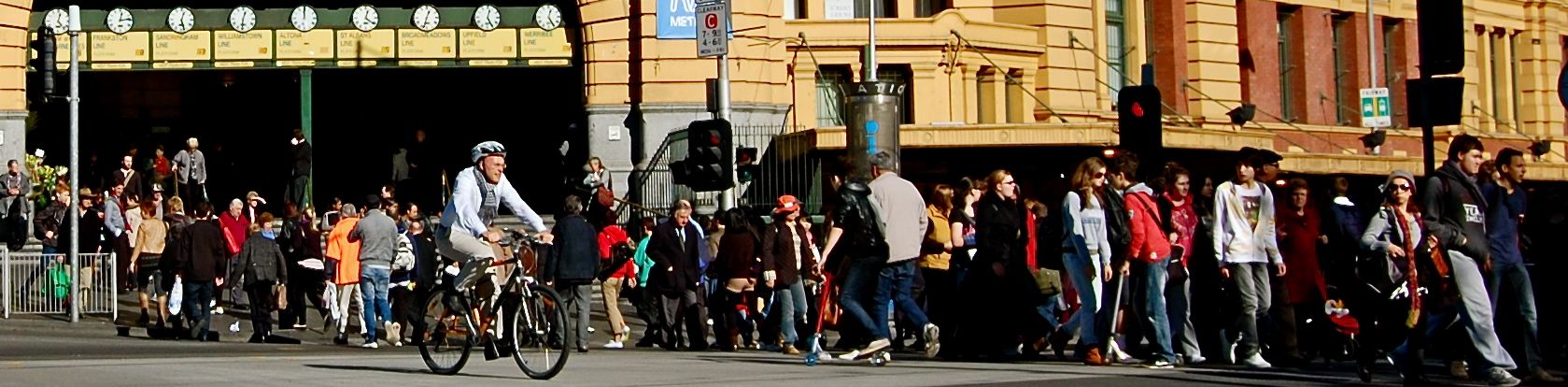
There are no bicycles in the shot, which is a surprise to me. Standing at this intersection now, you’d struggle to frame a shot without a bike in it.
Apparently cycling was extremely popular in the 1890s. That enthusiasm has seemingly waned by the time film was exposed for this shot. Will Melbourne’s current love affair with bikes also prove transitory, or is this shot just unrepresentative?
There have been a lot of technology changes since the 1920s. One of the most dramatic is in construction. Despite being a shot of the city, this photo, repeated today, would not show any sky scrapers. This area has heritage protection. Perhaps there were height controls even then – the shadows reveal bigger buildings lurk just outside the frame.
Most of the technology changes since the 1920s are at a smaller, human scale. The contents of the pockets of the people in the shot is probably where the most dramatic changes would be evident. The one clue we have in this shot to that sort of technological change is the fact it is shot in sepia.
There are a lot of lessons in this old shot, a lot of differences. But the biggest single point is probably the similarity.
The crowds swarming across Flinders St look exactly as they do today. That suggests the patterns of life – catch a train into the city, go to work, go home – have not changed too much. And three of those four corners – the railway station, the pub and the cathedral remain the same. Only the old Princes Bridge Railway Station in the bottom right is gone, replaced with Federation Square.
Swanston Street 2014
The trams in the shot are cable trams – they are not powered by electric wires but pulled along by a cable that ran beneath the street. [edit: apparently cable trams were replaced by electric trams the year before this shot was taken.]
Despite the advent of electricity and computers, trams still follow these same routes.
This shows the way infrastructure and patterns of human life endure. Technology is often first used to do the same old tasks a bit differently. We don’t quickly end up in a Jetson’s future, but a sort of inverted Flintstones, where the objects are much the same and the technology behind them is different.
His big problem is a tough budget that broke promises.
One of the Government’s signature policies is to push young people into taking work. Their policy is called “earn or learn.” It will deny the Newstart (dole) payment to anyone under the age of 25; and people aged 25-30 will not be eligible for the dole in their first six months of unemployment.
”There is no right to demand from your fellow Australians that just because you don’t want to do a bread delivery or a taxi run or a stint as a farmhand that you should therefore be able to rely on your fellow Australian to subsidise you,” said Employment Minister Eric Abetz.
The rationale is to stir up resentment at the welfare state.
“The bludger should not be our national icon.” – Rupert Murdoch, (American citizen)
It’s an entirely political, dog-whistle ploy to make underpaid workers of Australia target their resentment at the unemployed, not the managers that dine with their own remuneration committees.
But doesn’t mean the policy intent is all bad. Here’s why the policy can do good for some people (caveats follow).
Long run unemployment is also bad for the economy. Hysteresis is now an accepted fact of macroeconomics. It describes the way long periods of high unemployment make the minimum achievable unemployment rate creep higher and higher. An economy that can match people into jobs swiftly increases the welfare of future workers.
Sure unemployment is bad. But people know that and want to get themselves a job. No?
“workers are 24 percentage points more likely to accept an offer that is equal to or exceeds their reservation wage than to accept a job with a wage below the threshold.”
Wolfers’ article focuses on how arbitrary thresholds could cause irrational investment behaviour, especially the case of people being unwilling to sell their house for less than they bought it for. But the analysis could as easily apply to reservation wages, which can be set with reference to what you used to earn.
If you refuse a job because if pays $5000 a year less than your old job, but then spend months more unemployed, you may well be worse off.
These pieces of research are part of the new behavioural economics that finds predictable irrationalities in human behaviours.
It is not uncommon for social outcomes to be improved with a “nudge” toward the more rational course of behaviour. Traditionally, of course, conservatives oppose these kind of nudges, preferring to let humans remain “free”, while liberals tend to endorse them. In the case of “earn or learn,” it is more of a shove then a nudge, and conservatives are more likely to be fans of it.
I don’t want to stand up for the exact policies that the Coalition has brought in. I think they are too blunt to have a net good effect. But the concept that the labour market will reach equilibrium without intervention is also likely wrong – unemployed people should be encouraged to not just search for, but take a job.
Are all jobs equal? Sex work is legal – should young men and women be forced to take jobs as prostitutes if they are unemployed? Should young people be forced to join the armed forces, do coal mining or be prison guards? Some jobs can be really dangerous to your reputation – for example, not everyone would want to be a member of parliament.
Public choice theory argues government leaders want to create big organisations they control. The more money and people controlled by the leaders, the more powerful they feel.
Other theories argue leaders are motivated by the preferences of voters / citizens.
Crimea and its capital Simferopol
The question is extremely pertinent when a government decides it wants to expand its borders. What does a government gain by controlling more land? More sources of revenue, sure, but also more costs. How do voters weigh those?
In the case of Crimea, a little peninsula on the south side of Ukraine, Russia’s annexation has obtained it a sizeable store of energy deposits, making the adventure potentially valuable in cash terms. But the leading explanation of the decision to occupy does not revolve around Putin doing the math on oil.
Occupying more land – empire building – is a time-honoured strategy for leaders. From Rome via the Mongols and on to the British Empire a measure of greatness is territorial control. Perhaps the sort of people who can be bothered climbing the greasy pole of political leadership are never tired of attempting to gain more power. So when they rule, they feel they must rule more.
Partly this is because the international community has arranged itself to try to raise the cost of territorial expansion and diminish the benefits. Sanctions can follow.
But partly it is because dictatorship is in decline.
The best way to prevent land grabs and invasions is probably democracy. The characteristic common to Putin’s Russia and China (with Tibet in its back pocket, the south China Sea Islands almost in its grasp, and its eyes on Taiwan), is that the leaders need not fight to win votes. Once in power, their will to rule more can only be fed by expanding the territory they control.
In democracies, empire-building is defined by ruling for more than one term. Gerry-mandering, pandering to voters and rorting electoral funding rules in order to win the next election might not be ideal behaviour, but it is less damaging than rolling squadrons of tanks over the border.
From the perspective of the global economy, land grabs are destabilising. Any chance they will spark a war makes them a major risk to global output and standard of living. The sinking of a Vietnamese ship in the South China Sea, for example, is a risk to the balance of power in Asia, a balance in which the US and Australia are involved.
The motivations of powerful non-democracies remain a threat to our well-being.
LinkedIn is rubbish, we all know it. But we can’t stop using it.
Why?
We fear there are benefits of using LinkedIn that we’ll miss out on. Prospect theory calls it loss aversion, but the kids call it FOMO – Fear Of Missing Out.
Humans are wired to hate losses more than they enjoy gains. This is not strictly rational, and it means we make some bad choices.
Haunting LinkedIn might be among them.
At some level, we know LinkedIn is not worth it
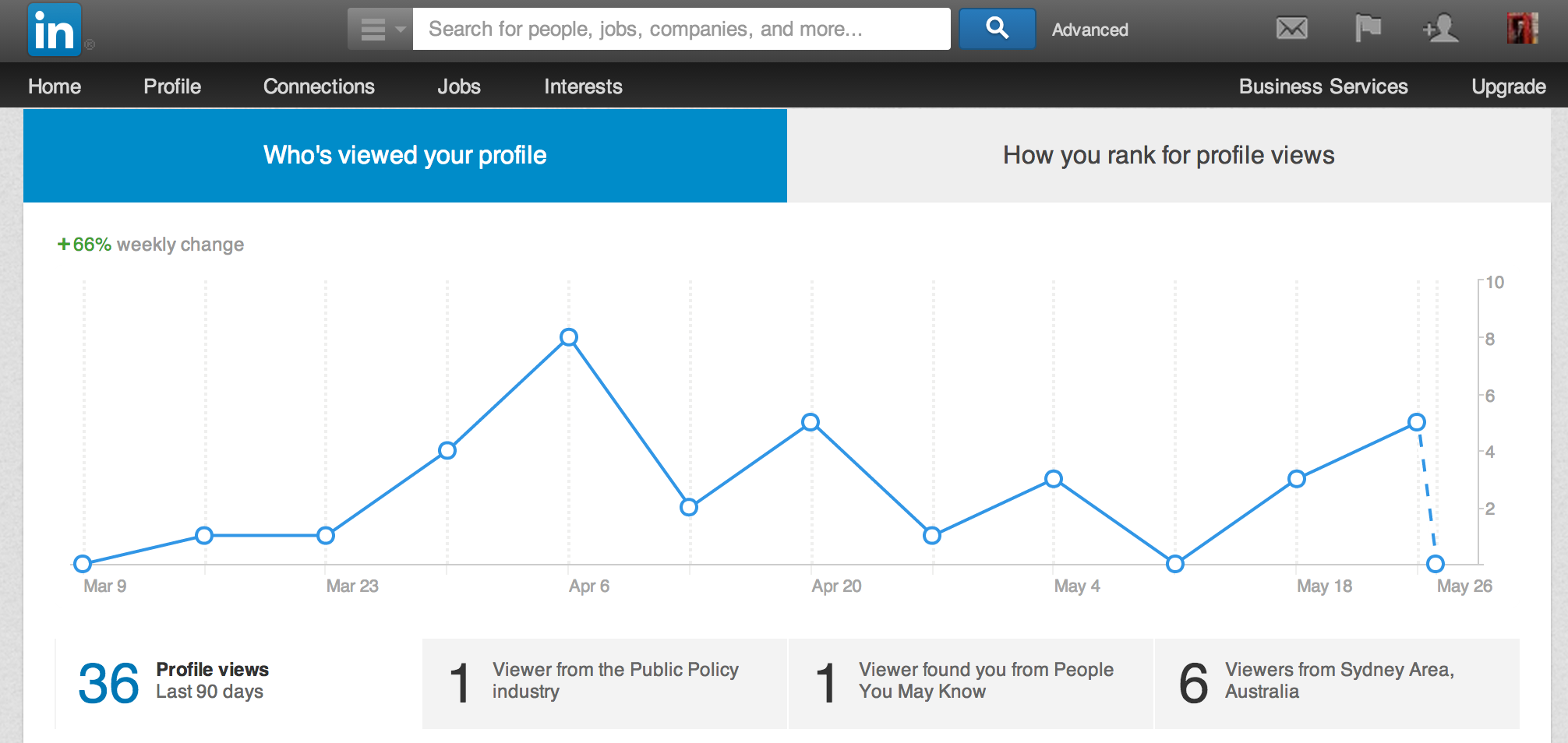
I mainly visit LinkedIn when I get a reminder from the website. Maybe someone has looked at my profile, or maybe someone wants to be a connection.
I hover there for a few minutes, wondering what it all means. Sometimes I do get a phone call from a person that LinkedIn said was looking at my account. But would they have called me anyway?
LinkedIn has to taunt you to get you to network.
Congratulating people on work anniversaries is an alien concept, but the idea other people are doing it means we wonder if we should too.
LinkedIn plays on our fears that other people are getting ahead of us professionally.
It taps not into our desire to be better people, but our much more powerful fear that we will lose our rank and status.
We also imagine it will cushion our fall should we lose our jobs. In the newspaper industry, redundancy rounds were strongly correlated with LinkedIn connection requests.
It doesn’t hurt that making a LinkedIn account is quick and easy. People probably maintain their LinkedIn like an insurance policy. It’s not costly to have, but it helps manage the anxiety that might come with losing your job.
LinkedIn is the facebook of work. We know facebook doesn’t really help us make friends. So does LinkedIn work as a resumé?
But this emperor’s new clothes situation is not going to resolve itself with LinkedIn shivering nude and all of us turning away. We’d be too worried that even a nude emperor might be worth our attention.
I may be a LinkedIn skeptic, but I still like to make a new connection as much as the next person. Connect with me here!
There’s a lot of talk about how Australians are buying smaller cars, and how Australian car makers are stupid for pushing on with big petrol-guzzling cars nobody wants.
But Australians do want big petrol guzzling cars. They just want them to be tall.
The SUV category is going crazy. In April 2004, 12,351 SUVs were sold. By April 2014 monthly sales had doubled to 25350.
Meanwhile, “passenger vehicles” – your classic sedan, sold fewer. April 2004 saw 44,000 sold, but by April 2014 sales shrank to 39,000.
In 2014, even as the car market is having its worst year for a decade, SUV sales are creeping up.
When people buy an SUV, they’re purchasing the ability to go off road. Right?
Not if you look at the details. Companies are pushing out two wheel drive versions of their SUVs and they sell fast.
The AFR’s motoring writer nailed this in a review of the new $90,000 BMW, which is two-wheel drive.
“Some surprisingly large SUVs – including the X6 fastback from BMW – feel like hatchbacks on stilts,” he wrote.
Reflecting: a BMW SUV in its element.
And there’s the key.
People want to be high up. It’s game theory. If the car in front of me is small, I can see over it really well from an SUV. If the car in front of me is tall, I want to be in an SUV or I won’t see anything at all.
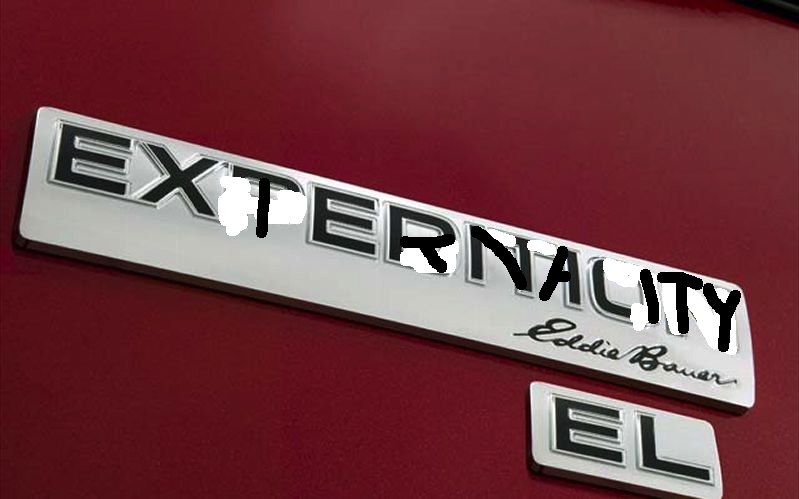
Externality would be a sweet name for the new Ford SUV. I imagine its prestige to come from being that little bit bigger, heavier and harder to stop than the Explorer, the Excursion and the Expedition.
As someone who drives a car that comes up to armpit height, I can confirm sitting in traffic involves looking at a lot of SUV bumper bars and having no idea what is happening in the traffic up the road.
An elevated position doesn’t just permit a better view of traffic, but of other people in the traffic. I can’t see what that Range Rover driver is texting from down here, but they can sure see what’s on my phone (at right).
The light commercial category also shows the change. You can’t easily sell a ute you have to step down into these days. The 1.74 metre tall Nissan Navarra tops the category, easily out-selling the 1.5 metre tall Holden ute.
Buying a tall car is what’s called a dominant strategy, if you want to be able to see. It’s also a dominant strategy if you want to crash into another SUV, according to research.
“In head-on collisions between passenger cars and SUVs … Drivers of passenger cars were more than four times more likely to die even if the passenger car had a better crash rating than the SUV.”
This is the classic game theory scenario of an arms race.
The arms race analogy is a good one. Like the proliferation of weapons, taller cars are costly and risky. They are heavier, take up more road space, cause more wear and tear to roads and emit more carbon. They may be more likely to roll in a crash. They’re exactly the kind of purchase decision in which a government might try to intervene.
For a long time, SUVS had lower import tariffs than passenger cars. That changed in 2010 when tariffs on cars fell. But by then, the proportion of SUVs sold was already steadily marching upwards.
Changes to the way we tax cars are possible in the next few years. The Henry Review recommends getting rid of the luxury car tax and fuel taxes, replacing them with congestion taxes or user pay systems. It is clear that our current system does little to deter SUV purchase. Could a well-designed licensing and user-pays system be better, or is the only stable game theory equilibrium one where we all drive cars like the Dodge Ram, that can barely fit in a lane?
Every reader fell greedily upon that story, I assure you, but the headline hints at far more certainty than the excellent Mr Aly projects. Here’s three reasons why “one-term Tony” will win the 2016 election, and one reason he might not…
In the lower house, the Coalition leads Labor 90 to 55. Labor needs to peg back 21 seats to win. If you look at the pendulum, that means they need to win every seat that the Coalition holds be a margin of 4.3 per cent or less, while not losing any of their own seats. That’s a lot.
Winning a lot of seats will be hard for Labor, because it requires not just a swing but a lot of good candidates, a lot of organisation and a lot of money.
2. Sophomore surge
In theory, someone who was an unknown at their first election becomes familiar at the second (sophomore) election. They enjoy a surge in popularity. This effect, if it exists, will help the Coalition a lot – they introduced 19 new MPs.
As the name implies, the sophomore surge is a US concept. Is it real in Australia?
I can see just one good example of a government coming back from that, in the early 90s. Keating took over a very unpopular government and won the next election.
If this polling continues, expect newspapers to push the idea Malcolm Turnbull should take over from Mr Abbott. Not only would it likely help the Liberals, the media have clearly learned that a good leadership challenge narrative attract eyeballs and, crucially, elevates their (our?) own importance.
The great saviour of the Australian economy arrives in a Porsche 911 convertible. The saviour’s professionally dyed locks are artfully disarrayed in order to best conceal an advancing bald zone. He whips his Raybans from his tired eyes and advances up the pavement to meet you, hand out-stretched.
The great hope of the Australian economy is the advertising man.
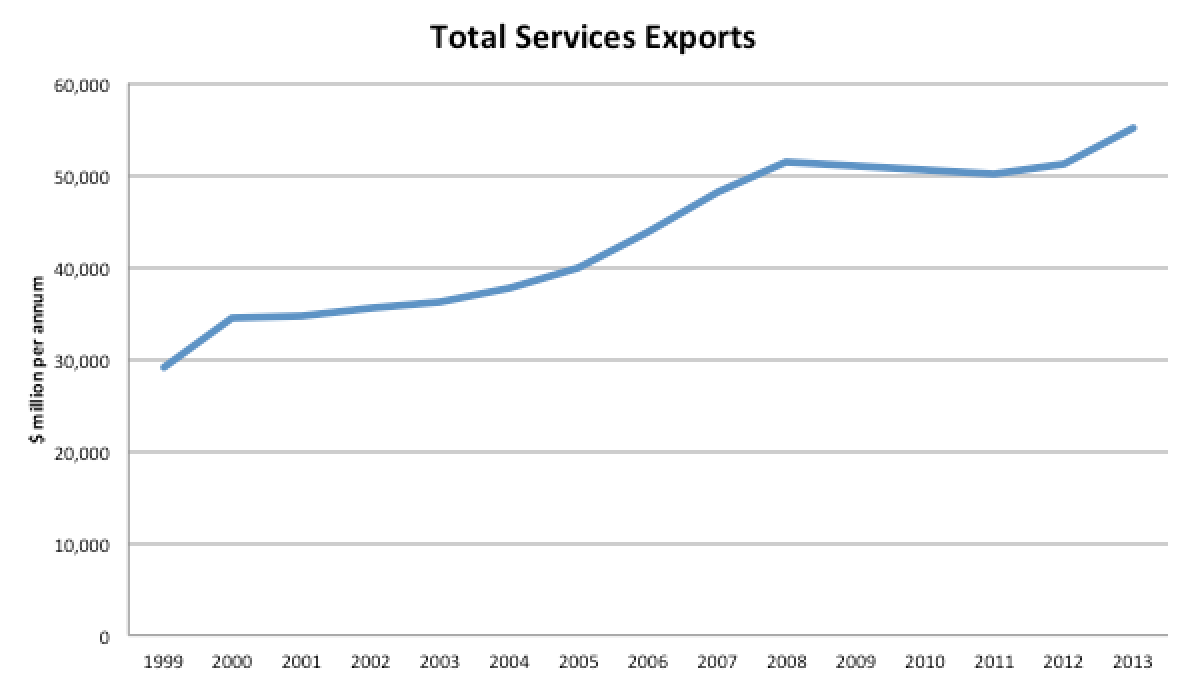
New data on services exports have revealed a whopping great leap in the export of salesmanship. No surprises really. As markets to our north develop there is more need for first world advertising expertise. And as the world’s developed markets become culturally more similar, Australian ads can play offshore.
Regular readers of this blog will know that I am a giant fan of the services economy. I believe that in the future, politicians will idolise services as they now idolise “making things,” because the services sector will have provided the vast bulk of great jobs of their parents generation.
Almost any high-value service can now be provided across national borders.
I was talking to a consultant the other day who’d just signed a whole lot of what he hoped were visa forms for his staff – they were completely in Arabic. His medium-sized Melbourne business was sending people off to the middle east to work on a big project.
Great services export growth is happening not just in travel, but across the economy.
I got a lot of thoughtful responses on the twitter.
The audit suggested giving ten percentage points of income taxation to the states to raise or lower as they pleased. I argued:
“Putting more tax and spending power in the hands of a demonstrably more left-wing level of government will likely lead to more spending on – and better outcomes in – health and education.“
ACTU economist Matt Cowgill wasn’t going to let that wash, and tweeted:
MattCowgillMay 02, 11:11am via Web
@jasemurphy I completely disagree that giving income tax powers to the states would be “left wing” or have progressive results.
A bunch of other comments followed.
This is what’s awesome about the information superhighway. You get to talk to super smart people who have done a lot of thinking, who compel you to think deeper and refine your views.
“the Budget flags that potentially significant changes in the distribution of responsibilities for schools and hospitals could arise from the forthcoming Federation and Tax White Papers.”
Is it a good idea to give more taxing and spending power to the states? Now I’ve thought more about it, I’m not going to die in a ditch for the idea. But I think it deserves to be considered, not dismissed out of hand.
Here’s a list of possible outcomes, arranged into pros and cons.
PROS
More tax and spend at state level
When I first wrote on this topic, nobody took issue with my point that letting states set taxes would lead to more tax and spend.
If you believe publicly provided services are good, you may believe this would lift national living standards
Because Australia’s poor states are also small, I contend extra money for state schools in rich states would be more useful for the disadvantaged than extra money for state schools in poor states.
Sure, a smaller proportion of Victorians are very poor than Tasmanians. 15 per cent of Victorians rely on the government for 90 per cent of their income, compared to 21 per cent of Tasmanians.
But the absolute number of people in need in Victoria is seven times higher. (15 per cent of the population of Victoria is 750,000 people. 21 per cent of the population of Tasmania is 100,000 people.)
Keeping one’s focus trained on equalising between states may distract from equalising between people.
Self determination
Consider Europe. Would it really be a good idea to equalise funding between Sweden and Greece? You’d help Greece, but dim a beacon of quality in publicly-funded systems, and disenfranchise the people of Sweden.
I have in the past been accused of excessive parochialism, and I really do identify as a Victorian, but I think letting different states set different priorities can be good. Should not Victorians be able to set our taxing and spending policies without being compromised by Queenslanders?
Imagine if our federal government set health policy, but health funding came from ASEAN or the G20, along with a range of rules. Would that really be satisfactory?
More accountability for state governments.
State governments are a bit of a joke at the moment. A technocratic solution would be to kill them off and locate responsibility for everything with the federal government. Given that won’t happen, and we’re stuck paying state MPs salaries, can we not use them?
Politicians with big goals and deep skills play the game federally. Relatively little press attention is given to state governments. This is a shame because they have domain over much of what one thinks of as the role of government.
A system that really gave state governments power would simultaneously create an expectation for them to deliver.
More opportunity for innovation
State governments are bundled up inside the COAG system, and trussed with conditional grants. Their policy making freedom is curtailed, by decree of the level of government that holds the purse strings.
But smaller governments can excel. If this were not true, Malaysia would be a disaster compared to Vietnam, Switzerland a shambles compared to Germany.
Left alone to experiment, Australia’s states could model their education system on the Finnish system, the Korean system, a version of the Montessori method, or indeed become the next global model themselves. No doubt some would go backwards for a time, but neither is a the status quo an iron-clad defence against standards slipping.
CONS
Differences in outcomes between jurisdictions.
Matt Cowgill tweeted a link to a terrific story he wrote about the US school system. He uses the HBO show The Wire to demonstrate how a poor area can be left behind under a system where small jurisdictions each fund their own education system.
This is a powerful point. But Matt’s argument – People of equal means and need should have same access to services regardless of state – sets a bar we do not currently clear.
Poor states go into suffering spiral.
The reason we have “horizontal fiscal equalisation” is that without it smaller, poorer states will tend to get further and further behind the rest. Lacking both economies of scale and a wealthy population, they face a tough choice between high taxes and good services, or low taxes and bad services. Both options will hurt living standards and the outcome gap between a Hobarter and a Sydney-sider will grow even wider.
Sorting effect
After a few years of differential tax and spend settings, a possible “sorting” effect could emerge.
People who want more services move to left wing states (e.g. Victoria) and people who want less tax move to right wing states (e.g. Queensland). This could polarise the whole nation, a la Americana.
—
I’m not going to try to tally the pros and cons column here. But I hope you feel, as I do, that this has been a useful exercise. Feel free to engage in another round of debate!
Economics says we must reward people for effort. If you train to become a teacher then work hard, society rewards you. This is both morally sound and economically important.
The flipside: if you could work but sit on the couch, you get nothing. This is both morally sound and economically important.
The moral and economic imperatives are aligned perfectly. Right up until birth.
Children crack the perfection of this theory. A child born into a poor household will be punished by material poverty they do not “deserve”. A child born into a rich household will be rewarded in ways they have not earned.
So we muddy the moral and economic imperatives for generation 1, in order to secure the moral and economic imperative for generation 2. A trade-off.
Decisions about this trade-off are shaped by a number of beliefs.
1. Does providing welfare hurt incentives for work?
2. Does raising taxes to pay for welfare hurt the economy?
3. Does welfare really help the second generation, or foster a culture of entitlement and dependency?
Just the other day I was snacking on this “coffee caviar” in a Fitzroy cafe, but this Budget doesn’t really hurt me. Does our society have its priorities straight?
The recent Budget by Messrs Hockey and Abbott reflects beliefs on all of these. It took an axe to welfare payments of all sorts.
So it was extremely timely to see new research (released May 12 by the US National Bureau of Economic Research) on the third point above – the effect of welfare payments on the second generation.
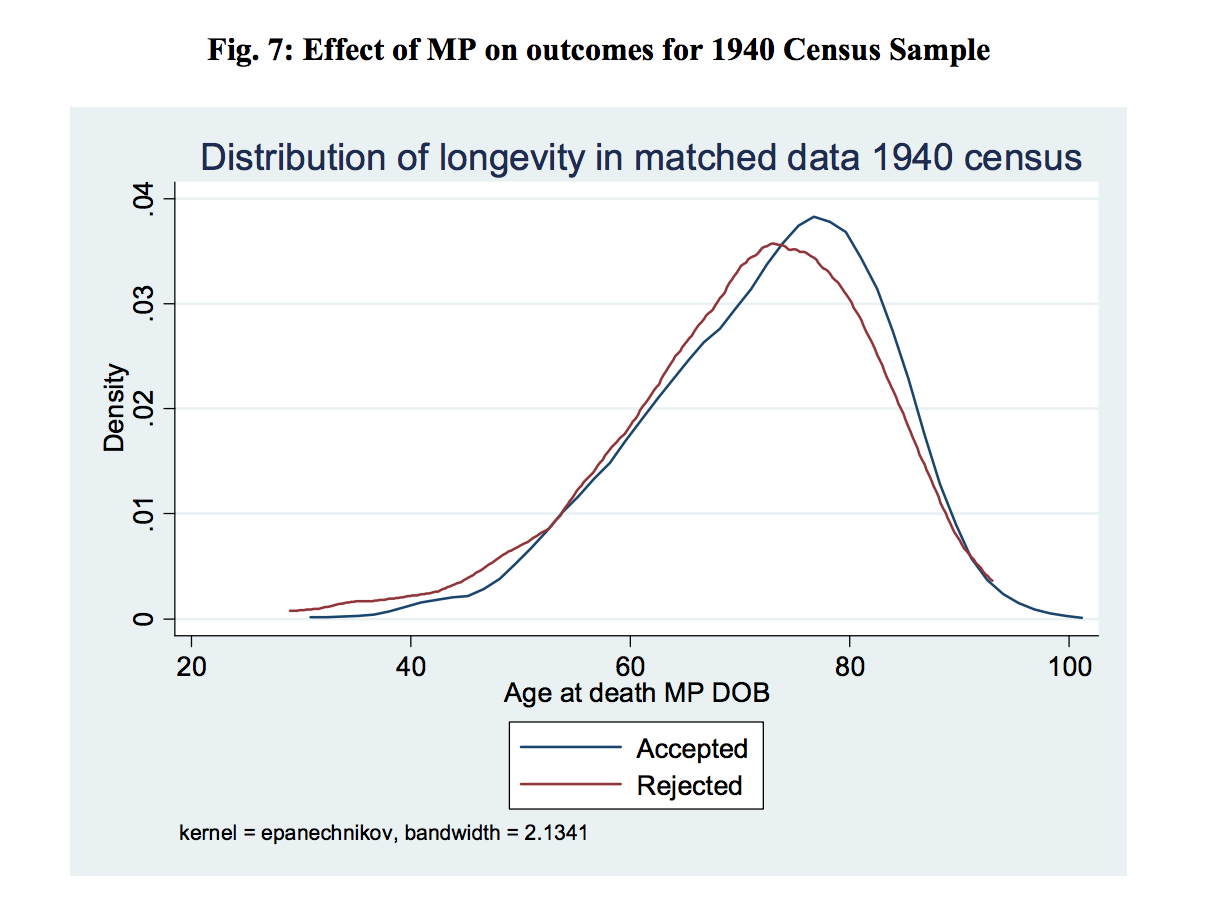
“Male children of accepted applicants lived one year longer than those of rejected mothers. Male children of accepted mothers received one-third more years of schooling, were less likely to be underweight, and had higher income in adulthood than children of rejected mothers.”
The positive differential comes despite the boys who were rejected from the program being slightly better off on average prior to the government intervention. That means the effects are, if anything, likely to be an understimate. (The research is unable to track results for females over the long run because of their tendency to change their names. The use of a very old program allows them to more fully collect data on longevity.)
“While conditions today differ significantly from those at the beginning of the twentieth century, three important similarities remain. Then and now, women raising children alone (whether divorced, unmarried, widowed, abandoned, etc.) represent the most impoverished type of family. In fact, the income gap between children in two-parent versus single-mother families has only grown over time”
This research is very timely.
The 2014 federal Budget cuts a payment that goes to single parents: Family Tax Benefit Part B. The government has not only capped the rate of the payment from 2014 but reduced eligibility. Parents will now be cut off when their youngest child turns 6, not when it turns 18.
The Budget replaces Family Tax Benefit Part B with a new allowance, worth $750 per child per year. That will work out as less for many smaller single parent families. Family Tax Benefit Part B was worth up to $4,172 a year.
Single parent families will “manage” – buying cheaper groceries, scrimping on clothes and driving less. But these impacts add up. The cut to their incomes will likely be felt by their children for a long time, in educational attainment, income, and even longevity.
[ANZ is the third-largest bank in Australia, worth $91 billion, putting it in the top 20 banks in the world by value. Is there a corporation out there with more than six CEOs? I checked the other Australian banks and ANZ has a big lead on them.]
There are sound economic reasons for title inflation. It makes the employee feel better, and, unlike other forms of compensation, it doesn’t hurt the bottom line. But it only works as long as people still believe the old title has value. Much like inflation works to make people feel better off – but only if they don’t notice prices are rising as much as their wages.
Titles come and go. Even CEO is a fairly recent invention.
In 1955, just one Fortune 500 company was headed by a CEO. The term came into fashion in the 1970s, in the pages of the Harvard Business Review. Before that, bosses were presidents, chairmen or managing directors.
One thing is clear. As ANZ leads the proliferation, dilution and diminution of the title CEO, its future is sunk.
As this article suggests, it is not smart to follow Yahoo!’s lead of fun and funky titles, unless your branding strategy is to be on the fringe. (it works for Miami’s Feverish Ice Cream company, run by a Chief Popsicle. But I don’t see that taking hold at a bank.)
Here are four new title ideas for bosses that could take off:
In a back to the future twist, quite a few bosses on the BRW Fast 100 list identify as Managing Directors.
The term Director is also coming back. It has a certain simple resonance that a three-letter acronym can’t match. Director says: “I don’t need to cloud and complicate this role. I steer the ship and that is that. ”
Have you come across title inflation in your career? Ever been a senior manager of making other people coffee? Seen a cool title that you think might be the next big thing? Leave a comment below!












 Forget the millions spent on building a brand that was recognised immediately across the state.








 Maybe LinkedIn is not good for the average guy, but if you’re trying to build a brand, it is awesome. Maybe?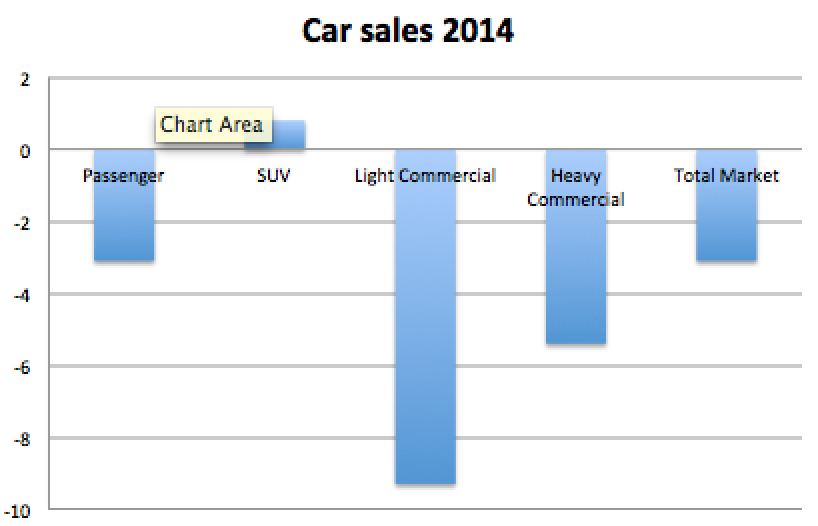



 MattCowgillMay 02, 11:11am via Web
 Thomas the Think Engine
