Stem cells and self-driving cars: Why we look stupid predicting the technology of the future

We’ve all seen technology proceed like greased lightning.

In my lifetime, we’ve gone from typewriters to internet-enabled laptops. We’ve seen smartphones go berserk and enormous progress in survival rates for cancer. These fields have transformed. It is tempting to predict more exponential change in the field you’re most excited by.

For example, last night I watched a couple of documentaries on stem cell research that were mind-blowingly exciting (12). Want to see a paraplegic stand? Click on that first link.

But caution is needed.

The fields in which we see progress are affected by survival bias. We don’t see the frustrated scientists trying and failing to revolutionise other fields. Look around you and much is as it was 100 years ago. I’m sitting at a wooden chair at a wooden table, wearing woolen socks and leather shoes. The alphabet is the same as it was, and so is my keyboard layout. There’s a clock on the wall telling me the time with two rotating hands. I just got over a common cold. I’m eating brown rice and snowpeas. It could be 1850 – if not for the macbook.

So not everything is on the brink of revolution. Which is why I have to pull back on my former enthusiasm for autonomous cars.  I admit I was focused on the potential upsides – in traffic, in accidents, in parking, and on the successes Google has had with its autonomous car program. Google is backing the project, appointing the old head of Ford. But even Google fails sometimes, as with Google Wave.

“The benefits are so great that we will force ourselves to accept them, even with a few risks,” I told myself.
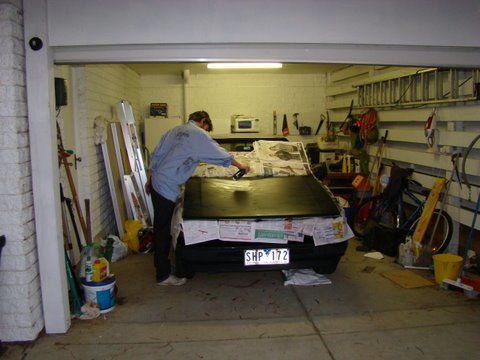
ship painting

But then I started thinking about the development path, and I became significantly cooler on the chances of success.

Autonomous cars will only break through once they are trusted.

TRUST

Humans set a very high bar for risk in situations where they perceive they are not in control. (This is why people object to tiny risks of living downwind of a polluter and won’t let their kids walk to school, but still eat chips and drive fast.)

Autonomous cars won’t just have to prove they are safer than humans at driving, but much safer – for car occupants, other road users, pedestrians, wildlife and pets.

THE LONG TAIL

Computer operated cars are probably already better than humans at driving in car traffic on freeways and on busy roads. Humans are dreadful at mundane repetitive tasks that require paying attention.
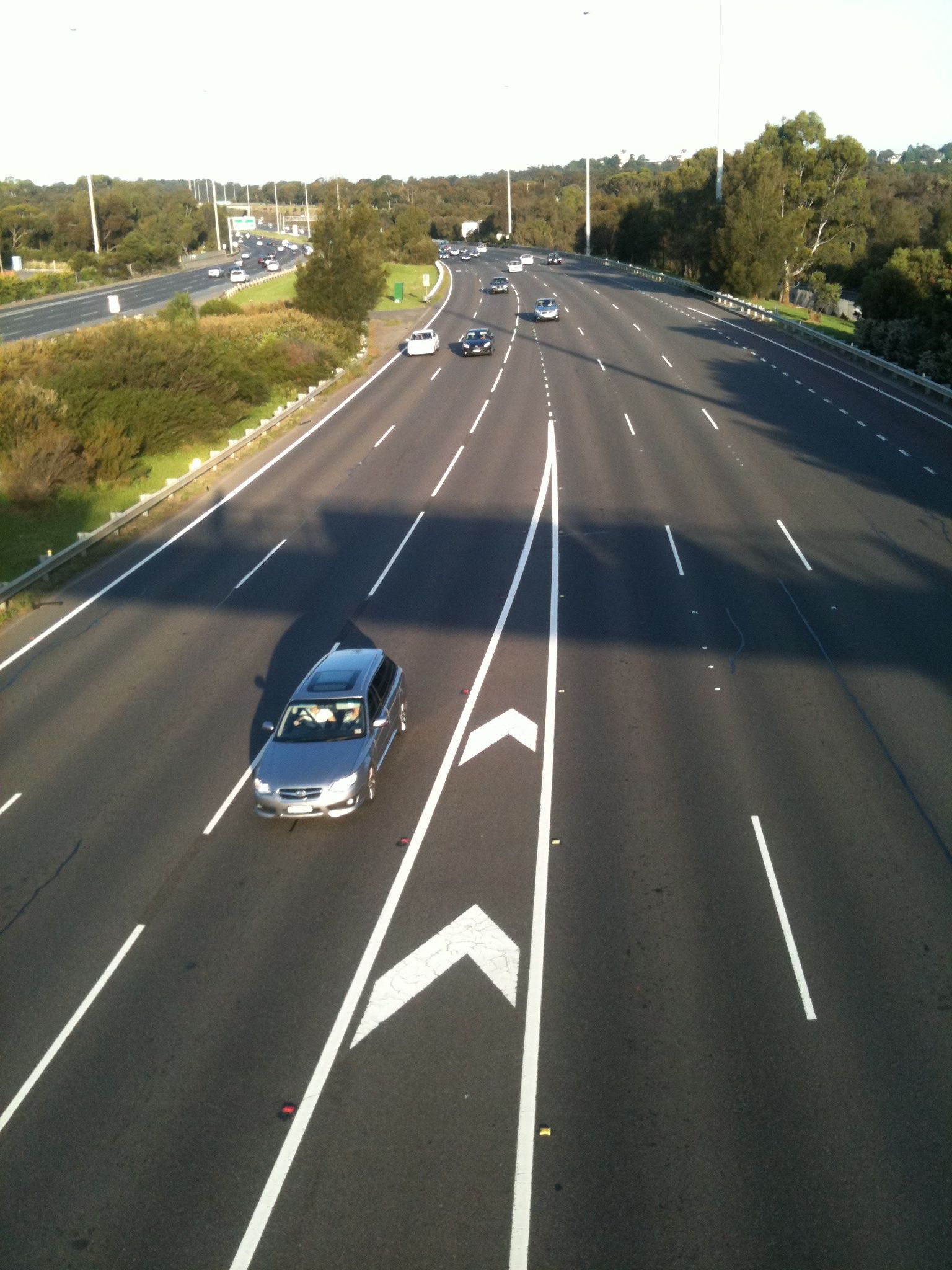
Computers could do this part.

But car crashes can happen in odd moments.

This is where humans excel. We dominate computers at dealing with problems we never saw before.

Humans will remain best at dealing with things like:

  1. A big black garbage bag blows onto the road but we know we needn’t swerve as we can tell it is light by the way it moves.
  2. Kangaroos are on the side of the road so we better slow down because they often jump in front of the car.
  3. It’s Saturday afternoon, there’s just been a football match, some sort of fight is happening on the side of the road, and you know someone could easily step out into traffic as part of the brawl.

etc, etc.

Many serious crashes occur in scenarios that are in the long tail of distributions. Machine learning will not cover them all, so there will remain a few scenarios (I predict on the basis of statistics alone) in which autonomous cars continue to perform predictably worse than humans despite the best efforts of programmers.

RISKY LAUNCH

Other types of software can launch with “beta phases” where failure is embarrassing, but not catastrophic. But the testing that will have to happen before any serious real world traffic experiments involving autonomous cars will be enormous. Google’s experiments driving round California are good, but still limited in scope and scale.

A few high-profile crashes will be enough to set a very high technical and legal bar for autonomous cars. The concept of surrendering ones life to a machine is a staple of science fiction because it irritates a real issue in human psychology – control.

MANY OPPORTUNITIES FOR SETBACK

It is not just technical problems that can hold up autonomous cars indefinitely. Political, road engineering, PR and software challenges will impede getting autonomous cars to the point where people trust them and forgive their mistakes.

For just one example, the FBI is opposed to driverless cars, according to a brand new report. Solving that will be tricky. And when it is solved another impediment will arise.

There’s a lot of fail points. I suspect – again on the basis of pure statistics – one will resolve into a  big sticking point for a long time to come.

What role for motorbikes under this all autonomous future?
What role for motorbikes in this all autonomous future?

SUCCESS WON’T LOOK LIKE SUCCESS

Cars will continue to have more and more sensors and autonomous capabilities. But during this time, non-autonomous cars will continue to be sold.

Traffic will be mixed for at least the next 50 years. Some freeways and highways will perhaps be autonomous-only. But not places where there are pedestrians, bicycles, shops, parking, and of course traffic lights. So the benefits of full autonomy will not be realised for a very long time. Don’t hold your breath.

The upside of the failure of the fields about which we are most excited is that we might get blindsided by a revolution in a field where we didn’t expect any improvement. Nano technology, GM foods, high-speed trains, smell-o-vision: any of these could be the one in which a breakthrough happens that turns out incredibly positive.

The Euro is sowing the seeds for the next European war

When the euro was adopted, cash was still a big thing. Economists hailed the savings in transaction costs that would come from Europe having a single currency.

At that stage, we had not had the GFC. The currency union did not cause the GFC, but it sure made recovering from it tough. When the global economy is foundering, the importance of having an independent currency and an independent monetary policy is suddenly very clear.

Now we see what happens if your economy is screwed but your currency and monetary policies are made far away.

Europe unemployment map


Some countries get a free ride and others suffer.

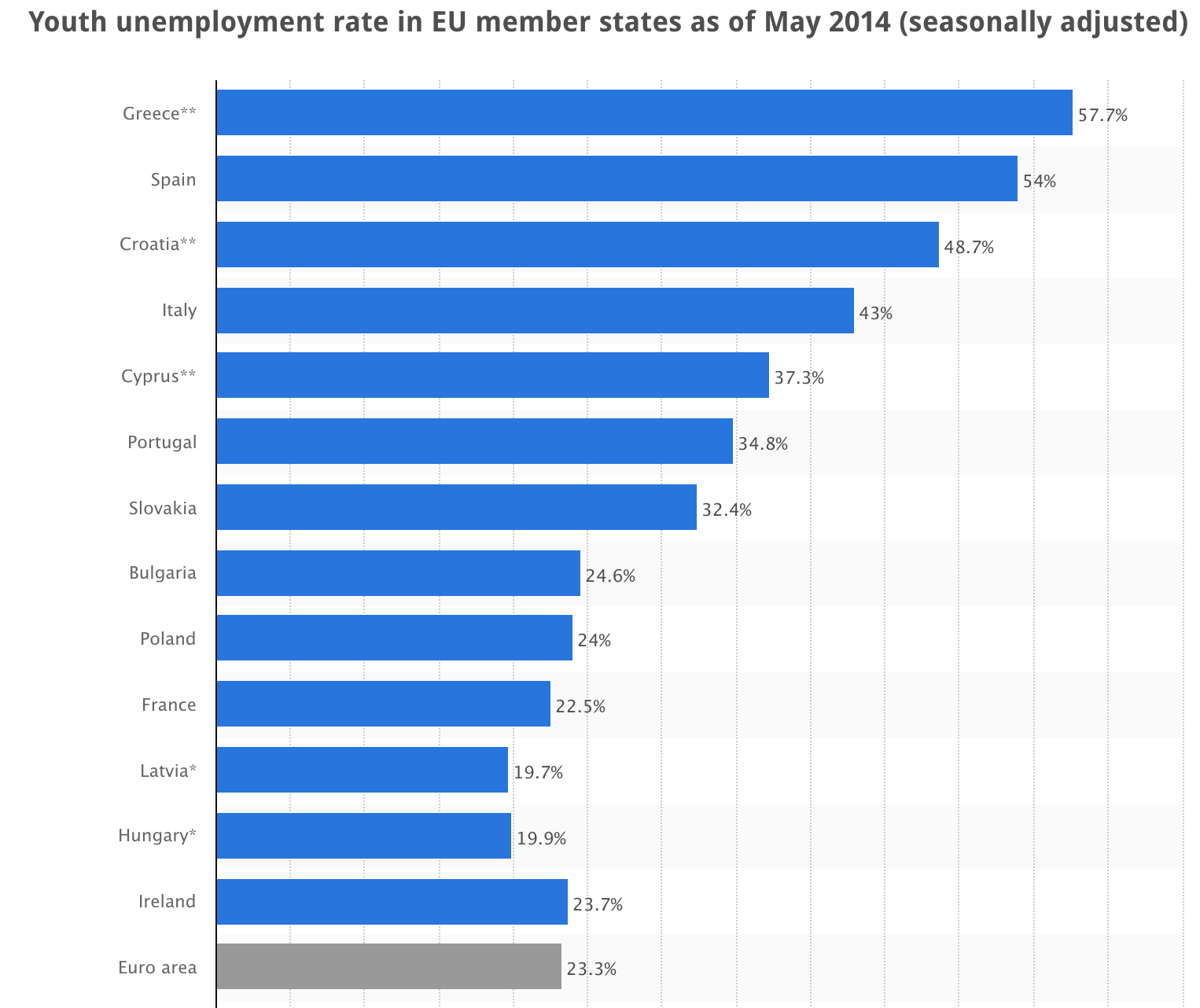
The problem is especially acute for those under 25.

youth unemployment graph

This is how Europe is poisoning itself. All those young southern europeans – 23 years old and no job – are seeing their human capital withering on the vine. Among them are growing numbers who will vote for extremist parties in a decade’s time, because the promise society made to them has not been kept.

If you don’t get a job early on, you can be stuck without one for a long time, and then channeled into low-value work.

Here’s what the IMF says about youth unemployment:

“Unemployment can exact a big personal toll on young people. Failure to find a first job or keep it for long can have damaging long-term consequences on their lives and career prospects. But youth unemployment also has broader social consequences and contributes significantly to growing income inequality in advanced economies.”

Economic problems are worst in Greece, Portugal, Italy and Spain. Luckily these are not the countries with the biggest populations, nor the strongest warring traditions. But they are not without their flash-points.

I’m not predicting a world war. But separatist movements and terrorism are on Europe’s doorstep and remain very possible within its borders.

Terrorism has already struck Spain, in Madrid in 2004. Spain also contends with two separatist regions – Basque and Catalonia.

Greece has Golden Dawn, a party somewhere between far right and neo-nazi, which got 7 per cent of the vote in 2012 elections, putting 18 representatives into Greece’s Parliament. IN 2014 it won 9.4 per cent of the vote in European Parliament elections.

Even Italy has a major political party that wants to split the country in half – Lega Nord.

These movements won’t need much encouragement to blame Germany for their plight while it enjoys rapid growth and very low unemployment.

What the countries of Southern Europe need desperately is the kind of quick shot in the arm that can come from rapid exchange rate devaluation. Then, independent monetary policies that can help them get back to growth in their own time. And they are not going to get that in the Euro.

The national debts of these countries will appreciate as their currencies fall. The inevitable need to restructure that debt is the major sticking point for letting these countries go. But paying the debt down while the countries remain inside the strangling embrace of currency union also seems unlikely. If the issue is left too long, radical politicians may take power for whom debt default is minimo.

For the good of the future of Europe, we need to bring back the Peseta, the Drachma and the Lira.

(For a deeper discussion of debt and the issues of the euro, I recommend reading this post at the blog of Michael Pettis)

Where did all the first home buyers go?

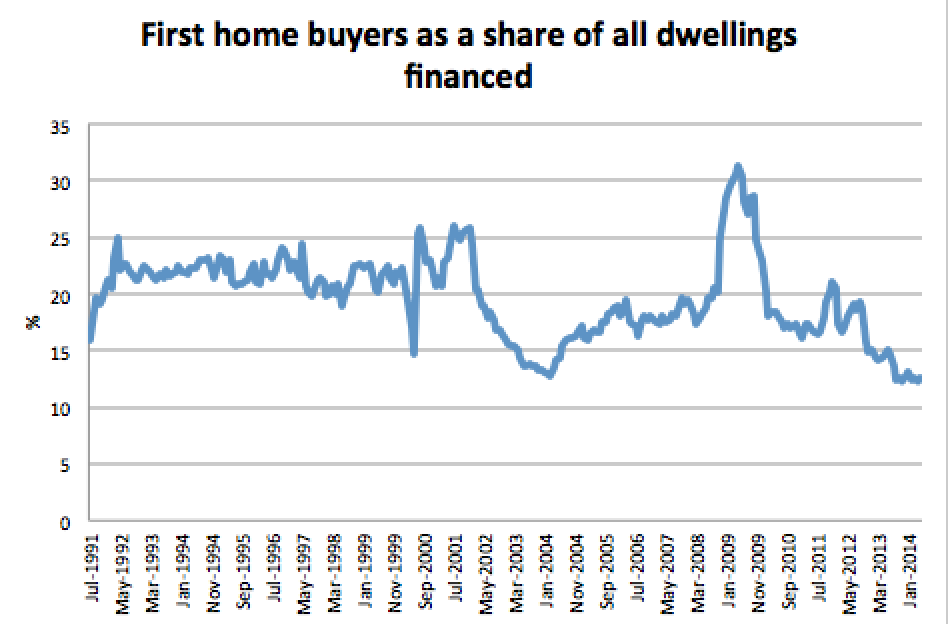
First home buyers are off the market. The current share of 12.6 percent is around the lowest on record.

Screen Shot 2014-07-14 at 10.44.00 am

The 2000s, where first home loans grew really fast and were about as big as other home loans, looks like an outlier period, but so does the current (post-2009) period, where there is little to no growth in first home loan value

Screen Shot 2014-07-14 at 10.21.36 am

What’s happening?

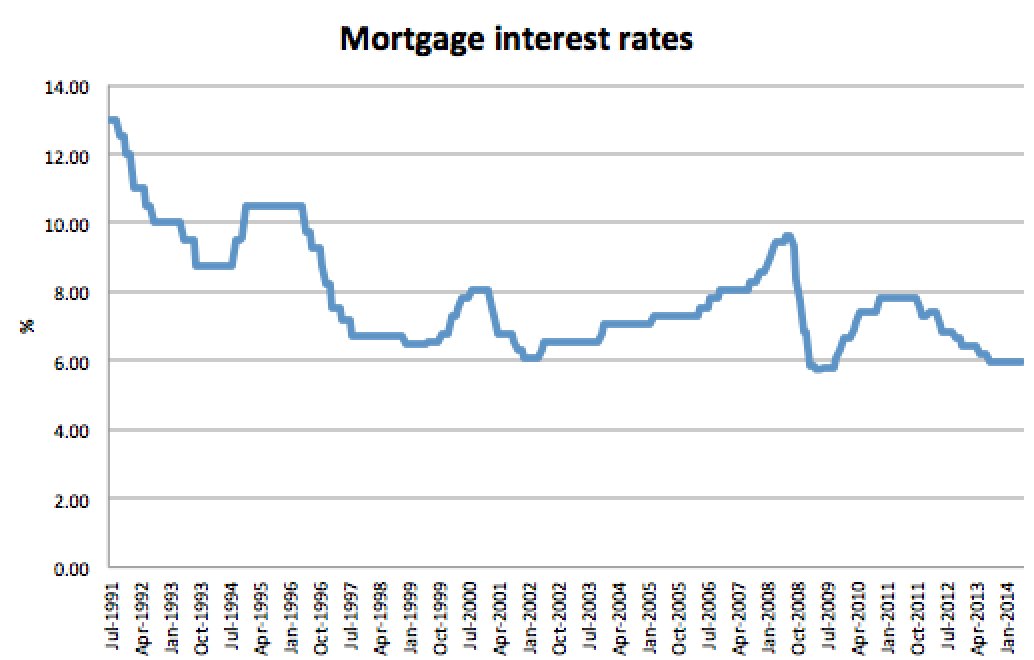
I was surprised to find cutting interest rates is not helping. First home buyer shares have sunk as interest rates have fallen. On average, cutting interest rates by a percentage point cuts the share of first home buyers by three-tenths of a percent.

mortgage interest rates


Rent is a significant factor. But it seems to work in the opposite direction to what I thought. In the long-run, as rents rise, the first home buyer share falls. I found a correlation of -0.39 per cent between rents and first home buyer share

rent growth each quarter

rent cost to mortgage cost ratio
Mean housing costs for mortage holders and renters in NSW, 2011-12 dolalrs

The whole thing looks like something of a mystery. But fortuitously, while I was thinking about this, a clue arrived.

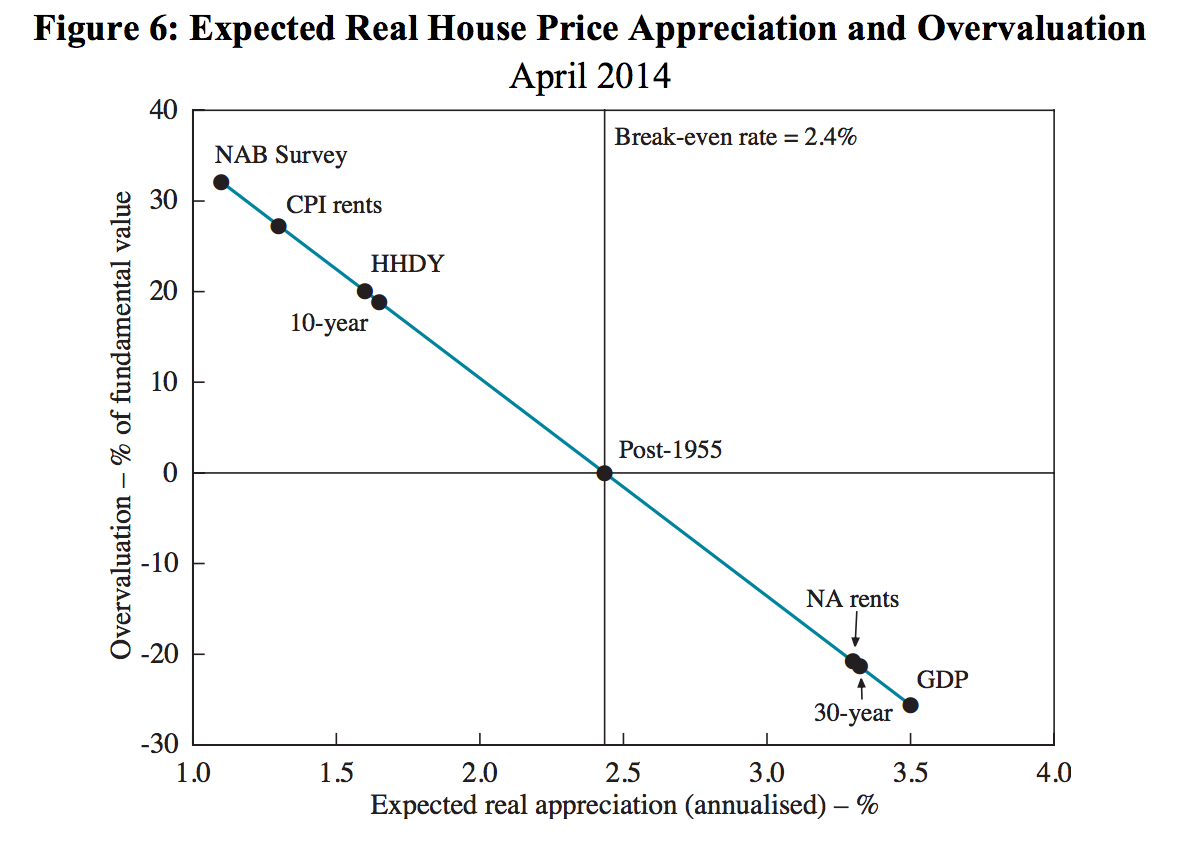
The RBA released a big paper yesterday that said house prices are fairly valued, if you assume that house prices will keep growing at 2.4 per cent a year real (say 4.4 per cent to 5.4 per cent including inflation). That 2.4 per cent is the rate they’ve grown at, on average since 1955.

The paper breaks down some of the reasons for house price growth. At the moment, low rates are propping up growth, rather than expectations of appreciation, which are negative. When rates eventually go up, expectations about appreciation will have to change, or rental yields will have to boom, or house prices will turn downward.


rba reasons for house price growth


The paper suggests that if you think house prices will grow at the same rate as GDP, you think they are undervalued, but if you think they will grow at the same rate as real household disposable income (HHDY in the chart below), you think they are overvalued.

over valued or undervalued


There’s two more points I want to draw your attention to. The 10-year figure and the 30-year figure. If you are in the market for a first home, you may have focused on house-price growth in the last ten years, and see house prices as about 20 per cent over-valued. Hello first home buyers.

If you’ve focused on them across the last 30 years (Hi Mum and Dad) you might still see houses as 20 per cent undervalued.

This is no doubt an overly neat explanation, but it must go some way to explaining first home buyer reticence at this time of record low interest rates.

Ride-share company Uber alienates core demographic: Economists

Uber must be very confident in its continued growth. Because it has just alienated its early adopter crowd in order to appeal to the mass-market.

Uber functions a bit like AirBnB but matching passengers with cars. It’s an app uses limo drivers and non-professional drivers to increase supply at reasonable prices.

To say it has been successful is an understatement. A recent funding round valued it at $18 billion. 

But Uber’s PR strategy has been an unusual one. It has gone out of its way to appeal to economists. 

Traditionally, taxis charge the same fare no matter how many people are in the taxi rank. The whole industry is a byzantine mess of regulations. But Uber is much less regulated and has a wholly variable pricing model.

DSC01149
Taxis are sheltered by regulations

Uber prices go up when demand is high. It charged one customer $82 for a one-mile journey at 1.50am on New Years’ Eve.

The wildly variable prices should help get cars on the road when they are needed, and make sure people who really need a ride (about to miss a flight, on way to hospital) get a car ahead of those simply heading into town to window shop.

uber1
A high-price sort of time.

They also worked as a terrific PR boost. Every economics blogger and every financial newspaper there is has been writing excitedly about Uber for years. (1, 2, 3).

That may have been a side-effect of a revenue maximising strategy, but it worked very effectively. Uber’s aggressive expansion into a whole lot of markets has been welcomed – a lot of regulators, political advisors and decision-makers *are* economists.

But now, surge pricing is done. After a whole lot of complaints, New York City has forced Uber’s hand, and it has got rid of surge pricing during emergencies  (e.g a blizzard) across America.

Is this rational?

It might be. Uber’s market is not economics graduates, it’s humans. And humans love what they see as fair. To defend fair, they are not afraid to cut off their nose, seemingly to spite their face.

I’ve written before about how people will hurt themselves to teach other people a lesson. This can explain why people shop around for bargains. Even if we spend more on petrol going to the cheaper shop, it can be satisfying to deny a profiteer our business.

Surge-pricing was seen as unfair. Killing it is a sign of Uber’s expansion.

It is now in the business of appealing to people whose interactions with markets are shaped by their own feelings, not the things they learned in economics class. It is time to take complaints about surge pricing (“price-gouging”) seriously.

(If you’ve made it this far, you’ll probably love this piece at Noahpinion on how complaining about price gouging is a legitimate strategy for signalling the shape of the demand curve away from the familiar parts that normally form equilibirium.)

It might be time to sell your shares and your house

Another big financial crash could be coming.

There is a lot of evidence that markets are doing that thing they do. Getting out of whack.

It’s hard to believe that this could happen again so soon. In the past, major financial events have been interspersed with decades of good times.

But to count on history repeating would be … brave.

Here’s the symptoms of the problem. Stocks are super high, with the US markets setting records:

DJIA high
Source CNN

That could be a good thing right? Companies get high valuation when they have high earnings. And high earnings mean a healthy economy!

Hmm. 

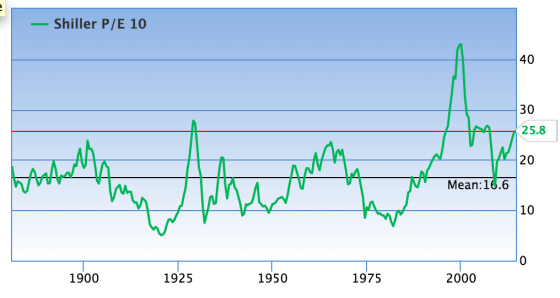
Price to earnings chart
Source

This chart shows a ratio of stock prices to company earnings. It shows that prices sometimes get well out of line with earnings and the market can’t sustain that.

How can this happen?

As anyone who has played monopoly knows, the more times people pass Go, and the more money in the system, the higher the asking prices for trading properties. 

The same thing can happen at a much bigger scale. The more cash in the global economy, the higher asset prices are.

Here’s evidence that cash is swilling around in the global economy like burger wrappers in the passenger footwell.

Greece government bond yields
Source

The Greek government can now borrow money at 6 per cent. In 2012 they had to pay over 30 per cent. That’s how much cash is lying around. Even though Greece’s problems remain dramatic (e.g. 27 per cent unemployment), money managers are happy to give €€€€ to the government. Similarly in Spain, where unemployment is 25 per cent, bankers are happy to lend money to the government at the lowest interest rates since 1789. Seventeen. Eighty. Nine. 

Meanwhile Dutch interest rates are at their lowest in 500 years.

You can also spy the global economy’s excess cash in the way Facebook is buying things like WhatsApp, for $19 billion, and in the near-record valuation of Apple even as iPhone enthusiasm is being studied by historians. 

Here’s how the New York Times describes it:

“Around the world, nearly every asset class is expensive by historical standards. Stocks and bonds; emerging markets and advanced economies; urban office towers and Iowa farmland; you name it, and it is trading at prices that are high by historical standards relative to fundamentals.”

Australian stocks have rallied hard in the last two years, and here’s a chart of Australian house prices, just to show that our assets are not immune. 

House prices
Source

Global markets have not got to this point without a reason. The billions pumped into the economy by central banks doing quantitative easing explains the surplus cash. 

The Bank of International Settlements has said that this has caused capital “misallocation” on a scale similar to the GFC. 

So what could happen next?

The United States is now planning to stop its five-year quantitative easing program, this October

The billions a month it “printed” will cease to arrive at the banks and they will have to go back to more old-fashioned ways of finding capital.

Then, we find out if economic growth can catch up fast enough to make all those high prices make sense, or if everything crashes. 

Plummeting asset prices in North America and Europe would hurt us, no doubt. But a fall in China has already begun and that simultaneity would be the worst case scenario.

Last time round, China was basically immune from global financial contagion. But this time, everyone agrees China is in an asset bubble that is already ending. 

china property prices
Source: Economist

If asset prices fall fast in China and the West at once, it will be time to move your savings into something very very safe.*

*You know I’m not a financial advisor, right? Right.


SO ANGRY

I’m pretty powerful.

I’m an educated citizen in a democratic country. I live in an electoral division that could be won by a couple of parties. I have free speech and a twitter account. I’m enfranchised and privileged.

But right now I feel absolutely powerless.

I want to stop cruelty being done in the name of Australia. I want to help people who need help. I want to treat asylum seekers with compassion.

But I feel like I can’t.

I sit here in front of my high definition internet, reading about boats full of desperate people bobbing around in the tropical seas, and I can’t think of a single thing to do. And I am as angry, if not angrier, than I have ever been.

My taxes pay for the drones that go looking for asylum seeker boats to turn back, for the barbed wire that surrounds those that already slipped through, for the immigration officials that make the policy tick, and the elected officials who set the whole thing in motion. I can’t think of anything more infuriating.

Why so cruel?

The idea that we can prevent future asylum seeker boat arrivals through cruelty to asylum seekers who already left was always a grey area. A very dark grey area.

It’s not unlike the medieval idea that you prevent social decay by cutting off hands and stoning people. It seems to be the ends justifying the means – and ignores a strand of enlightened thought that goes back a long way (esp. in western christianity) suggesting we should be merciful to the weak.

But the philosophical objection is not as powerful as the practical. The arrival of two boats recently shows that our regime of deliberate cruelty is not even working.

I went to a protest on Saturday, to say at least something about the current government’s policies. It felt utterly impotent.

There’s a lot of policy in the world I disagree with, but very little – not even public transport policy! – that gets me into such an emotional state as the way my name and tax dollars go to mistreating asylum seekers.

It’s unfair and I feel like there’s nothing more I can do.

Powerless. This is how much of the world feels, I guess.

Hockey on house prices: Two incomes now necessary.

I went to the Melbourne Institute economics conference yesterday and heard Joe Hockey speak at lunch. He’s not bad on his feet. Even when he’s not across the detail, he bluffs well. He seems likeable and projects passion.

But he said something I couldn’t quite believe.

Let’s face the reality. Unlike our parents, our generation and the ones that follow will not be able to afford a house in a capital city on just one income.”

This little message came in the middle of a spiel about how the paid parental leave scheme would pay women to raise kids. I wondered if it was a slip-up. But no. He said it again later.

“Try living in any capital city in Australia on just one household income. It’s nigh impossible. But the mortgage still keeps coming in. And the bills still keep coming in.

While this matched my own experience quite neatly – I don’t own a house and wouldn’t consider buying one without going halves in it – I doubted a Treasurer should accept it as a fact.

But perhaps the problem is too far gone. Here’s a table I made that shows who might be able to afford what.

But perhaps the problem is too far gone? Here’s a table I made that shows who might be able to afford what. (The cheapest house I could find in Melbourne was this one bedroom unit in Noble Park for $160,000.)

house prices out of reach
The average house (~$550k) is unaffordable on the average wage

When lone-person households are our fastest growing demographic group, making up 24 per cent of Australian households, and single parent households are raising over a million children (961,000 single parent families representing 15 per cent of all families), house prices rises seem less like a boon to the economy and more like a social welfare disaster.

Systems that permit stability of tenure for renters should be introduced as a matter of urgency. Housing affordability is at least partly a policy question. As a starting point, Treasurers should talk about low housing affordability as a problem, not as a fact.

#ESOC2014 Why even skeptics should embrace action on climate change

I’m venturing out of the house today, to bring you the blog from the glamorous surrounds of the Grand Hyatt, where the annual Melbourne Institute Economic and Social Outlook conference is taking place.

Say what you will about the state of our nation, but the fact we can gather all these eggheads into such an opulent ballroom to ponder on the distant future suggests that things are not so bad, relatively to many other places and points in history. (I will note that I had to pass a phalanx of police to get inside though.)

The biggest point of interest for me so far today was a comment from renowned contrarian economist Warwick McKibbin.

He was talking about the policy outlook for climate change, and he made a strong case for action. “Even if you don’t believe in climate change, other countries are acting,” he said, citing research done for the Howard Government at the time of the Kyoto Protocol.

“If you look at global effect of the Kyoto Protocol on Australia, 80 per cent of its costs were in what other countries did to our exports.” he said.

“That was ignored,” McKibbin said. “Even if we think this is a myth, other countries are taking action and that will have an impact.”

With the carbon tax all but gone and the Renewable Energy Target at risk, the costs of an approach that see Australia out of step with the rest of the world deserve more attention.

Trevors in Traffic: a PR strategy for congestion charging.

Congestion charging is, I think, an urgent public policy priority. But it is wildly unpopular. This post is going to look at how we can change the way people view congestion charging.

1. The Problem:

Congestion charging makes people very angry. Charging to use a road is widely regarded as “unfair” and it doesn’t seem to matter that society charges for lots of other necessities, including food and water.

Here is a tiny selection of comments from a really terrific recent article on the causes of traffic jams:

“Not only do voters not want to pay congestion fees because they’re now paying for something that was free, they also understand that they’re basically being punished for going to work. What if you make a low wage and already making ends meet, and now, you have to shell out an extra $X a month just to get to work? No, congestion fees won’t work.” – gfish3000


“The politicians, who don’t really care about serving the public, will get extra (congestion fee) $$ for NOT doing their job, namely, providing an infrastructure (roads) for us to go about our business.” – Force Meow


“The other thing is that making use of an automobile more difficult hurts the poor the most. I have a problem with that.” – Tim Johnson

These objections fall into two main categories: 1. congestion charging hurts the poor, and 2. congestion charging lines someone’s pockets.

These arguments may or may not be true, but refuting them isn’t the goal. Changing the dialogue is.

Here’s one comment I quite liked:

“soccer mom making me late for dinner so she can take snowflake to ballet practice can foot the bill” – Bob Dobalina

There’s some feeling there. Some hatred. Something we can use.

The reason congestion pricing is so unpopular is people imagine it applying to themselves. It’s only if you imagine it applying to others that you see benefits.

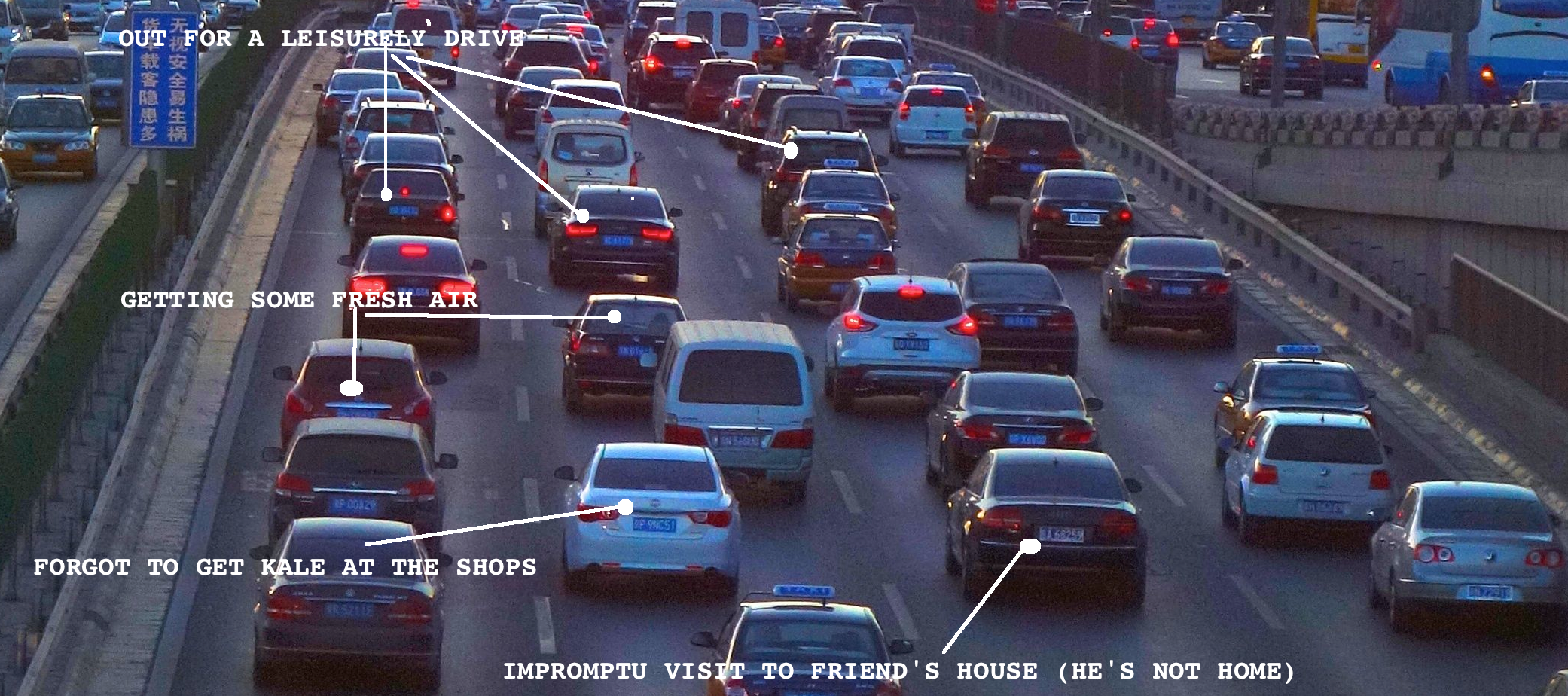
A PR campaign for congestion pricing would show the real reasons for a traffic jam, like this:

TRAFFIC JAM REASONS

This would help drive home the point that a lot of trips are low value, and so even a small congestion charge would be effective in deterring them. Survey data on whether peak hour trips could easily be delayed would underpin such a campaign.

I can imagine a TV ad where a stressed driver is stuck in traffic. A counter clicks up the congestion charge from $0 to $1 in 10¢ increments and the cars around gradually disappear, leaving our busy mum to get home from work speedily.

Promoting the understanding of congestion charging is complex. People need to grasp the reasons for it. When they think about annoying traffic, it is probably easiest to call to mind times when they really must get to their destination, as on a trip to work. We assume everyone is equally frustrated. But commuting does not even account for half of trips.

“Commuting to work constitutes approximately 16% of all person trips and 19% of all person miles of travel. For roadway travel, commuting constitutes 28% of household vehicle miles of travel and, for transit systems, 39% of all transit passenger miles of travel.” (US DATA)

The case for congestion charging needs to be built from the very beginning. That means seeding the (true) idea that the road is full of people that needn’t be on it.

Much like the terrific 1980s behaviour change advertisements featuring Wallies with Water, we could have Trevors in Traffic – people who drive across town at peak hour to go to their beach house, or to listen to some drive-time radio, who get in the way of everyone else.

I remember reading about a behaviour change campaign to get kids to wash their hands. Rather than starting with facts about soap, they started with an ad that dramatised germ transfer. Everything the main character touched after leaving the bathroom turned green. Understanding the problem (even in a stylised way) came first.

If you can make people believe that a share of traffic doesn’t deserve to be on the road, they will be more open to hearing about a solution.

Building more roads will not solve congestion. It only moves congestion around. A scheme that targets the actual problem is an urgent priority before we waste more time and effort building bridges and tunnels.

Cognitive biases might be making you believe Brazil will win the World Cup

As of today, there are 10 teams left in the World Cup, and Brazil is favourite. Never mind that they have won just two of four games so far (in regulation time, not including the match they won on penalties), and conceded goals in three matches (including an embarassing own goal.)

In fact, Brazil’s two wins, one draw, and one win on penalties is equivalent to Costa Rica’s performance. But nobody thinks the Ticos will win.

Here are the odds as presented by Sportsbet.

Sportsbet odds

Germany, who have won all four of their matches, surely look to have better form than Brazil. France too.

Colombia, who have won four matches, scored 11 goals, conceding only two, would appear to be in even better form. The team ranked eight in global soccer at the start of the tournament doesn’t seem to be high on anyone’s list.

So why is everyone backing Brazil?

I propose that a cognitive bias is affecting prediction markets: The availability heuristic. The heuristic is that if people can imagine something clearly they believe it is more likely. The most famous proof for the availability heuristic goes like this:

“In one experiment that occurred before the 1976 U.S. Presidential election, some participants were asked to imagine Gerald Ford winning, while others did the same for a Jimmy Carter victory. Each group subsequently viewed their allocated candidate as significantly more likely to win.”

What’s available to our minds when we think about Brazilian football is scenes like this, from 2002:

brazil 2002

And what comes to mind when we think of Brazil hosting an event is scenes like this:

carnivale crowds
Carnivale!

Rio is synonymous with celebration. Can you really call to mind a picture of Rio de Janeiro full of glum Brazilians moping? Neither can I.

The availability heuristic probably means teams like Brazil are over-rated (the same to a lesser extent is likely true of recent World Cup finalists France, Germany and the Netherlands.) So should we let that affect our betting? Probably not.

But there is one exception.

We must acknowledge that referees play an important role in deciding the outcome of Soccer matches. Dodgy penalties come at crucial moments, like the one awarded to the Netherlands to effect their defeat of Mexico.

And referees are just as subject to biases as the rest of us. Research shows they are susceptible to crowd noise, home ground advantages and racial biases.

So if, with scores tied, a Brazilian player sprawls on the turf inside the penalty area in the 90th minute of the World Cup final, the incredible surge of noise inside the Maracana could well blend with the availability bias inside the referees head, and encourage him to point to the penalty spot.

If that happens, the team in green and gold will get to hold the trophy aloft, and all this lofty pontification about controlling predictions for cognitive biases will have been a waste.

Is a lack of competition causing inequality in Australia?

When I started studying economics I was 17. Young enough to be arrogantly skeptical of everything I heard. One of the many questions and concerns I had as I chomped through the stale bread of first-year economics was why we would believe that firms in competitive markets would put all their efforts into producing at lowest cost, when they could instead put their efforts into deterring competitors.

What was assumed away in the basic competitive market theory we were learning was that firms will fight hard to protect their space. Few firms operate in the unrestrained markets where they live and die red in tooth and claw. Far more operate in spaces where competitors are kept at bay, by owning a key resource (Telstra, Rio Tinto) or by making sure regulations operate in their favour (Woolworths, Commonwealth Bank). Their operations are run with an eye on costs, sure, but also with an eye on the competition.

Competition matters. Western countries run relatively unfettered capitalism because the prediction of competitive market theory is that capitalism will deliver more happiness, more efficiently. But competition is a key input to that theory. If competition falls short, we must question whether relatively unfettered markets are serving us best.

Some new research from the United States shines an important light on competition.

How America Became Uncompetitive and Unequal is a Washington Post op-ed that summarises a great body of work from non-partisan think tank the New America Foundation. It outlines how mergers and market power see prices pushed up and looks at how firms use their power to suppress workers’ wages.

“While dwindling competition hurts the vast majority of Americans, for the well-off it often proves a path to huge payoffs. Indeed, it has even become a basic formula for successful investing. Goldman Sachs in February published a research memo advising investors to seek out “oligopolistic market structure[s]” in which “a smaller set of relevant peers faces lower competitive intensity, greater stickiness and pricing power with customers due to reduced choice, scale cost benefits including stronger leverage over suppliers, and higher barriers to new entrants all at once.” Goldman went on to highlight a few markets, including beer, where dramatic consolidation over the past decade has enabled dominant companies to use their market power to extract more from suppliers and consumers — and thereby enrich investors.”

In Australia, competition policy has flickered through the news like a shooting star in the last few weeks, with a warning from ACCC head Rod Sims that privatisations are creating uncompetitive scenarios; and a Wikileak that suggests Australia’s financial sector would be exposed to competition if Australia signs a new Trade in Service Agreement. But we should wish on that shooting star, because competition is more important than ever.

“The lack of competition in America inhibits dynamism and risk taking. A New America Foundation study shows that the number of job-creating businesses that Americans start every year fell by 53 percent between 1977 and 2010, when measured as a proportion of the U.S. working-age population.”

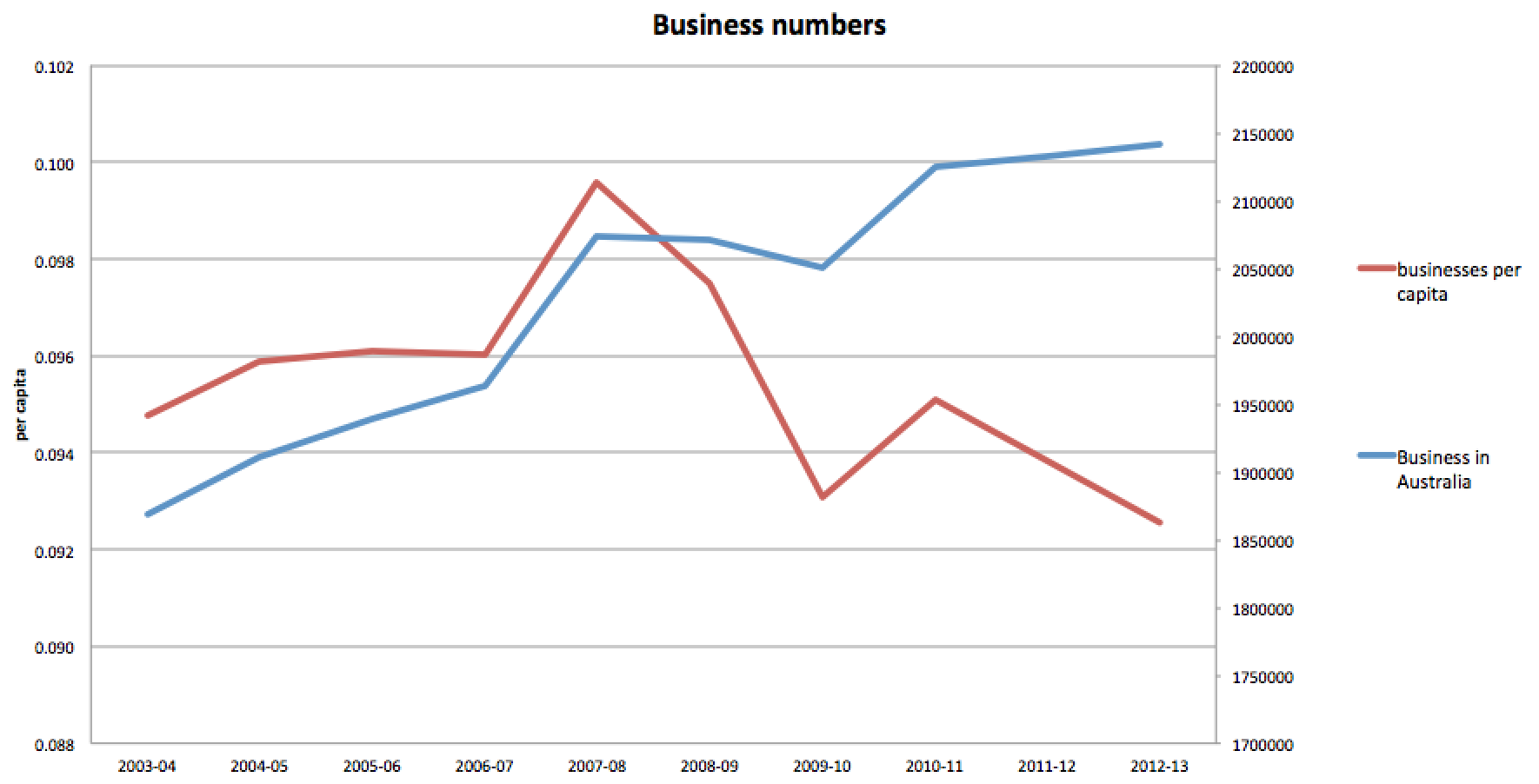
I’ve dived into the ABS figures to see what Australia looks like on the same issue. We don’t have as much historical data as America, but the numbers are just as striking. While Australia is home to ever more businesses, the number of businesses per person has fallen from nearly ten to closer to nine.

Business numbers

The explanation for this is in the willingness of Australians to open businesses. A decade ago, 900 new businesses were registered every day. Now it is under 700.

Bu
Bu

This is not necessarily a bad thing. If people can have employment without risking their house on a business idea, then perhaps that’s a good thing. Perhaps something has changed in the economies of scale that mean our economy runs on fewer bigger businesses now.

But the coincidence of rising inequality(1, 2) and higher market concentration makes the application of vigorous competition a huge priority for Australia. If rising inequality is explained by markets becoming more cosy than competitive, that is something we should act on as a matter of urgency.

Competition is something both left and right should be able to get behind. The only people who support market power are plutocrats who grow fat on the cream churned up by insufficiently competitive systems.

Wearables: more like social networks or hoverboards?

Apple is going to release its highly-anticipated iWatch this October. It will have a 2.5 inch rectangular display. I’m pretty skeptical that anyone will want one. But I could, I suppose, be wrong. iWatch could turn out to be the next facebook. let me explain:

Apple’s chance of first-mover advantage is zero. The smart watch market is already quite busy. Samsung and Google have products out. So do others.

smash misses.
smash misses.

None is making much of a splash.

We have a vision of tech breakthroughs as being radical new inventions. But really they stand on the shoulders of others.

Here’s a little extract from an email I got in April 2005, when facebook was still mainly for ivy league students and working on attracting early stage investors.

“I actually don’t know what this Bebo service does, but it looks like some of you are ‘existing members’ so I’m assuming it’s a good thing I need to get on the band wagon with.”

I joined Bebo. I can’t remember if I joined Hi5. I definitely didn’t join MySpace. But I thought about all of them and dismissed their usefulness long before I …

Joined facebookApple is betting that its smartwatch will be like facebook. That it will enter a market that has been a graveyard for competitors and make them look foolish. You wouldn’t bet on any company that wasn’t Apple being successful. And the Apple of 2009 might have been able to make a smartwatch into a runaway smash hit. But is 2014 Apple equally savvy?

There are clues that the magic began to evaporate when Steve Jobs passed away:

Why Apple no longer innovates.

Apple Inc. (AAPL) No Longer The King Of “Cool Tech”

There’s No Way Around It: Apple Is In ‘Reset,’

Although there are clues that the backlash is mainly clickbait and the magic is still there.

Source: Google
Source: Google

Investors are betting that the combination of fitness monitors and mini-notifications in the smartwatch will be just right. That it will click with the zeitgeist and zoom away until tehre are two types of people. Those who have an iWatch, and those planning to get one.

But when a product already exists in the market, you have to really nail your version to capture the market. That’s an art, not a science, it requires judgment in the 99th percentile, not the 98th. There is evidence a company like Apple can continue to be good for a long time. But can it be very very good? I doubt it.

The iWatch may not turn out not to be a facebook. It could be a hoverboard.

Something from science fiction that is possible to produce, but turns out to have severe limitations.

Not like this.
Not like this.

If that turns out to be the case, the iWatch will be a niche product and eager investors will lose a lot of money on Apple stock.

Who would bother sponsoring the World Cup?

The World Cup has dozens of sponsors. Companies like McDonalds, Sony and Budwesier, with a combined value of trillions of dollars. Are they wasting their money?

The biggest PR win of the World Cup so far has been by headphone company Beats by Dre.

Beats headphones

They got stacks of press when players were banned from wearing their products in the arenas, with FIFA citing Sony’s sponsorship as the reason. (Press examples: 1, 2, 3, 4, 5, 6, 7, 8, 9, 10 ...)

Here’s the lead from the original Reuters story:

“Neymar likes them Brazil-green. England’s Wayne Rooney, white. Luis Suarez, blue.

Banned from the pitch by FIFA for licensing reasons, the bulky Beats headphones are a favorite for many of the world’s top players, making the World Cup a huge unofficial ad for the company acquired by Apple Inc last month.”

The message is clear: players that are idols to kids around the world really want to wear Beats Headphones – if only the powers that be would get off their back! Somewhere, a PR agent is looking at a payslip with the biggest bonus they have ever seen.

Just one of the many articles I linked to notes that the ban might be just what Beats was after. That kind of disruption shows business smarts and is probably why Apple recently paid $3 billion to acquire Beats.

A sponsorship costs a lot. How much is a closely guarded secret, but possibly over a hundred million dollars for the top rung. FIFA is set to make $1.4 billion from sponsorship from this World Cup.

Sponsors

Companies who don’t get their name on teh FIFA website don’t hang their heads and trudge home. They instead prepare for ambush marketing. At the last World Cup, a beer company called Bavaria Brewery reaped the spoils.

“The company gave hundreds of young women skimpy orange Bavaria-branded dresses before a match between the Netherlands and Denmark. When the women were ejected and a number were arrested under South Africa’s Contravention of Merchandise Marks Act — an anti-ambush marketing law passed in advance of the country’s World Cup — the reaction sparked an international backlash that brought the company loads of free media attention.”

McDonalds is a major sponsor of the World Cup, but appears to be trying to run an ambush marketing campaign anyway, by making tie-in products with names they could have used even without buying a sponsorship.

Wasteful?
Wasteful?

Coke and Pepsi are also battling it out for pre-eminence. Pepsi’s Rio-based ad shows that no matter how much you fence off a sponsorship, you can’t own the concept of football, the town where a tournament is based, or the personalities that bring it to life.

Formal association with the tournament means dealing with FIFA – nothing to be proud of. Meanwhile, being associated with Lionel Messi is unambiguously good marketing.

Consumers, meanwhile, have little idea who is a sponsor and who is not. 38 per cent think Mastercard sponsors the World Cup (wrongly), 42 per cent realise Visa does.

If I were a shareholder in McDonalds or Coca-Cola, I’d understand. These are massive legacy brands that don’t want to yield an inch to competitors. But for the likes of Sony, Hyundai and Adidas, the decision to sponsor reeks of timidity and a lack of creativity. If they can’t think of a better way to spend their marketing dollar they should probably save it instead.

How much should we spend to get cycling up to 5 per cent of trips?

Melbourne’s weather is poor. It rains often. The city is huge – 100 km from edge to edge – and vast swathes of it are covered in the kind of densely packed contour lines that make cyclists legs tremble.

In winter, Melbourne’s cycling community shrinks by over a third.

Image

On days like today I suspect the number of cyclists is far smaller.

Image

In short, Melbourne will never be the sort of city where 50 per cent of trips are possible by bike. Cycling (and walking) will never ever do the “heavy lifting” in our transport mix. That role will always be split between public transport and private motorised transport.

At the moment, the mode share split between these three is:

Image
Source: 2011 census

And the trends are these:

Cycling is growing fast, more than doubling in eight years.:

Image
Source: VicRoads

Public transport growth has been its highest in sixty years, with train travel accounting for most of the increase:

Image
Source: PTV

And vehicle kilometres have surged on freeways, while not increasing on arterial roads.

Image
Source: VicRoads

Expenditure on specific infrastructure looks like this:

Nationwide, spending on cycling is $112.8 million. Spending on roads is over 100 times more, at $18 billion.

Image
Source: BITRE

The data is tough to aggregate, but one estimate is that roads get four times the investment of public transport.

All the modes are growing. How do we decide what the data means? And why not let the market decide what modes live or die?

The answer to the second question is that transport is going to be a centrally planned space until we can charge users per kilometre.

Public roads built to accommodate cars push the whole investment process into the world of “second-best.” If subsidising roads is a given, subsidising public transport can be efficient. Subsidising public transport makes policy makers wonder if there are other, cheaper ways to move people around, like bikes.

So if we’re going to be centrally planning our transport mix, we must ask: do we like the current 78/17/5 mix?

I’d argue we should not. I’d argue we should be aiming to grow the share of modes that have fewer negative externalities and greater returns to scale.

I’d hazard a guess that for Melbourne, 10 per cent share evenly split between walking and bike, 30 per cent for public transport, and 60 per cent for cars would be optimal.

Does that mean we should start spending 10 per cent of infrastructure funding on active modes, 30 per cent on public transport and 60 per cent on cars?

Only if we want to move very very slowly.

Image

Infrastructure lasts a long time. That means the stock of existing infrastructure is the single biggest determinant of infrastructure in five years time. Marginal changes in expenditure rates affect outcomes only very gently. If we want to effect change, we need to tip the scales massively in favour of the modes we want to grow, in the short term.

That means that announcements like $650,000 for changes to a cycling bridge in Melbourne’s west should not be cause for widespread congratulation.

In the short term, we could probably usefully spend 60 per cent of the transport infrastructure budget on public transport and 15 per cent on active modes. If we did that for a few years, we would move swiftly towards the outcomes we want, before returning to a “maintenance” split, where expenditure is based on usage.

Spending even $500 million a year on bicycle infrastructure might seem like a lot when the recent budget has been around $30 million. But when you look at what passes for “bicycle infrastructure” and imagine replacing it with global quality bicycle infrastructure, it would be a drop in the ocean.

Image
“Bike boxes” were the sine qua non of Melbourne bicycle infrastructure innovation just a few years ago.

I don’t imagine gold-plated bicycle infrastructure should go everywhere. Far from it. Cycling infrastructure should be optimised in the areas where cycling can thrive, likely to be areas that already see some bicycle traffic. Fixing missing links, creating Copenhagen lanes on major on-road routes, plus widening and lighting off-street bicycle paths would be the top three priorities.

If we want to increase the share of some modes, we need to be bold about throwing money at them, and not be afraid to acknowledge that such a move comes at the expense of other modes.

If change is constant, is it time to toss our coins?

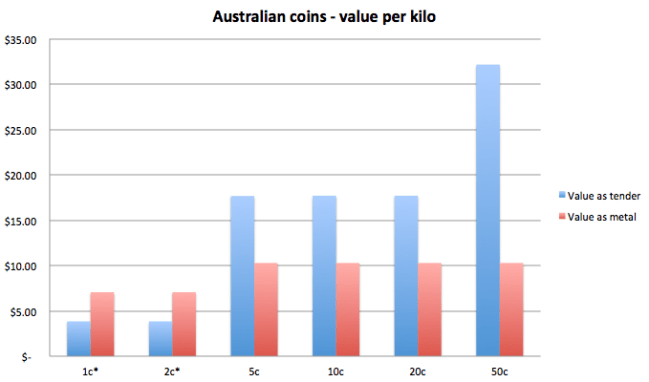
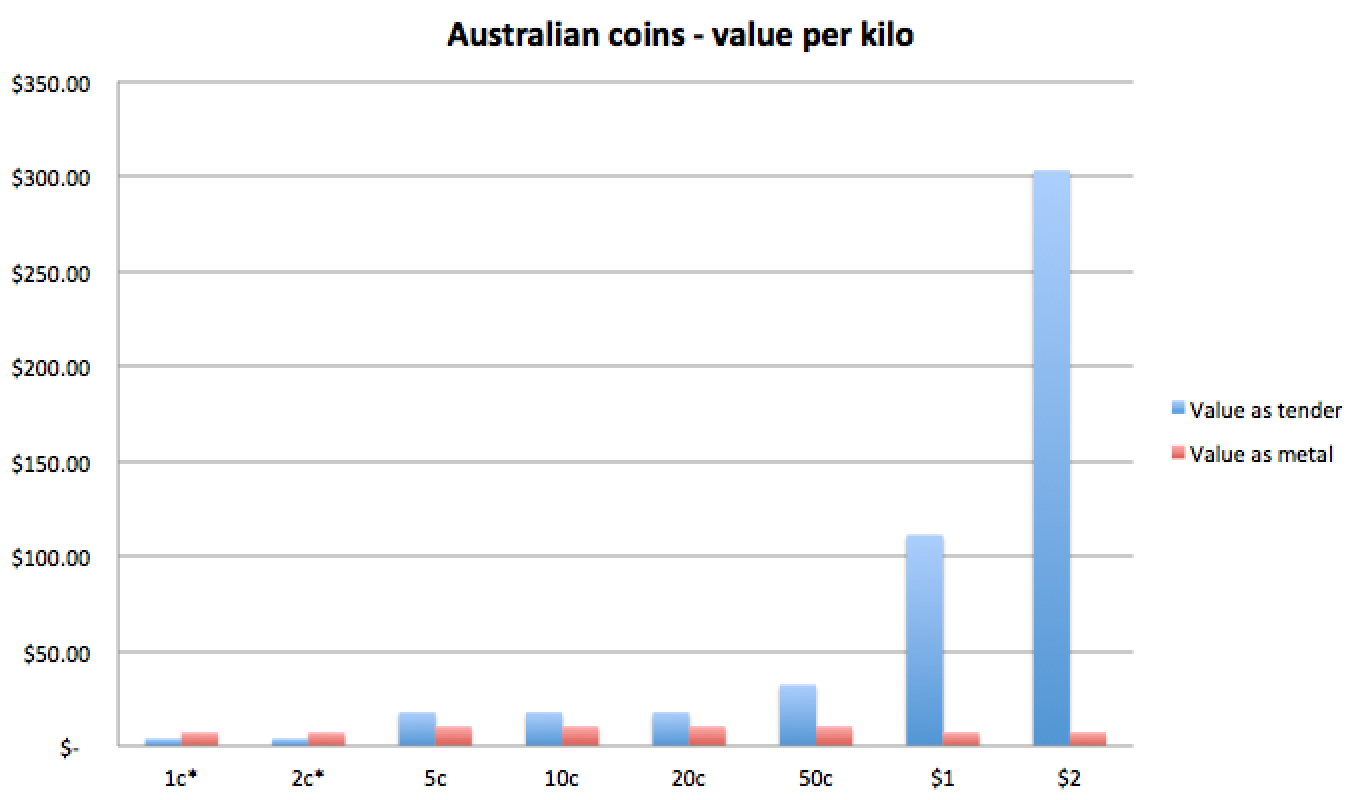
The Australian coin system is all wrong. The weight and bulk of our coins is disproportionately high, to the extent that some are worth over half as much as raw metal.

Image


The 5-cent, 10-cent and 20-cent coins, which have a value of just $17.70 a kilo, are the worst offenders. 


Image

The economic damage wrought by Australia’s hefty loose change situation is serious, and I offer as exhibit A my old wallet, which had to be held together by electrical tape after the coin section busted its stitching.

Image

But it’s not just purses, wallets, and pockets being busted by heavy coins. Think of the petrol cost as armoured vans deliver tonnes of change around the city, especially to big coin users like supermarkets, pokie venues and public transport ticket machines.

Even the Royal Australian Mint is at risk if copper prices rise. Copper represents 75 percent of our silver coins and 92 percent of our gold coins. The profit (seigniorage) that the mint makes on selling coins to the RBA was a not-insignificant $96 million in 2012-13. It would be crazy to put that upside at risk for the sake of big fat coins.

During 2011, it looked like our coins might soon be worth melting down.

Image

The solution to these problems is obvious. Smaller coins. We have the answer in front of our noses, in the shape of our $2 coin, whose outstanding value-to-weight ratio makes it the Bradman of coins.

Image

The $2 coin is the only one you’re actually pleased to find in your wallet. Introduced in place of the two dollar note in 1988, it’s worth keeping around. You never take a handful of them and dump them into a jar. 

Image
The second best way to carry around two dollars in coins is nearly three times heavier

The Canadians call their $2 coin a Toonie, yet for some reason, this nickname-mad nation has yet to come up with a diminutive for our Mighty Two.

If we want to try to make our coins a bit more like the Mighty Two, we need not look far afield for a model. In 2005 New Zealand got rid of 5¢ coins and changed its 10¢, 20¢ and 50¢ coins from copper and nickel to plated steel. Their new coins are much smaller and much lighter than ours.

Image
Extinct kiwi specimens.

Businesses who have to heft big bags of change back from the banks would welcome the change – you might imagine only the vending machine industry would object. But even they are increasingly moving towards electronic payments, because the industry wants to cut costs by diminishing the frequency with which it collects coins from its machines.

The argument for smaller coins is a simpler one than the argument for getting rid of the smallest denomination.

If you try to get rid of the 5-cent piece, everyone gets up in arms about supermarkets rounding up the price of things to the nearest ten. Never mind that this argument doesn’t hold water. It’s what keeps the pennies circulating in the US, and 5-cent pieces in Australia. The case for smaller coins is much simpler. 

Doubting Thomas: Why skepticism of economics is crucial

I remember third-year economics. The lecturer played some sort of Wheel of Fortune game where he had students answer questions correctly for the chance to guess a letter. It was around the time we were learning about how markets would reach general equilibrium if left alone. The eventual phrase spelled out “Don’t screw with our markets.”

“It’s beautiful,” said the lecturer as he delivered the mathematical proof.

“Why can’t the arts students just see this!” exclaimed the girl in the row in front of me.

Classical Economics has some beautiful theories.

John “beauty is truth” Keats may well have been a free-marketeer. But beautiful theories are a trap.

The human brain has a wide range of biases, the most risky of which is a conclusion bias. We are inclined to latch on to an answer as soon as possible, which then goes on to frame our subsequent information gathering and processing.

Of course, a beautiful unifying theory will be very tempting for us. Succumbing to that temptation explains a lot, from biblical literalists, to libertarians and communists.

But the real world is very messy, and the project of the entire enlightenment is to get us engaged with that complexity and put aside our tendency to simplify.

I’ve written about this problem before: I Haven’t Decided Yet.

Some of the most intuitively appealing theories in history (e.g. from each according to his abilities, to each according to his needs) have proved unworkable.

The point I’m driving at is well encapsulated by the parable of the fox and the hedgehog. An ancient Greek Poem turned into an essay by Isaiah Berlin, the Fox vs Hedgehog debate has been given a new life by statistical guru and seer Nate Silver.

It classifies people into two groups, foxes – who rely on lots of little scraps of knowledge, and hedgehogs, who know one big thing. Nate Silver shows that in making predictions, having one big belief can be a block to seeing the future well, and being a fox is the better approach.

(Of course, that itself is a simplification, and a truly foxy approach will accept there are times when a big simple truth is just that: big, simple and true.)

I raise this issue now because I see two big examples where a simple, hedgehoggy application of economics seems to be taking sway.

1. Our federal government. A political fox willing to try anything to get into power, Tony Abbott turned into a policy hedgehog after occupying the Prime Minister’s Office. His latest budget is the repetition of one simple trick: apply market forces. From higher education to GP visits, via cuts to social security payments, the Budget tries to fix Australia by allowing the power of markets to seep in.

It’s not nuanced but it is no doubt deeply satisfying to those elements of the base for whom the solution to the world’s problems is obvious.

2. Piketty. A French economist working on inequality, Mr Piketty has made an enormous splash in 2014. His very long book entitled Capital in the 21st Century considers a lot of evidence and distills it to one simple equation: r>g. That posits that the growth in inequality is due to a mathematical problem – the return on capital (r) is higher than the rate of growth (g). Existing stocks of wealth grow more than the paycheques of workers and so the world grows more unequal.

I do not claim to be smart enough to prove that r<g, or that applying market forces to government services will always undermine them. But I hope to be smart enough to watch the debates unfold while remembering that a simple answer pleases a simple mind.

How long until Tasmania is totally empty?

You can buy a fully renovated mansion on top of a hill in Tasmania for under $850,000.

Tasmanian MansionDid I mention that it is a mansion?

Hobart House plansIt’s also in the heart of Tasmania’s capital city, 1.4 km from the waterfront.

Even though a similar property in Melbourne would cost probably seven times as much, a multi-million dollar saving is apparently not enough to actually tempt people to live in Hobart.

Demographic data out today show the Apple Isle circling the plug hole. Its population growth rate is not far from zero, and people continue to leave in large numbers.

Tassie interstate migration

In the 36 years since 1981, Tasmania has managed to actually lose people to interstate migration, despite the Australian population more than doubling. They’ve been saved from extinction by overseas migration and the birth rate. But will that continue?

The entire state has managed just 700 babies in the last six months, an amazing new low.

Tassie births

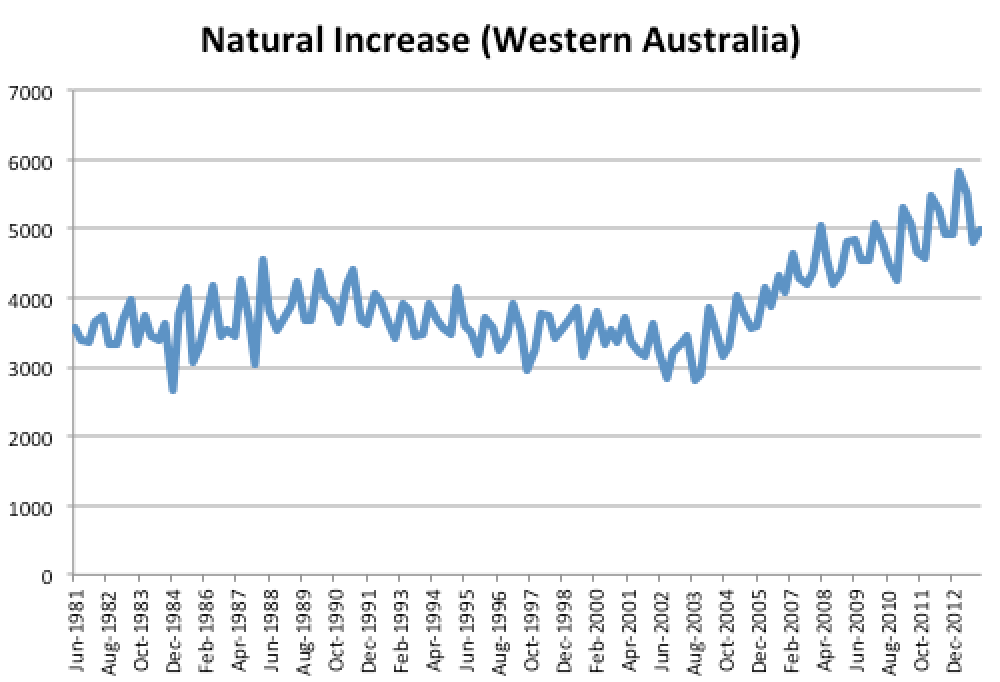
The Tasmanian fecundity shortfall looks especially stark when you compare it to other states. WA has had 9800 babies in the last six months.

Screen Shot 2014-06-19 at 12.37.09 pm

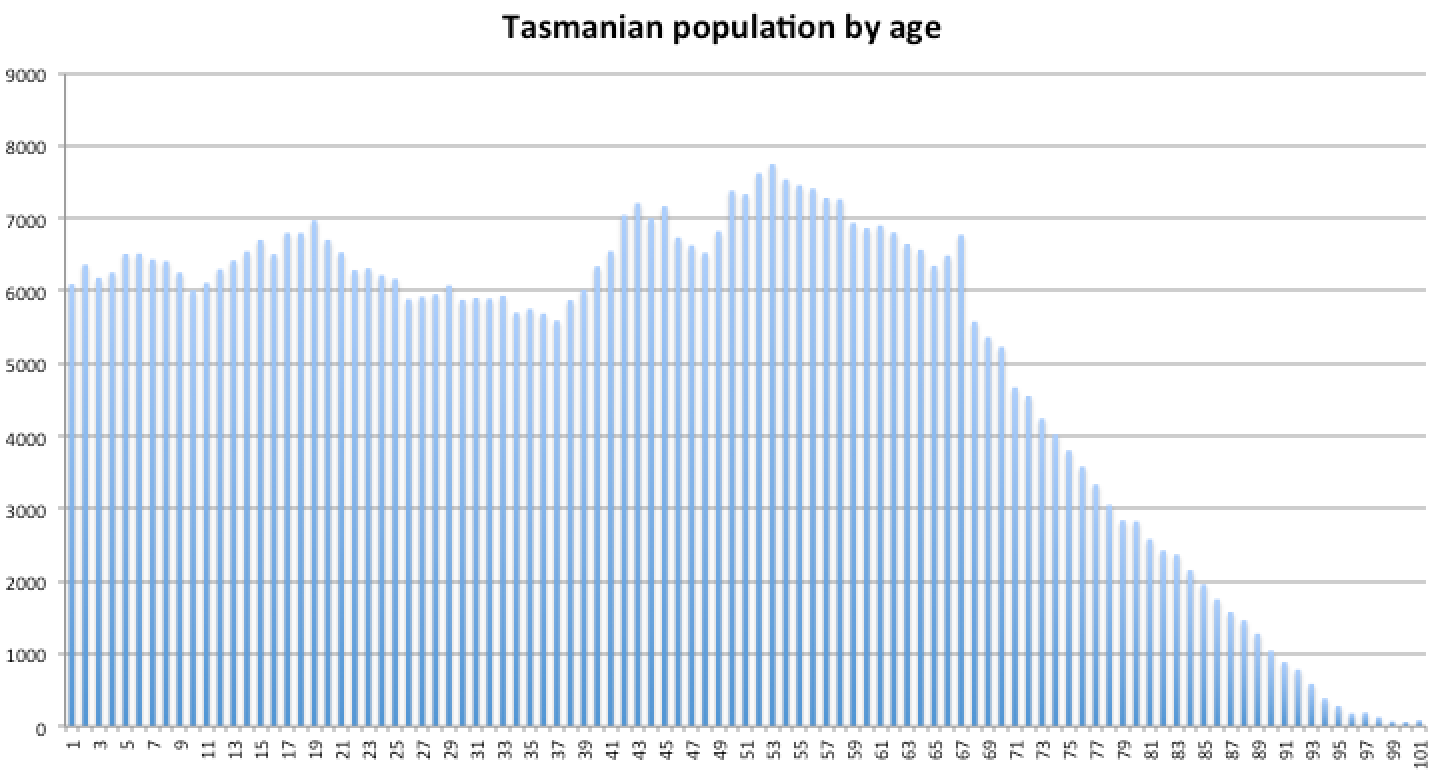
The reason for Tassie’s child shortfall is not unguessable: Too few mums and dads, and too many grandmas and grandpas.

Tasmania by ageHow does Tasmania break out of this cycle? If mainland house price growth continues, there should eventually be push factors. Once the price of new housing in country Victoria and outer Melbourne starts to be much higher than the price of new housing in Tasmania, people might start moving there.

Also if climate change picks up, Tasmania will offer the last temperate zone in Australia.

But that doesn’t offer much to Tasmania in terms of positive actions it can take. Another option I’ve canvassed is learning from the failure of the EU, and giving Tasmania its own monetary policy and currency (The Boonie).

Essentially, the lesson of migration everywhere is that most people (except retirees) will move for jobs. That’s something Tasmania has too little of.

Unemployment by state

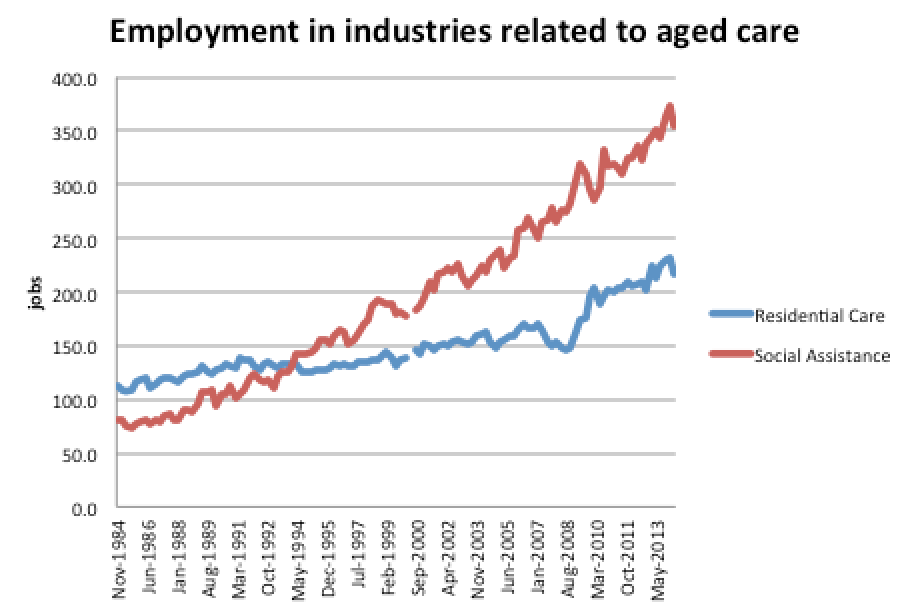
How to fix? There are glimmers of hope in the data above. Australia’s next big boom will be looking after the aged. If Tasmania can turn itself into Australia’s Florida (the place to move when you retire), there should be lots of jobs in aged care.

It just needs to convince the mainland-dwelling elderly that if they don’t want to work all the way to Tony Abbott’s new pension age, they should downsize to a much cheaper house on the other side of Bass Strait.

That would bring an influx of wealth to the island, and provide for a lot of jobs. The aged care industry is already showing a lot of growth.

Aged care

Can the Apple Isle fill those creaky old Hobart mansions with happy retirees? The key to Florida’s success has been “Weather, effective marketing, low taxes and a herd mentality.” Tasmania can match two of those already (good marketing and a retiree flow). Lower stamp duty for over-55s buying a new property might be a good policy move.

As for the weather? It can’t do much more than it’s doing already, by logging those virgin forests and exacerbating climate change.


Faster train journeys – some low-hanging fruit.

The state government is prepared to make big investments to make train travel easier and faster. So they should. They are contemplating a $9 billion tunnel that will make journeys faster and more reliable.

But what if I told you there was a much much cheaper way to improve travel times of the rail system, while making people’s journeys to work more comfortable?

The solution requires thinking outside the box. This is not about putting faster motors on the trains. Not about improving signalling or driver training or anything to do with the train system itself. It’s about cutting walking times to the station.

Let’s look at my local station, Clifton Hill.

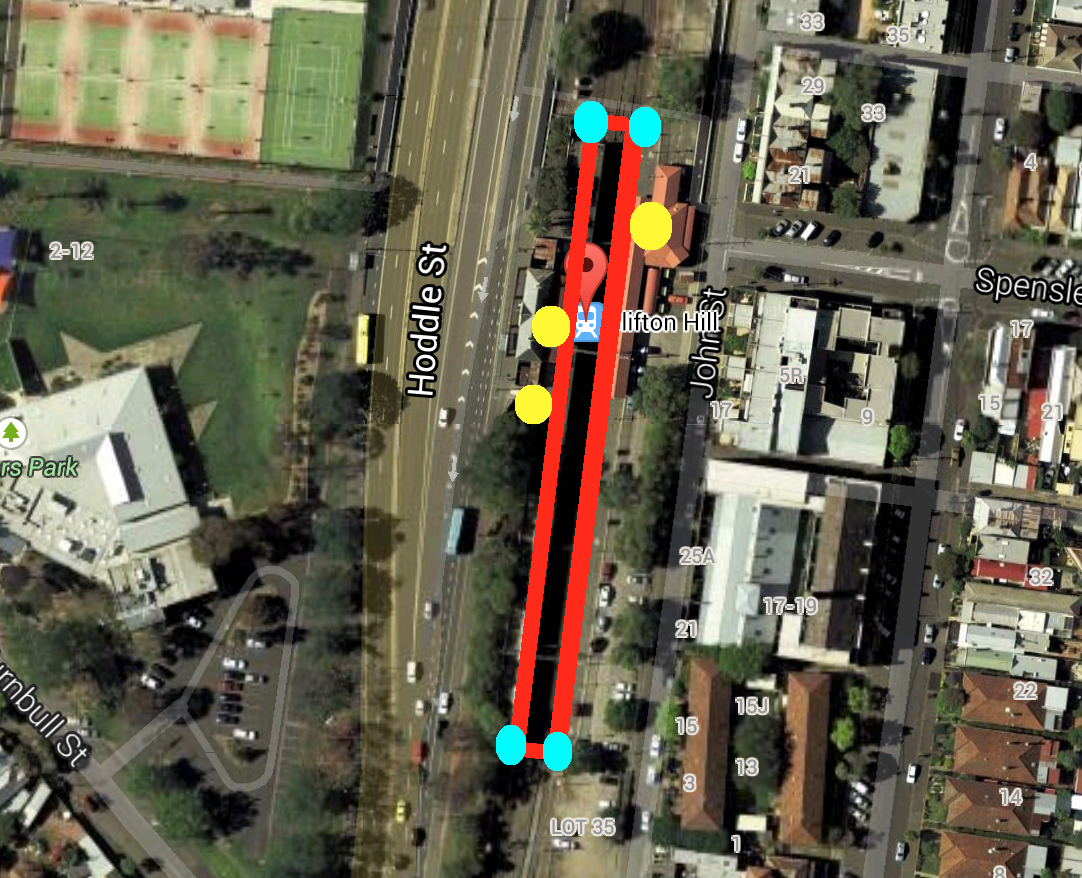
Clifton HIl station entrances and exits.
Yellow dots mark the entrances

There are just three entrances, all clustered up the northern end of the station.

The last 100 metres.
Placing the entrance at the northern end means passengers walking from the south have to walk an additional 120 metres to get on the platform. (I reckon 2 minutes is an overestimate by our friends at Google Maps.)

This is not a passenger-centric design, but an operator-centric design.

Where new station entrances should be
Where new station entrances should be (blue dots)

Walking times are some of the most important parts of a train journey. A meta-analysis of the subject cites research that found ten minutes of walking was equivalent to 20 minutes of riding in the vehicle. In other words, the walking section of the journey is an important place to focus improvements.

I’ve made a model for the benefits at Clifton Hill station. Clifton Hill Station got 3,009 boardings per weekday in the 2011-12.

I model it like this: 25 per cent of the users who walk to the station live in line with the platform, so moving entrances to the end is of no benefit, while 75 per cent of users currently walk past the end of the platform to get to the entrance. An amazing isochrone map app I found shows that my model is probably conservative, because of the local geography.

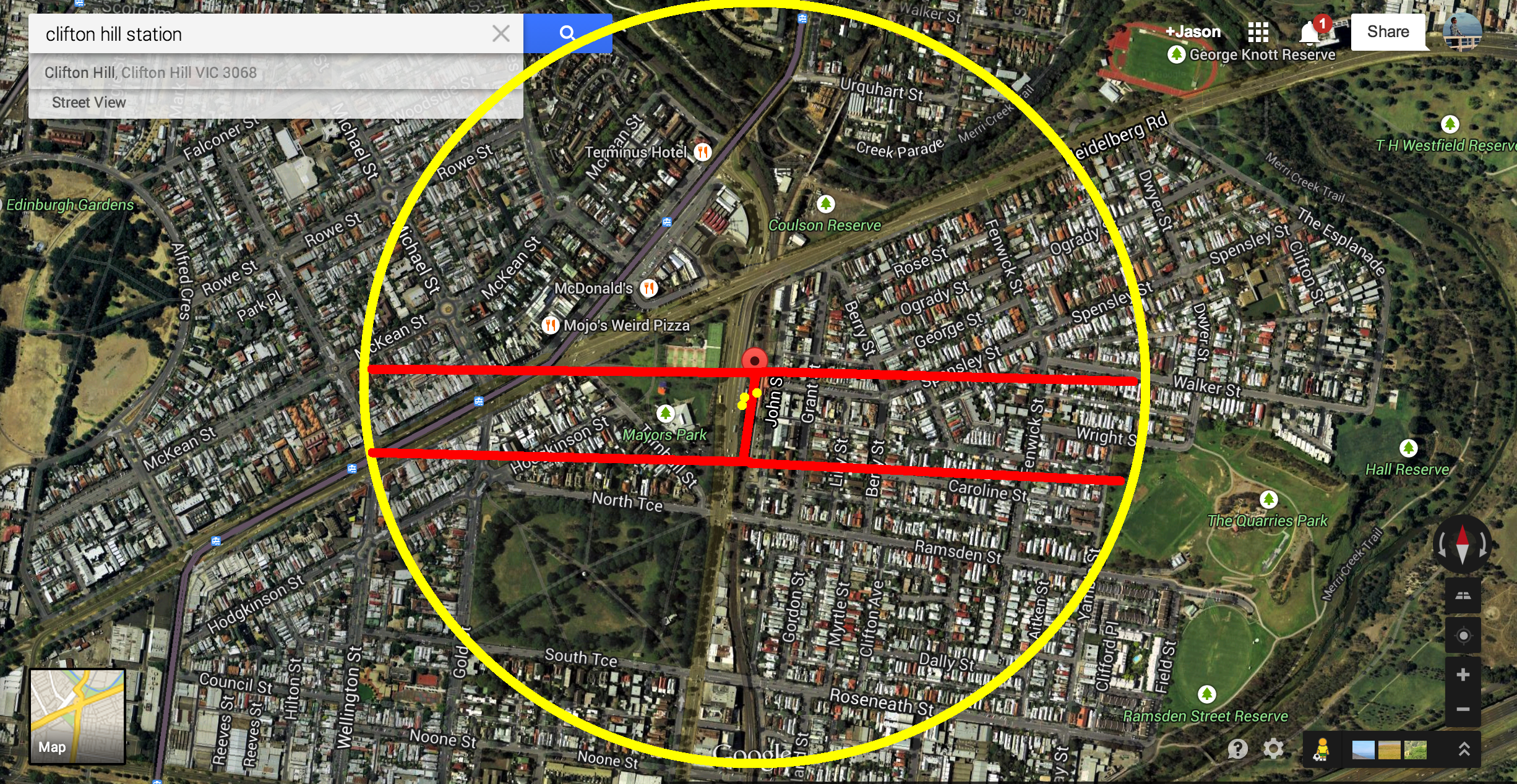
Those inside the yellow circle and not between the red lines can be assumed to benefit from new platform entrances.
How far can you get in 12 minutes?
12-minute walking map. Source: Cartoo

There are 90 car parks at Clifton Hill Station, and it is served by buses. There are trams not so far away. I estimate two-thirds of people walk to the station. (2000 users a day.) Let’s say 1500 of them could potentially access the station via the new gates I propose.

But smart public transport users know not all carriages are equally useful. Depending on what station you get off at, and where you’re headed, your train exit may be speeded up most by being at the front, back, or middle of the train.

If you come to Clifton Hill Station from the south, but you want to board the southbound train’s last carriages (and you’re not running late) it provides you no advantage to have an extra gate at the south end of the station.

But if you’re coming from the south and you want to be in the front carriages of that southbound train, you need to walk that distance twice. Once along the street outside the station, and then back again along the platform.

Putting an entrance at each end of the platform, replacing a northern-end entrance
WALKING DISTANCE SAVED (m)
Southerners Middlers Northerners
front carriage riders 150 0 0
mid train riders 75 0 0
last carriage riders 0 0 0

12 per cent of the 2000 walkers will save a conservatively estimated 150 metres, or 90 seconds. 12 per cent of them will save an estimated 75 metres, or 45 seconds. That adds up to 563 minutes on access to the station. That makes 9.4 hours. If the same effect is present when they return home, it’s worth 18.8 hours.

The model does not assign any benefit to all the trains that may now *just* be caught when before they were just missed.

Assuming a value of time of $30 an hour, the value of the additional exits would be $146,000 a year, just measuring weekday trips. For a gap in the fence, a bit of concrete paving and some extra Myki machines, which I estimate to cost perhaps $500,000, it would pay itself off within a few years, yielding a positive rate of return.

You may think a minute here or there is not important, but there is no single change that can cut a train journey’s duration in half. If we want improvements to service we need the operators to accumulate small easy changes like this across the network.

Clifton Hill Station is not even the worst offender. Camberwell station has the entrance to two of its three platforms about 100 metres away from the main road it serves.

Camberwell station served 6,571 passengers each weekday in 2011-12
Camberwell station served 6,571 passengers each weekday in 2011-12.

Why haven’t they thought of these fixes already?

There will be a perceived trade-off with safety. I don’t doubt the ex-post rationalisers are currently saying “but having one entrance allows for surveillance!” But a single entrance also funnels station users past a single choke point. In the same way a narrow alley feels dangerous at night, so can a single station entrance with no alternatives.

In fact, more exits and entrances should mean fewer people spending time at stations, increasing the visibility of anyone loitering with malicious intent and decreasing their opportunities.

I contend the reason this sort of station design is not widespread is institutional. The Public Transport Victoria guidelines for station design seem to support this kind of solution:

“Many aspects of the local context and surrounding urban design will influence the station entry configuration. A thorough study of the station catchment area is required to determine the most appropriate placement of the entry or entries in order to attract patronage by:
a) Encouraging the use of the station by simplifying connections with existing and future urban design;
b) Providing accessibility, convenience, clarity and quality of arrival to and from the station;
c) Providing safe and attractive public spaces that contribute positively to the local identity;”

But in fact, station access runs second to concerns over train boarding patterns. PTV tries to alternate whether station entrances are at one end of the train or the other, to prevent any one carriage getting too full. Their conception of their job focuses on the trains, not the passengers.

But building more station entrances should be a priority. It won’t help just walkers. At the margin, making walking distances to train stations shorter will encourage more people to walk, and free up scarce car parking spots for people who live even further away.

As well as institutional bias from the departments, there is a ribbon-cutting bias in public transport investment. Politicians want grand visions. The Premier can’t imagine himself showing up to the construction of a new station entrance, so he doesn’t push for it to get done. But that doesn’t mean it’s not the best idea.

a+b=c. Algebra can save a poor black kid’s life.

Doubling the amount of time poor kids in Chicago spent studying algebra in grade nine led to an 8 per cent increase in their high school graduation rate, and an 11 per cent increase in college enrolment.

That’s the finding of a terrific new paper out of the US National Bureau of Economic Research.

Given that US high school dropouts die earlier than graduates by 3-5 years and make up 7 out of 10 prisoners in the US, it is fair to argue that for thousands of these kids, algebra has saved their life.

The paper exploits a natural experiment whereby students in the Chicago Public School System were placed into double dose algebra classes (largely replacing music or art classes) if they scored below the national median on an eighth-grade math test. The researchers compare kids just above and below the cut-off. 

Image

Barack Obama in Chicago in 1995. Photo By Mark Pokempner

The numbers of students in the algebra courses is substantial, because maths skills are thin on the ground in the 73 public high schools studied. In the US, just 20 per cent of hispanic students, 13 percent of black students, and 17 per cent of students poor enough to qualify for free lunches are rated proficient in maths. In the Chicago Public School System 90 percent of students are black or Hispanic.

“In the Chicago Public Schools (CPS), the focus of this study, roughly half of high school freshmen fail at least one course, with the highest failure rates in math courses”

Schools assigned weak students to a back-to-back lesson in Algebra with the regular algebra teacher, and gave the teachers professional development, permitting them to use different instruction methods, including working in small groups, solving problems verbally, and having students set problems for each other.

Image

The impact on test scores was modest. But the impact on the students lives was not.

“…the test score impacts of this policy dramatically understate its long-run benefits as measured by educational attainment.”

The effect of double dosing in the first year of high school remained over time. Students who were in the program were 9.3 per cent more likely to pass algebra in that year. But they are also 7 per cent more likely to still be in school in the fourth and final year of high school.

The students who got the most out of the instruction were ones with poor reading skills. They end up passing three more subjects in high school on average, after taking the double dose, creating a 13 per cent increase in the number of poor readers who complete enough subjects to pass high school. The researchers suggest that the focus on using verbal methods to solve maths problems may explain this result.

Black students who got the double dose  also saw a dramatic effect, with a 15 per cent increase in college enrolment. For the double-dose population at large, the increase was 11 per cent. The effect can be seen in this chart:

Image

For some of these student, the impact of these classes – which their 14 and 15 year old selves no doubt dreaded – will be dramatic over their life times.