The problem with online comments. Solved.

I read an article in the Guardian the other day calling for an end to online comments.

“On most sites – from YouTube to local newspapers – comments are a place where the most noxious thoughts rise to the top and smart conversations are lost in a sea of garbage.”

Prima facie, there’s something to this argument. There are a lot of downright scary comments online. YouTube is about the worst place for it. I figure that’s because videos are the main intellectual sustenance for people who can’t read well, so when it’s time for comment you get the blatherings of the intellectually incapable.

(Here, by contrast, the readers are shining beacons of erudition and compassion and the comments section is a delight. ;) )

So partly, the problem is that different sites have different readers and not everyone’s worth listening to.

But think about The Guardian. In theory it’s a thinking-person’s paper. But the comments section is a disaster. What’s the explanation?

(Nobody is going to die of surprise in the next paragraph as the economist reaches for the folder marked I for Incentives.)

The problem with online comments is the incentive structures! For some idiot with anti-social views, this is his one chance to get his views amplified. The pay-off here is high. Normally he can’t get anyone to listen. But if he quickly writes something inflammatory, he can spend a happy afternoon jousting with people he made angry.

The intelligent person looks at the animals head-butting each other in the comments section and can see no reason to get involved.

For the Guardian writer up above, there’s no solution to comments beyond chucking the whole system out. I know different because I spend a lot of time on Reddit. There’s a site with a wide variety of people on it, from all over the world, from all over the political spectrum, of all ages and of all levels of education. And the comments over there often genuinely brim with wit and intelligence.

Reddit is nominally a link-sharing site. But the value of it is actually in the comments. How do they do it?

Reddit’s comment section is ruled by two main incentive features. Upvotes and Downvotes. Users can upvote or downvote any link or any comment.

Upvoted comments rise to the top. Vile idiocy exists on Reddit, of course. But it sinks into the murky depths where it is little seen. And any comment that gets more than 5 net downvotes disappears from view.

So the incentive system is different. Instead of bad comments floating round riling people up, they disappear. That disincentivises trolls.

And good comments are rewarded.

Every user has a “karma” account that tallies their “karma” – simply the total upvotes they’ve ever received. This Karma is not exchangeable for gold, rubies or bitcoin. It has no value. But those status-seeking missiles we call human minds don’t give a damn. One of the problems on Reddit is actually people doing dumb stuff for karma.

While other sites do have incentives – e.g. the New York Times picks, the Reddit system is a more proven success.

Redditors can ask a stupid question on the site and see a dozen people go scurrying off to provide a well-written, well-researched answer provided with wit and goodwill.  Reddit’s growth is extremely rapid. The site has seen 1.7 billion comments so far.

This system is actually the goldmine lying beneath the land investors in Reddit purchased. They may have thought they were buying a succesful domain name or a winning web brand, but what they’ve got is a killer comment system they need to patent, ASAP.

And then preferably license out. The comment threads of the world need it desperately.

Recent work: A compilation of links

I haven’t been updating the blog quite as often as I would have liked but I haven’t been totally idle either. Here’s a few pieces I’ve written in recent times for other outlets.

Crikey

With Silk Road iced, budding entrepreneurs bluntly selling drugs online* (Still paywalled for now)
If oil prices are tumbling, why is petrol so damn expensive?
Stocks: hold ‘em, fold ‘em, walk away or run?
CEOs trump MPs for profligacy, but at least they’re not wasting our money
Pollies will spend $506m on entitlements in 2015-16 — $2.2m per MP
Would the ALP’s ‘Buffett tax’ put an end to tax-rorting millionaires?
If Greece defaults, it will join an illustrious club of debt welshers (including Australia)
It’s the end of the euro as we know it (and I feel fine)

news.com.au

The truth about running a franchise
Blender wars: Why sellers of stuff are stuffed [If you only click one link on this page click this one. It’s my favourite]
Australia? Japan? Canada? What’s really the best value place to ski?
Masters is the screw up that could hammer Woolworths – and the rest of us
Are Amazon mad? Or mad geniuses?
Is it time to start panicking about China?
Four ways a lower Aussie dollar will make your life better
Why house prices don’t need to be a consistent multiple of income

The New Daily

Babycinos, boutiques impact house prices
Even poor AFL clubs can enjoy finals glory
Forget the big city. We find homes for $12,000
Rising cost of private schools may be driving parents away
Uber’s bait and switch: passengers taken for a ride
Duty free shopping not always the bargain it seems

And here’s a really interesting story about being a freelancer in America. (Which I did not write.) It’s not so lucrative here!

And lastly, the view from my “desk”:

My PA is attentive but not that effective.
My PA is attentive, but not that effective.

Why do we need 3% economic growth to keep unemployment stable? – Part 2

This series started yesterday when I started wondering about the exact reason we needed economic growth to keep the unemployment rate down.

I wrote an introductory post then, explaining I was going to do some learning in public.  (The risk of embarrassing myself is real). Now I want to dive into this a bit more.

It’s true we need economic growth to prevent the unemployment rate rising. I checked and important people believe it.

RBA Assistant Governor Chris Kent has specifically linked changes unemployment to trend growth. “Since about mid 2012, Australia’s GDP growth has been a bit below trend and so the unemployment rate has been rising gradually.”

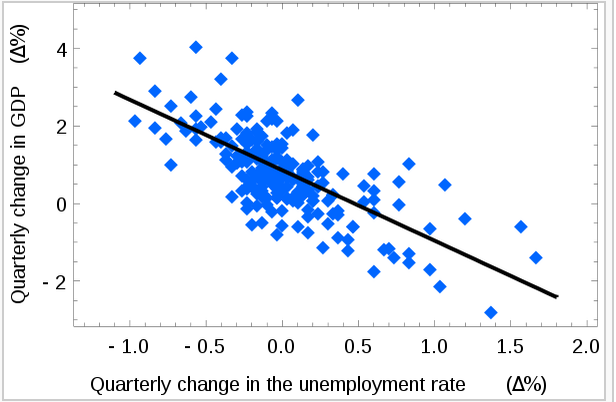
And he has given us this excellent graph:

Recessions send unemployment spiking. And so can low growth.

Phew! That’s one thing I got right.

The link between economic growth and changes in unemployment is real and it has been formalised in a relationship called Okun’s Law.

Screen Shot 2015-09-09 at 8.47.18 pmI put the word out on Twitter for an explanation and I was swamped with awesome economists offering helpful explanations. Thanks to everybody.

This was the main thing I heard.  Basically:

  • Because of population growth you need growth in output to have jobs for the new people.
  • Because of labour productivity changes (people getting more efficient) you need more output or else you’ll employ fewer people.

This is a nice neat story. If you have 2 per cent labour force growth and 1 per cent productivity gains, you need 3 per cent growth. It’s mathematically sound. I learned something.

So is that it? Are we wrapped up? All silent?

I still find myself with questions. I want to understand things in more than just mathematical terms.

Productivity causes growth. It allows us to produce more, using the same. But we also need growth to compensate for it? This sends me into something of a chicken and egg loop.

I’m aware that chicken/egg scenario is why economics uses maths so much. Supply and demand need to be solved simultaneously. You can’t think through a market equilibrium slowly because you need an answer on both sides at once.

So I could stop here. But I have other questions.

If rising labour productivity is both cause and cure for unemployment, why is it spoken of in exclusively glowing terms? Would we not be as well off, in unemployment terms, without it?

And population growth causes economic growth too. This is what I believe, a belief reflected in articles like these:

Fewer people want to live in Australia in growth risk for RBA

RBA’s Glenn Stevens: Australia may need to rethink growth

If we did not have the population growth, would we still have stable unemployment? This remains my sticking point – my reason for wondering about the deeper reasons and implications of why we need 3 per cent growth.

Seems to me an important part of the existing population is employed creating space for the new population to live in.

While the productivity angle makes sense to me, the population one still gives me pause. Establishing the new capital stock to accommodate the lives of new babies and new migrants is a huge cause of economic activity. More roads, more shops for them to shop in, more buildings for them to live in, more pipes going to their houses, more hospitals for them to be sick in, etc.

New population consumes and works the same as the existing population; but also requires extra spending. I intuitively believe population growth causes a rise in employment so I can’t quite grasp that it’s a wash, unemployment wise.

Whenever I think about this question I think about Japan, where capital is being abandoned as the population shrinks, and (while unemployment is low) secure employment is a problem.

Perhaps I need to think about this differently? Perhaps I need some more empirical evidence? I’ll dive deeper and present what I find tomorrow.

If you have any thoughts on this topic or want to suggest some reading, please feel free to make a comment below.

Why do we need 3% economic growth to keep unemployment stable? – Part 1

I like to think of myself as not too stupid. When I don’t understand something, I like to dive into that.

  • Sometimes I learn new facts that help me make sense of what seemed like disparate and nonsensical data points.
  • Sometimes I learn what I thought were facts were not.
  • Sometimes I learn new theories of the world.
  • Sometimes I decide those theories are nonsense and the reason I didn’t understand the thing in the first place is that it makes no sense.

Searching out areas where I feel confused or uncertain is a useful way to figure out how to move forward. I try to shield from public view when these areas of uncertainty are to do with economics. But no more.

I believe we need high growth to keep unemployment stable. But I’ve never really understood why.

My economics education was a good one. But I never did honours – let alone a PhD – and it was a long time ago. They didn’t teach us everything, and I’ve forgotten plenty.

This is my way of saying I don’t know everything about economics. (Despite how obvious it is this is weirdly hard for me to type.)

What I’m doing here then, is going on a learning expedition. Trekking deep into territory that has been explored, but not by me. Maybe along the way I’ll learn something. Maybe even have some insights that are new to me. Maybe even have some insights that are new!? Most likely I will discover everyone else already knew something I didn’t.

This is part 1. I’m expecting to be able to put together a few more parts over coming days as I learn a bit on this topic. But for now, I’m going to write about a few of the preconceptions I have that give me the idea this is an important question to pursue.

  1. My sense is if the Australian economy saw population growth and productivity growth drop to zero it would have growing unemployment. But basic economic equilibrium theories would suggest that doesn’t happen. Why wouldn’t all the firms just produce the same again next year, using the same workers?
  2. My guess is that growth has in the past come largely from population growth. Which is weird. It suggests adding new people to the population / labour force creates so much new demand that it props up not only their own job but other people’s jobs too.
  3. The global population is growing fast. But it may stop doing so within our lifetimes. At that point, population growth will stop contributing to economic growth. If population growth causes econ growth causes employment, the end of pop growth could be the end of employment.  That’s a nasty scenario. We may have to choose between the limits of the planet or the employment of its workforce.

At the least this will be a quick two part series where I explain the answer in part 2 and am forced to revise the first thing I said in this post. ;)

Please leave any helpful comments or suggested reading for me in the section below. I’ll write more soon.

Ross Gittins swings at reform, misses, falls flat.

Ross Gittins has just published an article making a case against the reform obsession that grips the current political class.

I like Gittins and I’m always interested in a smack-down of a new religion, so I started reading eagerly.

But Gittins was unable to deliver a smackdown. Unable to deliver much at all.

See if you can spot the fallacy here:

“Simple statistical theory should be telling economists that a protracted period of below-average growth is most likely to be followed by a period of above-average growth.”

Whew, that’s embarrassing.

The nicest thing I can think of to say about it is there are economic models suggesting poorer countries grow faster than richer ones. They imply a degree of catch-up – perhaps those were the theories Mr Gittins was fumbling for?

But the problems with the article go beyond just one dodgy paragraph. His whole case against “reform” depends on the idea that the economy will grow just fine without it.

That’s certainly possible. I actually think the economy might well be about to bounce back a bit. But that doesn’t make a case against reform.

Economists know you get growth from adding more people and machines, and then you get extra growth for free via productivity gains. Productivity gains are the really good gains because they come without real trade-offs. You don’t need more ingredients, just a better recipe.

Productivity gains can come from two main sources.

  1. Better ways of doing business (innovative ways of combining inputs inside the firm), and
  2. Better-functioning markets (innovative ways of combining inputs outside the firm).

Why do we obsess over the latter one? It’s where we have our hands on the lever. Governments can’t really control innovation at the firm level. Not in the short-term at least. They do control market regulation.

So “reform,” that buzzword that’s as popular as a buzzard, refers to this latter issue. Making markets work better.

Sometimes they work better with less regulation (economists arguing against the taxi cartel, for example) sometimes they need more regulation (economists arguing for a carbon tax or higher capital requirements for banks.)

Whether or not you get the first kind of productivity improvement, there’s a chance you can bring growth into existence by focusing on the latter.

Growth matters.

The desire for growth is not about the hope of self-enrichment. The sad fact is growth remains the only way we know to ensure full employment. Unemployment is horrible. It hurts people and ruins lives long-term. Meanwhile higher growth can bring better standards of medical care, lower infant mortality, safer foods, more opportunities to work in satisfying jobs. So the hunt for growth is a humanist pursuit. Obsessing over it is a risk-averse social scientist’s way of trying to maximise human happiness.

Gittins seems to think gambling on future growth is a great idea.

When you convince yourself, as many economists have, that the only way we’ll see faster growth and further productivity improvement is for governments to engage in extensive reform, you’ve convinced yourself our economy is deeply dysfunctional.

Optimism is an endearing quality in a friend, not an economic policy-maker.

The great thing about market reform is it should work whether or not we’re getting the other kind of productivity inside firms. It’s additive. If Mr Gittins’ optimism is rewarded and we see a great surge of firm-level productivity unleashed, it won’t be a mistake to have unleashed market-level reform too.

There are strong arguments against reform. Arguments about the extent of economic encroachment into our lives. About materialism and reification. About market power. About whether we can shape economic growth in ways that brings us more of the good and less of the bad. These are good arguments we should all be engaging in.

It’s a shame those column inches didn’t attempt such an engagement.

Want a glimmer of hope? Look at this.

Things look bad.

Today, economic growth figures are coming out (at 11.30am) and for the first time in ages, people are predicting negatives.

Recession talk is in the air. I have my doubts about that. But the talk alone is very suggestive, and there are lots of reasons for it.

Chinese markets are falling, our own stock-market is in a sustained slide, and with all that bubble talk our housing construction sector looks weaker.

Screen Shot 2015-09-02 at 8.36.13 amIs Australia about to get a surge of growth, or a slump?

One way to answer that is to look at what business is up to. In May, we checked in with business spending plans and they gave me intestinal cramps. Things have changed, sort of…

Capital expenditure is what makes your business bigger, lets you employ more people, etc. It’s one of the big signals of future economic growth. And it’s going backwards.

The mining sector is in such a funk that it won’t bring us any growth. This next graph shows the plans the mining industry has for capital expenditure.

The grey bars show actual expenditure. The last one for 2014-15 is the lowest in four years. The white ones are plans for next year. The latest white bar (3rd estimate for 2015-16) is the lowest 3rd estimate in five years.Screen Shot 2015-09-02 at 8.25.14 amThat is having a seriously negative effect on Australia’s total capital expenditure. Check out the increasing steepness of that slope at the end.Screen Shot 2015-09-02 at 8.26.15 am  Manufacturing won’t save us.Screen Shot 2015-09-02 at 8.25.06 am But there’s other parts to the economy. Other selected industries are investing more than ever.

Other selected industries sounds like a miscellaneous grab-bag. But check out the labels on the vertical axes. This is a massive part of our economy. Not only that, it just invested more than it expected, which is more than ever. Plans for 2105-16 are more modest, but increasing fast.Screen Shot 2015-09-02 at 8.24.55 amOther selected industries* includes:

Electricity, Gas, Water and Waste Services
Construction
Wholesale Trade
Retail Trade
Transport, Postal and Warehousing
Information Media and Telecommunications
Finance and Insurance
Rental, Hiring and Real Estate Services
Professional, Scientific and Technical Services
Accommodation and Food Services
Administrative and Support Services
Arts and Recreation Services

In other words, a whole lot of important parts of our economy that we can actually believe in.

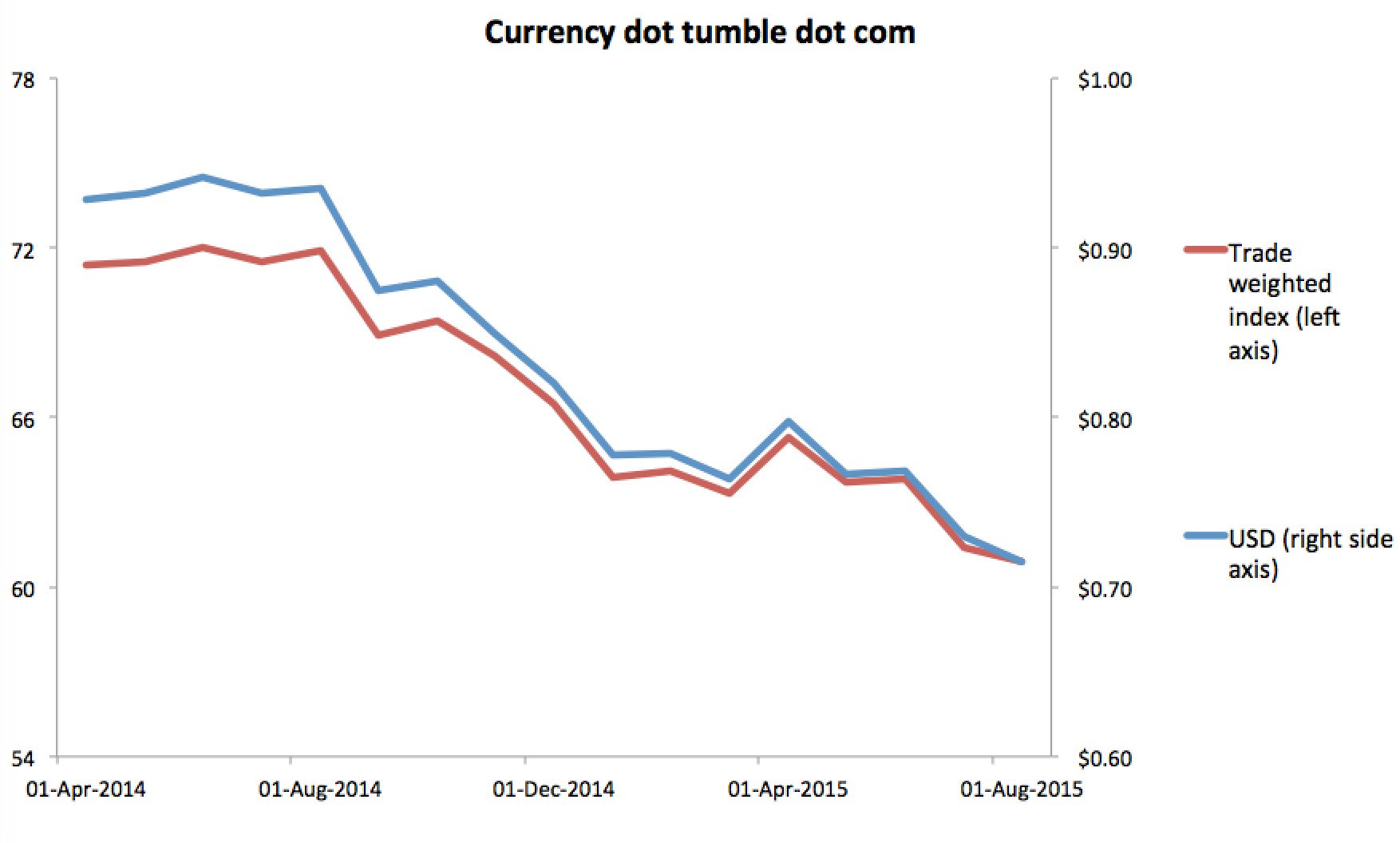
And there’s one simple reason why they might grow. Our falling dollar.

Screen Shot 2015-09-02 at 8.57.45 amThe fall in our currency is a bit like being a lobster in a boiling pot of water. Unlike stock market fluctuations it happens slowly and we don’t pay it so much mind. But it matters a lot.

The slow growth of non-mining industries in the last few years can be attributed to our high dollar. America’s incredible recovery from its recession in the same time period can be explained by its low currency.

A falling dollar could flip slow growth on its head. And we’d be too busy worrying about mining to notice.

The current mood of widespread gloom may prove to have been peak fear.

*This whole private capital expenditure data-set excludes healthcare and social assistance, which as we know, is one of the fastest growing sectors of the economy. In Melbourne, a billion dollar new cancer hospital is being built, for example. That’s not in the stats. Further reason to hope.

Amazon is lazy in the one place it should be hard-working.

The New York Times published a great story about Amazon 10 days ago. I’ve thought about it a lot. Amazon treats its employees harshly. It fires a lot and forces even more out by making their lives hard.

I wrote a story last week about how this won’t work well. Most people can’t hack 80 hours a week. Our productivity drops. But a tiny percentage thrive.

Amazon wants to hire the best and brightest. And that’s terrific.

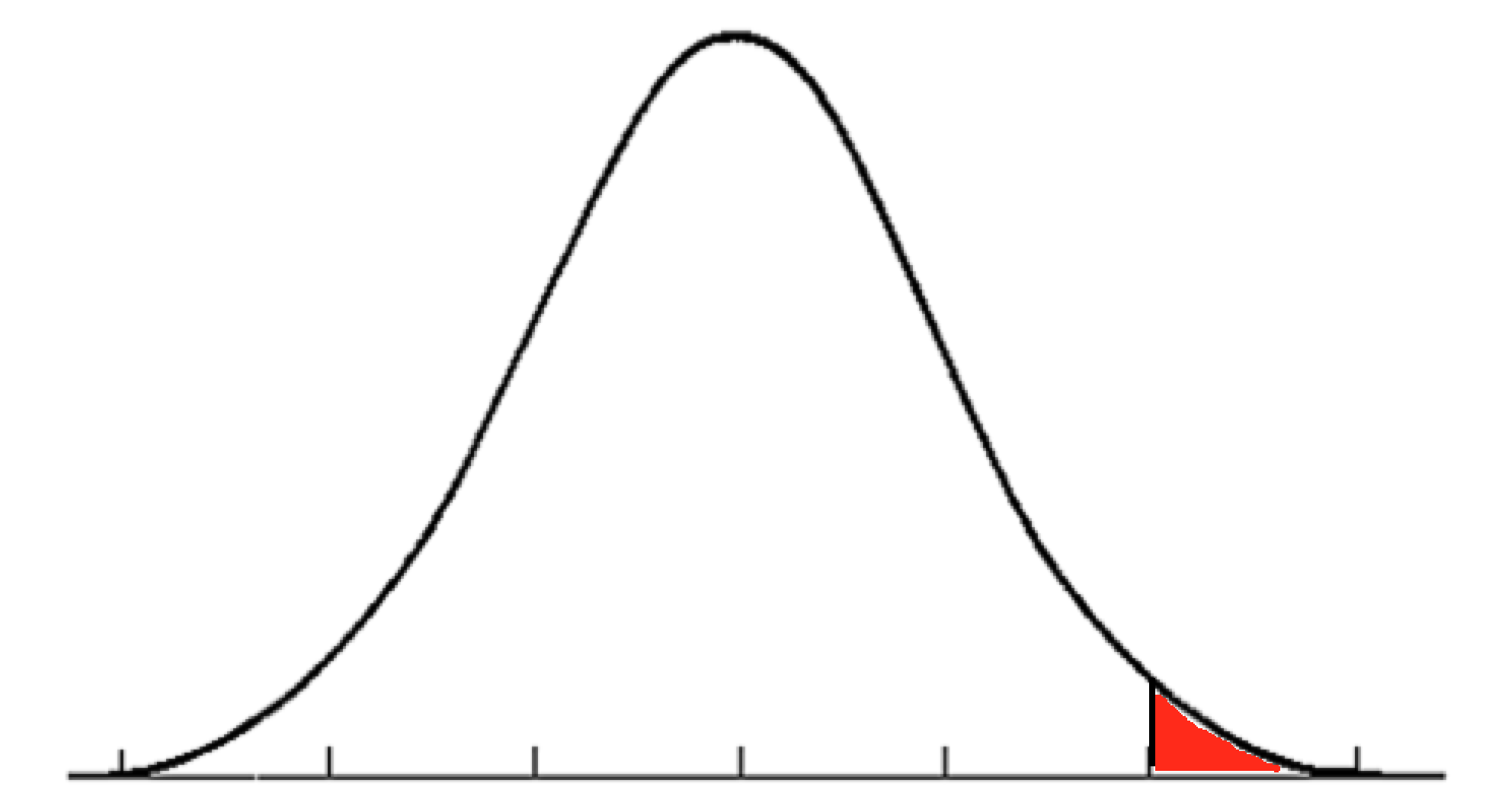
red=smarrrrrt.
Top 2.5% of smart people are marked in red

There’s a bell curve of bright people. Amazon wants the ones on the right. The red group who represent the top 2.5 per cent. And it is prepared to pay for them. Pay is very good. Software engineers get $76,00 to $148,000 a year in salary. And there are big stock bonuses if you can hang around.

But it also wants to hire the people who want to work first and live second. The 80-hour a week crew. That’s great. Those people need a place to work that welcomes people like them.

Amazon has a right to target such people and it should expect benefits. Here’s a distribution of people by how much they want to work. Amazon wants the red people on the right.

red = diigent.
Top 2.5% of hard workers are marked in red. Emails after midnight! Woo!

But here’s the thing. The red group in graph 1 is not the red group in graph 2.

There is probably some correlation between the two groups, but it will be imperfect.

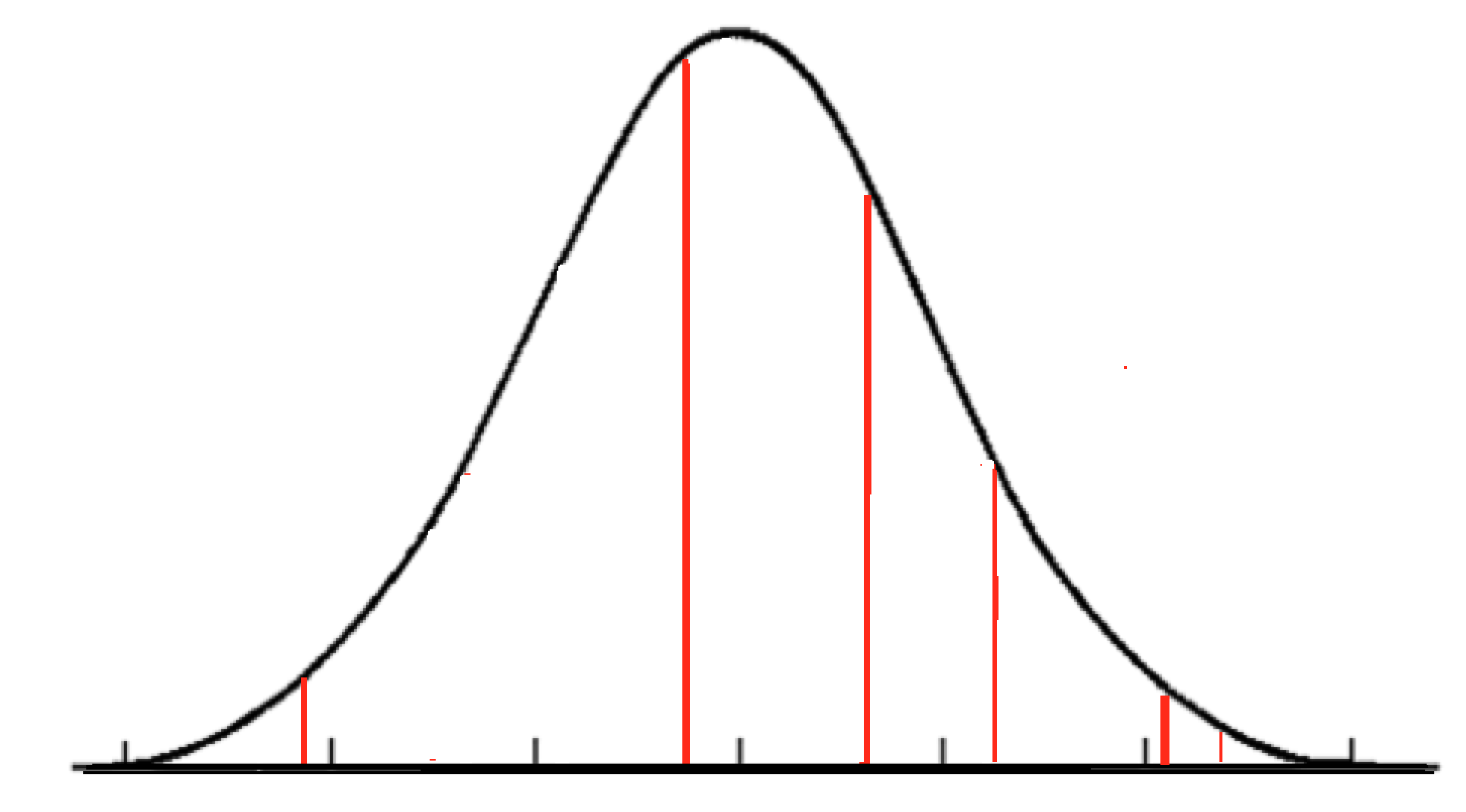
Here’s a hypothetical distribution of best and brightest, with the people from the top of the willing to work graph marked red.

red lines are tough bastards.
Where the hard workers might fall on the ability spectrum.

Amazon has a problem. The people they want to hire are very few. It can hire smart people, but they won’t all be willing to work hard enough. It can hire hard workers, but they won’t all be smart enough.

There are two ways of solving this problem. The easy way and the hard way.

The easy way is to throw people in the deep end and see who swims. This is a scatter-gun approach that says “recruiting candidates with a high chance of success is hard, and we are lazy.”

Screen Shot 2015-08-24 at 8.40.08 pmThe hard way to solve the problem is to narrowly recruit more people with a higher chance of success.

Rather than hiring “high volume recruiters” maybe they should look into hiring “high-accuracy recruiters.” This will cost money in the short-run. But it will probably be smart in the long-run.

Staff learn on the job. I’ve never had a job where I reached my potential in my first year. By burning so many staff so fast Amazon misses out on improvements. Working people to the bone in their first six months probably gets as much performance from them as they would achieve if they’d been there six months longer.

It’s not smart and the PR cost of hiring so many people that hate working there has blown up.

If you add the “externality” effect of lives damaged, marriages ruined and kids’ birthdays missed, then the cost of Amazon’s lazy recruiting strategy is even higher.

There is a moral imperative for Amazon to stop hiring so widely. Seriously. Stop it. Now.

The one piece of good news in all of this is that the New York Times piece will probably weed out some applicants who are unsuited for the company.

I suspect the names of journalists Kantor and Streitfeld are mud at Amazon HQ right now. But their expose may have actually done the company a favour.

The puzzle of where men outnumber women, and vice-versa.

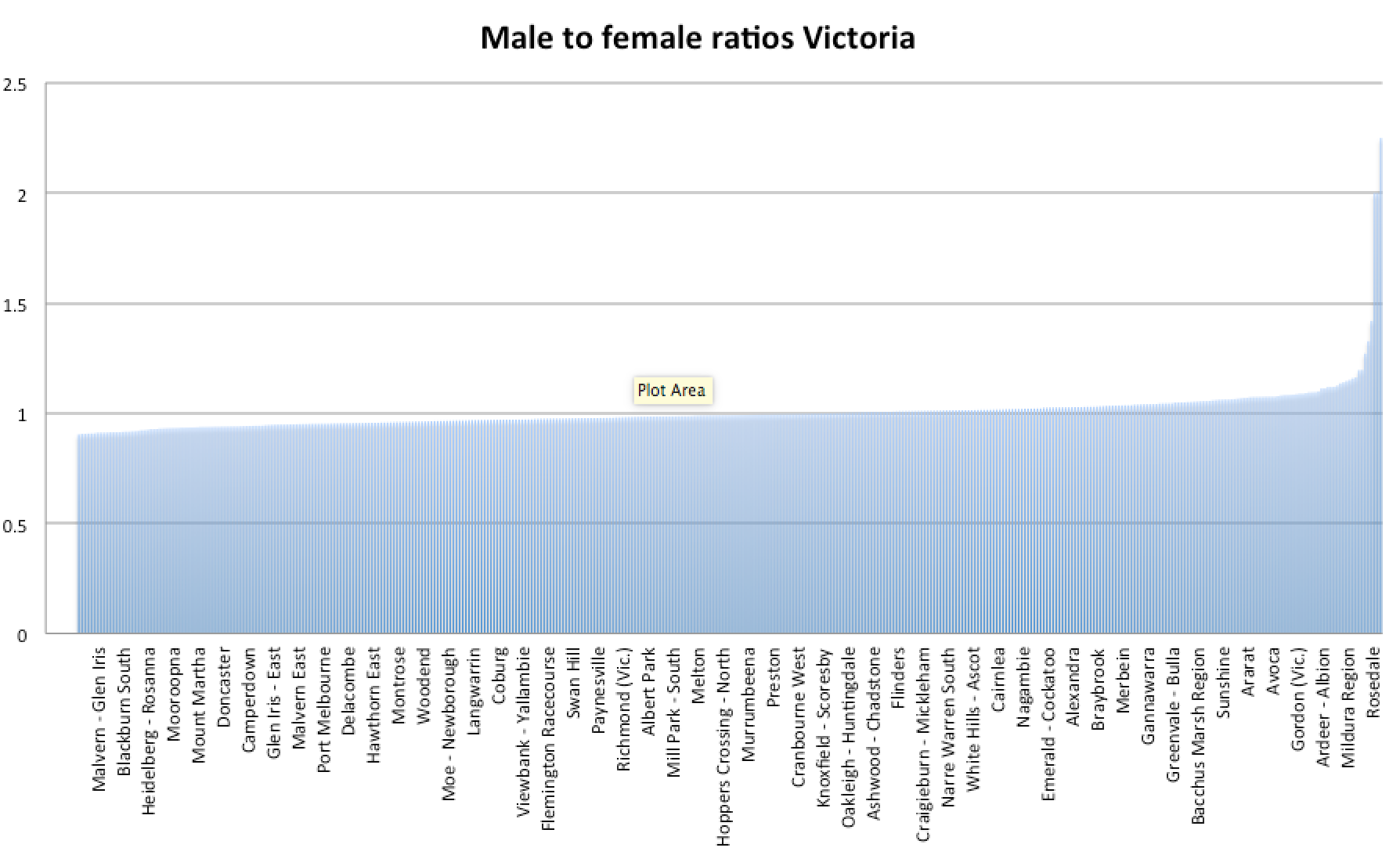
The concentration of men and women in various parts of Victoria is stronger than you’d expect according to random variation.

There’s some real trends in place that seem like a genuine puzzle. (These charts are made from fascinating data released by the ABS this week.)

Screen Shot 2015-08-20 at 11.51.11 am Fully a third of postcodes have a gender ratio that’s skewed more than 5 per cent one way or the other. There are slightly more postcodes where women outnumber men by 5 per cent (79) than those where men outnumber women by 5 per cent (62.)

That’s to be expected because there are 99 men per 100 women in Australia.

But where men outnumber women they do so by a lot more.

The top result is Port Melbourne Industrial, which is a place I’m surprised anyone calls home. And indeed there are just 9 males to 4 females (ratio 2.25). Security guards who sleep among the containers? Who knows.

The next one is Braeside. A similar story with a ratio of 12 men to 6 women.  Then Alps East with 18 and 9. I’d like to imagine those 18 men have swags and wake each day to see their horse breathing steam under an old ghost gum.

Anyway, we can discount those three because the samples are tiny.

Screen Shot 2015-08-20 at 11.50.54 am
Female dominated suburbs include Chelsea and Rosebud. More men live in Seymour. Is this another case of nominative determinism?

Rosedale is the real thing. 2645 men to 1863 women (ratio 1.42). A little hamlet out in the Latrobe Valley, it is probably full of people working in the coal-fired electricity industry. A hard place for a fella to get a date, no doubt. Although the photos on the Rosedale Tavern’s facebook page suggest that’s where the local ladies go. (and it’s not as bad as East Pilbara where men outnumber women 350 per 100.)

It’s easy to explain some locations of high concentrations of men by reference to workforce pressures. They are found around heavy industries and agriculture.

Some are more tricky. Why is Footscray so full of testosterone? Why Docklands?

And why do women crowd into the expensive eastern suburbs? We see Burwood, Camberwell and Armadale in the top 10 with less than 90 men per 100 women.

Toorak, the suburb most emblematic of wealth, has a ratio of 91 men to every 100 women. Are there many young single women there perhaps? Or families whose daughters live with them for a long time?

The CBD , meanwhile, has a ratio of 107 men to every 100 women.

Perhaps we are seeing women self-select into suburbs they deem are very safe, while men are more willing to live in supposedly rough areas?

Do you have another explanation? Please feel free to share it in a comment below!

EDIT

Commenter Matt points out that women live longer, which is a very good point (that I wish I thought of). This is definitely part of the explanation as we can see in the graph for the most skewed suburb, Burwood:

Screen Shot 2015-08-20 at 1.21.51 pmBut it’s not the whole explanation. If it were, Footscray would look similar up til the mid-40s, when men start dropping off. Instead Footscray has more men at every age.

Screen Shot 2015-08-20 at 1.33.30 pmI think the puzzle has had a lot of pieces added, but there’s still some blank spots… Any further ideas?

The curious case of poll-driven political reporting.

The Guardian published a report yesterday about Bill Shorten. The author set out to repent for calling  Bill Shorten a “tired accountant”. The impetus for the story was the turn around in the polls.

“Shorten is still leading the Labor party in the wake of this latest credibility disaster for the Coalition, after last week’s credibility disaster (blocking a free vote on marriage equality) and the preceding week’s credibility disaster (chopper-friendly Bronwyn Bishop). He’s now sitting atop polls from both Ipsos and Morgan that have the Coalition facing a loss of between 36 and 44 seats.

Is it time for a rethink?”

I’ve seen this kind of thing before, and I don’t like it.

Interpreting what a political leader does through the polls is intellectually vacuous. It’s easy to write. There is no need to have a view on tough questions about policy effectiveness or priorities, the merits of intriguing questions about whether the head of the AWU should be matey with big business, or the management and composition of their front bench.

The author of yesterday’s piece is not especially guilty. She has written about policy more than polls. But overall, allowing poll numbers to drive judgment of politicians’ merits is now commonplace. [1, 2, 3, 4, 5, 6, 7, 8, 9].

The rise of this sort of reporting means a swing in the polls does double business.

Not only does a poll bump get the leader kudos in their party, but it changes the tone of reporting about them. The new, glowing stories therefore amplify swings in popularity. That may be responsible for the increasingly binary popularity positions we see among our political leaders (They’re often wildly popular like Baird or old Abbott, or wildly unpopular, like Gillard and new Abbott).

This kind of reporting validates the paradigm that political hacks of the most cynical kind push inside their parties: We can do good once we’re in power. For now let’s focus on winning. It sidelines those inside a political party who think they should focus on making the country better, not just making the polls better.

Here’s a choice example of the kind of reporting I’m talking about.

The Sydney Morning Herald's Peter Hartcher thinks parties should use poll numbers not policy ideas to choose their leader. Is he right?
The Sydney Morning Herald’s Peter Hartcher thinks parties should use poll numbers to choose their leader. Is he right?

I can only imagine the cognitive dissonance some reporters must experience when they write articles demanding more policy substance and less poll-driven rubbish.

Of course, we do need some political reporting. It’s helpful to peek behind the curtain from time to time and see the way the magician performs his tricks. You feel like an insider.

But it can’t be all we have, most of what we have, or even a substantial minority of it. It’s a sometimes food.

Our meat and veg must be stories about policy.

Worried about having too many messaging apps? Boy do I have bad news for you.

Today my twitter app offered me the option to integrate my Instagram. I said no. Shortly afterward I started reading about a service called “Slack”.

Screen Shot 2015-08-17 at 3.25.02 pmThe line about the email killer made me laugh.

If you hope one day your email, your twitter, facebook, sms, skype, postal mail and home phone will all be in one app, you’re dreaming.

Likewise, if you invent a messaging app you intend to be the one to rule them all, you’ll end up contributing only clutter to the landscape.

This is not a bad thing.

We have specific needs for different types of communication. Each will be best served by different kinds of technology.

I think this argument is best served with an analogy.

The area of our lives where technology is most mature is the kitchen. What we see is not a streamlining of technology but hyper-specialisation.

I just counted and there are thirteen separate heat sources in my kitchen.

  • Oven
  • Grill
  • Microwave
  • Toaster
  • Kettle
  • Espresso machine
  • Sandwich press
  • Hot tap
  • Rice cooker
  • Four gas burners

There has been no major technological innovation there for years. And human tastes when it comes to food are very well-established. We can’t pretend the current state of technological proliferation is due to rapid developments or uninformed consumer prefereneces.

In theory I could use a single hot plate to get (almost) all the tasks done. But the cost of proliferation is small compared to my preference for getting the job done properly.

The microwave promised to do it all too
The microwave promised to do it all too.

For the same reason I have a cutlery drawer, not a Swiss Army knife.

The idea human communication needs can be met with a single “killer” app is crazy. We talk, we write, we draw, we sing, we shout and whisper. Even in the medium of “mail” we send not just letters but also bills and postcards.

In the future we’re going to have phones full of messaging apps, each subtly different. We’ll appreciate them all and look back with amusement on this naive era – an era where entrepreneurs who aimed to be all things to all people invented apps that ended up with a very specific purpose.

One of the leading candidates for President in the US is a socialist.

We all know about Donald Trump and his mad plans to do mad things, fired by a madness rich and deep.

Screen Shot 2015-08-14 at 11.08.23 amBut there’s someone else in the US Presidential race who is even further from the American mainstream and who could be even more influential.

Screen Shot 2015-08-14 at 11.28.39 amVermont Senator Bernie Sanders is ahead of Hillary Clinton in the poll for the New Hampshire primary – the vote to select the Democrats presidential candidate. He leads 44-37.

New Hampshire is the first primary vote held and is therefore seen as a key marker in the Presidential race. It gets a vast amount of media attention. The last seven Presidents have all come first or second in their New Hampshire primary.

Sanders is currently ranked about third for odds of winning in 2016. He’s rated by the betting agencies as having about a 7 to 8 per cent chance of becoming president. That maybe doesn’t sound like a lot, but at this stage of the process when the field is littered with contenders, it’s pretty good. Only Jeb Bush and Clinton are ahead of him.

All this matters because Sanders is not another cookie-cutter centrist. He offers real policy alternatives. He’s genuinely left-wing. (A socialist in American terms although maybe not by the criteria of the rest of the world)

For example, these are from his 12-point agenda for America, on his website:

Trade Policies that Benefit American Workers: We must end our disastrous trade policies (NAFTA, CAFTA, PNTR with China, etc.) which enable corporate America to shut down plants in this country and move to China and other low-wage countries. We need to end the race to the bottom and develop trade policies which demand that American corporations create jobs here, and not abroad.

Taking on Wall Street:  The greed, recklessness and illegal behavior of major Wall Street firms plunged this country into the worst financial crisis since the 1930s. They are too powerful to be reformed. They must be broken up.

Growing the Trade Union Movement: Union workers who are able to collectively bargain for higher wages and benefits earn substantially more than non-union workers. Today, corporate opposition to union organizing makes it extremely difficult for workers to join a union. We need legislation which makes it clear that when a majority of workers sign cards in support of a union, they can form a union.

Those are not the kind of things other Democrats are proposing.

Now, I’m not saying that Mr Sanders will beat Hillary Clinton. One poll ahead of one primary is not enough. Endorsements also matter and on that front Hillary Clinton is miles ahead.

But the way politics works is that a successful candidate with more extreme views pulls the whole field in their direction.

In US politics, the primaries see candidates tack out to the political extremes as they chase the votes of the party members who vote in primary elections. They then tack back to the middle as they chase the votes of ordinary citizens in the actual presidential election.

But the process of winning the primary forces a candidate to nail some colours to the mast. Sanders’ success will pull Clinton to the left as she tries to neutralise him. That effect will fade after she beats him, but it can’t be erased completely.
And as the two eventual candidates face off for President, trying to capture the centre, Clinton’s extra leftness will pull the eventual Republican nominee slightly leftward too.

So even if he loses the Democratic nomination, the effect of Sanders’ run will be to shift the whole of the US ever so slightly to the left.

Rising house prices: not a wealth fountain. A money-go-round.

RBA deputy governor Phillip Lowe gave a great speech last night. Lowe is the guy most likely to replace Glenn Stevens when Stevens quits as Governor and it is worth paying attention to what he says.

Last night’s speech was pretty radical. In the guise of a dry discussion of Australia’s balance sheet, Lowe single-handedly deflated arguments for rising house prices.

That puts him in direct opposition to noone other than Prime Minister Tony Abbott. Abbott, of course, said in June “I do hope our house prices are increasing.”

The argument Lowe makes is so smart and so obvious it’s amazing we don’t hear it more often. He starts out by showing that the rise in “house prices” is really a rise in land prices.

Screen Shot 2015-08-13 at 10.33.46 am“[T]he figures that I have presented invite the conclusion that our national wealth has risen largely because of higher land prices. But is such a conclusion really warranted? Have we really become wealthier as a nation simply because the value of our land has increased?

“The answer would clearly be yes if this increase was because we had discovered more land. To my knowledge, though, this has not happened.[7]”

Lowe argues that the rise in house prices is not a nice neat story about the returns to city life increasing. He says prices rose because of financial deregulation and supply constraints.

This creates not a wealth fountain but a money-go-round, he explains.

“from the perspective of society as a whole, much of what is gained on the one hand is lost on the other: there are windfall gains from higher land prices but then everyone pays more for housing services.”

Lowe also reveals that the “baby boomers are ripping off the kids” narrative has some credibility even in that palest of economic ivory towers, the RBA.

“For an older person who owns their own home and has no children, the capital gain from the higher land prices more than offsets the expected higher future housing costs. Such a household is better off. The same is true for owners of investment properties, since they own multiple dwellings on which they earn a capital gain. In contrast, for young homeowners with multiple children, the calculation can look quite different. If they care about the future housing costs of their children, then, in some circumstances, it is possible that the higher future expected housing costs could exceed the capital gain on their dwelling. In a welfare sense, the increase in land prices could make them worse off, even though they own land. The same is obviously true for renters as they do not have any capital gain to offset the higher future housing costs.”

“I think many Australians have an innate understanding of the concept and share the concern. Many parents around the country look at the high housing (really land) prices and worry that their children will not be able to afford the type of property that they themselves have been able to live in, even if their children were to have the same life-time income profile as they have had.”

“So it is arguable that the main impact of higher land prices is not really to increase our national wealth, but to change the distribution of that wealth.”

He goes on to argue that if parents help their kids buy houses, high house prices are perpetuated. But their wealth effect is diminished because the people that have expensive assets are using them as collateral for buying more expensive assets. That is to say the high prices bring no benefit.

If, however, parents don’t help their kids buy houses, and instead spend up big (say on trips overseas) then house prices are more likely to moderate.

This latter scenario, as unpleasant as it may seem to some, is actually the better one for social stability. Because with Australia’s strong immigration profile, not everyone has parents who own property in Australia. The divide between new migrants and established citizens will only grow larger if property wealth is transmitted across generations.

Who is to blame for the state of the labour market?

Last week unemployment was up. This week wages growth was down.

Screen Shot 2015-08-12 at 4.41.18 pm

chart
Worst annual growth on record (since 1978)

These two series measure the most important and relevant determinants of Australia’s economic well-being. Both are deteriorating.

Forget interest rates. Forget house prices. Forget the dollar. Forget petrol prices and forget the share market.

How much money people make is the single biggest determinant of how well off they are. And we’re not doing well at all on that score.

This is a failure of economic policy. No government should be complacent in the face of a weak labour market.

The Government is silent on this and to its credit the opposition is squawking at them.

But it is to no avail. No decent policy is evident.

There’s a Productivity Commission report on our workplace relations policies, but nobody really thinks that will make a lick of difference, even if the government had the political capital to implement it.

These days it seems like some on the left actually relish a bit of weak wages growth. They use that to bash the government for hypocrisy over a wages breakout and guard against workplace reform.

I wouldn’t mind seeing a wages break-out. Isn’t that what good economic policy would produce? Wealth shared widely?

The failure of our labour market to do very much in the last few years probably comes down to macroeconomic factors. The high dollar crimped output and hiring. So did weak federal spending.

Screen Shot 2015-08-06 at 12.08.47 pmThe high dollar was a result of US quantitative easing and there was little more we could do beyond slashing official interest rates. That policy front was maxed out. But fiscally, we pulled puches.

Esteemed labour market economist Jeff Borland argues our failure to remedy unemployment is due to a shortage of aggregate demand.

“•The rate of unemployment in Australia has increased from 4.0 to 6.4 percent since the GFC. Over that period it has shown little tendency to decline. The rate of unemployment in the US is now lower than in Australia.
• This increase in the rate of unemployment in Australia appears to be explained entirely by the cyclical downturn in aggregate demand.

How could the government have increased aggregate demand? Spending more would have been one answer.

The Swan Budgets in 2012 and 2013 and Hockey’s efforts in 2014 and 2015 were all deficit-obsessed. All were focused on “return to surplus.” None of them achieved it. Instead unemployment has risen from 5.2 per cent to 6.3 per cent.

That deficit obsession hurts us all.

Why I’m going cold on rational charity optimising

People don’t decide to give, then choose where.

They see a problem they want to fix and try to help. Maybe that’s saving the world’s cutest fauna or trying to fix homelessness in their own suburb.

I’ve written lots about optimisation of charitable giving. So to me, that’s wasting money. But not to them.

Obsessing over worthiness of charitable donations assumes the amount of giving is fixed. It’s not. The amount of giving depends enormously on emotions. And not every charity causes emotions.

In fact, the ones that measure their impact and do the most good don’t necessarily create the biggest tidal wave of fellow-feeling. The Schistosomiasis Control Inititiative doesn’t exactly bring a tear to the eye.

If I criticise giving to the guide dogs, as I did in May, I’m applying an economic framework that doesn’t occur to the donor. They don’t want to optimise their return. They want to feel a good emotion. They don’t actually give a shit about the opportunity cost and the additional good they could be doing. They just want to feel warm and fuzzy.

Who am I to point and laugh at that? Warm fuzziness is what electrifies the philanthropic sector. Without warm fuzziness there would be no philanthropy.

Altruism is not rational in and of itself. Why should we expect it to be applied rationally?

Telling people warmth is weakness and fuzziness is foolishness is the quickest way to cut off philanthropic donations at their source. And we don’t want that.

There was a really amazing story in Vox today about “effective altruism” and how even supposedly rational giving can easily get trapped in a cul-de-sac where people give to what makes them excited. It’s a really terrific article and I recommend clicking it.

Scarcity: A book review

I just finished reading a book called Scarcity, by two US academics – a Harvard economist and a Princeton psychologist. It’s an economics book, sort of. But mostly it’s completely innovative.

It contains a theory of a new kind. One I had never thought of, but which I have found very useful.

The theory is that scarcity – no matter what its source – affects your brain. People affected by scarcity have their mental capacities focused on the problem at hand. And that diminishes their ability to deal with everything else.

The authors use four main categories of scarcity in the book.

  • material poverty:  a scarcity of money;
  • being too busy: having a scarcity of time;
  • being on a diet: facing a scarcity of permitted calories;
  • being lonely: having a scarcity of social connections.

For each category they find similar effects on mental capacities.

The person facing scarcity focuses on their own immediate problem, which gains them a limited upside in that sphere – perhaps they scrounge and borrow enough to pay this weeks rent, or remain disciplined enough to not eat dessert tonight. But the focus means other things are ignored to their detriment. They may not be focused at work, for example.

Anyone who has tried to play a computer game and hold a conversation at the same time knows performance and distraction are not compatible.

The theory that scarcity is distracting is well-backed by research. For example, simply reminding people of their financial constraints can lead to a drop in IQ of over 10 points in one famous study.

It is an appealling theory in part because it knits well with a socially progressive view of the world.

The poor, data shows, are worse at sending their kids to school, at taking medicines, at getting their forms filled in at Centrelink, at quitting smoking, eating well, etc. This is a puzzle that would appear to lend credence to a conservative viewpoint that says the poor are lazy.

This theory as expounded in the book helps explains these phenomena by reference to the circumstances of poverty, rather than by blaming the individual.

The authors created a study in which Princeton students had to play Family Feud. They were allocated to either a “rich” group with plenty of time to answer the questions, or  a “poor” group with little time to do so. The poor focused hard. They made more correct guesses per second. But the rich outperformed them overall. Then the authors offered the groups the opportunity to “borrow” time from future rounds for use in the current round. The “poor” group’s performance overall tumbled as they borrowed more and more. The scarcity mindset itself led to poor decision-making.

The book not only describes the problem of scarcity. It suggests interventions that could prove helpful.

The effect of scarcity is described in the book as a “bandwidth tax”. Which is to say that focusing on a single problem of scarcity inhibits the amount of mental bandwidth we have to deal with other scenarios.

Recognising that the “bandwidth” of the poor is especially thin permits better-designed social programs. Rather than intensive financial education programs, a few behavioural nudges will be more effective, for example. And where education is necessary, courses that are cumulative and that fail to accommodate students who miss a class will be far less effective than modules learners can take at their own pace.

They suggest  boom and bust scenarios, such as those issuing from monthly welfare payments or variable pay cheques, can create bigger bandwidth problems as people struggle to manage cashflow. The implication is that stable, frequent, predictable payments are better for bandwidth.

Homelessness – an extreme version of scarcity – is another good example. With nowhere to sleep, wash, prepare food, relax, read or store possessions, it is no wonder the homeless are rarely focused on their health, education or financial futures. Fixing the lack of accommodation in one fell swoop may be more effective than complex incentive structures (and evidence shows that is the case).

The book is excellent at describing scarcity traps, where we get behind – in payments or on a schedule – and constantly borrow from the future, all the while sinking deeper and deeper into the morass.

For those of us not stuck in grinding poverty, the book has some great examples of how to avoid being stuck in a scarcity trap. It is eloquent on the need for “slack” in order for systems to function. Much like when the fridge is literally full to bursting you can access nothing in there easily and things tend to fall out onto the floor, any system that has no slack is inefficient.

A great example comes from a hospital which was able to manage its surgery schedule far better by leaving one operating theatre empty for emergencies. The authors are also advocates of agreeing to fewer commitments than you can manage, and of leaving spare space in your diary so meetings can be moved around without creating disastrous cascades.

The seed of the book, in fact, comes when Professor Mullainathan, writing a book chapter about low-income Americans, sees a great deal of his own time management habits in the budgeting of Americans with payday loans and food stamps. The commonality of the scarcity mindset – which makes a top economist likely to snap at his kids because he’s stressed and busy – is reinforced throughout the book, all the while acknowledging poverty is a more severe, more binding problem than being over-committed at work.

The suggestion scarcity can be better managed with explicit provision for slack could have pay-offs in any number of realms – not least at a national level.

What is our national budget if not a circumstance where every last dollar is committed and deficits keep cropping up most unexpectedly? Is our Treasurer stuck in a scarcity mindset? Is his ability to think clearly about the big picture damaged by his burning desire to fix the budget in this time period? Is the Treasurer more like a 28 year old single mum trying desperately to pay the rent this week, or a 28 year old bond trader with a million dollar portfolio trying to optimise returns across their lifetime? I fear it is the former.

This book got me thinking thoughts like that. And that’s reason enough to recommend it whole-heartedly.
Unemployment. Something important has changed.

Unemployment numbers came out today and they’re bad. Unemployment is up. Again.

I was fossicking round in the data when I realised something important. There’s been a massive change. We are experiencing something unprecedented.

Screen Shot 2015-08-06 at 12.08.47 pm(These are raw numbers. No seasonal adjustment.)

In the past, unemployment has surged up fast and fallen back down slowly. That’s the pattern. You’d get rising unemployment only in bad economic shocks. Now we’re getting slowly rising unemployment.

Something has changed in the belly of the beast.

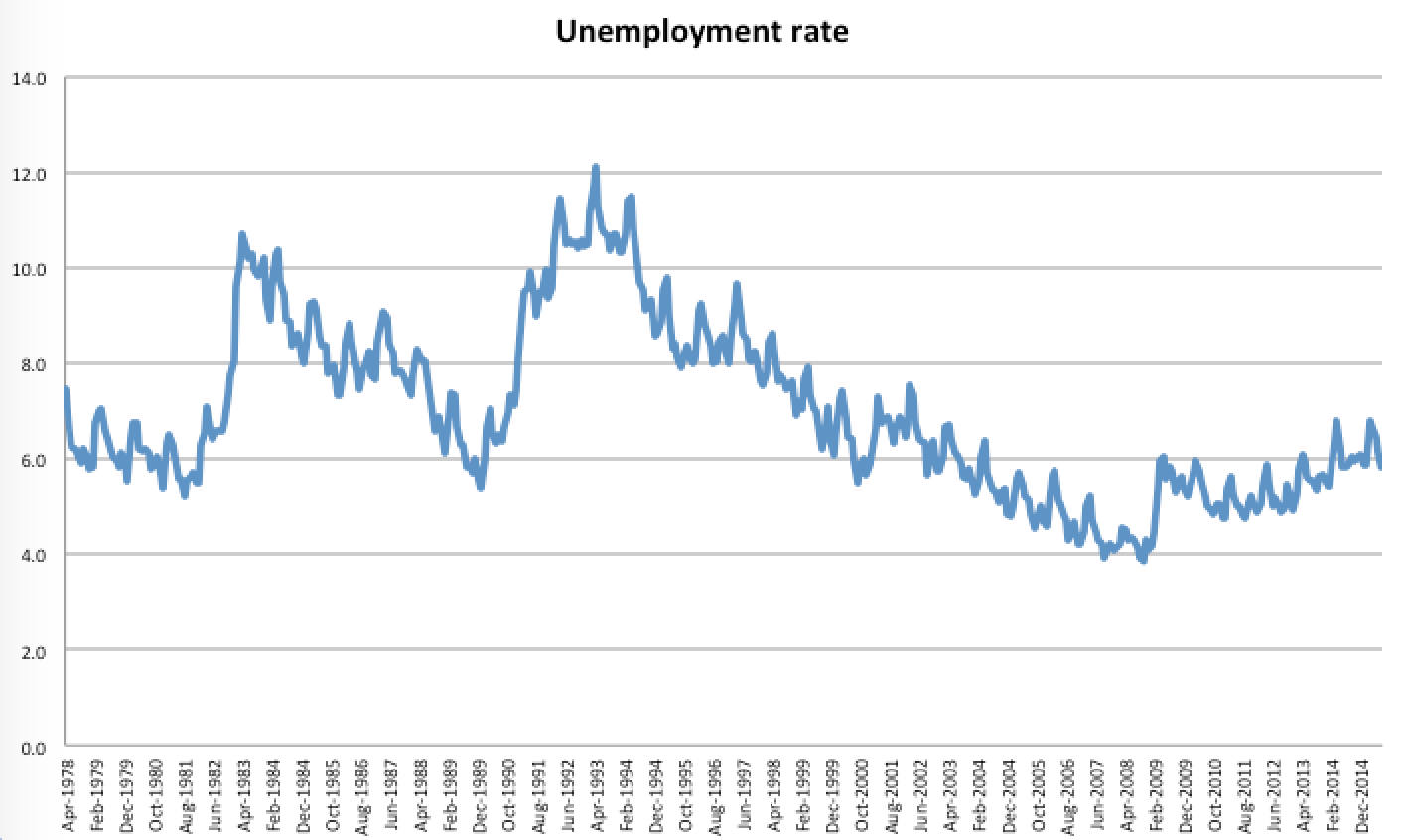
And the effect you see above is not just an artefact of a higher population making the slope up look bigger on the graph. Here’s the unemployment rate graph for comparison.

Screen Shot 2015-08-06 at 12.21.34 pmWhat’s going on?

Five notoriously brilliant business models Netflix cobbled together into an undefeatable vortex of binge watching.

This story originally appeared over at The New Daily, where I’ve been writing a consumer-focused story each week.

Netflix – the subscription TV service that launched in Australia this year – is a juggernaut. It drags people in and captures them. And they love it.

Binge-watching TV shows is not just a national pastime. It’s global. The stock-price of Netflix shows the incredible extent of the company’s success. Screen Shot 2015-07-16 at 8.51.18 pmIf you’d put $1000 into Netflix in 2003, you’d have $115,000 now. In just one day last week its stock rose 18 per cent as the company revealed more new users than expected.

How did they do it? What’s the secret to turning the globe into zombies who spend all their spare time consuming your product?

The answer is shamelessly appropriating good ideas.

Netflix has swiped the world’s sharpest and most effective business models – some well-known, some well-hidden – and combined them into one unstoppable force.

Netflix owes a debt to big oil, all you can eat buffets, airlines, Microsoft and casinos.

Screen Shot 2015-07-27 at 1.52.37 pmThe Oil Industry perfected the concept of owning the whole supply chain.

Think about Shell. It owns everything it needs to do business – from exploration activities that discover where the oil is, to drilling machinery, to the service station where you fill up your car.

When Netflix decided it was going to spend $100 million to hire Kevin Spacey and make House of Cards, it was thinking like an oil company.

Owning the whole supply chain is known as vertical integration and it gives a company power. Oil companies do it to control price, quality and quantity.

Don’t just own the distribution mechanism, because that makes you vulnerable. Own what you’re selling too. Netflix’s most famous house-made products are House of Cards and Orange is the New Black, both of which have proven to be black gold. It has dozens more.

The risk for Netflix is a hit show gets made and someone else wants it. For example, Amazon.com got exclusive rights to Downton Abbey by paying up big. The makers of a hit show can charge a fortune for the rights. By making its own shows, Netflix can’t be held to ransom.

Instead, when it owns content we’re dying to watch, it holds us to ransom. When you call the shots you can raise the prices, which Netflix this week announced it would do.

Screen Shot 2015-07-27 at 1.56.56 pmAll-you-can eat buffets perfected the idea of eliminating transaction costs.

In a normal restaurant, you pay only for what you eat. But you do pay for everything. Market economics at its purest.

We weigh up the value of every choice, and get a bill that lists each item. That mental and administrative effort are part of what economists call transaction costs.

Buffets, though, are like an anti-market. Once you’ve paid, it’s a wonderland where the rules of economics don’t apply. Want more lasagne? Go for it!

Humans love buffets. It’s no surprise Netflix acts like a buffet. Who wants to pay every time they click on something? Who wants to weigh up the value of letting the kids watch yet another episode of the Wiggles?

Of course, real world buffets have a problem – if lots of hungry people or lots of fat people show up, they can go broke. To manage this they cut quality and try to entice people into eating bread and potatoes. It’s a fine balancing act.

Netflix, has no such problems. It generally costs them no more whether you watch Seinfeld repeats once or a thousand times. That’s why they are happy to let you binge for hours.

Screen Shot 2015-07-27 at 1.53.04 pm

Microsoft perfected the art of bundling.

Microsoft doesn’t care that you never want to make a slide-show. When you buy Microsoft Office, you get PowerPoint whether you like it or not.

This is bundling. You get some stuff you want, bundled in with some stuff you don’t want. Companies do it because it let them make more profit.

The ideaa is simple: imagine I would pay a maximum of $10 for product A and $6 for product B. Your preferences are the other way round.

If the company tries to charge $10 for product A and $1 for product B we each buy just one thing. The company makes $20.

If the company wants to sell two of product A and two of Product B, it must set the price for each at $6. It can makes $24. Better, but not the best.

If it bundles the products into A+B packages costing $16 each, it can sell all four items and make $32! This is their best option.

When you buy Netflix you get a lot of stuff you’ll never watch. Maybe horror films, or BBC murder mysteries. That’s the Microsoft PowerPoint part of the bundle. IMAG3814Airlines perfected the art of price discrimination.

When you go to the Netflix website, you face a decision. Pay $8.99, $11.99 or $14.99.

No matter how much you pay, you get access to all the same shows. The difference is in whether the content is delivered in high definition, regular definition, or ultra high definition, and how many screens the content can be viewed on.

This is what experts call price discrimination. Airlines do it best.

Whether they sell you an economy ticket for $700, a business class seat for $2000 or a first class experience for $5000, you all take off and land at the same time.

Charging people different amounts for the same basic thing works well because of a concept called “willingness to pay”. Not everyone will pay the same amount for the same good.

If a business sets just one price, it misses out on profit. There are some people that would pay more than that. Even more important, there are people who would be profitable customers if the price was just a bit lower. Different prices for different folks is a proven model.

Netflix wants to skim their first-class passengers for as much as possible, but also fill up the back-end of the plane. The great thing for them is their plane has an unlimited number of seats.

Expect even more pricing levels to arrive in future.

Screen Shot 2015-07-27 at 1.53.43 pmCasinos perfected the art of keeping us hooked

The flashing lights on a poker machine are scientifically designed to provoke the reward centres in our brain. Like rats in a cage we get addicted on the dizzying sequence of highs and lows, pay-offs and disappointments.

Just one more spin, says the poker machine addict.

Just one more episode, says the Netflix addict.

Scientist have shown a good film or a good show controls our brain. A director makes a character act in a certain way and cuts the scene. The brains of viewers all release neuro-transmitters on cue. (The same is not true of a bad film.)

With free-to-air TV there was nothing we could do except wait a week to watch the next episode. But with Netflix the next episode is right there, ready and waiting to deliver more brain stimulation.

Its hard to believe Netflix has only been in Australia for a few months. Its devotees are already wild-eyed with fervour and Google Trends data shows it blowing rivals Stan and Presto out of the water.

Screen Shot 2015-07-16 at 2.30.41 pm

Netflix has nearly doubled its subscriber base outside America from 12.9 million to 21.6 million, in just the last 12 months. And it plans to launch in Japan very soon.

The executive at Blockbuster that passed up the option to buy Netflix for $50 million over a decade ago is probably feeling very sheepish.

The Wilting West

A high-vis vest slowly buried in the blowing sands of the Great Sandy desert.

Screen Shot 2015-07-17 at 9.58.41 amA small business owner awake at 2am, wondering if they should talk first to their bank manager or their spouse.

Screen Shot 2015-07-17 at 10.00.44 am Fridges, clothes, tables and chairs all packed into boxes, in a freight train chugging east across the Nullarbor.

Screen Shot 2015-07-17 at 9.57.58 am

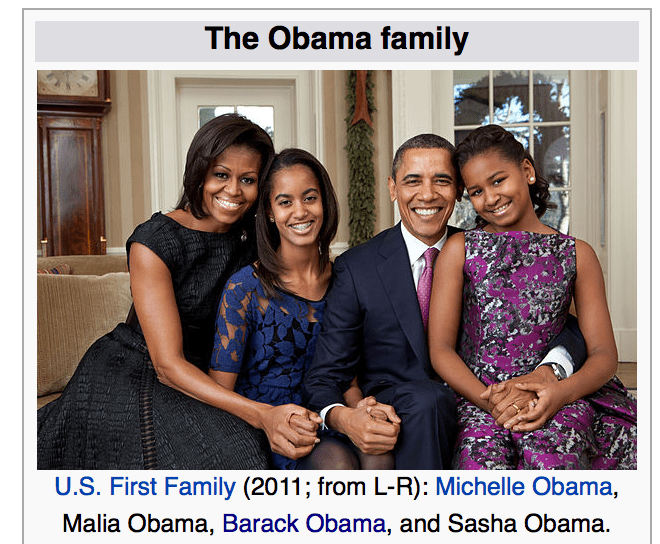
Four reasons the 53rd President of the United States will be Malia Obama (and one reason we should hope it isn’t).

The 47th President of the USA will be elected in 2016, when Barack Obama leaves the White House. Let’s guess that’s Clinton and she is a one-termer.

If that’s followed by three eight-year Presidents and two one-term Presidents, the 53rd POTUS will be elected in 2052.

By that time Malia Obama, who is seventeen now, will be 53. That’s a very Presidential age. (Her dad was elected at age 47, but the average age for Presidential accession is 54).

Screen Shot 2015-07-16 at 10.32.23 amHere’s why Malia Obama can be a contender.

1. Her dad will go down in history as the greatest Democratic President since Roosevelt. His progressive achievements – health care, gay marriage, and reversing a giant spike in the unemployment rate – far outweigh those of any other Democrat President in the last 50 years. For impact, they may even outweigh the achievements of Reagan.

2. When Malia Obama is prime presidential age, her father’s presidency will be far enough past to have serious mystique. About half of Americans who will vote in 2052 are minors or unborn now. Meanwhile, the people in positions of power will be the generation in their 20s when Barack Obama was elected, i.e. the people who voted for him and therefore keen to burnish his legacy.

Screen Shot 2015-07-16 at 9.53.25 am
Source: Wikipedia

There is precedent for kids who grow up in the white House to have political ambitions. The last young child in the white house was JFK Jr, who was set to enter politics when he died.

3. The Obama daughters look likely to go down the swottish, nerdy path. Their mum is a tiger mum in a way Laura Bush wasn’t. It seems likely an Ivy League university is in their future, and that can’t hurt. (The last seven US presidential elections have seen 12 candidates who went through Harvard and/or Yale and only two who didn’t). One wrinkle in this narrative is that Malia Obama is seemingly trying to get into film and TV. Of course, that and presidential ambition are far from mutually exclusive. (see Reagan, R.)

4. America is reaching its dynastic era. By 2040 that trend may have increased even further. America’s place in the world may well be threatened by China, and these decades of MTV, Nike, Facebook and Apple may be seen as an American golden age. Returning to that may seem very comfortable. Obama, M was literally born on the 4th of July. In an increasingly uncertain world, voting for her may feel a lot like voting for an America that reigns supreme.

(5. All this is assuming they don’t become basketball professionals. Their dad has a pretty decent game.  Their mum’s brother is a coach and analyst for ESPN. The Obama kids are tall!)

6. But there are serious reasons (other than basketball) why we should hope M.Obama isn’t running in 2040. America is increasingly a land of inherited opportunity. Barack Obama has pledged his presidency against that trend. If his reforms in the areas taxation and health endure, they should help ensure someone other than the child of privilege can become president.

His daughter’s gainful employment in some less consequential office than the White House would be a sign of his legacy.

AFL v NBA. Why Matthew Dellavedova earns less than Buddy Franklin

This story originally appeared in Crikey and is now out from behind the paywall. Here’s a quick excerpt:

Delly is not the star of the Cavaliers. Or he’s not supposed to be, anyway.

His team includes LeBron James, named four times the NBA’s most valuable player and a basketballer many say is the best of his generation.

James’ pay is the sixth highest in the NBA. In 2014-15 he made US$20.6 million. His next highest paid teammate on the Cavaliers made US$15.7 million. Dellavedova got US$816,000. Then you have to add in endorsements. James made $44 million this year.

NBA pay is always an issue.

The NBA has a Gini coefficient of 0.52, according to one estimate, making it more unequal than Mexico

Every team has players that make as much as top CEOs, living, travelling, eating and playing alongside players who make a lot less. (The lowest paid player in the NBA in 2014-15 got US$29,000, according to ESPN statistics. David Stockton was on court for 26 minutes this year, took 9 shots and made 7 points).

For comparison, here’s AFL player pay.  The distribution has a stronger centre. (And the numbers are a lot lower!)

Screen Shot 2015-06-15 at 8.49.04 am Screen Shot 2015-06-15 at 8.48.52 amPlease go check out the full version over at Crikey.