In fact, the east-west distance between Melbourne and Sydney is almost exactly the same as the east-west distance between Melbourne and Adelaide. (Both are just over 6 degrees of longitude difference).
The result of this is different times of daylight. A good friend of mine who works between Sydney and Melbourne says the early sunrises in Sydney get him up and running before work, which he never does in Melbourne. But he misses the languid light of Melbourne’s evenings after leaving the office.
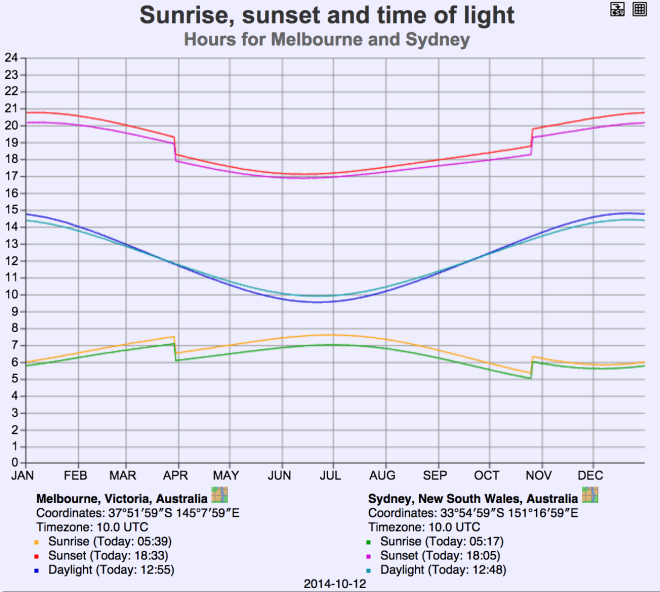
Both sunrise and sunset are later in Melbourne, all year round. This graph shows sunrise, and sunset a for both cities. Melbourne is the yellow and red lines, Sydney the green and purple. The difference is almost an hour.
The difference manifests itself in interesting ways. I reckon Sydney’s surf culture is nourished not just by the warmer weather and better beaches, but also by the fact there’s hours of sunlight before work. The pop-culture phenomenon that is Aquabumps could only thrive in Sydney.
There’s evidence of a much stronger early morning workout culture in Sydney too.
Melbourne Sunset. When I took this shot, it was dark in Sydney
Much like daylight savings, being further west in a timezone moves daylight to the after work hours.
The great advantage of having more light in the evening is supposed to be using less power around the home. But because of the different energy mixes between Melbourne and Sydney, (the southern capital uses a lot more gas) and the temperature differences, it’s hard to compare. And with the declining role of lights in electricity use, and the rising role of air conditioning, sending people home from work in the heat of the day may have the opposite effect.
So which is better?
The concept of solar time means you can measure which timezone is closer to “accurate.” This maps shows Melbourne is in the red, with an assymetric sort of day, and Sydney closer to balanced. If Melbourne’s time zone explains my tendency to get up late and stay up late, it has a lot to answer for.
The case for finely balanced time-zones is most obvious where they are absent.
China uses just one time zone, creating giant differences between one end of the country and the other. During daylight savings, the sun sets at 10pm in Lhasa, and two hours earlier in Shanghai.
The vast majority of the world is in the red, suggesting people like the evening hours to be daylight. But if you look closely, a lot of very dynamic cities are in the green parts of the map: Tokyo, New York, LA, Shanghai. Perhaps there’s something to this “early to bed, early to rise” idea.
Should Melbourne perhaps change time zone? If we moved to Adelaide time, we’d see sunrise as early as the Sydney-siders do. Then the only reason not to spring out of bed and do exercise would be the weather!
There are lessons in Australia’s history we can learn from. One of them is the screw-up that is Sydney.
Sydney was well-placed to become the London of Australia. A prime location, settled first, the early seat of power. It had it all. But while London remains by far the wealthiest and biggest city in the UK, Sydney is on-track to be overtaken by Melbourne in population.
If Melbourne overtakes Sydney, it won’t be the first time. Sydney had a 40-year headstart and yet lost its lead in the 19th century. At that stage the reason was the Gold Rush. Sydney got its lead back when a financial crisis hit in the 1890s.
Sources: various, but consider this a rough approximation.
If Sydney is overtaken by Melbourne in population, you can’t blame the Sydney-siders. They work hard, but they’re behind the eight-ball. The problem is the harbour.
If you think of it as public space, it’s lovely to look at and nice to use. But if you think of it as distance, is it smart to put so much of it right in the middle of your city? Do you really want so much distance between inner-city suburbs? Wouldn’t it be better to have a network of streets?
I contend that the harbour creates a massive problem in the middle of Sydney. The CBD is unable to connect properly into adjacent suburbs because they are a ferry-ride away.
Sydney has more than one major business cluster. The city competes with North Sydney and Parramatta.
But I’d argue that’s a sign of weakness, not of strength. Of course every city has suburban centres, but powerhouses like New York and London aren’t confused about where might be the centre of power, or the best spot to locate a business. Sydney’s situation whispers: this city is too big to really be one functional city. But globally-speaking, Sydney is not even that big, population wise.
So, the harbour in the middle could be part of the problem. But the harbour became the centre of Sydney only when a bridge was built that made the north shore more accessible. You can see the population develop in this video and the north only really takes off after 1932, when the final rivet was painted.
The smart move would have been to densely fill in the area to the south, intensively, before building to the north.
We’ve all played computer games where you have to build certain things in a certain order. If you build too many of the wrong thing too early, you get out of whack, run out of gold and you can’t beat the game. I’d argue that’s what Sydney did.
The Bridge was built using £6.25 million of public money. That represented about 2 per cent of NSW’s GDP at the time. For comparison, 2 per cent of GDP now would be about $10 billion. (sources: 1, 2)
Despite using tolls to pay it off, the debt lingered until 1988.
The opportunity cost? Not just the proper development of contiguous land areas, but also what that money might have bought if spent differently. When the rest of the world was building world class public transport systems, Sydney let theirs go.
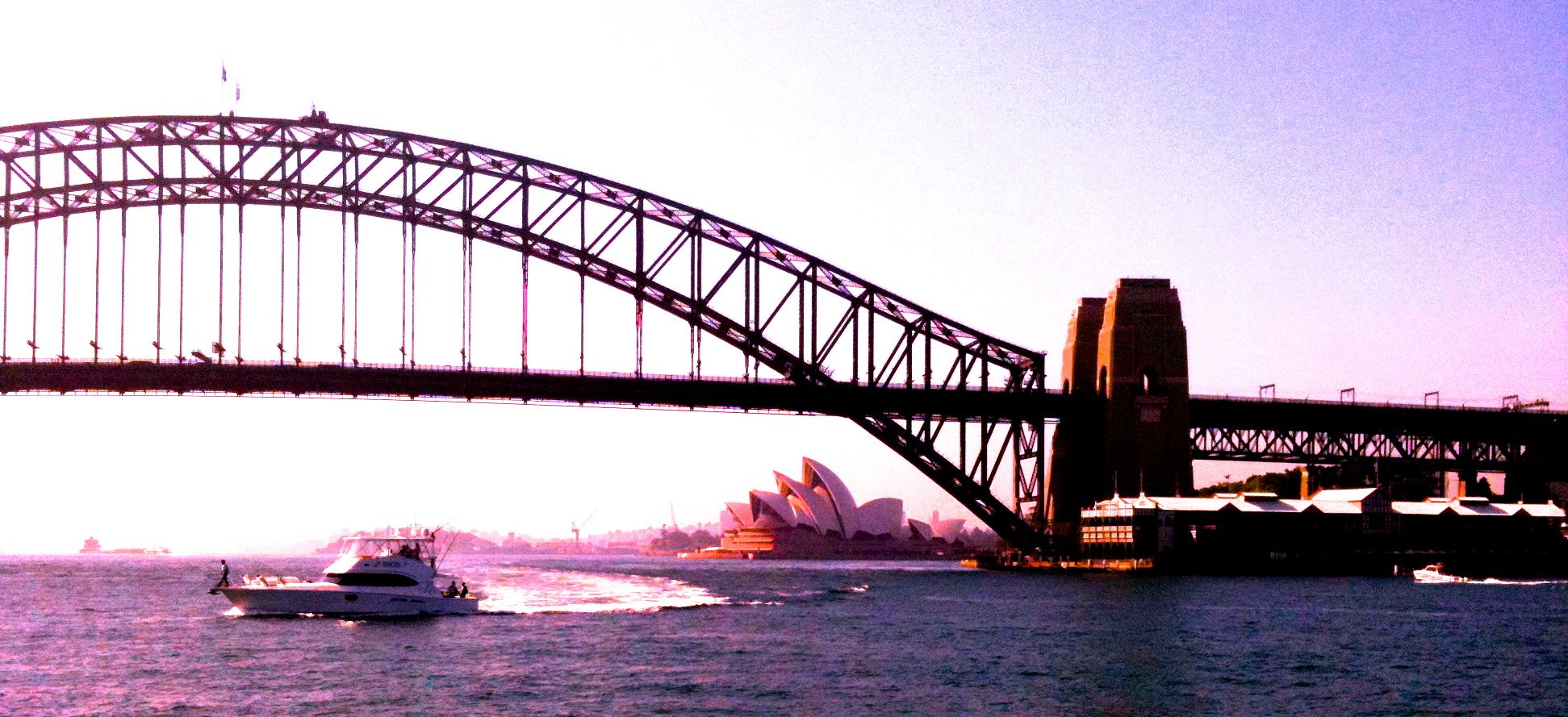
If Sydney didn’t build the bridge, the city might have simply left the harbour as a boundary on the north. Of course some people would have chosen to live there still, but probably fewer. There’s plenty of space to the south that could have become very desirable had the economic centre of the city not been shifted north by the “coat-hanger”.
London has lots of bridges but the wealth and the productivity is overwhelmingly on one side of the Thames. It required Manhattan house prices to reach many millions before Brooklyn got any buzz, and Shanghai only developed the far side of the Huangpu in the last 20 years.
I’d be very interested to see a meta-analysis of whether, in the last 50 years, the value of having a river has turned from positive to negative in terms of a city’s economic growth. The impediments a big river would create to city connectivity are likely to be significant, especially where bridges are in short supply.
All this is very interesting, but we can’t go back and unbuild the Sydney Harbour Bridge. So what’s the point?
The point is we can learn a valuable lesson. Don’t spend valuable taxpayer resources providing infrastructure that will “shape” your city in the wrong way.
Infrastructure is extremely durable. Every mis-spent dollar will spend centuries choking your city. If it accidentally facilitates growth in hard-to-access places, or encourages inefficient kinds of transport use, infrastructure spending can be the enemy of a good city.







 Thomas the Think Engine