Accountants are looking over their shoulders. We see their faces contort with fear, they lengthen their stride, break into a run. They drop what they are carrying, wave their arms, panic.
But it’s no good. They are not fast enough. It it not long before they are caught and consumed. The sound of their shrieking is horrible, horrible!
Robots are picking them off.
“New technologies are “encroaching into human skills in a way that is completely unprecedented,” McAfee says, and many middle-class jobs are right in the bull’s-eye; even relatively high-skill work in education, medicine, and law is affected. ” MIT Technology Review.
Some are calling this a new robot age. But to be honest, robots have been chewing up professions and pooping out their bones for centuries now.
First, the man with a mortar and pestle was ground out by a miller with a water wheel.
Then a farmer with his hoe was trampled by an oxen pulling a plough. More recently, the chainsaw cut the lumberjack workforce in half, and the production line worker was outmuscled by a robot.
Robots have taken physical jobs. We are used to that. We actually like it and appreciate it. Who would want to work for Fedex delivering packages if they didn’t have trucks and planes?
We don’t even notice the amount of automation that already exists. In Japan, FANUC company turns off the lights at its factory for 30 days at a time. It runs without humans.
The difference now is robots are no longer simply mechanical. Inside each is a silicon chip and the power to run a whole lot of equations. They can make decisions, and that means they are coming for cognitive work.
The era since the 1950s might be known as the White Collar Age. An era in which cognitive work was done by humans, and they were well-rewarded for it. Accountants kept books, engineers designed buildings, economists ran models, coders wrote code, journalists wrote stories, call-centre workers took calls.
But repetitive cognitive jobs are suited in some cases to be done by robots. Here’s a business story written by robots. It’s perfect.
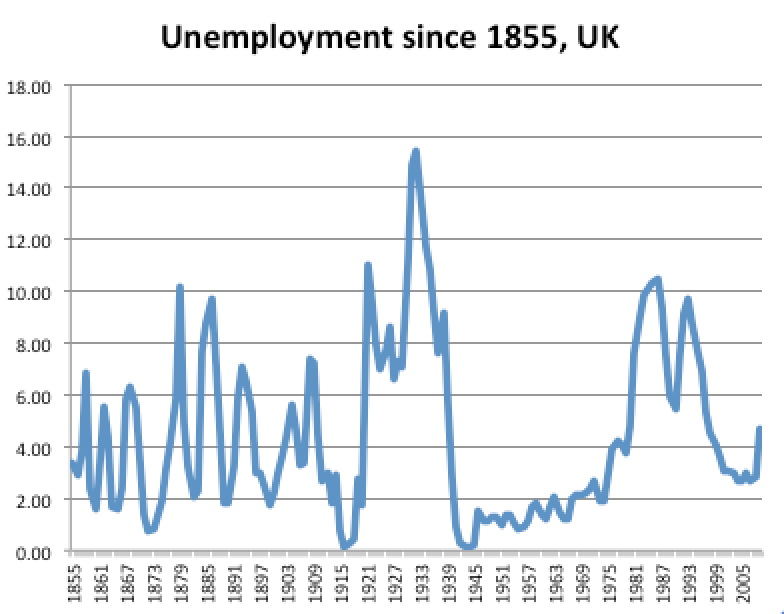
History shows us that the march of the robots crushes professions. But it need not crush the people that work in them, and it need not crush the economy. The mechanical robot age was followed by a period of very low unemployment.
The socially inept might not like it, but the coming economic era is going to see humans flushed out of dimly lit rooms where they have been doing repetitive mental tasks.
All that practice, all that expertise will be wasted when the robots come. We nerds will come blinking into the light, resume in hand.
What jobs will be available?
The answer is that they will be human-facing jobs. Jobs where cognitive or physical work is mixed with emotional work.
The next era will be a “Face Age”. Where humans add value to services by being present in their delivery, face-to-face. Where we add value by exercising social skills. This could be intermediated by communications technology, but a human touch will be part of the bargain.
We can already see the leading edge of this trend in the first part of the economy to try to fully automate: call-centres. The boast that you will “talk to a real person” is now a powerful marketing message.
The waiter is a much maligned profession. A vending machine and a conveyor belt can do their job (and in parts of Japan, in cheaper restaurants, they do). But the continued existence of the waiter signals something.
1) Customers attach value to human interaction.
2) Complex problems pop up in tasks that seemingly should be routine.
I was at a pub last night and there was a guy trying to order “a bowl of plain rice or a boiled potato”. The young lady taking orders may have rolled her eyes, but she also went and checked with the kitchen and came back with an alternative. That’s something a robot couldn’t or wouldn’t do.
I also suspect supermarkets will ease up on automated check-outs. There’s only so often they will let people put through Quinces as Granny Smith apples before they realise human operators add real value. (In this case it may simply be the gaze of a human reminding us of our moral obligations).
From a consumer perspective, dealing with a human is currently quotidian. It seems like all service jobs will always be low-pay jobs.
But this is not always going to be the case. Think about this: Who has a personal banker? Who has a butler? Who has a driver?
Machines are cheap and nasty. The only person in the organisation who can get away with not understanding email is the CEO. Meanwhile you see the wealthy roll with an entourage. Personal assistants, managers, bodyguards and nannies.

In short, human interaction is on its way to be desirable and luxurious. Personal services are a superior good and will likely occupy the role in our economy that consumption of physical goods has in the last 60 years.
This era will be one where while robots produce our basics we’re working in human-facing jobs to purchase yet more services delivered by people. That will be tough for people without much interest in social interaction.
“jobs will be human-facing. … fewer book-keepers and widget makers … never seeing another human.” Aspie dystopia
— Richard 塚正 Green (@RHTGreen) July 21, 2014
It could indeed be a tough time to have Asperger syndrome. The era where nerds could triumph may be waning, and the cool kids might regain the ascendancy. But it was always odd – is there another point in history where a Gates and a Zuckerberg could have become richer than Kings?
A human-facing services economy will operate much like our current one. Humans are already able to get food and clothing very cheaply. (source: ABS)
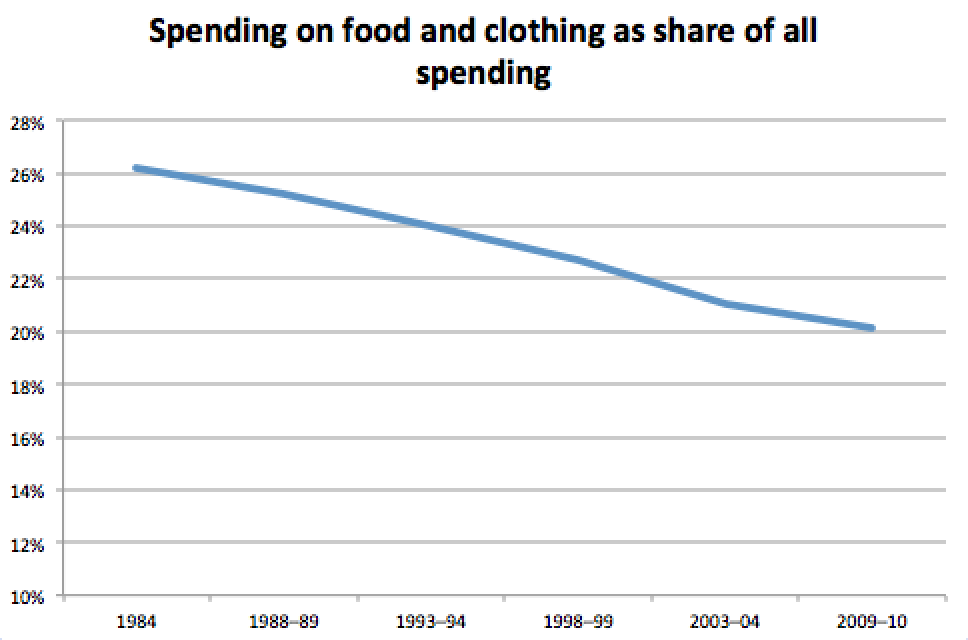
That percentage could continue to fall as automation makes production of basic goods cheaper and cheaper. Certainly a smaller and smaller share of people will work in those sectors. What do people do instead? They will work to meet humans’ higher-order needs. There will lots of different kinds of such jobs. High-skill human-facing jobs, like financial planners, medium skill ones like personal chefs, and lower level jobs like hairdressers.
Is this dignified? It’s an important question. You can find online the argument “we can’t all just hold doors open for each other” – that an economy built on the interchange of services is somehow debased.
But that depends on an outdated idea – that humans only really value the basics. This has been untrue for as long as humans have had more food than they needed. The moment the first cavemen had a surplus, they turned to story-telling, cave painting and ceremony. The Greeks focused on citizenship and later civilisations have added yet more layers of non-basic occupations to idolise, such as professional footballers.
Growing wheat or apples is a perfectly fine occupation, but I’ve argued before that higher-order services are more than merely dignified. Services are where the heroes and myth-making comes from, and complex interaction defines us as a species.
It would be folly to underestimate the ability of people to come up with new demands to occupy labour that might otherwise turn surplus: exhibit A: we now have nail artists.
Rapid changes in technology can cause localised unemployment, but the lesson of history is that demand grows, and humans will filter into the jobs that they do best.
There’s nothing to fear in the robot revolution … but it might be time to practice your smile and your small talk.

